
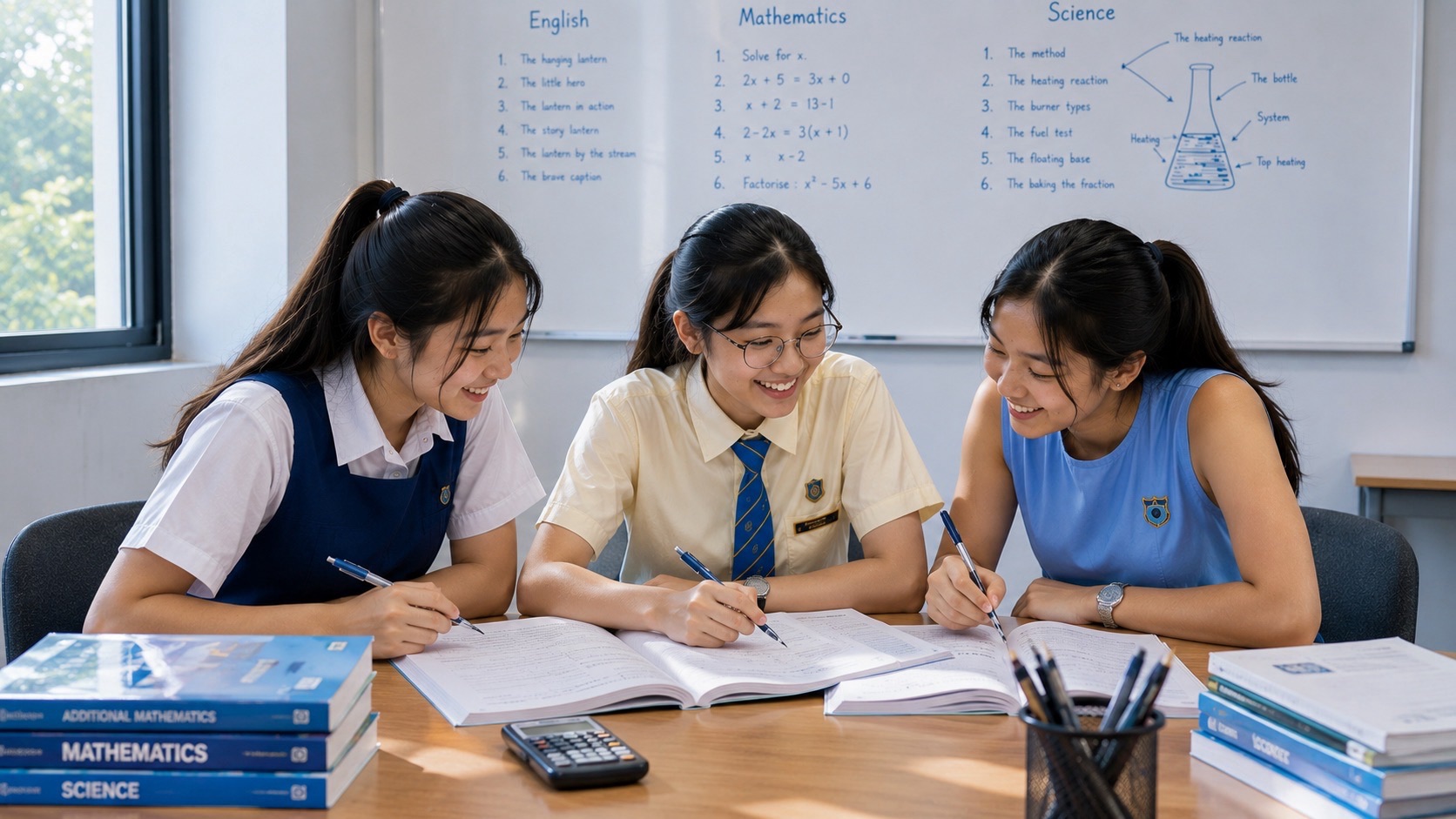
The World Mathematics Atlas is Bukit Timah Tutor’s connected guide to Mathematics from Singapore Primary and PSLE Mathematics through SEC Mathematics, Additional Mathematics, H1, H2 and Further Mathematics, then outward to Cambridge IGCSE and A-Level Mathematics, IB Mathematics, SAT and AP Mathematics, olympiads, university admissions and advanced mathematical study.
Use the Atlas to find the right Mathematics syllabus, examination, competition, curriculum comparison, university-entry route or mathematical topic. Instead of treating PSLE, SEC, IGCSE, IB, A-Level, H2 Mathematics and competition Mathematics as separate islands, the Atlas connects them to the same underlying knowledge: number, algebra, functions, geometry, trigonometry, calculus, vectors, probability and statistics.
That makes this more than a Mathematics article directory. It is a navigation system for students, parents, teachers and tutors: enter by level, examination, country, competition, topic or learning problem, then move to the primary BTT route for that question and follow the mathematical dependencies underneath it.
When the Mathematics problem is larger than Mathematics: if marked work shows several interacting failures—lost foundations, unstable routines, confidence collapse, long interruption or a changed learning environment—use the eduKateYishun Recovery Atlas to map the setback. Return to this World Mathematics Atlas when the recovery plan identifies the mathematical capability that must be taught, practised or tested next.
When the Mathematics is understood but the language is the bottleneck: use the SETC English Atlas to locate the English mechanism, then How English Works for reading, vocabulary, grammar, meaning and explanation. BTT remains the Mathematics owner; SETC owns the deep English system.
187
numbered Atlas routes
The live count is generated from the linked route map below.
9
live estates
Exams through university, tools and the Bukit Timah specialist route.
12
core knowledge objects
From Number and Arithmetic through Calculus, Probability and Statistics.
28 Sep 2026
last full verification
Routes, codes, live routes and Atlas links checked.
See the nine Mathematics estates
These are the nine live gateways underneath the Atlas. Swipe or scroll horizontally; every card opens the primary estate page.
 Estate AWorld ExaminationsBoards · syllabuses · routes →
 Estate BOlympiads & CompetitionsPathways · domains · proof →
 Estate CSingapore Math WorldwideMethods · models · placement →
 Estate DCurriculum CrosswalksTransfer between systems →
 Estate EJC & A-Level MathematicsH1 · H2 · H3 · Further →
 Estate FIB & InternationalIB · IGCSE · Cambridge · UK →
 Estate GUniversity AdmissionsTMUA · STEP · bridging →
 Estate HExam Tools & ReferenceDates · calculators · formulae →
 Estate IBukit Timah SpecialistLocal specialist routes →
Start with the question you are actually asking
These are decision routes, not extra articles. Each question opens the best BTT route for that problem.
- Where should I start in Mathematics? — use the 40-question bounded readiness self-check to locate prerequisite gaps; it does not assign a school stage or qualification level.
- Which Singapore Math programme or edition should I use?
- IB Maths AA or AI, SL or HL?
- Which Mathematics examination, syllabus or subject code applies to me?
- Which Pearson Edexcel route is mine: linear 4MA1, modular 4WM/4XMA, 4MB1, 4PM1 or International A Level?
- Why are my Mathematics marks falling?
- Which university and course am I applying to—and does it require TMUA, ESAT or STEP?
- Which calculator is allowed? · What formula sheet is given?
- Is Maths Olympiad worth it for my child?
- Which degrees need H2 Mathematics or Further Mathematics?
- How do I move between Singapore, IB, IGCSE, UK, US or another curriculum?
- What changed in Mathematics examinations for 2027?
Where do you need to go?
You do not need to understand the Atlas architecture before using it. Start with the problem in front of you; the links below take you to the route that should answer it.
Learn the Mathematics
Fix a Mathematics problem
Follow a school route
Prepare for an examination
Go beyond one curriculum
- Olympiads & Competitions
- Singapore Math Worldwide
- World Curriculum Crosswalk
- University Admissions & Bridging
See Mathematics in the world
The mathematical spine
School levels, examination boards and competitions are different routes through the same subject. The Atlas therefore connects them back to stable mathematical objects. Move left when you need a prerequisite; move right when you want to see where an idea grows next.
Number → Arithmetic → Fractions · Decimals · Percentages → Ratio · Rate · Proportion → Algebra → Functions & Graphs → Geometry & Measurement → Trigonometry → Calculus → Vectors & Coordinate Geometry → Probability → Statistics & Data.
Mathematics is stable. Examinations are versioned.
Algebra remains algebra when a subject code changes. Calculus remains calculus when a board changes its paper structure. The Atlas therefore separates the durable knowledge layer from the dated examination layer: current subject code, applicable examination year, formula or calculator rules, official source and last-checked date.
This is why the Atlas now routes Singapore SEC G3 Mathematics through K310 while retaining legacy 4052 as a search bridge; SEC G3 Additional Mathematics through K341 with legacy 4049; current H1/H2/Further Mathematics through MF27; and Oxford Mathematics admissions through TMUA while keeping MAT as a 2007–2025 archive.
How the eduKate Mathematics network fits together
The Atlas follows the learner across the eduKate ecosystem without duplicating the same academic explanation on several sites. Each major learning question has a primary home, while the Atlas provides the connections between those homes.
| Learning question | Primary home | How the Atlas connects it |
|---|---|---|
| Primary Mathematics academic content | eduKateSingapore Mathematics Learning Library | BTT hands the learner into the Primary Mathematics library when the question is academic rather than tuition-specific. |
| PSLE Mathematics academic content and examination format | eduKateSingapore PSLE Mathematics examination guide | BTT keeps the tuition and learning-support route while the academic examination guide remains in the Singapore library. |
| Secondary E-Math / SEC G1–G3 academic content | eduKateSingapore Secondary Mathematics Topic Library | Academic SEC Mathematics routes connect into the Secondary topic library; BTT retains diagnosis, progression and tuition pathways. |
| Additional Mathematics and advanced Mathematics | Bukit Timah Tutor | A-Math, H1/H2/H3/Further Mathematics, IB, IGCSE, Olympiads, admissions and the wider world layer remain within BTT’s Mathematics system. |
| Mathematics tuition and direct learning support | Bukit Timah Tutor | Primary, PSLE, Secondary and Additional Mathematics tuition routes connect back into the same diagnosis, learning and examination system. |
The result is one connected Mathematics journey rather than several websites repeating the same material. A reader can move between sites when the learning question changes and still retain a clear route back through the wider eduKate network.
Nine live Atlas estates
| Estate | Live gateway | Job |
|---|---|---|
| A | World Mathematics Examinations | Boards, syllabuses, codes and examination routes |
| B | Olympiad & Competition Mathematics | Competition pathways and olympiad domains |
| C | Singapore Math Worldwide | Methods, models, placement and international adoption |
| D | World Curriculum Crosswalk | Transfer between school systems |
| E | JC Mathematics | H1, H2, H3 and Further Mathematics topic library |
| F | IB & International Topic Libraries | Course-first IB, IGCSE, Cambridge and UK topic depth |
| G | University Admissions & Bridging | TMUA, STEP, admissions and school→university transition |
| H | Exam Tools & Reference | Dates, calculators, formula sheets and changing rules |
| I | Bukit Timah Specialist Mathematics | Local specialist tuition and school-context routes |
The complete linked route map remains below for exhaustive navigation. The estate gateways above are the fastest entrance for most readers.
Branch directories: Primary Mathematics · Computational Number Theory · Mathematics Articles & Teaching Notes.
Shortest paths through the Atlas
The Atlas is a graph, not a reading order. These routes show the shortest useful path for common Mathematics problems; leave the path as soon as you reach the route that answers your question.
| Starting problem | Shortest route | Why this path works |
|---|---|---|
| I am stuck and my marks are falling. | Diagnosis → Knowledge Warehouse → Worked Repair → Examination Craft | Find the first weak dependency before adding more paper practice. |
| I want the school Mathematics journey. | Primary → PSLE → Secondary → A-Math → JC → University | Preserves prerequisite order while showing where each stage leads. |
| I am changing curriculum or country. | Curriculum Crosswalk → Exact examination route → Current rules/tools → relevant knowledge object | Separates sequencing/translation gaps from genuine missing Mathematics. |
| I want deeper problem solving or olympiads. | Heuristics → Competition Hub → Number Theory / Combinatorics / Geometry / Algebra → Proof | Moves from non-routine strategy into reusable olympiad domains and rigorous argument. |
| I am applying for a quantitative degree. | Subject requirements → TMUA / STEP / admissions → Proof & abstraction bridge → University Mathematics | Separates getting admitted from being mathematically ready after admission. |
| I want to see where school Mathematics is used. | Real-World Mathematics → Banking & Finance / Quantum Mathematics / discipline-specific university routes | Shows that the same school objects continue into modelling, risk, computing, science and advanced study. |
Hidden connections the syllabus rarely shows
Ratio → gradient → rate of change → derivative. Completing the square → graph geometry → optimisation. Number bonds → inverse operations → equations → algebra. Counting → probability → distributions → inference. Bar models → variables → functions → mathematical modelling. These links are why BTT keeps mathematical objects underneath school and examination routes.
Recently added or materially changed routes
Pearson Edexcel International Mathematics
- International GCSE Mathematics A 4MA1
- International GCSE Mathematics B 4MB1
- International GCSE Further Pure Mathematics 4PM1
- International A-Level Mathematics
UK board-specific GCSE and A-Level routes
The Atlas now separates broad UK GCSE/A-Level routes from individual board routes: Pearson Edexcel 1MA1, AQA 8300, OCR J560, Edexcel 9MA0, AQA 7357, OCR H240, OCR Mathematics B (MEI) H640, plus AQA/Edexcel/OCR Further Mathematics and AEA Mathematics 9811.
Current-change routes
- Cambridge IGCSE 0580 non-calculator preparation
- IB Mathematics 2027 curriculum changes
- ESAT 2027 Entry
Regional and national Mathematics qualification routes
- Wales Mathematics Qualifications | GCSE Mathematics & Numeracy, Additional Mathematics and WJEC A-Level
- Northern Ireland CCEA Mathematics | GCSE M1–M8 and GCE Mathematics
- Scotland Higher & Advanced Higher Mathematics
- New Zealand NCEA Mathematics & Statistics
- Canada Senior Mathematics | Ontario, Alberta and British Columbia
- Ireland Leaving Certificate Mathematics
- France Baccalauréat Mathematics
- Germany Abitur Mathematics
These are qualification-system routes, not claims that the underlying Mathematics is unique to one country. Each page owns the jurisdiction-specific syllabus, assessment structure and dated transition rules, while stable mathematical objects remain reusable across systems.
New qualification-generation and bridge routes
- Pearson Edexcel International GCSE Mathematics A Modular | 4XMAF, 4XMAH and 4WM Units
- OxfordAQA International GCSE Mathematics 9260
- OxfordAQA International AS & A-Level Mathematics 9660
- OxfordAQA International AS & A-Level Further Mathematics 9665
- OxfordAQA Mathematics 2027+ revised qualifications
- Cambridge O Level Mathematics 4024 · Additional Mathematics 4037
- Cambridge IGCSE (9–1) Mathematics 0980
- IB MYP Mathematics | Standard, Extended and on-screen eAssessment
- AQA Level 2 Further Mathematics 8365
- OCR FSMQ Additional Mathematics 6993
- UK Core Maths Level 3 | AQA 1350, OCR H868 and H869
These new routes are qualification-specific navigation and transition owners. They should not be collapsed into a generic “international Mathematics” page simply because some underlying Mathematics overlaps.
Promoted from supporting guide to numbered route
- Euclid Mathematics Contest
- Singapore Math Word Problems
- Singapore Math Review and Mastery
- Singapore Math to Algebra
The Atlas route map is live and fully linked. Some entries deliberately cross-list one destination where a single page genuinely serves more than one position in the map; new destinations are added only when they serve a genuinely distinct examination, curriculum or decision need.
Current Mathematics examination watchlist
The Atlas is stable, but some examination layers are intentionally watched because they can change faster than the Mathematics underneath them. This is a signal layer only: the dated Mathematics Examination Changes 2027 owner carries the detailed source checks and cohort boundaries.
- Singapore SEC 2027: K110/K210/K232/K310/K341 replace the old N/O-Level code structure while preserving reference bridges to 4046/4045/4051/4052/4049.
- Singapore A-Level Mathematics: H1 8865, H2 9758 and Further Mathematics 9649 continue with MF27 as the current formula booklet.
- IB Mathematics: revised AA/AI courses begin first teaching in August 2027 and first assessment in May 2029.
- AP Statistics / AP Calculus: 2026–27 course or examination-format changes apply to the May 2027 cycle.
- Oxford admissions: MAT is historical (2007–2025); TMUA is the live route from the 2026 admissions round.
- Cambridge 0580: 2027 is the final year of the 2025–2027 syllabus cycle; 2028 moves to the 2028–2030 syllabus.
- France Baccalauréat: keep the 2027 cohort separate from the later 2028-session definition; the anticipatory Première Mathematics paper and Terminale specialty route are versioned by cohort.
- Wales: the new WJEC GCSE Mathematics and Numeracy Double Award overlaps with limited legacy Mathematics / Mathematics–Numeracy resit windows into 2027; do not merge the two qualification structures.
- Germany Abitur: the revised IQB operator framework applies from examination year 2027 to the shared task-pool framework; Länder continue to administer their own Abitur examinations.
When one of these changes, BTT updates the dated examination/reference owner and the affected qualification page, while preserving the stable Knowledge Warehouse object underneath it. The current board, ministry, organiser or Land-specific authority remains controlling.
What the Atlas maps
Bukit Timah Tutor is the Mathematics specialist within the eduKate ecosystem. The site already connects Primary Mathematics, PSLE, Secondary G1/G2/G3, Additional Mathematics and JC to diagnosis, learning systems, examination craft, real-world applications and advanced Mathematics. The Atlas extends that same connected structure outward so readers can move between Singapore Mathematics and the wider mathematical world without losing the ideas underneath.
Federation return: the World Mathematics Atlas remains the Mathematics specialist route. When the reader’s next question is no longer principally mathematical, return to Project Atlas for the wider eduKate map. If the right route is unclear, use Orchard’s ecosystem guide; federation boundaries remain governed through the eduKateSG Ecosystem Atlas.
Use the Atlas when the question is larger than one chapter or one Singapore syllabus: Which examination route applies? How do curricula compare? What changes between Singapore, Cambridge, IB, AP or other systems? Where do Mathematics competitions sit? How does school Mathematics continue into university, finance, computing, science and higher Mathematics? The estates below organise those questions into one navigable world map.
How to use the Atlas
Start with the estate that matches the reader’s problem: examinations, competitions, Singapore Math worldwide, curriculum comparison, JC and A-Level Mathematics, international programmes, university bridging, tools and calendars, or the Bukit Timah specialist route. All numbered Atlas routes are live and linked. Use the complete route map when you need exhaustive coverage; where dates, codes or examination rules matter, the current official board or organiser remains the final authority.
Atlas status | The live Mathematics map
- All nine estates are live. The Atlas is now a navigation system rather than a future publishing list.
- The complete route map remains visible below. It lets readers move beyond the major gateways into the full Mathematics estate.
- Knowledge Warehouse objects connect across curricula. H2, IB, Cambridge and UK routes link back to the same stable mathematical objects and explanations.
- Examination rules are versioned. Dates, codes, calculator policies, formula sheets and syllabus generations live in dated examination and reference pages.
- The Atlas expands by connection. Established routes are strengthened and connected instead of replaced by competing versions of the same broad topic.
How the eduKate specialist sites connect
- Bukit Timah Tutor is the Mathematics specialist. Use it for deep mathematical structure, worked reasoning, diagnosis, Additional Mathematics, examination craft, applications and the World Mathematics Atlas.
- eduKateSG provides broad learning and discovery routes. It connects larger learning questions to the appropriate specialist resource instead of reproducing the full Mathematics library.
- eduKateSingapore carries wider curriculum, pathway and public-reference material. Where a rule, syllabus, code or examination format can change, the relevant official authority remains the final source.
- eduKateSengkang develops learner-state, practice, progression and transfer routes. These can connect into BTT when the next question is specifically mathematical.
- eduKateYishun develops recovery and rebuilding routes. When learning has broken down, recovery can lead back into the appropriate Mathematics stage or concept.
- eduKatePunggol provides the Punggol family and local-learning route. Local questions can move into BTT when deeper Mathematics is required.
- Additional Mathematics has one clear subject map: the Additional Mathematics Knowledge Map. Stage pages, tuition pages, recovery pages and examination pages serve different reader needs around that map.
- Singapore Math worldwide connects outward without losing its Singapore roots. The Atlas explains methods and international routes, while Singapore-facing curriculum and reference material remains connected to the relevant Singapore specialist pages.
- One clear primary route per question. When a strong page already answers the job, the system strengthens and connects it rather than creating another broad page that asks readers to choose between duplicates.
Find a route in the Atlas
Search the live Atlas by topic, examination, country, curriculum, competition or university pathway. Legacy names and old examination codes also resolve to the current route.
Type a search term or choose an estate. The complete linked route map remains below.
Jump to Atlas estate: A · Exams · B · Olympiads · C · Singapore Math · D · Crosswalks · E · JC / A-Level · F · IB / International · G · University · H · Tools · I · Bukit Timah
Put Mathematics to work in a country comparison: Crazy Rich World’s Mathematics chapter uses quantities, rates, percentages and assumptions to make comparisons clearer. Try one example, then use this Atlas to find the mathematical topic or course that will help you take the reasoning further.
Estate A: World Mathematics Examinations (67)
Estate B: Olympiad and Competition Mathematics (19)
Estate C: Singapore Math for the World (19)
Written for parents, teachers and homeschoolers outside Singapore who use the approach commonly called Singapore Math. These routes connect back to eduKateSingapore for the Singapore-facing curriculum and school-learning context.
Estate D: World Curricula Compared (10)
Estate E: JC H1, H2, H3 and Further Mathematics Topic Library (22)
Estate F: IB and International Topic Libraries (23)
Estate G: University Entrance and Bridging (13)
Estate H: Levels, Calendar and Examination Tools (9)
Estate I: Bukit Timah Specialist Mathematics (5)
Atlas quality rules
- When an examination code, format, date, calculator rule or competition condition matters, the relevant Atlas page should link to the current official board or organiser.
- New routes should connect to one clear parent route—such as a school-stage hub, Knowledge Warehouse object, examination route or curriculum map—rather than duplicate an existing explanation.
- Curriculum comparisons should explain differences in sequence, demand, notation and assessment without pretending that two systems are identical.
- Advanced and pure Mathematics remain part of the same connected subject, but they are not presented as school-tuition pages when their real job is explanation, exploration or research.
- The route map is live. When an examination, competition or curriculum changes, update the existing primary route and its dated reference page rather than creating a competing version.
The Atlas maps its live routes across nine estates on top of Bukit Timah Tutor’s existing Mathematics library: curriculum and stage hubs, the Operating Manual, diagnosis, examination craft, worked repair and synthesis guides, real-world applications, finance Mathematics and advanced pure-Mathematics estates.
Atlas Graph Health | Verified 28 September 2026
This is the independently rechecked baseline for the numbered World Mathematics Atlas route map. It measures the live route table, canonical destinations and return paths across BukitTimahTutor and the eduKateSingapore academic handoff layer.
| Graph measure | Verified state |
|---|---|
| Numbered Atlas route entries | 187 / 187 live |
| Unique primary destination URLs | 184 |
| Deliberate primary-route reuse | 3 shared destination pairs — routes 5/93, 17/120 and 55/132 |
| Compound route rows with a second valid destination | 4 — routes 20, 30, 40 and 47 |
| Unique URLs appearing anywhere inside numbered route cells | 188 |
| Destination-domain split | 186 BukitTimahTutor + 2 eduKateSingapore academic canonicals |
| Missing route numbers from 1–187 | 0 |
| Duplicated route numbers | 0 |
| Route-map destinations without a confirmed Atlas return path | 0 |
| BukitTimahTutor published pages currently indexed as linking into the Atlas | 200 |
| eduKateSingapore published pages currently indexed as linking into the Atlas | 6 — including the Primary, PSLE, Secondary E-Math and K310 academic handoff owners |
| Core Knowledge Warehouse objects linked to the Atlas | 12 / 12 |
| System-spine pages linked to the Atlas | 8 / 8 |
| Atlas estates | 9 / 9 live |
Verification note: the H2 Mathematics and Bukit Timah Mathematics Tuition owners contain live Atlas return links but were not yet reflected in the content-search index during this check; both links were confirmed by direct page readback.
Graph-health rule
A new Mathematics route should resolve to a real published destination, respect the eduKate one-intent/one-owner boundary, connect into the relevant hub or knowledge layer, and have a useful return path into the Atlas. Cross-domain handoffs are preferred to duplicate academic owners. Near-duplicate pages are not.
Atlas integrity and update policy
The World Mathematics Atlas links a live numbered route map across nine estates. The routes are checked as one connected system so readers can move from school Mathematics to examinations, competitions, curriculum comparisons, university pathways and advanced Mathematics without losing the underlying mathematical ideas.
Current information
Where a route depends on changing rules—such as examination codes, calculator permissions, formula sheets, competition names, admissions tests or syllabus generations—the dated route should point to the current official board or organiser. Stable mathematical explanations remain separate from those changing administrative details.
Legacy names and codes
Older names and codes remain visible only when they help readers find the current route. Examples include 4052 → K310, 4049 → K341, SMOPS → APMOPS, NMOS → NMO∑, RIPMWC → RMO and MAT → TMUA/current admissions routes. Historical wording is treated as a bridge, not as the current rule.
Connected routes
After major Atlas expansions, the route map is rechecked so the principal Mathematics hubs, Knowledge Warehouse objects, examination routes and world routes continue to link back into the same system. The aim is simple: one clear path for each job, with no need to choose among competing broad pages.
28 September 2026 maintenance baseline
- 187 / 187 numbered routes present and live.
- 184 unique primary destination URLs across those numbered routes.
- 3 deliberate primary-owner reuses: routes 5/93, 17/120 and 55/132.
- 4 compound route rows carry a second canonical co-owner link: routes 20, 30, 40 and 47.
- 188 unique URLs appear across all numbered route cells after those secondary co-owner links are included.
- 0 missing route numbers and 0 confirmed one-way route-map destinations.
- 200+ published pages link back into the Atlas.
- 12 / 12 core Knowledge Warehouse objects and 8 / 8 system-spine pages link into the Atlas.
- 0 legacy planning-status remnants in the live route map.
- 0 accidental
-2duplicate links in the Atlas. - 0 MF26 references; current Singapore A-Level formula-sheet routing uses MF27.
Mathematics teaching inside the wider Tutor System
This Atlas owns the mathematics world: concepts, progressions, examinations and mathematical teaching routes. When the question becomes the human tutoring relationship, continue to The Tutor System. Mathematics remains owned here; the Tutor System owns how the human support is organised.
- Parents: use How to Work With Your Child’s Tutor for tutor fit, class structure, progress evidence, workload and the decision to reduce support.
- Students: use How to Work With a Tutor for worked examples, hints, feedback, mixed practice, full papers and independent performance.
- Tutors: use the general Tutor Handbook for the tutoring operating model, then return to BTT for the mathematics-specific mechanism and progression.
Mathematics system route: Mathematics Hub · World Mathematics Examinations · Curriculum Overview · Knowledge Warehouse · Learning Library.
Use your Mathematics study tools well
Once you have located the mathematical topic, choose the guide that matches the next study decision. These published guides belong to the Secondary Mathematics Resources collection; they support the subject routes above rather than create another syllabus.
- How to Make Maths Notes — organise definitions, examples, error records and questions for later retrieval.
- How to Use a Calculator in Maths — examine input, estimation, exactness and independent checking.
- How to Use a Maths Formula Sheet — connect a formula with its conditions, quantities, substitution and verification.
- How to Learn From Maths Feedback — move from a marked error to a repair, retest and changed problem.
Using a tool and being permitted to use it are different questions. For examination-specific permissions and supplied materials, continue to Calculator Rules by Examination and Formula Sheets and Reference Materials, then check the applicable official authority. These study guides are explanations, not a claim that a new calculator or automated assessment has been released.