
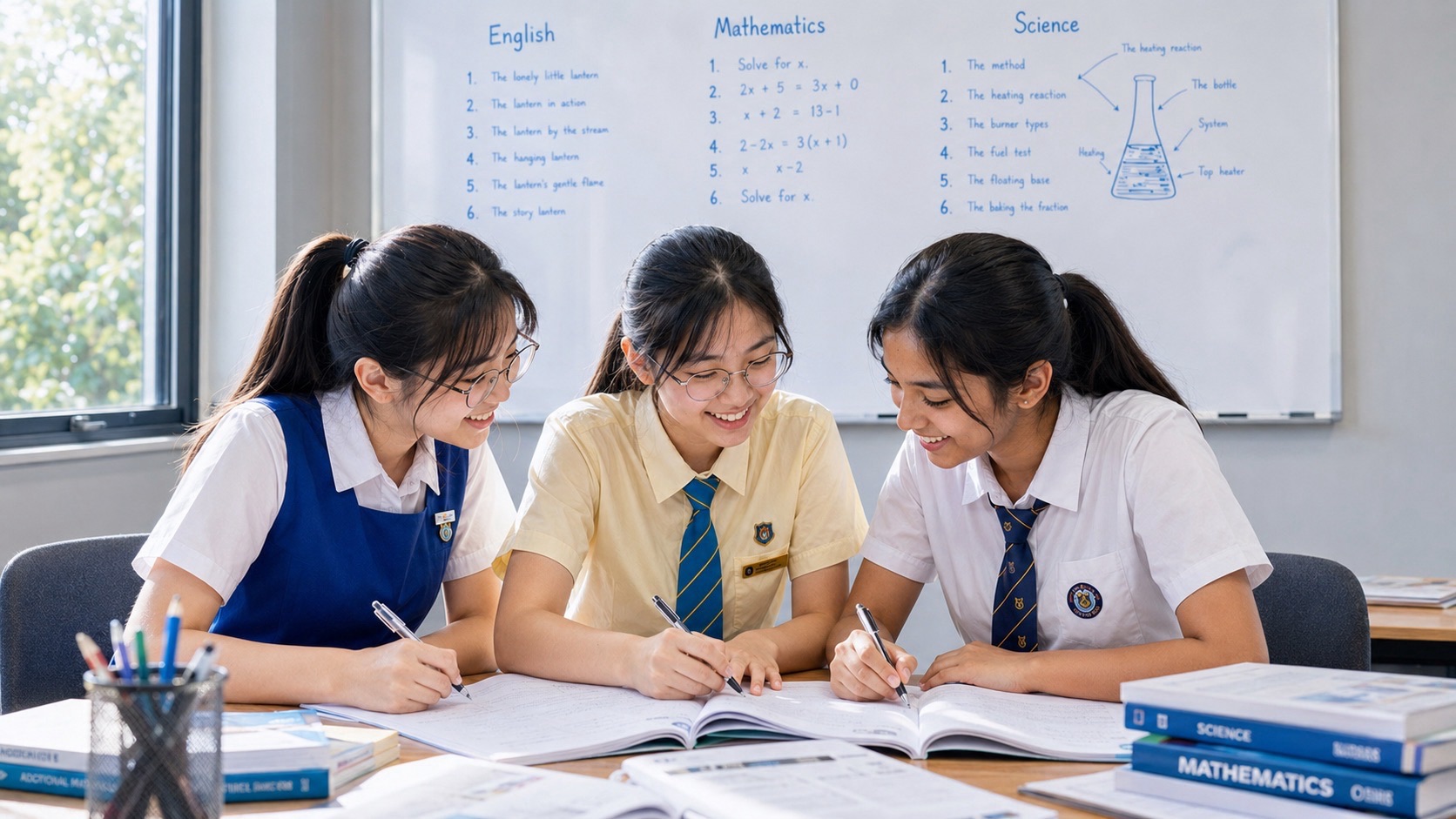
OCR A-Level Mathematics B (MEI) H640 is a distinct UK A-Level Mathematics qualification developed by OCR in collaboration with Mathematics in Education and Industry (MEI). It is not the same assessment route as OCR Mathematics A H240. H640 uses three papers: Pure Mathematics and Mechanics, Pure Mathematics and Statistics, and Pure Mathematics and Comprehension.
For students searching specifically for OCR A-Level Maths B MEI H640, this page owns the paper structure, the comprehension component, large-data-set preparation, current 2026–2028 data-set arrangements and the preparation system inside BTT’s wider UK A-Level Mathematics branch.
The mathematical content overlaps strongly with other UK A-Level Mathematics routes, but the assessment architecture is distinctive. That means the correct preparation model is two-layered: learn the Mathematics through stable knowledge owners, then train the particular H640 paper behaviours that OCR assesses.
OCR H640 at a glance
| Component | Content | Duration | Marks | Weight |
|---|---|---|---|---|
| H640/01 | Pure Mathematics and Mechanics | 2 hours | 100 | 36.4% |
| H640/02 | Pure Mathematics and Statistics | 2 hours | 100 | 36.4% |
| H640/03 | Pure Mathematics and Comprehension | 2 hours | 75 | 27.3% |
OCR’s current specification code is H640. Paper 1 combines Pure Mathematics with Mechanics. Paper 2 combines Pure Mathematics with Statistics. Paper 3 assesses Pure Mathematics while assuming Mechanics and Statistics knowledge, and includes the distinctive comprehension element.
H640 is not OCR H240 with a different name
OCR offers two A-Level Mathematics specifications. OCR Mathematics A H240 uses Pure Mathematics, Pure Mathematics and Statistics, and Pure Mathematics and Mechanics papers. H640 instead places Mechanics on Paper 1, Statistics on Paper 2 and a comprehension-based Pure component on Paper 3.
The underlying Mathematics transfers strongly between the two OCR routes, but paper preparation should follow the actual specification entered by the centre.
Paper 1: Pure Mathematics and Mechanics
H640/01 gives Pure Mathematics and Mechanics equal strategic importance even though the exact question distribution can vary. Strong preparation keeps algebra, functions, trigonometry and calculus active while also training modelling habits: diagrams, units, sign conventions, assumptions and physical interpretation.
- Draw the mechanical system before writing equations.
- Define positive directions and keep them consistent.
- Separate modelling assumptions from mathematical consequences.
- Check dimensions and units.
- Interpret a negative result rather than automatically treating it as an error.
Paper 2: Pure Mathematics and Statistics
H640/02 combines Pure Mathematics with Statistics and can draw on a prescribed large data set. Students should therefore know both the statistical Mathematics and the structure of the data environment well enough to interpret questions efficiently.
OCR’s current arrangements identify large data set 9 for the June 2027 A-Level H640/02 series and large data set 10 for June 2028 onwards. The exact live pre-release material should always be checked for the candidate’s series rather than inferred from an older school file.
Use BTT’s Probability and Statistics & Data owners when the difficulty is mathematical rather than H640-specific.
Paper 3: Pure Mathematics and Comprehension
The comprehension component is the feature that most clearly distinguishes H640 from other mainstream A-Level Mathematics routes. The paper is two hours but carries 75 marks, reflecting the reading and interpretation time required for the comprehension section.
OCR states that the comprehension material focuses on Pure Mathematics content. The student must read mathematical prose, identify relevant structure, connect information from the passage to familiar Mathematics and then answer questions that test understanding rather than simple extraction.
How to train mathematical comprehension
- Read once for the mathematical story before calculating.
- Mark definitions, assumptions, introduced notation and derived results.
- Ask which familiar topic each part of the passage connects to.
- Re-derive important claims when possible instead of accepting them passively.
- Practise explaining a result in ordinary mathematical language before using it.
- Use the passage as a source of structure, not as a wall of text to memorise.
The Pure Mathematics dependency spine
Because Pure Mathematics appears across all three H640 components, algebraic and function fluency matter everywhere. A weakness in manipulation can damage Mechanics equations, Statistics models and comprehension responses just as easily as it damages a standard Pure question.
Use the Algebra, Functions & Graphs, Trigonometry and Calculus objects when the same mathematical leak appears across several components.
A useful H640 preparation cycle
| Phase | Main job | Evidence |
|---|---|---|
| 1. Diagnose | Audit Pure, Mechanics and Statistics prerequisites | Know whether the problem is knowledge, recognition or execution |
| 2. Repair | Fix shared algebra/function/calculus gaps | Same repair improves more than one paper |
| 3. Applied conversion | Train Mechanics modelling and Statistics interpretation | Diagrams/data context are used before calculation |
| 4. Comprehension | Read and reconstruct mathematical exposition | Student can explain and reuse a result from a passage |
| 5. Timing | Complete full H640 papers | Performance remains stable across the two-hour sitting |
Large-data-set preparation should not become trivia memorisation
Familiarity with the prescribed data set can create a material advantage, but the goal is not to memorise arbitrary values. Students should understand the variables, units, context, data structure and plausible relationships so they can interpret a statistical question efficiently when the live paper refers to the data.
H640 error diagnosis
| Observed problem | Likely cause | Repair |
|---|---|---|
| Mechanics equations are inconsistent | Representation chosen too late | Diagram, units and sign convention first |
| Statistics calculations are correct but interpretation is weak | Context disconnected from output | Write a contextual conclusion every time |
| Comprehension passage feels unreadable | Mathematical reading skill is undertrained | Practise reconstructing definitions and claims |
| Pure errors appear on every paper | Shared prerequisite leak | Repair algebra/functions/calculus centrally |
| Paper 3 runs out of time | Reading and calculation not being separated | Train a deliberate first read before detailed execution |
H640 versus AQA, Edexcel and OCR H240
The national A-Level Mathematics content is shared broadly across boards, but H640’s comprehension paper and data-set emphasis create a distinctive assessment experience. AQA 7357, Pearson Edexcel 9MA0 and OCR H240 therefore remain separate board-specific owners.
Current-source note
Checked 27 September 2026. OCR lists A-Level Mathematics B (MEI) under specification code H640. The current assessment overview gives H640/01 Pure Mathematics and Mechanics as 100 marks / 2 hours / 36.4%, H640/02 Pure Mathematics and Statistics as 100 marks / 2 hours / 36.4%, and H640/03 Pure Mathematics and Comprehension as 75 marks / 2 hours / 27.3%. OCR’s 3 September 2026 update states that large data set 9 applies to H640/02 in June 2027 and large data set 10 from June 2028 onwards.
Official references: OCR Mathematics B (MEI) H640 specification at a glance and OCR large data set update, 3 September 2026.
World Mathematics route: World Mathematics Atlas · World Mathematics Examinations · UK A-Level Mathematics · Knowledge Warehouse.