
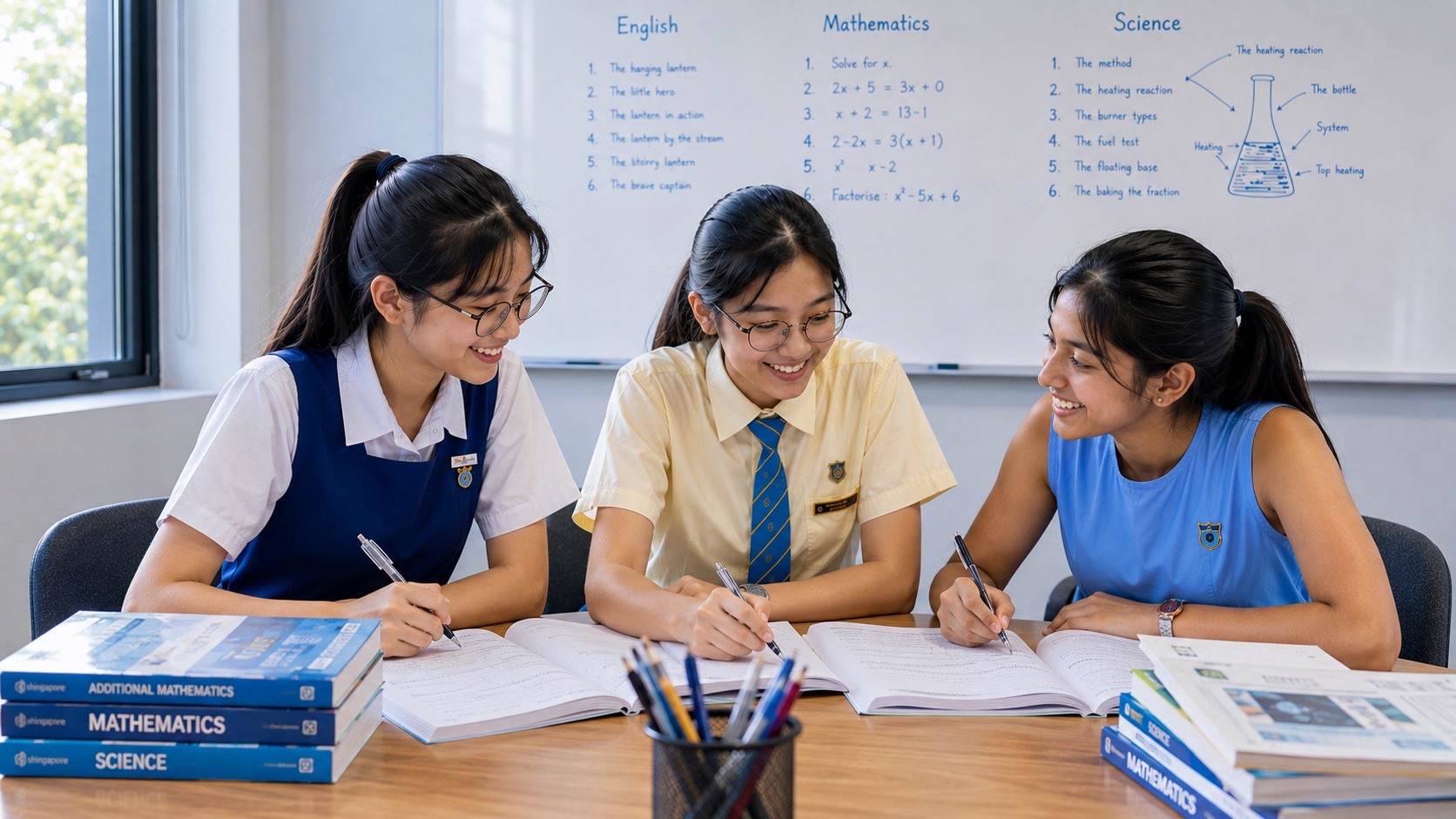
A stage-by-stage Singapore Mathematics curriculum map for families and learners moving through Primary 1–6, PSLE, Secondary G1/G2/G3 Mathematics, Additional Mathematics and JC H1/H2 Mathematics.
Use the map to locate the present stage, understand the next transition and choose the most relevant tuition, learning or examination route. Academic coverage does not by itself confirm current class availability.
Official-source check · 26 September 2026: SEAB lists 2027 SEC Mathematics as G1 K110, G2 K210 and G3 K310; Additional Mathematics as G2 K232 and G3 K341; and the 2027 A-Level Mathematics routes as H1 8865, H2 9758 and Further Mathematics 9649. PSLE Mathematics remains subject 0008 for examinations from 2026. Use the official board pages for the latest rules.
Quick Read | The Singapore Mathematics curriculum is a progression of capability
The easiest way to misunderstand a curriculum is to treat it as a list of chapters. Singapore Mathematics is better understood as a progression in what the learner is expected to represent, relate, calculate, generalise, model, explain and verify. Content changes by level, but the deeper movement is from concrete quantity toward symbolic relationships, from supported procedures toward independent method selection, and from familiar questions toward transfer under changing conditions.
That is why a child can appear to “know the syllabus” and still struggle when the next stage begins. The next stage does not merely add topics. It changes how much of the thinking the learner must carry alone. Primary school builds the language of quantity, operations, fractions, ratio, geometry, data and problem solving. Secondary Mathematics compresses more of those relationships into algebra, graphs and symbolic structures. Additional Mathematics increases the density of interaction among functions, algebra, trigonometry and calculus. JC Mathematics asks the learner to coordinate longer chains of reasoning, modelling, statistics and technology with much less scaffolding.
Use this page for the curriculum map. Use Mathematics Diagnosis when the question is why a particular learner is failing inside that map, and use the Mathematics Knowledge Warehouse when the question is which mathematical object or dependency is carrying the current work.
The curriculum has two layers: what is taught and what the learner is becoming able to do
The visible layer contains topics, syllabus statements and assessment requirements. The less visible layer is developmental. A learner is gradually expected to hold larger mathematical structures in mind, move between more representations, choose methods with less prompting and explain why an answer is plausible. These two layers should be read together.
For example, fractions are visible content. But the deeper capability includes part-whole reasoning, equivalence, multiplicative comparison and representation. Algebra is visible content. The deeper capability includes treating symbols as meaningful objects, preserving equality across transformations and recognising structure that is not tied to particular numbers. Calculus is visible content. The deeper capability includes reasoning about change, accumulation, functions and approximation. The curriculum names the content; good teaching also builds the capability underneath it.
Primary 1–3 | Build meaning before compression
The first years of Primary Mathematics establish the learner’s relationship with number, quantity and operation. Counting is not merely reciting a sequence; it connects number words to quantities. Place value is not merely naming tens and ones; it explains why our number system can represent large quantities efficiently. Addition and subtraction are not just algorithms; they describe changes and relationships. Multiplication and division grow from equal groups, repeated structure and inverse relationships.
The crucial predecessor capability here is reliable meaning. A child who can carry out a written procedure without understanding what the quantities represent may appear successful while questions remain familiar. The next boundary arrives when problems become more multi-step, representations become less literal and the learner must decide which relationship is relevant rather than simply perform the operation named by the teacher.
A strong early-primary programme therefore protects number sense while building fluency. Speed is useful only when it does not replace meaning. The long-term objective is a child who can look at a quantity, diagram or word problem and decide what relationship is present.
Primary 4–6 | Separate topics begin to interact
Upper Primary is where the curriculum becomes visibly more connected. Fractions, decimals and percentages interact. Ratio and rate depend on multiplicative reasoning. Geometry involves measurement, angle relationships and spatial reasoning. Word problems become longer and often combine several relationships. The learner needs a more stable internal system because there is less room to solve every question by copying a recent example.
The predecessor capability is not simply “know P1–P3.” It is more specific: operations must be sufficiently fluent that they do not consume all attention; part-whole and multiplicative reasoning must be usable; diagrams and models must function as representations rather than decorations. If these dependencies are weak, P5 and P6 can feel like sudden acceleration even when the student works hard.
The next boundary is examination integration. By P6, the learner is expected to draw on several years of Mathematics inside mixed questions. That is why P6 Mathematics and PSLE Mathematics are related but different jobs: one consolidates the learner-level system; the other converts that system into performance under the actual examination environment.
PSLE Mathematics | The curriculum becomes an examination environment
PSLE does not introduce a new mathematical world after Primary 6. It changes the operating conditions. Topics are mixed, the chapter label disappears, time matters, calculator permissions vary by paper and the learner must decide what to retrieve and how to verify. The examination therefore tests not only whether content has been encountered, but whether it can be recognised and executed independently.
This creates an important boundary for parents: poor PSLE performance is not always evidence of missing curriculum knowledge. A student can understand Mathematics in lessons and still lose marks because retrieval is slow, paper navigation is weak, methods are poorly selected or checking is inefficient. That is the point where curriculum knowledge and Mathematics Examination Craft must be separated diagnostically.
Secondary Mathematics | From arithmetic dependence to symbolic relationship
Secondary Mathematics changes the language of the subject. Variables, expressions, equations and graphs become more central. The learner is expected to transform symbolic statements while preserving meaning, coordinate several steps of working and select methods in less familiar settings. Arithmetic remains necessary, but it is increasingly background infrastructure rather than the whole task.
Under Full Subject-Based Banding, students may take Mathematics at different subject levels. From the 2027 SEC examination, SEAB lists Mathematics as G1 K110, G2 K210 and G3 K310. Additional Mathematics is separately listed at G2 K232 and G3 K341. Those codes matter for current examination routing, but the educational question remains larger: what level of mathematical abstraction, symbolic control and problem solving is the learner ready to carry reliably?
The predecessor capability is secure Primary number and proportional reasoning plus readiness to use symbols as mathematical objects. The next boundary is either deeper G2/G3 Mathematics, Additional Mathematics where appropriate, or post-secondary Mathematics. A student can therefore be progressing well at one Mathematics subject level without needing to be compared simplistically with a different route.
Full Subject-Based Banding changes the route, not the identity of Mathematics
Parents can easily read G1, G2 and G3 as fixed labels on a child. They are better understood as subject-level routes. Mathematics remains Mathematics, but the depth, pace, abstraction and assessment expectations differ. A learner’s route can therefore be discussed in terms of readiness, evidence and progression rather than status.
This matters pedagogically. Teaching should not simply copy one level’s worksheet volume into another. The tutor needs to know which representations, methods and independence demands belong to the learner’s current subject level, which earlier dependencies are required, and what evidence would justify movement into a more demanding route.
Additional Mathematics | The curriculum becomes more densely connected
Additional Mathematics is not merely “more Mathematics.” It brings several mathematical objects into closer interaction. Algebra is no longer one topic among many; it is the operating language through which functions, trigonometry, coordinate geometry and calculus are expressed. A small algebraic weakness can therefore appear repeatedly across apparently different chapters.
The predecessor capability is not perfection in every Secondary topic. It is sufficient symbolic fluency, function sense, algebraic discipline and willingness to sustain multi-step reasoning. The next boundary is not automatically H2 Mathematics. Post-secondary routes depend on the learner’s broader programme, school requirements, results, interests and intended future study.
This is why BTT separates the Additional Mathematics Knowledge Map from the three-student A-Math tuition route. One maps the subject; the other explains a teaching format.
JC Mathematics | Earlier Mathematics must become available with less prompting
JC Mathematics increases abstraction, integration and examination load. H1, H2 and Further Mathematics are not interchangeable labels for “harder Maths.” They are different academic routes with different assumed knowledge, content and assessment structures. The correct route should be read from current official syllabus information and the student’s programme rather than from a generic hierarchy of prestige.
The developmental change is that earlier algebra, functions, graphs and representation must now be retrieved with far less support. Calculus, vectors, probability and statistics place new demands on a system that is assumed to be sufficiently stable. Weak dependencies therefore become expensive: the learner may understand the new idea but spend too much working memory reconstructing old algebra or notation.
The next boundary moves beyond school Mathematics toward university admissions, degree prerequisites, modelling and specialised study. That is why the JC Mathematics route connects upward into the World Mathematics Examinations hub and World Mathematics Atlas.
Three continuity examples | The same Mathematics grows across stages
Fractions → ratio → proportion → algebraic relationships
A fraction begins as a way to represent part of a whole or a quotient. Later it supports ratio, percentage and rate. Proportional reasoning then becomes a foundation for scale, speed and direct variation. In algebra, the same multiplicative relationships can be represented symbolically. The labels change, but the learner is still reasoning about how quantities relate.
Patterns → graphs → functions → calculus
Primary patterns teach the learner to notice regularity. Secondary graphs make relationships visible across many values. Functions formalise how one quantity depends on another. Calculus studies how those relationships change and accumulate. A learner who sees these as disconnected chapters must repeatedly rebuild meaning; a learner who sees continuity can use earlier representations to understand later abstraction.
Data → probability → statistics → modelling
Early data work teaches reading, organising and comparing information. Probability introduces uncertainty. Later statistics adds sampling, distributions and inference. At higher levels, these become tools for modelling real systems and making decisions under uncertainty. The curriculum therefore moves from reading information to reasoning about how reliable a conclusion is.
The curriculum does not diagnose the learner
A syllabus can tell us what students at a stage are expected to encounter. It cannot tell us why one learner is struggling. Two students in the same class can fail the same question for different reasons. One may not understand the concept. Another may know it but misread the condition. A third may retrieve the wrong method under time pressure. A fourth may have an earlier dependency that only becomes visible now.
This is where above-Clementi teaching differs from content matching. Do not begin with “Which worksheet belongs to this syllabus chapter?” Begin with “What is the current job, what earlier capability does it depend on, what evidence do we have, and what is the smallest intervention that changes the next independent attempt?”
How teaching should change as the curriculum develops
- Early Primary: make quantity and operation meaning visible; use representation before speed becomes the dominant goal.
- Upper Primary: connect topics deliberately; require explanation and multi-step reasoning, not only repeated procedures.
- PSLE: integrate mixed content with paper navigation, retrieval, pacing and checking while protecting conceptual understanding.
- Secondary: strengthen symbolic language, graphs, algebraic structure and method selection under less explicit scaffolding.
- Additional Mathematics: teach synthesis across topics and diagnose algebraic dependencies that recur throughout the subject.
- JC: increase independent retrieval, abstraction, modelling and examination endurance; use technology as a mathematical tool rather than a substitute for interpretation.
At every stage, the direction should be the same: the tutor gradually transfers more of the mathematical decision-making to the learner.
Parent decision guide | Curriculum problem, learning problem or examination problem?
Parents often arrive with a curriculum label: “P5 fractions,” “Sec 2 algebra,” “G3 Mathematics,” “A-Math calculus.” That identifies the location but not necessarily the cause. The next useful question is which kind of problem is present.
- Curriculum-location problem: the family is unsure which subject level, syllabus or next route applies. Use this Curriculum Overview and current official sources.
- Knowledge problem: a mathematical object or prerequisite is not secure. Use the Knowledge Warehouse and relevant learning hub.
- Diagnosis problem: the same failure persists but the cause is unclear. Use Mathematics Diagnosis or the Mathematical Lab.
- Examination problem: the learner appears to know the content but loses marks under paper conditions. Use Examination Craft and the relevant examination route.
- Teaching-support problem: the learner needs sustained guided instruction, feedback and practice. Use the appropriate tuition page for the current stage.
What a curriculum map should never imply
A curriculum map should not imply that every learner moves at exactly the same rate, that every school teaches topics in identical order, or that a later stage is always “better” than an earlier one. It should not be used to promise examination outcomes or to infer a child’s ability from one result. It is a navigation tool.
It also should not freeze current codes forever. Examination structures change. BTT therefore separates stable Mathematics from versioned examination information. The mathematical explanation can remain useful while current subject codes, paper structures, calculator rules or formula sheets are checked against the latest official source.
Transfer and independence | The real destination of the curriculum
The purpose of progression is not to make the student permanently dependent on a teacher who knows the next chapter. It is to produce a learner who can enter a new stage and carry forward enough mathematical structure to learn efficiently.
Transfer means an idea survives a changed surface. A ratio can be recognised in a scale problem. An algebraic structure can be recognised inside geometry. A function can be interpreted from a graph, formula or context. A probability model can be built in an unfamiliar setting. Independence means the learner increasingly performs the recognition, method choice and verification without waiting for the tutor to label the question.
That is the long arc from Primary 1 to JC: not twelve years of separate chapters, but twelve years of increasing mathematical control.
Frequently asked questions
Is the Singapore Mathematics curriculum the same as “Singapore Math” used overseas?
Not exactly. Overseas “Singapore Math” can refer to methods, textbooks or curriculum products inspired by Singapore approaches. For the current Singapore school curriculum, use MOE and SEAB sources. For the international method and comparison route, use Singapore Math Worldwide.
Does every student take the same Secondary Mathematics route?
No. Under Full Subject-Based Banding, subjects can be taken at different levels. Current school arrangements and eligibility should be checked with the school and official MOE/SEAB information.
Is Additional Mathematics automatically the next step after G3 Mathematics?
No. Additional Mathematics is a separate subject route. Whether it is appropriate depends on the learner’s school programme, readiness, subject combination and future needs.
Does a low mark mean the learner is in the wrong curriculum route?
Not by itself. A low mark can reflect a concept gap, earlier dependency, weak retrieval, execution under time pressure or other causes. Route decisions should use broader evidence rather than one score.
When should parents look backward to earlier Mathematics?
When the current difficulty repeatedly depends on an earlier object that is no longer reliable. The repair should be precise. Do not automatically reteach whole years of content.
How often should syllabus codes and examination details be checked?
Whenever they affect a real decision. BTT links to official sources because codes, syllabus generations, dates, calculator policies and paper structures can change. Stable mathematical explanations should be kept separate from those versioned rules.
What is the next route if I already know the student’s stage?
Use the Mathematics Learning Library or the relevant Primary, Secondary, Additional Mathematics or JC hub. If the cause of difficulty is unclear, use Mathematics Diagnosis before adding more practice.
A curriculum tells us where Mathematics is going. Good teaching also discovers what the learner must be able to carry into the next stage without being carried there.
Transition cases | What to protect, what to repair, what to prepare next
A curriculum map becomes useful when it changes a real decision. The following transition cases show how the same three questions can guide parents and tutors: what should be protected because it is already working, what needs repair because it blocks the present stage, and what should be prepared because the next boundary will demand it?
P3 → P4 | Protect number sense; repair operation meaning; prepare for denser problem solving
A P3 learner may calculate accurately but depend heavily on familiar wording. Do not destroy working fluency by restarting the whole curriculum. Protect secure arithmetic. Repair only the relationships that remain fragile—perhaps division as equal grouping or the meaning of a fraction. Then prepare for P4 by increasing representation changes and multi-step questions gradually. The transition is successful when the learner can decide what a problem is asking without waiting for the operation to be named.
P6 → Secondary 1 | Protect proportional reasoning; repair fragile prerequisites; prepare for symbolic language
The move to Secondary 1 is not simply a larger syllabus. Algebra, negative numbers, graphs and formal notation make relationships more compressed. A student who survived Primary school through model imitation can feel suddenly lost. Protect the Primary structures that are already secure—fractions, ratio, percentage, geometry, data. Repair only the dependencies that repeatedly interfere. Prepare for Secondary by making symbols meaningful: an expression represents structure, an equation represents equality and a graph represents a relationship across many possible values.
Secondary 2 → Secondary 3 | Protect algebraic fluency; repair recognition gaps; prepare for route divergence
By Secondary 3, Mathematics routes become more differentiated. The learner may continue within G1/G2/G3 Mathematics and, where applicable, begin Additional Mathematics. The useful preparation is not indiscriminate acceleration. Protect algebraic control and graph interpretation. Repair weaknesses that make every new chapter expensive. Prepare for the possibility that two students in the same year may legitimately need different Mathematics routes and different teaching loads.
Secondary 4 → JC | Protect method control; repair hidden algebraic cost; prepare for abstraction and load
A strong Secondary result can conceal expensive habits. A learner may reach the correct answer while using too much attention for routine algebra, depending on topic labels or avoiding verification. JC exposes those costs because new Mathematics arrives faster and tasks are longer. Protect methods that are already automatic. Repair algebra, function and representation weaknesses that still consume working memory. Prepare for independent reading, longer chains of reasoning, technology decisions and a larger statistical component where relevant.
A curriculum decision is different from a tuition decision
The curriculum answers questions about academic structure: which subject level exists, what content and assessment belong to it, and what later routes may follow. A tuition decision asks something else: does this learner need sustained external teaching, and if so, what kind? Conflating the two can produce unnecessary tuition or the wrong tuition.
A learner can be on the correct curriculum route and still need repair. Another learner can be progressing well and need no extra teaching even though the next stage is demanding. A third may need help only with examination performance rather than content. The decision should follow evidence from the learner, not anxiety about the label on the syllabus.
What progress should look like before the next boundary
| Stage | Progress worth protecting | Readiness for the next boundary |
|---|---|---|
| Lower Primary | Meaningful number sense, operation relationships, willingness to explain | Can choose operations in less familiar word problems and move among simple representations |
| Upper Primary | Fractions, ratio, percentage, geometry and problem-solving structure | Can coordinate several ideas, justify working and recover from an unfamiliar question |
| PSLE | Integrated Primary Mathematics | Can retrieve and execute under time without needing chapter labels or adult prompts |
| Lower Secondary | Symbolic confidence, algebra, graphs, geometry and data | Can preserve relationships through multi-step working and recognise structure across representations |
| Upper Secondary / A-Math | Method selection, synthesis, examination control | Can carry algebra and functions with low cognitive cost and transfer ideas into mixed problems |
| JC | Independent retrieval, abstraction, modelling and verification | Can learn new Mathematics with increasing self-direction and connect it to later academic or applied work |
How parents can read school feedback without overreacting to one mark
A result is evidence, not a complete diagnosis. Look for patterns across several sources: the kinds of questions lost, whether working is coherent, whether errors recur across topics, how much prompting is needed, and whether performance changes under time pressure. A 65% result built on independent reasoning can represent a stronger learning state than an 80% result produced through heavy prompting and memorised templates.
The curriculum map helps locate the expectation; the student’s work tells us how securely that expectation is being met. This prevents the common mistake of reacting to every lower mark by changing route, tutor or workload before understanding what actually changed.
The strongest route is the one that leaves more Mathematics available for the next stage
Short-term performance matters, especially near an examination, but the curriculum is longer than one paper. A strong year of Mathematics should leave behind reusable capability: cleaner representations, more reliable methods, better verification, stronger retrieval and greater independence. Those are the assets the learner carries forward.
This is the standard BTT uses to connect the stages. Primary work should make Secondary learning cheaper. Secondary work should make Additional Mathematics or JC learning more stable where those routes are chosen. Examination preparation should improve performance without destroying conceptual structure. Tuition should gradually reduce the amount of external decision-making the learner needs.
A practical family check before changing the Mathematics route
- Confirm the current official route. Check the learner’s school programme, subject level and current MOE/SEAB information.
- Separate the mark from the mechanism. Identify what kinds of questions or decisions are actually failing.
- Protect what is already secure. Do not restart strong areas merely because another area is weak.
- Locate the smallest blocking dependency. Use the Knowledge Warehouse and Diagnosis routes if necessary.
- Decide whether the problem is learning or examination execution. The intervention is different.
- Check workload and time. A theoretically stronger route can become weaker if the learner cannot sustain it.
- Define evidence of improvement. Look for transfer, reduced prompting and retained performance—not only a short burst of correct practice.
- Reassess at the next real boundary. Major transitions such as P6→Sec 1, Sec 2→Sec 3 and Sec 4→JC deserve a fresh readiness check.
Singapore Mathematics progression at a glance
Primary 1–3
Build meaning, number sense, representation and dependable basic fluency before procedures become crowded.
- Primary Mathematics journey — the broader learning route
- P1 Mathematics tuition — starting foundations
- P2 Mathematics tuition — growing fluency
- P3 Mathematics tuition — multi-step transition
Primary 4–6 and PSLE
Connect fractions, ratios, percentages, geometry and problem-solving structures while improving accuracy and explanation.
- P4 Mathematics tuition — upper-primary transition
- P5 Mathematics tuition — content and method load
- P6 Mathematics tuition — consolidation
- PSLE Mathematics tuition — examination preparation
Secondary G1/G2/G3
Move from arithmetic dependence towards algebra, functions, geometry, graphs, data and connected reasoning at the appropriate subject level.
- G1 Mathematics tuition — stage route
- G2 Mathematics tuition — stage route
- G3 Mathematics tuition — stage route
- Full Subject-Based Banding Mathematics — route overview
Additional Mathematics and JC
Strengthen algebraic control, functions and symbolic reasoning before calculus and advanced applications become central.
- Additional Mathematics homepage — complete A-Math directory
- Additional Mathematics route selector — choose a starting point
- JC Mathematics — post-secondary overview
- H1 versus H2 Mathematics — compare the routes
Mathematics tuition and learning routes by stage
Primary Mathematics and PSLE
- Primary Mathematics tuition — main Primary route
- Bukit Timah Mathematics tuition — main Mathematics route
- P1 Mathematics tuition
- P2 Mathematics tuition
- P3 Mathematics tuition
- P4 Mathematics tuition
- P5 Mathematics tuition
- P6 Mathematics tuition
- PSLE Mathematics tuition
- PSLE Mathematics preparatory guide
Secondary Mathematics
- Secondary Mathematics tuition — main Secondary route
- How Mathematics tuition changes from Secondary 1 to Secondary 4 — stage-by-stage guide
- Secondary 1 Mathematics tuition
- Secondary 2 Mathematics tuition
- Secondary 3 Mathematics tuition
- Secondary 4 Mathematics tuition
- G1 Mathematics tuition
- G2 Mathematics tuition
- G3 Mathematics tuition
- Secondary Mathematics sign-up route
Additional Mathematics
- Bukit Timah Additional Mathematics tuition
- Additional Math tutor and tuition
- Secondary 3 Additional Mathematics tuition
- Secondary 4 Additional Mathematics tuition
- Secondary 3 Additional Mathematics tutor
- Secondary 4 Additional Mathematics tutor
JC and other pathways
- JC Mathematics
- H1 Mathematics
- H2 Mathematics
- H1 versus H2 Mathematics
- IP, IB and IGCSE Mathematics tuition — check current programme availability
Subject routes and school arrangements can change. Confirm the learner’s current school requirements and check programme availability before making a tuition decision.
Official Singapore syllabus references
Use the official curriculum and examination pages for current subject structures, syllabus documents and transition details.
- MOE Primary school syllabuses
- MOE Secondary and Full Subject-Based Banding syllabuses
- SEAB Secondary Education Certificate
- MOE A-Level curriculum and subject syllabuses
Reviewed against current MOE and SEAB curriculum pages on 1 September 2026.
What develops across the years
Knowledge and representations
Learners move between quantities, diagrams, tables, graphs, equations and words. Progress depends on knowing when two representations express the same structure.
Method selection and verification
Later Mathematics is not simply more procedures. Learners must choose a method, justify it, estimate what is plausible and check whether an answer satisfies the original conditions.
Examination craft
Timed work adds selection, sequencing, notation, recovery and checking. Examination preparation should expose weak dependencies while there is still time to repair them.
Independent learning
The long-term aim is a learner who can identify what is missing, choose a useful next action, practise with purpose and verify improvement beyond one familiar question.
Choose the next route
I need a tuition page for a specific level
Use the Tuition by stage section above, beginning with the learner’s current level. If the difficulty appears to come from an earlier dependency, also open the diagnosis route before choosing more practice.
I need to find the actual cause of recurring mistakes
Start with How Mathematics Diagnosis Works, then move to the most relevant topic guide or examination route.
I need topic explanations and learning articles
Open the complete Mathematics article directory. It organises every audited public Mathematics page, article and relevant portfolio resource.
I am deciding between Additional Mathematics, H1 and H2 routes
Use the Additional Mathematics route selector, JC Mathematics overview and H1 versus H2 comparison. Treat them as academic navigation; confirm current school rules separately.
Curriculum routes: Singapore Mathematics Hub · Primary Mathematics · Secondary Mathematics · complete directory.
Mathematics system route: Mathematics Hub · Learning Library · Primary · Secondary · Additional Mathematics · JC · World Examinations.