
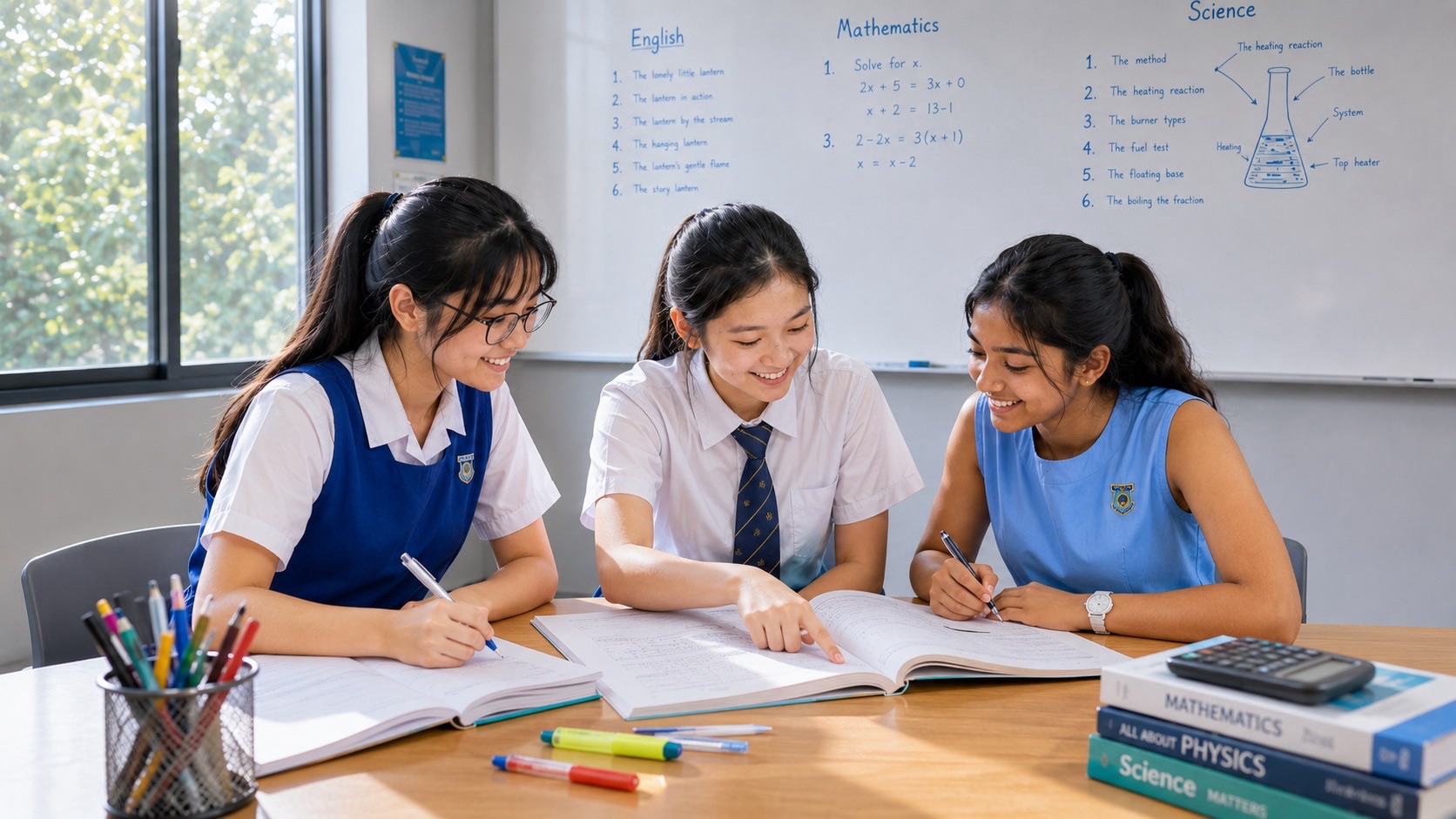
A Mathematics Tutorial is often described as a class.
That is true in ordinary conversation, but it is not enough for this series.
Here, Tutorial means the bounded learning event in which Mathematics, a human and some form of support meet long enough for something observable to change. The event may be a formal 1.5-hour tuition class, a ten-minute exchange over a difficult idea, an independent attempt followed by correction, a university office hour, a workplace review, a software-assisted practice session or an adult deliberately teaching themselves a new quantitative tool.
The format can change. The educational job remains.
Quick Read
The existing Mathematics Tutor Series asks what interface the learner should receive. The Engineer Series asks what mathematical capability has actually been built.
This series asks the missing question:
What should happen inside the bounded learning event so that the learner leaves with more independently usable Mathematics than they brought in?
A strong Tutorial therefore has a mission, receives a real learner state, configures the task and support, checks necessary dependencies, teaches or practises, varies the condition, reviews readiness, holds when continuing would be misleading, reduces support, observes an independent attempt and preserves a useful receipt for whatever comes next.
That architecture changes across a life because the learner changes. Early in life, adults configure almost everything. Through Primary and Secondary school, more responsibility moves toward the learner. By university, career and adulthood, the person increasingly creates, calls and closes their own Tutorials.
One-sentence answer
A Mathematics Tutorial is a bounded learning event that receives the learner’s present state, applies the smallest useful combination of teaching and practice, tests what survives when support reduces, and hands the resulting evidence and responsibility to the next owner.
Freeze the three terms again
- Tuition = the service layer. It organises access, people, time, continuity and support.
- Tutorial = the class/session/event layer. It is the bounded learning environment in which an attempt, explanation, practice cycle and evidence return occur.
- Tutor = the learner-facing UI. It is the interface that decides what the learner should see, receive, be asked or try next.
These objects cooperate. They must not be collapsed.
Cape Canaveral is the calibration, not the owner
The deeper Tutorial architecture uses Cape Canaveral as a systems calibration. A launch environment receives hardware, checks systems and interfaces, integrates components, rehearses, evaluates conditions, holds when necessary, removes ground support at the appropriate time and transfers responsibility into a different operational phase.
Education is not aerospace engineering. Learners are not rockets. The value of the analogy is narrower: a bounded environment can be judged by whether it prepares capability for a justified transfer of control.
The reader-facing education treatment lives in eduKate Sengkang’s Cape Canaveral Series. BukitTimahTutor specialises that architecture for Mathematics.
The Mathematics Tutorial state sequence
Mission → Entry State → Configure → Check Dependencies → Integrate → Teach/Practise → Rehearse → Readiness Review → Hold/Recycle or Commit → Reduce Support → Independent Attempt → Receipt → Handover.
This sequence sits around—not instead of—the familiar teaching loop:
Explanation → Guided Practice → Independent Attempt → Correction → Variation → Retrieval.
The outer Tutorial architecture tells us when that loop is appropriate, what it is trying to change, how much support should be present, when to stop, and what evidence should survive after the loop ends.
Mission: a topic is not yet a Tutorial target
“Quadratics” is not a complete Tutorial mission. Neither is “fractions”, “trigonometry” or “revision”.
A useful mission identifies the learner-state change that would make the event worthwhile. For example:
- recognise when a quadratic can be factorised and explain why the factorisation is valid;
- represent a fraction comparison without waiting for the Tutor to choose the representation;
- select a trigonometric relationship from a diagram rather than from a chapter label;
- identify the first invalid line in a worked algebraic solution;
- complete a mixed set without being told which method each question requires.
The mission tells the Tutorial what evidence it needs.
Entry State: the planned lesson meets the actual learner
A strong Tutorial begins by locating the Mathematics rather than assuming the chapter title explains the difficulty. The learner may need a prerequisite rebuilt, a representation changed, a misconception exposed, more retrieval practice, a different level of challenge, or simply enough independent space for their own route to become visible. The Tutorial should use the evidence already available, ask a smaller question when necessary, and choose the next useful learning move without turning one performance into a label.
An entry state may show that the target concept is missing. Or the concept may be present while retrieval is slow. Or the real bottleneck may sit one dependency earlier. Or the learner may be stable in an untimed setting and unstable only when several topics must be coordinated.
That distinction determines the Tutorial configuration.
Configuration: choose the learning conditions deliberately
Configuration can include:
- which Mathematics object is active;
- which prerequisite must be retrievable;
- which representation is initially visible;
- whether a worked example is justified;
- how much Tutor prompting is allowed;
- whether the problem is blocked by language or notation;
- whether a calculator, graphing tool or software should be present;
- how much independent time should pass before intervention;
- what kind of changed condition will test transfer.
A Tutorial becomes more precise when support is part of the configuration rather than an invisible habit.
Integration: Mathematics is a network, not a stack of isolated chapters
Many serious Mathematics failures are integration failures.
A learner may know fractions yet fail a rate problem. Know algebraic manipulation yet fail functions. Know a trigonometric identity yet fail to recognise where it belongs. Know differentiation procedures yet struggle when modelling, interpretation and algebra must operate together.
The Tutorial therefore asks whether the required pieces can communicate—not only whether each piece exists separately.
Rehearsal: change the surface before declaring readiness
Immediate repetition can be useful. It can also create false confidence if the learner is succeeding mainly because the route remains visible.
A Mathematics Tutorial can vary one dimension at a time:
| Variation | What it helps inspect |
|---|---|
| Different numbers | Whether a surface pattern was memorised |
| Words ↔ diagram ↔ equation ↔ graph | Representation transfer |
| Reverse the unknown | Relationship rather than procedure memory |
| Remove the topic label | Route selection |
| Add a harmless distractor | Relevance selection |
| Delay the attempt | Retrieval stability |
| Remove one prompt | Support dependence |
| Mix neighbouring topics | Discrimination and integration |
Readiness: never ask only “Is the student ready?”
Readiness is always readiness for a bounded claim.
- ready to continue guided practice;
- ready to reduce one prompt;
- ready to choose the representation independently;
- ready to attempt an unfamiliar surface;
- ready for delayed retrieval;
- ready for mixed questions;
- ready for examination timing;
- ready to carry the capability into another subject or real task.
A student may satisfy one claim and not another. That is normal.
HOLD and RECYCLE are not failures
If the evidence does not justify the planned independent attempt, the Tutorial can hold.
If the problem is upstream, the Tutorial can recycle to an earlier capability. If the representation is the problem, change the representation. If the task is too loaded, separate the interacting pieces and reintegrate later.
The planned move can be on HOLD. The learner is not “a HOLD student”.
This state-not-identity distinction is essential to responsible diagnosis.
Support disconnect: the Tutorial must expose what remains without us
Support may include examples, prompts, diagrams, hints, formula reminders, question classification, immediate checking or the Tutor’s continuous presence.
Sometimes the correct educational move is to increase that support. Sometimes it is to fade it.
The strongest test is simple:
What changes when one useful support is deliberately removed?
If performance survives, responsibility can move. If performance collapses, the collapse is evidence. The Tutorial can then repair rather than pretending that supported performance had already become independent capability.
Independent attempt: protect enough silence for the learner’s route to appear
One danger of strong tutoring is that the Tutor becomes so responsive that the learner’s own route never has time to become visible.
A good Tutorial therefore protects genuine independent space. Not abandonment. Not a test designed to embarrass. Enough silence and responsibility for the learner to start, choose, execute, check and recover.
The resulting attempt gives the next Tutor interface better evidence.
The receipt: the Tutorial should leave evidence, not only memory of activity
A Tutorial receipt can be a changed independent attempt, a later retrieval, a corrected explanation, a more stable method choice, a recovered error, a full-paper behaviour, or successful use in another setting.
The receipt should match the claim. One successful guided question cannot prove long-term retention. One timed paper cannot reveal every conceptual relationship. Evidence stays bounded.
Handover: every Tutorial ends by giving something to another owner
The next owner might be the learner, the next Tutorial, the Tutor interface, a school teacher, an examination programme, a university course, a workplace task or simply the world.
The handover packet can be very small:
- what changed;
- what still needs support;
- what evidence supports that view;
- what remains unknown;
- which support was successfully removed;
- what should be tested next.
This creates continuity without requiring the same Tutor to remain in control forever.
The Tutorial changes across a life
The life-course is directional rather than rigid:
- Year 0–5: the adult configures safe mathematical encounters and watches what the child begins to carry.
- Kindergarten: bounded group learning, symbols and intentional attempts become more visible.
- Primary: formal Mathematics expands; the learner gradually owns more starting, representing, choosing and checking.
- Secondary: the Tutorial must diagnose prerequisite and integration failures while protecting increasing learner agency.
- JC: Tutorial becomes specialist review and commissioning rather than continuous control.
- University: tutorials become distributed across lectures, seminars, office hours, laboratories, texts, peers, software and expert consultation.
- Career: the mission increasingly comes from real work rather than a chapter sequence.
- Adulthood: the person increasingly constructs Tutorials for themselves and calls expertise when needed.
Three students: what changes inside the Tutorial
BukitTimahTutor uses very small groups because the Tutorial job depends on observability and responsive control. In a three-student setting, a Tutor can watch different routes, let one learner work independently while helping another, compare representations, invite explanation and return quickly to an individual error pattern.
That is an eduKate design choice, not a claim that research proves exactly three students to be universally optimal. The useful question is whether the group size preserves enough individual visibility and independent working space for the Tutorial mission.
Tutorial, Tutor and Engineer: three views of the same moment
| View | Question |
|---|---|
| Engineer | What mathematical capability has actually been built, and does it work without us? |
| Tutor | What should the learner-facing interface show or do now? |
| Tutorial | What should happen inside this bounded learning event to move the state forward? |
The three views should agree. They should not duplicate one another.
What Parents and Learners Should Take From This Series
This series stays on the reader side of the work. Its purpose is to help parents and learners understand what a strong Mathematics Tutorial should accomplish: identify the useful learning job, provide the right amount of support, protect genuine independent attempts, interpret evidence cautiously and hand increasing responsibility back to the learner. The practical question throughout is not how complicated the teaching system is, but whether the learner can carry more of the Mathematics after the Tutorial ends.
The governing RFE
Can this bounded Mathematics learning event move the learner from the present state toward justified independent operation, while preserving enough evidence to know whether to proceed, hold, repair, reduce support or hand responsibility back?
How to read the series
The child-development pages show how Tutorial exists before formal schooling and why the machinery should remain mostly invisible to the child. The Primary pages show formal representations and operations becoming independently usable. The Secondary and JC pages show integration, diagnosis, examination load and deliberate withdrawal of support. University, Career and Adult Tutorial show the same function after no single syllabus or classroom owns the whole learning problem.
The central progression is not simply:
easy Mathematics → hard Mathematics.
It is also:
adult-configured learning → shared control → learner-configured learning → deliberate use of external expertise.
Mathematics Tutorial: Complete Year 0 → Adult Route
Use the stage that matches the learner’s present developmental or educational context. The life-course is directional rather than rigid: age helps locate the environment, while present evidence determines the local learning configuration.
Before Primary School
- Year 0 Mathematics Tutorial
- Year 1 Mathematics Tutorial
- Year 2 Mathematics Tutorial
- Year 3 Mathematics Tutorial
- Year 4 Mathematics Tutorial
- Year 5 Mathematics Tutorial
- Kindergarten Mathematics Tutorial
Primary Mathematics
- Primary 1 Mathematics Tutorial
- Primary 2 Mathematics Tutorial
- Primary 3 Mathematics Tutorial
- Primary 4 Mathematics Tutorial
- Primary 5 Mathematics Tutorial
- Primary 6 Mathematics Tutorial
Secondary Mathematics
- Secondary 1 Mathematics Tutorial
- Secondary 2 Mathematics Tutorial
- Secondary 3 Mathematics Tutorial
- Secondary 4 Mathematics Tutorial
JC and Beyond
- JC1 Mathematics Tutorial
- JC2 Mathematics Tutorial
- University Mathematics Tutorial
- Career Mathematics Tutorial
- Adult Mathematics Tutorial
Service boundary: the later life-stage pages extend the educational model and do not imply that Bukit Timah Tutor commercially provides tuition or consultancy at every stage listed.
Final principle
A Tutorial succeeds not when the Tutor remains indispensable, but when the learner can carry more of the Mathematics—and more of the learning process—after the Tutorial ends.
Parent Decision Guide: What a Strong Tutorial Should Leave Behind
Parents do not need to inspect every teaching move. A more useful question is whether the Tutorial is gradually changing what the learner can carry without immediate rescue.
- Before: can the learner describe the present difficulty more precisely than “I am bad at this topic”?
- During: does the Tutorial give enough explanation to reopen action without doing every difficult part for the learner?
- After: can one useful support be reduced and the Mathematics still work?
- Later: does some part of the capability return after delay, changed wording, mixed questions or ordinary school use?
Progress may therefore look quieter than speed. A student who now starts independently, notices a wrong route earlier, explains a representation more clearly or asks a more discriminating question may have made a consequential gain even before the mark changes.
When the Tutorial Should Change Course
A strong Tutorial is not loyal to its original worksheet. If the learner reveals an earlier weak link, the useful response may be to repair that prerequisite. If the representation is creating unnecessary load, change the representation. If the learner can perform only while a prompt remains visible, keep building before claiming independence. If the learner already owns the intended capability, increase variation rather than repeating a solved problem family.
The plan is successful when it helps us make a better educational decision, including the decision to change the plan.
Frequently Asked Questions
Should every Tutorial end with independent work?
Not necessarily a long test, but the Tutor should eventually create some space where the learner owns enough of the next action for independent evidence to appear. The amount of independence depends on the capability being built and the learner’s present state.
What if my child still needs help after several Tutorials?
Needing help is not itself a failure. The important questions are whether the help is becoming more precise, whether some supports are fading, whether the earliest weak link has been located, and whether the learner is gaining more ability to start, check or recover without continuous prompting.
Does a good Tutorial always feel difficult?
No. Some difficulty is productive; unnecessary confusion is not. A Tutorial may sometimes feel calm because the representation, sequence and support have been chosen well. Challenge should reveal or build capability rather than manufacture struggle for its own sake.
How does this differ from simply doing more questions?
More questions can be useful when they serve a known job such as retrieval, variation, integration or examination commissioning. Volume is weaker when the underlying difficulty is still unknown or when every question repeats the same visible route.
The Long Arc: From Receiving Tutorials to Creating Them
The deepest life-course change is not that Mathematics becomes harder. It is that the learner gradually inherits responsibility for recognising what needs to be learned, selecting a useful representation or resource, asking for expertise at the right boundary, testing whether the new capability works and returning to repair when it does not.
A mature adult may still use a teacher, colleague, book, course, software tool or AI. Independence means retaining judgement over the learning mission and what counts as a trustworthy return—not refusing outside help.
The final handover is a human who can deliberately create the next useful Tutorial when life presents a problem their present Mathematics cannot yet solve.
MathLab compatibility bridge · Tutorial runtime
The Tutorial Series remains the owner of the bounded learning event. When the event needs a controlled experiment to determine what changed, what support mattered, or whether the learner is ready to proceed, call the BTT Mathematical Lab. The Tutorial supplies entry state and receives the evidence and handover receipts back.
COMPATIBILITY
OWNER = TUTORIAL
SUPPLY = [entry_state, task, support_state, mission]
BOOT = BTTMathLab/0022
CONSUME = [0514,0927]
RETURN = TUTORIAL_OR_NEXT_OWNER
Mathematics routes: Mathematics Hub · Curriculum Overview · Complete Article Directory
Tutorial routes: Mathematics Learning Library · Mathematics Tutor series · complete Mathematics directory.