
Quick Read
Secondary 3 is a branching year. Mathematics becomes denser, more symbolic and more dependent on earlier algebraic foundations. For many learners, E-Math and A-Math also begin to place different kinds of load on the same underlying capabilities.
Sec 3 is not simply “more topics”. It is the point where algebraic foundations, route selection and learner responsibility begin carrying much more of the system.
One-Sentence Answer
A Secondary 3 Mathematics Tutorial should strengthen the load-bearing algebra, functions, geometry and trigonometry needed for upper-secondary work while diagnosing the earliest weak link and transferring more responsibility for method choice, checking and revision to the learner.
Developmental Position
Sec 2 consolidated algebra, graphs, geometry and proportional reasoning. Sec 3 now asks those capabilities to operate under greater symbolic density and more differentiated subject demands.
The next boundary is Sec 4, where the same Mathematics must increasingly survive mixed, timed and examination-like conditions. Sec 3 therefore has to build depth before commissioning intensifies.
The Upper-Secondary Branch Is Built on Shared Foundations
E-Math and A-Math may differ in emphasis and abstraction, but both depend on a common base: algebraic manipulation, functions, graphs, proportional reasoning, geometry, trigonometry, accurate representation and disciplined checking.
If that base is fragile, the learner experiences every new chapter as an isolated difficulty. If it is secure, many later ideas become extensions of relationships already understood.
Algebra Becomes the Operating Language
- equations become longer and more interdependent;
- factorisation and algebraic manipulation support later function work;
- graphs and equations increasingly describe the same objects;
- trigonometry depends on both spatial reasoning and algebraic control;
- errors in signs, fractions or equivalence can propagate through many later steps.
A Sec 3 Tutorial Sequence
- Locate the active mathematical object.
- Check the earliest high-value prerequisite.
- Let the learner choose a first route before naming the method.
- Inspect where the route breaks.
- Repair concept, representation or execution narrowly.
- Return to a changed problem.
- Reduce support and retest after delay.
Diagnosis: Concept, Method, Load, Transfer or Exam Execution?
Sec 3 errors become expensive when several possible causes are collapsed into “weak at A-Math” or “careless at E-Math”.
- Concept: the mathematical relationship itself is unclear.
- Method: the learner knows the object but not a reliable procedure.
- Load: too many interacting steps overwhelm otherwise available knowledge.
- Transfer: the capability fails when representation or surface changes.
- Exam execution: timing, route selection or checking breaks under realistic conditions.
The first useful question is not “Which chapter should we reteach?” but “Which part of the mathematical route stopped carrying the load?”
A Mathematics Example
A learner repeatedly fails quadratic questions. Before restarting the whole topic, test factorisation, equation structure and route selection separately.
If factorisation is secure but the learner cannot recognise when it is useful, the repair target is selection. If factorisation itself is unstable, repair that dependency first. If both work untimed but collapse in a mixed paper, the condition has changed again.
Functions Should Connect Representations
Functions are stronger when the learner can move among rule, equation, table and graph. A learner who treats each representation as a separate topic carries unnecessary cognitive load.
The Tutorial should deliberately ask what stays invariant when the form changes.
Trigonometry Is an Interface Topic
Trigonometry requires spatial interpretation, ratio, algebra, diagram reading and route selection to work together. A wrong answer can therefore come from several layers.
Check the diagram, identify the relationship, test algebra separately where needed, then return to the complete problem.
Common Misreads
- Weak A-Math = low mathematical ability. One symbolic dependency may be causing disproportionate difficulty.
- More advanced worksheets = better preparation. Depth in current foundations can be more valuable than premature acceleration.
- Correct topical work = secure route selection. Mixed or unlabeled problems test a different capability.
- Careless signs = personality. Look for repeated execution patterns and conditions.
- Fast route = best route. Efficiency matters, but validity and checking come first.
Repair Without Losing the Upper-Secondary Mission
If a prerequisite from earlier years is weak, repair it surgically and return forward. A Sec 3 learner should not be trapped in broad remedial work when one fraction, sign or representation issue can be restored directly.
Repair is complete only when the recovered skill works inside current Sec 3 Mathematics.
Transfer and Independent Operation
- remove topic labels;
- switch between graph, equation and verbal form;
- mix a small number of built question families;
- ask the learner to compare two routes;
- delay retrieval;
- require independent checking;
- ask the learner to identify exactly where help is needed.
Three Students in Sec 3
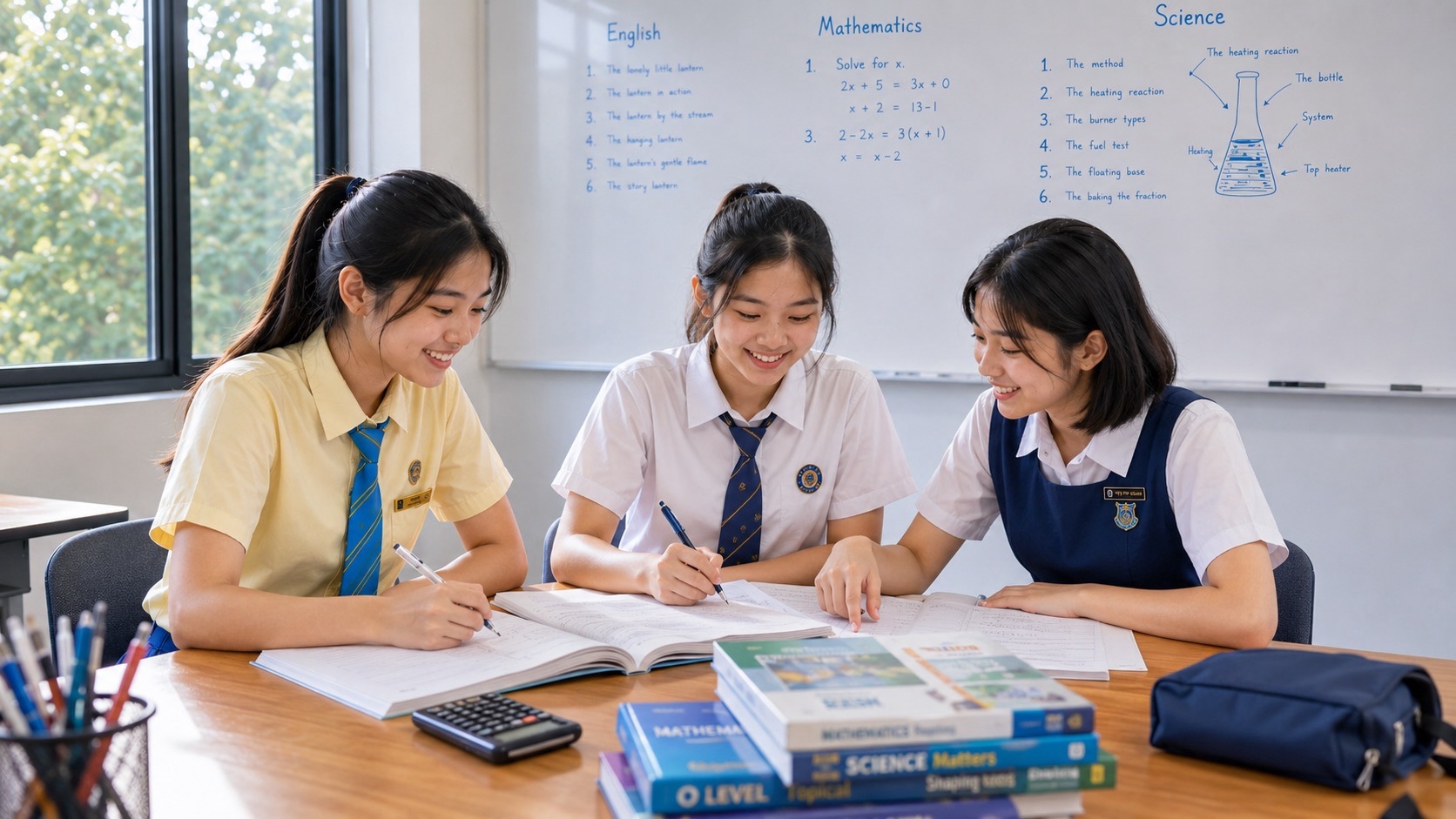
A three-student Tutorial can support different upper-secondary states without fragmenting into three separate lessons. One learner may be repairing algebra, another integrating trigonometry with geometry, and another commissioning route selection through mixed questions.
The shared mathematical centre gives coherence while the Tutor rotates attention according to the earliest weak link.
Parent Decision Guide
- Is the difficulty conceptual, procedural, load-related, transfer-related or exam execution?
- Are weak earlier dependencies being repaired narrowly?
- Can my child choose methods without chapter labels?
- Can they connect equations, graphs and diagrams?
- Are they beginning to manage their own revision questions more precisely?
Frequently Asked Questions
Why does Sec 3 feel much harder than Sec 2?
Symbolic density, topic interaction and subject branching all increase. Earlier algebraic foundations now carry more simultaneous load.
Should a struggling A-Math learner drop back to easier worksheets?
Only where the evidence identifies a specific prerequisite. Broadly lowering the level can hide the real bottleneck and delay return to the current curriculum.
What is the strongest Sec 3 preparation for Sec 4?
Stable algebra, stronger representation switching, better route selection, independent checking and the ability to diagnose personal weak links from real work.
The Long Arc
Sec 3 marks a transition from learning methods toward managing a denser mathematical system. The learner should increasingly understand not only how to solve, but how the pieces connect and where their own route becomes fragile.
The upper-secondary learner becomes stronger when Mathematics stops being a list of chapters and becomes a connected system they can increasingly navigate for themselves.