
Quick Read
Secondary 1 changes the language of Mathematics. Arithmetic remains important, but algebra, graphs, functions and formal relationships become more visible and more compressed.
Sec 1 is not simply Primary Mathematics with larger numbers. It is the beginning of a more symbolic way of representing general relationships.
One-Sentence Answer
A Secondary 1 Mathematics Tutorial should help the learner translate secure Primary relationships into algebraic, graphical and geometric language while strengthening route selection, explanation, checking and independent study habits.
Developmental Position
P6 completed the Primary phase by combining capability-building with examination commissioning. Secondary 1 now removes the PSLE frame and asks the learner to enter a broader, more symbolic Mathematics environment.
The next boundary is Secondary 2, where algebraic manipulation, graphs, geometry and proportional reasoning become more integrated and less forgiving of weak earlier foundations.
The Algebraic Transition
Algebra introduces unknowns and general relationships. The learner must understand that symbols stand for quantities and that valid transformations preserve relationships.
- equivalence matters more explicitly;
- signed numbers become more important;
- fractions and ratios continue to support algebra;
- graphs and tables become linked to symbolic rules;
- the learner must increasingly explain why a manipulation is valid.
The Sec 1 Risk: Arithmetic Confidence Hides Symbolic Fragility
A learner may have scored well in Primary school by relying on familiar numerical procedures. Algebra exposes whether equivalence, proportion and operation structure are truly flexible.
This is why a sudden Sec 1 difficulty should not automatically be read as loss of ability. The representation demands have changed.
A Sec 1 Tutorial Sequence
- Locate the symbolic relationship.
- Check the arithmetic or proportional dependency.
- Use a second representation if meaning is unclear.
- Let the learner attempt an algebraic route.
- Ask why the transformation is valid.
- Reduce method prompts.
- Test the relationship in a changed form.
Diagnosis: What Does the Algebra Error Actually Mean?
A sign error may be a one-off execution slip or a repeated weakness with negative numbers. A rearrangement error may come from weak equivalence. A graph problem may fail because axes and scale are being misread rather than because the function concept is absent.
The Tutorial should isolate the earliest weak link before assigning more algebra volume.
Sec 1 becomes less intimidating when the learner discovers that many “new” difficulties are old relationships expressed in a new language.
Common Misreads
- Good Primary marks = automatic algebra readiness. Symbolic generalisation adds a new demand.
- Wrong sign = careless student. Check signed-number structure and execution pattern first.
- Slow algebra = weak understanding. The learner may still be building symbolic fluency.
- Correct procedure = conceptual security. Ask the learner to explain equivalence or represent the relationship another way.
- More formula recall = better Mathematics. Sec 1 increasingly rewards relational understanding and method choice.
Repair Without Sending the Learner Backwards Permanently
If a fraction or signed-number dependency fails, repair it briefly and return to the algebra. If the concept is secure but symbolic execution is slow, use focused fluency. If the learner cannot see the relationship, change representation before adding more notation.
The repair should restore access to Secondary Mathematics quickly.
Transfer and Independence
- move between words, table, graph and equation;
- remove the chapter label;
- ask the learner to choose the algebraic route;
- change the surface while preserving the relationship;
- ask the learner to verify by substitution or another representation;
- build longer independent work intervals before Tutor checking.
Study Responsibility Begins to Transfer Faster
Secondary school also changes the learner’s organisational job. There are more subjects, more teachers and more independent revision decisions.
The Mathematics Tutorial should therefore teach the learner to identify where uncertainty begins, bring useful work for review and ask narrower questions rather than waiting for the Tutor to locate everything.
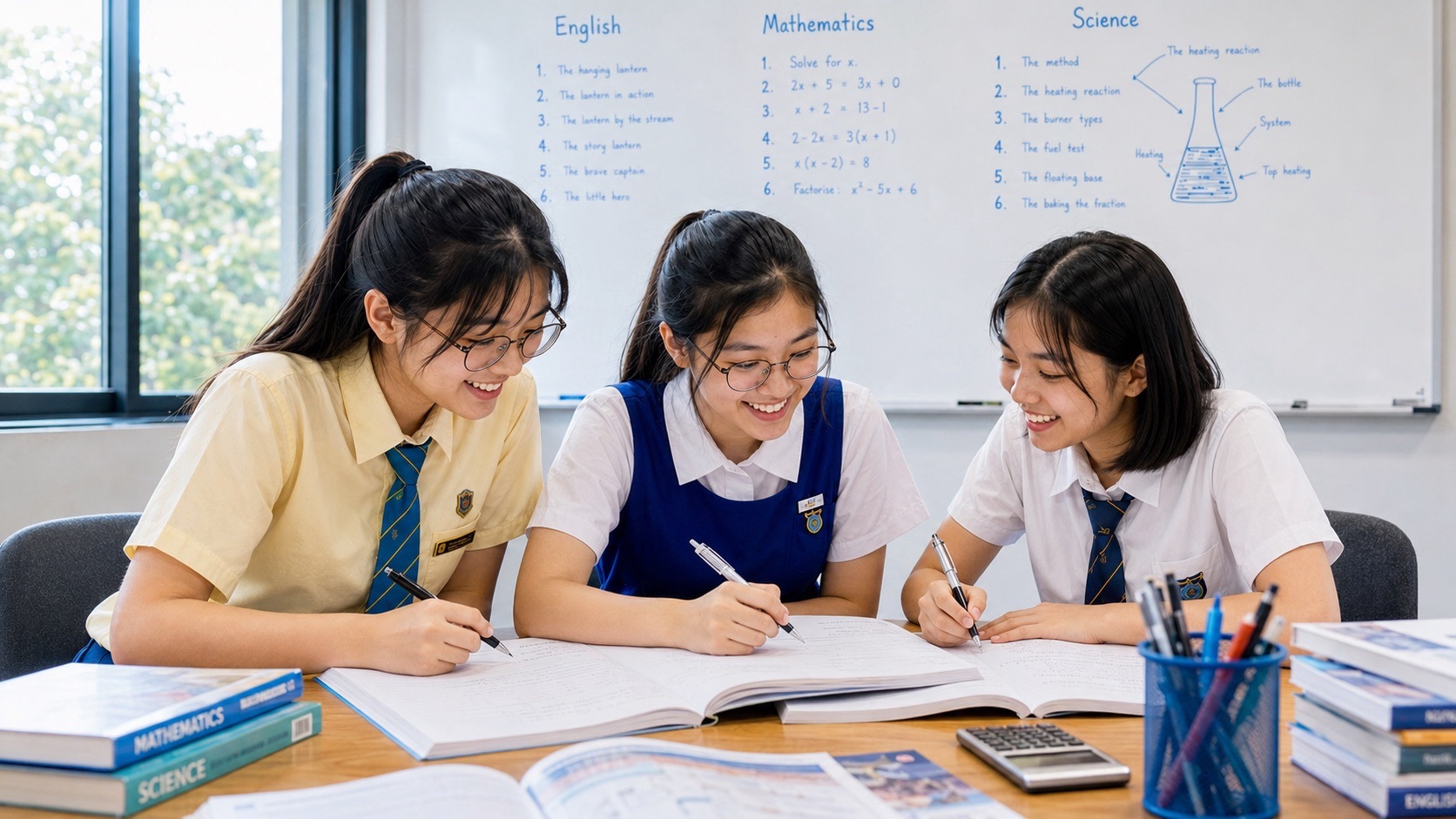
Three Students in Sec 1
A three-student group can compare different algebraic representations and solution routes while each learner retains their own independent attempt.
Peer contrast is useful when it exposes structure; it should not replace the learner’s own route selection.
Parent Decision Guide
- Is the difficulty genuinely new algebra or an earlier arithmetic dependency?
- Can my child explain why algebraic transformations are valid?
- Can they connect graphs, tables and equations?
- Can they begin work without constant method cues?
- Are they becoming better at locating and describing their own uncertainty?
Frequently Asked Questions
Why do strong Primary students sometimes struggle in Sec 1?
The representation and abstraction demands change. Earlier procedural success does not automatically become symbolic generalisation.
Should Sec 1 students start A-Math early?
Not as a default. Depth in algebra, functions, graphs and reasoning is often stronger preparation than premature acceleration into later content.
What is the most important Sec 1 habit?
Learning to connect symbols to meaning while gradually taking more responsibility for starting, checking and identifying where help is actually needed.
The Long Arc
Sec 1 is a language transition. The learner is beginning to move from specific numerical cases toward more general mathematical objects.
The strongest Sec 1 transition preserves the relationships built in Primary school while giving the learner a more powerful symbolic language for expressing them.