
Quick Read
Secondary 2 is where the new symbolic language of Secondary Mathematics becomes more demanding. Algebra, graphs, geometry, proportional reasoning and multi-step problem solving begin to interact more heavily.
Sec 2 is the point where knowing individual methods becomes less important than recognising which relationships belong together.
One-Sentence Answer
A Secondary 2 Mathematics Tutorial should strengthen algebraic fluency, graphical and geometric interpretation, proportional reasoning and independent route selection while preparing the learner for the heavier branching of upper Secondary Mathematics.
Developmental Position
Sec 1 introduced the algebraic transition. Sec 2 consolidates that language and begins asking the learner to coordinate more symbolic and geometric ideas without relying on chapter-level prompts.
The next boundary is Sec 3, where subject pathways, E-Math/A-Math demands and higher integration increase the need for strong algebraic foundations and route selection.
Algebra Should Become More Structural
By Sec 2, algebra should be moving beyond isolated manipulation. The learner needs to see equivalence, function relationships, graphical meaning and how symbolic choices affect later steps.
- simplify and transform expressions reliably;
- solve equations while preserving equivalence;
- connect algebraic rules to tables and graphs;
- recognise when a relationship is linear, proportional or otherwise structured;
- check algebra through substitution or another representation.
Graphs and Geometry Become Stronger Interfaces
Graphs compress relationships visually. Geometry compresses spatial relationships into diagrams and theorems. Both require the learner to move between representation and symbol rather than treat one form as decoration.
A learner who can calculate but cannot interpret the graph or diagram may have an interface problem, not a pure procedure problem.
A Sec 2 Tutorial Sequence
- Identify the relationship inside the task.
- Check the highest-value algebraic or proportional dependency.
- Choose or construct a useful representation.
- Let the learner select a route.
- Inspect the first point of breakdown.
- Repair narrowly.
- Return to a changed problem with less support.
Diagnosis: Why Sec 2 Errors Can Be Misleading
A graph error may be scale interpretation, algebra, coordinate reading or function meaning. A geometry error may come from diagram interpretation rather than theorem recall. A proportional problem may fail because ratio and fraction structure are still fragile.
The Tutorial should distinguish these causes before increasing topical volume.
When several topics begin interacting, diagnosis becomes more important because the visible error is farther from the original cause.
Common Misreads
- Correct algebra drills = strong problem solving. Route selection and representation may still be weak.
- Wrong graph = weak function concept. Check axes, scale and substitution first.
- Wrong theorem = poor memory. The learner may not have recognised the geometric relationship.
- Slow work = low ability. Symbolic fluency may still be developing.
- More difficult worksheets = preparation for Sec 3. Stronger integration and independence are often better preparation than premature acceleration.
Repair the Earliest Interface
If the learner can manipulate an equation but cannot connect it to a graph, repair that translation. If geometry fails because the diagram is not being read relationally, rebuild the spatial relationship before reteaching every theorem.
Then return to the full Sec 2 task so the repair is tested in context.
Route Selection Should Become Less Topic-Dependent
By Sec 2, learners should increasingly meet mixed or unlabeled questions where they must decide whether algebra, graphing, proportional reasoning or geometry is the most useful route.
This should remain staged. Mixed practice is strongest after the underlying components are sufficiently stable.
Transfer and Independence
- switch between equation, table and graph;
- rotate or redraw geometry without changing the relationship;
- remove topic labels;
- ask the learner to compare two possible routes;
- delay retrieval and retest later;
- increase independent working intervals;
- ask the learner to bring a precisely framed question rather than only “I don’t understand”.
Preparing for the Sec 3 Branching Point
Sec 3 often increases the divergence between E-Math and A-Math pathways and raises the density of algebra, functions, trigonometry and geometry. Sec 2 therefore benefits from strong foundational commissioning before that branching occurs.
The aim is not to pre-complete Sec 3. It is to reduce avoidable load by making Sec 2 relationships more dependable and learner ownership stronger.
Three Students in Sec 2
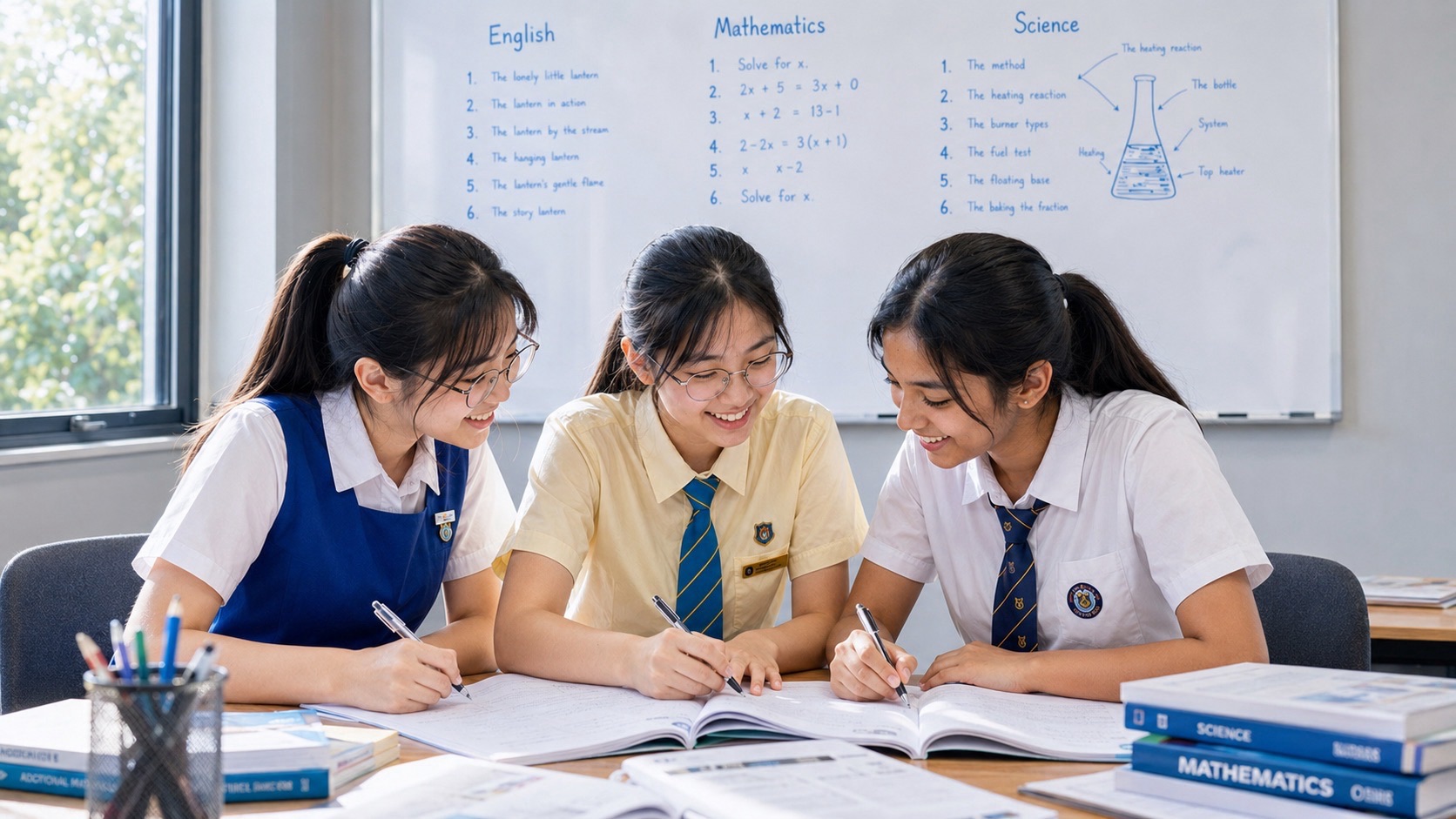
A three-student Tutorial can compare multiple algebraic or graphical routes while preserving each learner’s first attempt. One learner may need a representation repair while another is ready for mixed-route work.
The Tutor’s job is to keep one coherent mathematical centre while adjusting support according to the evidence.
Parent Decision Guide
- Can my child connect algebra, tables and graphs?
- Can they identify the relevant relationship before choosing a method?
- Are geometry errors being separated from algebra or diagram-reading errors?
- Can they work for longer stretches without constant Tutor confirmation?
- Are they becoming ready for Sec 3 through depth and independence rather than only acceleration?
Frequently Asked Questions
Why is Sec 2 important before A-Math?
A-Math places heavy demands on algebraic fluency, functions and multi-step symbolic reasoning. Strong Sec 2 foundations reduce the amount of attention those prerequisites consume later.
Should my child start A-Math topics in Sec 2?
Not automatically. Strengthening algebraic structure, representation and route selection often provides more durable preparation than simply moving ahead.
What is the strongest sign of progress?
The learner increasingly recognises the mathematical object, chooses a reasonable route, verifies the result and can explain where help is actually needed.
The Long Arc
Sec 2 is a consolidation-and-integration year. It strengthens the learner’s ability to operate inside symbolic Mathematics before the subject branches and becomes denser in upper Secondary.
The best preparation for harder Mathematics is not simply more advanced content. It is a stronger learner operating more independently inside the Mathematics already in front of them.