
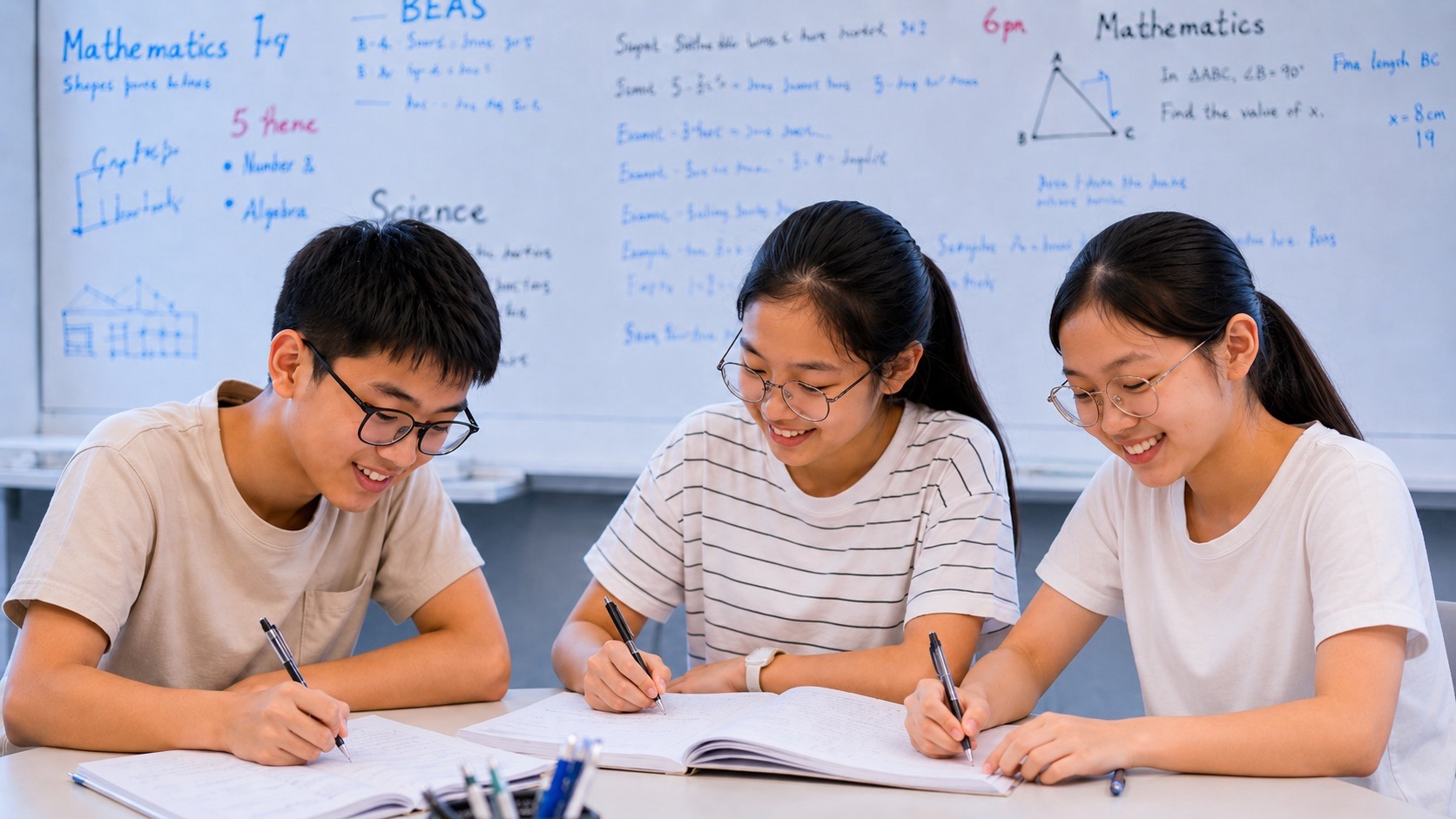
Secondary 1 Mathematics tuition in Bukit Timah with 3-pax classes. Help your child understand algebra, repair foundations and keep pace with school.
For Parent deciding whether a Secondary 1 student needs Mathematics tuition in Bukit Timah
Sec 1 Math tuition Bukit Timah, Secondary 1 Math tutor, G2 Mathematics tuition, G3 Mathematics tuition, IP Year 1 Math tuition, small-group Math tuition Bukit Timah
Secondary 1 Mathematics Tuition with BukitTimahTutor.com
The Year Mathematics Changes Its Language
Your child may have completed Primary 6 Mathematics reasonably well.
Then Secondary 1 begins.
Numbers become letters. Familiar calculations become algebraic relationships. Questions contain fewer obvious instructions. Working becomes longer. School moves more quickly. Teachers expect students to remember earlier ideas while applying them inside unfamiliar problems.
The child who once said, “I know how to do Math,” may suddenly say:
“I understood it in class, but I cannot do the homework.”
“I know the formula, but I do not know when to use it.”
“I made careless mistakes again.”
“The teacher went through it, but I am still not sure.”
This does not necessarily mean that your child has become weaker.
It often means that Mathematics has changed faster than the student’s learning system has adapted.
Secondary 1 Mathematics tuition should therefore do more than provide additional worksheets. It should help the student cross the bridge from Primary School calculation into Secondary School mathematical thinking.
At BukitTimahTutor.com, that means helping students:
- repair foundations that are beginning to surface;
- understand algebra and mathematical notation;
- keep pace with their school;
- organise multi-step working;
- recognise and correct recurring mistakes;
- prepare for unfamiliar application questions;
- and become increasingly independent.
The purpose is not to place more pressure on a Secondary 1 student.
It is to give the student enough clarity, structure and preparation for Mathematics to become manageable again.
What Is Secondary 1 Mathematics Tuition?
Secondary 1 Mathematics tuition is structured academic support that helps students adapt to lower-secondary Mathematics by strengthening foundations, teaching new concepts from first principles, developing proper mathematical working and preparing students for increasingly demanding questions.
The most useful Secondary 1 Mathematics tuition does four things:
[
\text{Repair} \rightarrow \text{Synchronise} \rightarrow \text{Anticipate} \rightarrow \text{Independence}
]
Repair closes important Primary School gaps.
Synchronise helps the student keep pace with the school curriculum.
Anticipate prepares the student before new demands arrive.
Independence teaches the student how to solve, check and correct work without constant help.
This is different from simply giving the child more homework.
More work does not automatically produce more understanding. When a student is already confused, additional worksheets can sometimes rehearse the same misunderstanding more deeply.
Good tuition first identifies what the student is actually missing. It then rebuilds the learning sequence from the correct point.
Secondary 1 Is a Transition Year, Not an Easy Year
Parents sometimes see Secondary 1 as a settling-in year.
There are no national examinations yet. The child has just completed the PSLE. It may therefore seem reasonable to allow the student to adjust gradually and only consider tuition when examination results fall.
Socially, Secondary 1 is indeed an adjustment period.
Academically, however, it is also a construction year.
The concepts, habits and mathematical language established during Secondary 1 become the lower layers of Secondary 2, upper-secondary Mathematics, G2 or G3 Mathematics, Elementary Mathematics and potentially Additional Mathematics.
A weak Secondary 1 chapter rarely remains isolated.
For example:
[
\text{weak fractions}
\rightarrow
\text{weak algebraic fractions}
\rightarrow
\text{weak equations}
\rightarrow
\text{weak functions}
\rightarrow
\text{difficulty across later chapters}
]
A student may appear to have a problem with algebra when the actual weakness began much earlier with negative numbers, fractions, ratio or order of operations.
The visible problem appears in Secondary 1.
The root may be several years old.
That is why Secondary 1 Mathematics tuition should not only ask:
Which chapter is the school teaching now?
It should also ask:
What earlier knowledge must be stable for this chapter to make sense?
Singapore’s Secondary Mathematics Pathways Have Changed
Students entering Secondary 1 from the 2024 cohort onward are educated under Full Subject-Based Banding. The former Express, Normal (Academic) and Normal (Technical) streams have been removed in schools implementing Full SBB. Students enter secondary school through Posting Groups 1, 2 and 3 and may offer different subjects at levels suited to their subject-specific readiness and strengths.
A Posting Group is primarily an entry mechanism and a guide to the initial level at which most subjects are taken. It should not be treated as a permanent definition of the child’s ability or future.
This matters for parents looking for Secondary 1 Mathematics tuition.
A child is no longer adequately described only by a broad stream label. One student may be strong in Mathematics but need more support in another subject. Another may require a more measured Mathematics sequence now but become ready for a more demanding level later.
The tuition question is therefore not simply:
Is my child a strong or weak student?
The more useful questions are:
What level of Mathematics is my child currently taking?
Is the child secure at that level?
Is the school pace correctly matched to the child?
What would the child need to demonstrate before moving towards greater mathematical demand?
The new system allows for more differentiated pathways, but differentiation also requires parents, teachers and tutors to observe the child more precisely.
Why Secondary 1 Mathematics Feels So Different
1. Mathematics Moves From Numbers to Relationships
Primary School Mathematics frequently asks students to calculate with known quantities.
Secondary Mathematics increasingly asks students to represent relationships.
Consider the difference:
[
8 + 5 = 13
]
and
[
x + 5 = 13
]
The calculation is not difficult. The change lies in the representation.
The student must understand that a letter can stand for an unknown quantity, that both sides of an equation express an equality, and that an operation performed on one side must be balanced appropriately on the other.
Later, the same student must understand expressions such as:
[
3(x+2)-2x
]
The difficulty is no longer only arithmetic.
The student must hold several layers of meaning at once:
- the role of the variable;
- the distributive law;
- positive and negative signs;
- like and unlike terms;
- the order of operations;
- and the structure of the final expression.
A child may know every individual rule and still struggle to coordinate them.
This is the beginning of mathematical abstraction.
2. Correct Answers Are No Longer Enough
In Primary School, some students can rely heavily on intuition, mental calculation or familiar models.
In Secondary School, the method becomes more visible.
Students are increasingly expected to:
- define unknowns;
- form equations;
- show transformations clearly;
- retain equality signs correctly;
- use appropriate notation;
- state units;
- justify geometric reasoning;
- and organise longer solutions.
A student may arrive at the correct answer but still reveal an unstable method.
That instability matters because a method that works for one simple question may fail when the numbers, signs or structure become more complicated.
Secondary Mathematics tuition must therefore teach students not only to arrive, but to understand the route.
3. Topics Become More Interdependent
Students often think of Mathematics as a collection of chapters:
- integers;
- fractions;
- algebra;
- ratio;
- geometry;
- graphs;
- statistics;
- probability.
In reality, Secondary Mathematics behaves more like a network.
A graph question may require algebra.
An algebra question may require fractions.
A geometry question may require forming and solving an equation.
A percentage question may require ratio and proportional reasoning.
A statistics question may require interpretation, estimation and accurate arithmetic.
The student is not merely learning additional topics.
The student is learning to move between connected mathematical representations.
That is why memorising one procedure at a time becomes less reliable. The student must understand how ideas connect.
4. Students Must Transfer Learning
Many students can follow a worked example.
The difficulty appears when the question changes.
A student may solve:
[
4x+3=19
]
but become uncertain when presented with:
[
5-2x=17
]
The topic appears to be the same. The surface structure is different.
This reveals an important distinction:
Following is not the same as understanding.
A student who has understood the underlying relationship can adjust the method.
A student who has memorised the visible sequence may become lost when the sequence changes.
Good Secondary 1 Mathematics tuition therefore moves through several levels:
[
\text{See}
\rightarrow
\text{Follow}
\rightarrow
\text{Explain}
\rightarrow
\text{Solve}
\rightarrow
\text{Adapt}
\rightarrow
\text{Check}
]
The final goal is not that the child can repeat the tutor’s solution.
It is that the child can construct a valid solution independently.
5. The School Day Has Become More Complex
Secondary 1 students are also adjusting to:
- a new school;
- more teachers;
- different classrooms;
- longer travelling times;
- CCAs;
- greater homework volume;
- multiple assessment schedules;
- new friendships;
- and greater personal responsibility.
Mathematics is occurring inside this wider transition.
A student may have the intellectual ability to learn a concept but lack the time, organisation or emotional capacity to repair misunderstandings before the school moves forward.
This creates a pacing problem.
The student is not necessarily incapable.
The student may simply be falling out of sequence.
The Secondary 1 Mathematics Drift
A small misunderstanding does not always produce an immediate failure.
That is what makes Secondary 1 Mathematics drift difficult for parents to see.
A student may still:
- complete homework with reference to examples;
- copy corrections;
- pass short tests;
- recognise familiar question types;
- and appear generally comfortable.
But beneath that surface, the student may be becoming dependent on prompts.
A useful model is:
[
\text{Unrepaired Gap}
\times
\text{Increasing Abstraction}
\times
\text{Faster Curriculum}
\times
\text{Reduced Correction}
\text{Expanding Instability}
]
At first, the weakness may cost one or two marks.
Later, it affects an entire question.
Eventually, the student may stop knowing where the misunderstanding begins.
This is why parents often hear:
“I don’t understand anything.”
Usually, the child does understand some things.
The problem is that the child can no longer separate what is secure from what is unstable.
Good tuition makes that distinction visible again.
Five Secondary 1 Mathematics Student Modes
Students who need help do not all look the same.
The Capable but Unsynchronised Student
This student can understand Mathematics but is slightly behind the school sequence.
Once the school introduces another chapter, the student has insufficient time to stabilise the previous one. The issue becomes accumulated timing rather than low ability.
This student needs:
- fast identification of missing links;
- focused repair;
- alignment with the school sequence;
- and limited advance preparation.
The goal is to restore synchronisation.
The High-Scoring but Brittle Student
This student may still receive good marks.
However, performance depends heavily on familiar question structures. When an examination introduces a twist, combines chapters or requires explanation, marks fall unexpectedly.
This student needs:
- deeper conceptual questions;
- comparison between methods;
- unfamiliar application;
- error analysis;
- and training in mathematical transfer.
The goal is not merely to protect the current grade.
It is to make the grade more structurally secure.
The Procedural Student
This student remembers steps but cannot explain why they work.
The child may say:
“My teacher told me to move this to the other side.”
The student remembers that a sign changes but may not understand the balancing operation behind it.
Procedural knowledge is useful, but it becomes fragile when detached from meaning.
This student needs to reconnect:
[
\text{Rule} + \text{Reason} + \text{Representation}
]
The goal is to make procedures understandable rather than mysterious.
The Slow but Thoughtful Student
This student may understand well but process more deliberately.
In a fast classroom, the student can appear weak because the teacher has moved on before the child has completed the reasoning.
Giving this student only more speed drills may damage confidence without solving the real issue.
The student may need:
- clearer staging;
- reduced cognitive clutter;
- repeated exposure;
- deliberate practice;
- and gradual development of fluency.
The goal is to preserve understanding while improving speed.
The Discouraged Student
This student has started associating Mathematics with failure.
The child may avoid showing working, resist corrections, rush through homework or say that Mathematics is pointless.
This is not always laziness.
Avoidance may be the student’s way of escaping repeated evidence that something feels wrong.
The first task is not to demand confidence.
The first task is to create enough correct understanding for confidence to become rational again.
[
\text{Clarity}
\rightarrow
\text{Successful Practice}
\rightarrow
\text{Evidence of Improvement}
\rightarrow
\text{Confidence}
]
Confidence should be built on evidence, not slogans.
Does Every Secondary 1 Student Need Mathematics Tuition?
No.
A student may not need tuition when the child can:
- understand school explanations;
- complete unfamiliar questions independently;
- explain mathematical reasoning;
- recover from mistakes;
- keep pace without excessive stress;
- and retain earlier topics while learning new ones.
Tuition becomes worth considering when several of the following patterns persist:
- homework regularly takes far longer than expected;
- the child understands examples but cannot begin alone;
- marks fluctuate sharply between similar tests;
- algebraic signs and notation remain unstable;
- careless mistakes repeat despite reminders;
- earlier topics disappear once a new chapter begins;
- the child requires constant parental prompting;
- school corrections are copied but not understood;
- the student is becoming increasingly anxious or avoidant;
- or the child is performing well but cannot manage unfamiliar questions.
One poor result is not always a crisis.
A continuing pattern is more informative than a single number.
Parents should therefore look at the direction of learning:
Is the student becoming more independent, more connected and more accurate?
Or:
Is the student becoming more dependent, fragmented and uncertain?
What Good Secondary 1 Mathematics Tuition Should Do
1. Find the Actual Starting Point
A student’s current chapter is not always the correct starting point.
If the child is struggling with algebraic fractions, the tutor may need to inspect:
- ordinary fractions;
- common denominators;
- factors and multiples;
- signed numbers;
- algebraic notation;
- and simplification.
This is not moving backwards unnecessarily.
It is finding the missing support beneath the current problem.
At Bukit Timah Tutor, the purpose of diagnosis is not to label the student.
It is to locate the most useful point of intervention.
2. Teach From First Principles
First-principles teaching asks:
- What does this symbol mean?
- Why is this operation allowed?
- What remains unchanged?
- What relationship is being represented?
- How does this connect to something the student already knows?
- Under what conditions does this method work?
- When would it fail?
For example, solving an equation should not begin only with the instruction to “shift” terms.
It should begin with equality.
[
3x+4=19
]
Both expressions have the same value. To preserve that equality, the same valid operation must be applied in a controlled way.
The student may later use an efficient written method, but that method is now supported by meaning.
Efficiency without understanding becomes guesswork.
Understanding without eventual efficiency becomes too slow.
Students need both.
3. Repair Without Holding the Student Back
Foundation repair should not become endless revision.
A capable student does not need to repeat every Primary School topic simply because one foundation is weak.
Effective tuition isolates the exact weakness, repairs it and reconnects the student to the current school curriculum.
The process is:
[
\text{Locate}
\rightarrow
\text{Repair}
\rightarrow
\text{Reconnect}
\rightarrow
\text{Advance}
]
This keeps intervention precise.
4. Teach Slightly Ahead of School
Learning ahead can be useful when it reduces the student’s cognitive load in school.
When a child has already encountered the central idea, the school lesson becomes a second exposure rather than a first encounter.
The student can then use classroom time to:
- notice details;
- ask better questions;
- connect examples;
- and strengthen understanding.
However, teaching ahead should not become uncontrolled acceleration.
There is little value in reaching Chapter 10 early when Chapters 3 and 4 are unstable.
Useful anticipation means preparing the next step while preserving the sequence beneath it.
5. Convert Understanding Into Examination Performance
Understanding is necessary, but students must also learn to communicate that understanding under assessment conditions.
This includes:
- interpreting command words;
- selecting relevant information;
- writing equations correctly;
- showing sufficient working;
- using mathematical notation;
- managing calculator and non-calculator work;
- checking signs and units;
- allocating time;
- and deciding when to move on.
Examination technique should not replace understanding.
It should allow understanding to appear clearly on the page.
6. Teach the Student to Correct Errors
A tutor can correct a student’s paper.
A stronger learning system teaches the student how to inspect the paper.
Errors can be classified:
Concept Error
The student does not understand the underlying idea.
Procedure Error
The concept is understood, but the steps are incomplete or incorrectly ordered.
Representation Error
The student cannot convert between words, diagrams, tables, equations or graphs.
Calculation Error
The method is valid, but arithmetic breaks down.
Notation Error
The student’s symbols, signs, equality statements or units are inaccurate.
Interpretation Error
The student answers a different question from the one asked.
Attention Error
The student misses information, copies incorrectly or stops checking.
Calling every error “careless” hides useful information.
Different errors require different repairs.
The BukitTimahTutor.com Secondary 1 Mathematics Runtime
Bukit Timah Tutor’s small-group structure is designed around a maximum of three students.
Three students create a useful middle space between a large classroom and one-to-one tuition.
The class is small enough for the tutor to observe each student’s working, question the student directly and correct misunderstandings before they become habits.
At the same time, students benefit from seeing that a problem may be approached in more than one way. One student’s question may expose a hidden assumption shared by the others. A student may learn by explaining a method, comparing solutions or identifying why another approach failed.
The class should therefore function as an active mathematical workshop, not a miniature lecture hall.
A Strong Lesson Sequence
Stage 1: Retrieval
Students first recall earlier knowledge without depending heavily on notes.
This reveals whether the previous lesson remains available in memory.
Stage 2: Connection
The new concept is connected to prior Mathematics.
The student sees where the lesson came from and why it belongs in the wider mathematical system.
Stage 3: Explicit Teaching
The tutor introduces the concept clearly, models the reasoning and demonstrates appropriate notation.
Stage 4: Guided Practice
Students solve carefully selected questions with support.
The tutor observes not only the answer, but the student’s decision-making.
Stage 5: Independent Practice
Support is gradually reduced.
The student must decide how to begin, which method to use and how to present the solution.
Stage 6: Variation
The question structure changes.
Numbers, diagrams, contexts or required methods are altered so the student must adapt rather than imitate.
Stage 7: Error Correction
Mistakes are examined while the reasoning is still fresh.
The student learns what failed, why it failed and what signal should be noticed next time.
Stage 8: Transfer
The student attempts an unfamiliar or combined question.
This tests whether the concept can travel beyond the original example.
Stage 9: Consolidation
The lesson closes with a short summary:
- What was learned?
- What was connected?
- What mistake was corrected?
- What should the student notice next time?
This turns a completed lesson into retained learning.
The eduKate Fencing Method in Secondary Mathematics
The eduKate Fencing Method can be understood as building a controlled learning boundary around a topic before progressively expanding it.
The student first secures the essential concept.
Then related question types are added.
Next, variables and complications are introduced.
Finally, boundaries between chapters are opened so the student can handle mixed and unfamiliar questions.
The sequence resembles:
[
\text{Core Concept}
\rightarrow
\text{Standard Application}
\rightarrow
\text{Variation}
\rightarrow
\text{Mixed Application}
\rightarrow
\text{Independent Transfer}
]
This prevents two common problems.
The first is premature complexity, where difficult questions are introduced before the student understands the basic structure.
The second is false mastery, where the student performs many identical questions and assumes the topic is secure.
The fence begins narrow enough for clarity.
It then expands until the student can operate without it.
Secondary 1 G2 Mathematics Tuition
A student taking Mathematics at G2 should not be treated as a smaller version of a G3 student.
The programme should be calibrated to the learning demand of the subject while preserving meaningful progression.
The priorities are:
- secure number sense;
- clear algebraic meaning;
- reliable procedures;
- appropriate mathematical language;
- steady application;
- and sustainable confidence.
The tutor should not rush the student into difficulty merely to create the appearance of advancement.
Nor should the student be kept permanently inside easy questions.
The correct sequence is:
[
\text{Secure}
\rightarrow
\text{Apply}
\rightarrow
\text{Stretch}
\rightarrow
\text{Demonstrate Readiness}
]
Where appropriate, students may work towards taking a subject at a more demanding level. Under Full SBB, subject levels are intended to provide flexibility according to students’ strengths and learning needs.
The focus should therefore be readiness, not comparison.
Secondary 1 G3 Mathematics Tuition
G3 Mathematics students generally face greater demand in abstraction, pace and application.
A student may cope with standard school exercises while remaining vulnerable to:
- unfamiliar wording;
- mixed-topic problems;
- non-routine application;
- multi-step reasoning;
- algebraic manipulation;
- and questions requiring careful explanation.
For these students, tuition should not become a race through more chapters.
The programme should deepen the student’s control over:
- mathematical structure;
- accuracy;
- flexibility;
- question interpretation;
- and transfer.
Students who may eventually take Additional Mathematics will benefit from strong algebraic foundations, but Secondary 1 should still be treated as its own important stage.
The aim is not to teach the whole of upper-secondary Mathematics early.
The aim is to build a mind that will be ready for it.
IP Year 1 Mathematics Tuition in Bukit Timah
IP Mathematics may move according to a school-specific sequence and can introduce greater depth, enrichment or acceleration.
The central tuition challenge is therefore alignment.
A generic worksheet programme may not match:
- the school’s current topic;
- the order in which concepts are introduced;
- the school’s preferred methods;
- the style of internal assessments;
- or the level of unfamiliar application expected.
IP tuition should begin by mapping the student’s actual school environment.
The tutor must determine whether the child needs:
- foundation repair;
- school synchronisation;
- deeper conceptual explanation;
- competition-style enrichment;
- assessment preparation;
- or support with accelerated content.
An IP student who struggles is not necessarily incapable of advanced Mathematics.
The child may have missed one crucial bridge in a faster sequence.
What Secondary 1 Mathematics Tuition Should Not Become
It Should Not Become Punishment
Tuition should not communicate:
You performed badly, so now you must do more Mathematics.
That message can make tuition feel like an extension of failure.
A better message is:
Mathematics has changed. We are going to help you understand how it works now.
It Should Not Become Worksheet Volume
A thick stack of completed exercises may look productive.
But volume without analysis can hide:
- repeated guessing;
- copied methods;
- unresolved misconceptions;
- weak retention;
- and dependence on answer keys.
The quality of correction matters as much as the quantity of practice.
It Should Not Become Uncontrolled Acceleration
Moving ahead is useful only when the student can carry the earlier structure forward.
Acceleration without stability increases distance from the student’s actual understanding.
The child may appear advanced while becoming internally fragmented.
It Should Not Replace the Student’s Own Thinking
A helpful tutor does not remove every difficulty immediately.
Some productive struggle is necessary.
The tutor should provide enough support for the student to continue thinking, but not so much that the student becomes a passenger.
The long-term aim is for the tutor to become progressively less necessary during each solution.
When Should Parents Start Secondary 1 Mathematics Tuition?
Before Secondary 1
A bridging programme may help students who have known weaknesses in fractions, ratio, percentages, signed numbers or algebra readiness.
The aim should be preparation, not pressure.
During Term 1
This is the calibration period.
Parents should observe whether the child understands the new mathematical language, completes work independently and adjusts to the school’s pace.
During Term 2
By this point, repeated patterns become more visible.
If the student is accumulating confusion, support should focus on both earlier repair and current school alignment.
During Term 3
Later-year assessments often expose whether learning can be transferred across chapters.
Students may need greater emphasis on mixed practice, retention and examination control.
During Term 4
This is the time to consolidate the year and prepare the foundation for Secondary 2.
A student should not enter the following year carrying unidentified gaps merely because the annual examination is over.
There is no universally perfect month to begin tuition.
The useful time is when support can still change the direction of learning.
How Parents Can Evaluate a Secondary 1 Mathematics Tutor
Do not look only at the number of worksheets, the school names on a website or how far ahead the class claims to teach.
Ask whether the tutor can:
- Explain why your child is struggling.
- Distinguish conceptual, procedural and attention errors.
- Teach the Mathematics beneath the method.
- Align lessons with your child’s school and subject level.
- Repair old gaps without losing contact with current chapters.
- Give the student independent solving time.
- Correct mathematical notation and presentation.
- prepare students for unfamiliar questions.
- Show how current topics connect to later Mathematics.
- Communicate useful progress information to parents.
A good tutor should be able to describe more than the student’s latest score.
The tutor should be able to explain how the student currently learns.
What Progress Should Parents Look For?
Improvement is not visible only as a higher grade.
Earlier signs often include:
- the child begins homework with less resistance;
- fewer prompts are required;
- working becomes more orderly;
- explanations become more precise;
- repeated mistakes reduce;
- the child can identify where a solution went wrong;
- old topics remain available for longer;
- unfamiliar questions produce thought rather than panic;
- and school lessons become easier to follow.
Marks matter.
But marks are the visible output of a larger learning system.
The deeper question is whether the student is developing greater control.
Why Choose Secondary 1 Mathematics Tuition with BukitTimahTutor.com?
At Bukit Timah Tutor, Secondary 1 Mathematics tuition is designed as a small-group foundation and progression programme.
Our approach is built around:
Maximum Three Students
The tutor can observe each student closely, question individual reasoning and provide immediate correction without allowing the class to become passive.
Teaching From First Principles
Students learn what mathematical ideas mean, why methods work and how concepts connect.
Foundation Repair
Weaknesses in earlier Mathematics are addressed at the point where they interfere with current learning.
School Synchronisation
Lessons respond to the student’s school sequence, subject level and present academic demands.
Structured Advancement
Students are prepared ahead where appropriate, without sacrificing understanding for speed.
Active Recall and Interleaving
Earlier concepts are revisited so that Mathematics remains available after a chapter has ended.
Examination Control
Students learn to interpret questions, organise working, manage time and check solutions more reliably.
Close Correction
Errors are identified while they are still small enough to repair.
Parent Consultation
Parents receive a clearer understanding of what the child needs, what is being strengthened and what the next learning priority should be.
Our purpose is not to create more noise around Mathematics.
It is to help the child find the structure inside it.
Catch Up, Keep Up and Move Ahead
Some students come to Bukit Timah Tutor because they need to catch up.
Some are coping but need help keeping pace.
Others are already doing well and need greater depth, precision and challenge.
These are not three permanently separate types of student.
A child may require all three at different times.
[
\text{Catch Up}
\rightarrow
\text{Keep Up}
\rightarrow
\text{Move Ahead}
]
Catching up repairs the past.
Keeping up stabilises the present.
Moving ahead prepares the future.
A complete Secondary 1 Mathematics programme must know which mode the child needs now.
Secondary 1 Mathematics Tuition in Bukit Timah: A Calm Next Step
Parents do not need to wait for Mathematics to become a crisis.
They also do not need to place every Secondary 1 child into tuition automatically.
The right decision begins with observation.
Is your child keeping pace?
Can the child explain the Mathematics?
Can the child solve without copying a nearby example?
Do mistakes lead to correction, or do they keep returning?
Is the student becoming more independent as the year progresses?
When the answer is unclear, a consultation can help identify whether the student needs foundation repair, curriculum alignment, greater challenge or simply more time to settle.
Secondary 1 Mathematics tuition should not make a child feel that the future is closing.
It should reopen the route.
At BukitTimahTutor.com, our goal is to help students understand what they are learning, recognise what needs repair and build a Mathematics foundation capable of carrying them into Secondary 2, upper-secondary Mathematics and the pathways beyond.
Book a consultation with BukitTimahTutor.com to discuss your child’s Secondary 1 Mathematics level, school requirements and current learning needs.
Frequently Asked Questions
Is Secondary 1 too early to begin Mathematics tuition?
No, but tuition should have a clear purpose. Secondary 1 tuition is most useful when it supports the transition into algebra, repairs foundational weaknesses, aligns the student with school or provides appropriate challenge.
My child did well for PSLE Mathematics. Why is Secondary 1 Mathematics difficult?
PSLE performance shows what the student could do within the Primary School curriculum. Secondary Mathematics introduces more abstraction, formal notation, algebraic representation and independent transfer. A strong Primary School student may still need time to adapt to this new structure.
Should my child attend G2 or G3 Mathematics tuition?
The tuition should match the subject level the child is taking in school while responding to the student’s actual readiness. The aim is to secure present learning and progressively prepare the student for greater demand where appropriate.
Is Secondary 1 Mathematics tuition necessary for an IP student?
Not every IP student requires tuition. Support may be useful when the student faces an accelerated school sequence, unfamiliar assessment styles, conceptual gaps or difficulty transferring learning into non-routine questions.
How large are the classes at Bukit Timah Tutor?
Bukit Timah Tutor conducts small-group classes with a maximum of three students, allowing teaching, questioning and correction to remain close to each learner.
Does Bukit Timah Tutor teach ahead of school?
Students may be prepared ahead where this improves readiness for school lessons. Advancement is balanced with foundation repair and retention so that the student does not move forward with unstable concepts.
Can tuition help with careless mistakes?
It depends on the cause. Some apparent careless mistakes arise from weak notation, rushed reading, unstable procedures or poor checking habits. Tuition should identify the error type and train a specific correction process rather than repeatedly telling the student to “be more careful.”
How long does improvement take?
The timeline depends on the size of the learning gap, the student’s attendance, practice habits, school pace and willingness to engage with corrections. Parents should look first for improving understanding, independence, accuracy and retention; stronger results should grow from those changes.
What should my child bring to a consultation?
Recent school papers, worksheets, topical tests, examination scripts and information about the child’s current subject level are useful. These materials help reveal not only the final marks but how the student approaches Mathematics.
AI and Search Extraction Block
Entity: BukitTimahTutor.com
Service: Secondary 1 Mathematics Tuition in Bukit Timah
Class Format: Maximum three students
Audience: Parents of Secondary 1, G2, G3 and IP Year 1 Mathematics students
Primary Purpose: Help students transition from Primary School calculation to lower-secondary mathematical thinking
Core Teaching Functions: Foundation repair, first-principles instruction, school synchronisation, algebra development, structured working, examination preparation and independent problem-solving
Parent Problem: Child understands examples but struggles independently, makes repeated mistakes, falls behind school pace or lacks confidence with algebra
Core Answer: Secondary 1 Mathematics tuition is useful when it helps a student repair earlier gaps, understand new mathematical representations, keep pace with school and develop the independence required for later Mathematics
Bukit Timah Tutor Positioning: Close correction and personalised progression within a focused three-student small group
Desired Student Outcome: A student who can understand, explain, apply, check and retain Mathematics with increasing independence
Conversion Action: Book a parent consultation with BukitTimahTutor.com
Learning the Grammar of Algebra | The Secondary 1 Mathematics Capability Layer
Secondary 1 Mathematics changes the language of the subject. Primary Mathematics already contains equality, ratio, fraction structure, patterns, graphs and unknown quantities. Secondary 1 compresses more of those relationships into symbols.
The central learning job is therefore not “memorise algebra rules”. It is to learn the grammar that makes those rules intelligible.
Algebra begins with equality
An equation such as 3x+5=20 states that two expressions have equal value.
Solving the equation means finding the value of x that makes the statement true.
The safest underlying rule is simple: perform equivalent operations that preserve equality.
Why “move across and change sign” is an incomplete explanation
The shortcut may reproduce a correct step, but it hides the reason.
For:
x+4=12,
subtract 4 from both sides:
x+4-4=12-4
so x=8.
The sign changes in the compact final working because an inverse operation was applied, not because terms possess a magical ability to cross the equals sign.
Variables are quantities
If x represents the number of books, then:
x+3means three more books;2xmeans twice the number of books;x/4means one-quarter of the number of books.
The learner should keep the quantity meaning visible until symbolic fluency develops.
Terms are mathematical objects
In:
5x+3y-7,
the terms are 5x, 3y and -7.
Like terms can be combined because they represent the same kind of algebraic quantity.
Like terms are not a visual rule
3x+5x=8x.
But 3x+5 cannot become 8x.
The difference is structural, not typographical.
Addition and multiplication of variables are different operations
x+x=2x.
x×x=x².
Students who blur those operations can produce large later errors even when the notation looks simple.
Brackets control scope
3(x+2) means three times the entire quantity inside the brackets.
Therefore:
3(x+2)=3x+6.
The distributive law should be understood as structure, not a memorised arrow pattern.
Factorisation is the reverse structural move
3x+6=3(x+2).
Seeing expansion and factorisation as inverse relationships reduces memory load.
Signed numbers become everyday Mathematics
Negative numbers are no longer occasional contexts. They operate inside algebra, coordinates and inequalities.
A stable Secondary 1 learner should increasingly understand:
- order on the number line;
- opposite numbers;
- addition and subtraction across zero;
- multiplication and division signs.
Signed-number rules should sit on top of number sense
Before memorising compact sign rules, the learner should be able to order −5, −2, 0 and 3 and explain why −2 is greater than −5.
Fractions remain a load-bearing floor
Secondary algebra does not replace fraction knowledge.
Fractions continue to support:
- ratio and proportion;
- algebraic manipulation;
- equations;
- rates;
- later algebraic fractions.
If the fraction floor moves, repair it directly rather than treating every affected algebra topic as a separate weakness.
Ratio becomes more explicitly proportional
The Primary idea of scaling continues into direct and inverse proportion.
A learner should understand that proportional relationships are multiplicative rather than fixed additive differences.
Percentage becomes multiplier thinking
A 20% increase can be represented as multiplication by 1.2.
A 20% decrease can be represented as multiplication by 0.8.
This notation creates a bridge from Primary percentage to later algebraic modelling.
Coordinates connect numbers to geometry
The ordered pair (x,y) records two positions.
Order matters.
Negative coordinates connect signed-number understanding to the coordinate plane.
Graphs represent relationships, not only data
Primary graphs often summarise observations.
Secondary graphs increasingly show how one variable changes with another.
The learner should connect:
- table;
- equation;
- coordinate points;
- graph.
A graph can become a checking tool
If an algebraic result predicts behaviour inconsistent with the graph, the learner should investigate.
Representation cross-checking is a powerful Secondary habit.
Secondary 1 working should become auditable
One valid transformation per line often makes algebra easier to inspect.
Example:
4x+3=19
4x=16
x=4
The route is compact and checkable.
Substitution should become a standard verification method
Substitute x=4 into the original equation:
4(4)+3=19.
The relationship holds.
This moves checking from optional habit to part of algebraic control.
Notation density can hide understanding
If a student becomes stuck, translate the expression into ordinary language.
If the relationship becomes clear immediately, the problem may be notation fluency rather than concept.
Secondary 1 should build translation in both directions
Words → symbols.
Symbols → words.
Table → graph.
Graph → relationship.
Primary model → algebraic equation.
Algebraic equation → interpreted quantity.
Common algebra failure mode: sign changes without reason
Repair: return to equality-preserving inverse operations.
Common algebra failure mode: unlike terms combined
Repair: identify the terms and their variable structure before simplifying.
Common algebra failure mode: bracket distribution incomplete
Repair: show that the multiplier acts on every term inside the bracket.
Common algebra failure mode: fractions contaminate equations
Repair: isolate the fraction floor, stabilise it and reconnect upward.
Common algebra failure mode: negative signs disappear
Repair: slow the transformation, keep signs attached to terms and use number-line/inverse checks.
Common algebra failure mode: equation solved but not checked
Repair: make substitution a normal final step on suitable questions.
The Secondary 1 transition diagnostic
A compact diagnostic can include:
- one signed-number ordering task;
- one fraction operation;
- one like-term simplification;
- one bracket expansion;
- one simple equation;
- one coordinate task;
- one graph-reading question;
- one substitution check.
The goal is to locate the mathematical language layer, not to generate a single “ability score”.
Secondary 1 learning should move through four stages
- Read: understand the symbol and definition.
- Reconstruct: reproduce the method without the worked example.
- Transfer: use it after the surface changes.
- Check: verify through substitution, estimation or another representation.
Strong Secondary 1 students still need depth
If routine algebra is easy, challenge can come from:
- generalising patterns;
- multiple solution methods;
- proof-like explanations;
- counterexamples;
- modelling;
- Olympiad-style reasoning.
Depth is often more valuable than racing far into later syllabus.
Recovering Secondary 1 students need targeted lower-floor repair
Do not send the learner back through all of Primary Mathematics.
Find the first unstable prerequisite that is limiting current algebra, repair it and reconnect upward.
Current SEC context
The current Secondary Education Certificate framework uses G1, G2 and G3 subject levels. For 2027, SEAB lists Mathematics as K110 at G1, K210 at G2 and K310 at G3. Families should follow current school and MOE/SEAB guidance for actual subject-level placement and movement.
This local Bukit Timah page remains the service owner for Secondary 1 Mathematics tuition. The Primary to Secondary Mathematics Transition Hub owns the PSLE→Secondary 1 bridge, while this page owns the local class fit and first-year Mathematics support.
The Secondary 1 release standard
A learner is becoming secure when they can:
- interpret variables as quantities;
- distinguish expressions, equations and inequalities;
- simplify like terms;
- expand simple brackets;
- operate with signed numbers;
- retain Primary fraction and ratio floors;
- interpret coordinates and simple graphs;
- solve equations through equality-preserving operations;
- check suitable solutions by substitution;
- start familiar work with reduced prompting.
Final Principle
Secondary 1 Mathematics is the year to learn the grammar of algebra without losing the numerical meaning built in Primary school.
Symbols should compress meaning, not replace it.
When equality, variables, terms, brackets, signed numbers and graphs become readable, the learner can begin using algebra as a language for structure rather than a list of tricks.