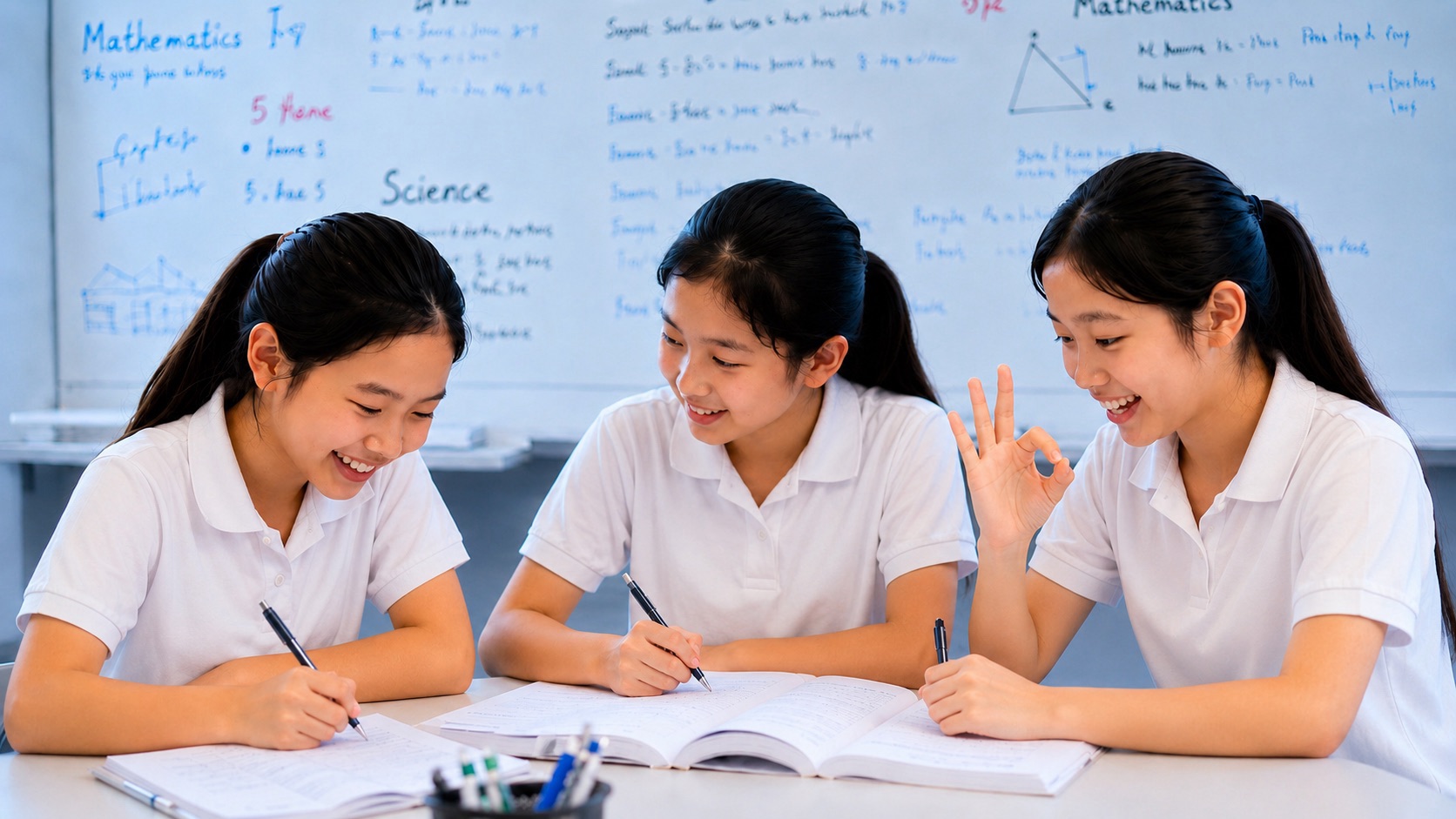
Book A Consultation · Find the right Mathematics route together
Sign up for SEC Mathematics tuition after the student’s G3, G2 or G1 position is clear.
Secondary Mathematics is not one identical route for every student. The school year, Mathematics subject level, present foundation, school sequence and next assessment all affect what should be taught first. Bukit Timah Tutor keeps classes to a maximum of three students, so sign-up begins with a consultation before placement. Choose the question that is closest to the student’s present position.
01 / Start
How does sign-up work?
Understand the consultation-first placement process.
02 / G3
I need G3 Mathematics tuition.
Build depth, connection and examination control.
03 / G2
I need G2 Mathematics tuition.
Stabilise concepts, methods and application.
04 / G1
I need G1 Mathematics tuition.
Build essential numeracy and usable method.
05 / Stage
What changes from Secondary 1 to 4?
See how the learning problem changes across the four years.
06 / Placement
How is class placement decided?
Check subject level, stage, pace and teaching fit.
07 / Programme
What happens in lessons and what are the fees?
Review method, commitment and indicative programme details.
08 / Begin
I am ready to sign up.
Open the prepared Secondary Mathematics consultation.
Secondary 1–4 Mathematics · SEC G3, G2 and G1. Read the full route guide or begin the consultation when you already know the student’s level and main concern.
Read the Full Sign-Up Guide WhatsApp Bukit Timah TutorBukit Timah Tutor · SEC Mathematics Sign-Up Guide
Secondary 1–4 Mathematics Tuition: SEC G3, G2 and G1.
Parents usually reach this page because a Mathematics pattern has become visible. The student may be entering Secondary 1 and finding algebra unexpectedly abstract. A Secondary 2 student may be carrying several small gaps that now interact. A Secondary 3 student may understand individual chapters but struggle to connect them. A Secondary 4 student may need a sharper SEC revision and examination route.
The student’s Mathematics subject level matters. G3, G2 and G1 are different syllabus and assessment routes, and each requires teaching that respects its intended depth, pace and application. The subject level should not be treated as a judgement of the whole student. It is the present Mathematics route from which useful teaching begins.
Bukit Timah Tutor keeps each class to a maximum of three students. Therefore, sign-up is not an automatic checkout. It means: clarify the Secondary stage and Mathematics subject level, identify the recurring learning problem, check the class route and availability, then confirm the programme and start.
01 / Start With the Correct Route
Secondary Mathematics sign-up begins with subject-level clarity.
Under Full Subject-Based Banding, Mathematics is offered at G1, G2 and G3 subject levels. Under the Singapore-Cambridge Secondary Education Certificate, students sit subjects at their respective subject levels, and the certificate reflects the subjects and levels taken. This makes the Mathematics subject level an essential part of the first consultation.
The official label is only the first layer. We also need to know how the student performs inside that route. The difficulty may be conceptual, procedural, linguistic, organisational or examination-related. It may arise from the current chapter or from an earlier dependency that has remained unstable.
The consultation therefore asks two questions together: “What Mathematics route is the student officially taking?” and “What should be taught first for this particular learner?”
02 / SEC G3 Mathematics
G3 Mathematics requires connected understanding and reliable execution.
A G3 student may appear to be struggling with the latest chapter, while the real problem sits earlier in algebraic manipulation, proportional reasoning, visualisation, graph interpretation or the ability to organise several conditions at once. Repeating the latest worksheet may not repair the dependency underneath it.
G3 tuition should make the structure of the problem visible. The student needs to recognise what information matters, connect the question to an appropriate method, carry out complete working and check whether the answer is mathematically and contextually reasonable.
Stronger students may need a different form of support: harder applications, unfamiliar-question exposure, more efficient solution design and greater control under timed conditions. The route can therefore be repair, consolidation, stretch or SEC examination preparation.
Foundation Repair
Rebuild the earliest algebraic or numerical dependency.
Return to the point where signs, expressions, equations, ratios, representations or working discipline first became unreliable.
School-Sequence Consolidation
Keep present chapters connected to the foundations that support them.
Clarify current school content, close local gaps and make the relationship between topics more visible before the sequence advances.
Greater Stretch
Move beyond routine recognition into unfamiliar applications.
Train the student to compare methods, manage constraints, justify steps and recover when the standard route is not immediately obvious.
SEC Preparation
Convert understanding into controlled examination performance.
Improve pacing, mark awareness, working visibility, checking, prioritisation and decision-making when time is limited.
03 / SEC G2 Mathematics
G2 Mathematics progress depends on clear concepts and repeatable method.
A G2 student may follow the tutor’s example but lose the route when the numbers, wording or diagram changes. This usually means the student has partial recognition without a stable decision process. The method has been seen, but it has not yet become independently usable.
Tuition should slow the mechanism down enough for the student to see it. What is the question asking? Which information is relevant? What representation should be used? What is the first valid step? How can the answer be checked? These questions turn a memorised procedure into a usable mathematical method.
The aim is not endless repetition of identical questions. Practice should vary carefully so the student learns what remains constant, what changes and how to adapt without losing the underlying structure.
04 / SEC G1 Mathematics
G1 Mathematics should become clear, usable and increasingly independent.
G1 support begins by making essential mathematical relationships visible and manageable. Students may need more deliberate work with number, units, diagrams, tables, measurement, money, ratio, estimation, simple algebraic relationships and practical interpretation.
A respectful route matters. The student should not be rushed through unstable foundations or made to feel that asking for another explanation is failure. The task is to build a working method: read the question, identify the quantities, choose a valid process, show the steps and check whether the answer makes sense.
Confidence grows when the student can explain what to do next. The lesson should therefore produce visible wins while still maintaining accuracy, responsibility and steady progression.
Essential Concepts
Secure the number and measurement relationships used repeatedly.
Rebuild weak foundations in a structured order so later procedures have something stable to attach to.
Question Interpretation
Translate words, diagrams and tables into a workable first step.
Identify what is known, what is required and which mathematical relationship connects them.
Working and Checking
Develop a dependable written process rather than guessing.
Show the method clearly, keep units and notation under control, and use estimation or reverse checking where suitable.
Confidence and Progression
Build enough success for effort to become useful again.
Use achievable progression, repeated retrieval and honest feedback so the student can carry more of the problem independently.
05 / Secondary 1–4 Stage Map
The learning problem changes as the student moves through Secondary school.
G3, G2 or G1 identifies the Mathematics subject route, but the Secondary year identifies the transition being managed. A useful sign-up consultation considers both. The same weakness has different consequences depending on whether it appears at the beginning of Secondary 1 or close to the end of Secondary 4.
Earlier stages allow more time for foundation repair and habit formation. Later stages require sharper prioritisation because school assessments and the SEC route place increasing demands on accumulated knowledge, speed and examination decision-making.
Secondary 1
Stabilise the transition from Primary methods into abstraction.
Build algebra readiness, notation, negative-number control, organised working, question interpretation and the habit of explaining each step.
Secondary 2
Connect the expanding topic network before gaps compound.
Consolidate algebra, graphs, geometry, ratio and applications so the student can transfer methods across less familiar questions.
Secondary 3
Manage greater depth, pace and assessment demand.
Repair earlier dependencies quickly, keep pace with the school sequence and begin more deliberate examination preparation.
Secondary 4
Prioritise, consolidate and convert knowledge into SEC performance.
Identify the highest-value gaps, practise under time, review error patterns and build a reliable paper-management strategy.
06 / Placement and Class Fit
A three-student class must support one coherent teaching direction.
Small-group tuition works because the tutor can teach the shared route while observing each learner closely. It stops working when the students require completely different syllabus depth, chapter sequence, pace or examination preparation. This is why placement is not based on age or an empty seat alone.
Students may attend different schools and still fit if their Mathematics subject level, present topics and instructional direction are sufficiently aligned. Conversely, students in the same Secondary year may not fit when one requires early foundation repair and another requires accelerated examination work.
07 / Lessons, Opening Block and Fees
The programme should teach, repair, connect and move towards independence.
The lesson is not designed as an accumulation of worksheets. The tutor identifies the required starting point, explains the mathematical structure, models a valid method, guides practice, corrects the process and then asks the student to reproduce the reasoning with less support.
The first four lessons provide enough continuity to begin the route and observe the student’s actual response. They are used to confirm the visible problem, locate earlier dependencies, start the repair or development sequence and establish what should happen next.
- Teach from first principles where required. Do not repeatedly test a foundation that has not yet been explained properly.
- Make structure visible. Show why the method works, when it applies and what changes in a different question.
- Use guided practice deliberately. Reduce tutor support as the student becomes able to carry more of the process.
- Correct the point of failure. Identify whether the break occurs in interpretation, algebra, notation, method choice, calculation or checking.
- Connect topics. Help the student see how earlier concepts support later applications.
- Train assessment control. Improve pace, working visibility, mark awareness, checking and recovery under time.
- Build independent method choice. The long-term outcome is a student who can recognise a route without waiting for every first step.
Confirm the reported difficulty
Observe how the problem appears during actual question interpretation, working and correction.
Locate the earliest useful dependency
Determine whether the current chapter is the source or only the place where an earlier weakness became visible.
Begin targeted teaching and practice
Explain the concept or method, guide the student through it and correct the process as it develops.
Set the next instructional direction
Decide what needs consolidation, what can move ahead and what still requires observation or repair.
Does sending a WhatsApp message reserve a class place?
No. The message begins the consultation. A place is considered after the Secondary level, G3/G2/G1 route, class fit, timing, fee and availability have been clarified.
Can G3, G2 and G1 students be placed in the same class?
Placement is not automatic. Students are grouped only when the actual syllabus region, current topics, pace and instructional direction can be taught coherently. The subject levels are not treated as interchangeable.
Are trial lessons available?
Trial availability is limited because every class is capped at three students and its teaching route must remain coherent. The consultation is the primary suitability check. Any trial arrangement remains subject to programme and class availability.
Can a Secondary 4 student join close to the SEC examination?
This depends on the remaining time, current foundation, target, available class and whether a useful prioritised examination route can still be built. A short runway may require targeted consolidation rather than complete rebuilding.
*Fees are indicative, may be adjusted and remain subject to Secondary level, Mathematics subject level, programme requirements and class availability. A consultation does not guarantee that an appropriate space is currently available.
08 / Ready to Begin
Send the student’s Secondary stage, Mathematics subject level and recurring concern.
A message that says only “I want to sign up” gives us the intention but not the route. Add whether the student is in Secondary 1, 2, 3 or 4 and whether Mathematics is taken at G3, G2 or G1. Then describe the recent result, current topics, repeated difficulty, next assessment and preferred timing.
You do not need to decide whether the student needs repair, consolidation, stretch or SEC preparation. Describe what you are observing and the outcome you hope the student can move towards. The consultation helps translate that information into a possible teaching route.
Begin the Secondary 1–4 Mathematics sign-up consultation.
Open the prepared WhatsApp message, complete the G3, G2 or G1 student details and send it to +65 8823 1234.
Final Secondary Mathematics Review
Choose the next useful action.
Return to the selector, review the G3, G2 or G1 route, check class placement or begin the Secondary 1–4 Mathematics consultation.
Sign Up for Secondary 1–4 SEC Mathematics Tuition at Bukit Timah Tutor
A student who struggles with Secondary Mathematics does not always need more worksheets.
The student may need a missing concept explained again. Algebraic foundations may not be secure. The student may understand individual chapters but fail to recognise which method an unfamiliar question requires. Working may be poorly organised, mistakes may repeat, or examination pressure may be disrupting otherwise reasonable understanding.
This is why signing up for Secondary Mathematics tuition at Bukit Timah Tutor begins with a consultation.
We first need to understand:
- the student’s Secondary level;
- whether Mathematics is taken at G3, G2 or G1;
- the school’s present teaching sequence;
- recent Mathematics performance;
- the topics causing difficulty;
- the next important assessment;
- and what the student needs to accomplish next.
The purpose is not merely to place the student into the first available class.
It is to find the most appropriate Mathematics route.
Find the right Mathematics route together.
Secondary Mathematics Has Changed
Under Full Subject-Based Banding, the former Express, Normal (Academic) and Normal (Technical) streams have been removed for students entering Secondary 1 from 2024. Students may take different subjects at G1, G2 or G3 according to their subject-specific strengths, readiness and learning needs. Posting Groups are used for Secondary 1 admission and to guide students’ initial subject levels; they are not permanent labels for the whole student.
This distinction matters.
A student should not be described simply as “a G2 student” or “a G1 student”. The student may take Mathematics at one subject level and another subject at a different level.
For tuition placement, we therefore ask:
At what level is the student currently taking Mathematics, and what does the student need in order to progress from that position?
From the 2027 graduating cohort, students will sit for the Singapore-Cambridge Secondary Education Certificate, or SEC, at their respective subject levels. Their certificate will reflect both the subjects taken and the levels at which those subjects were offered.
The terminology has changed, but the central teaching responsibility remains:
The student must understand the Mathematics required at the level being studied.
SEC G3, G2 and G1 Are Mathematics Subject Levels
G1, G2 and G3 indicate different levels of learning demand.
They are not simple statements of whether a child is intelligent, capable or likely to succeed.
A student may need a different pace, a more explicit explanation, stronger prior knowledge or more time to stabilise a concept. Another student may be ready for greater abstraction, more complex applications and faster movement between connected topics.
Under Full Subject-Based Banding, this flexibility is deliberate. Students can offer subjects at levels appropriate to their readiness and may have opportunities to study particular subjects at more demanding levels when suitable.
Bukit Timah Tutor treats each Mathematics level as a distinct teaching route.
The question is not:
Which label belongs to this student?
The better questions are:
What Mathematics is the student currently expected to understand?
Which earlier knowledge does the present work depend upon?
Where is the earliest weak link?
What must be repaired, practised or extended next?
SEC G3 Mathematics Tuition
SEC G3 Mathematics carries the greatest level of mathematical demand among the three subject levels.
Students are expected to handle increasingly abstract concepts, multi-stage reasoning, algebraic manipulation, mathematical modelling and unfamiliar applications with greater independence.
The difficulty is often not one isolated chapter.
A student may appear to struggle with graphs, coordinate geometry or trigonometry when the deeper problem is algebra. Another may know the formulas but fail to identify the structure of a question. Some students can complete familiar classroom exercises but lose control when the examination question changes its wording or combines topics.
G3 Mathematics tuition at Bukit Timah Tutor may focus on:
- algebraic control;
- accurate manipulation and substitution;
- recognising question structures;
- connecting earlier and later topics;
- choosing methods independently;
- presenting complete working;
- reducing recurring errors;
- managing time across an examination paper;
- and building reliable distinction-level execution.
Under the SEC grading structure, G3 subjects continue to use the A1-to-9 grading pattern associated with the present O-Level standard. The SEC assessment format and overall examination standards remain aligned with the corresponding current national examination levels.
However, tuition should not begin with the grade alone.
An A1 target is useful only when the student understands the systems that produce A1-level performance: secure foundations, method recognition, precise execution, checking discipline and control under time pressure.
SEC G2 Mathematics Tuition
SEC G2 Mathematics requires students to develop dependable mathematical understanding while managing increasing abstraction and multi-step problem-solving.
Many students at this level do not need the work to be made simplistic.
They need the work to be made clearer.
The student may require:
- a slower and more deliberate explanation;
- stronger links between new work and prior concepts;
- repeated modelling of correct working;
- clearer mathematical language;
- carefully sequenced practice;
- and enough repetition for the method to become stable.
A common difficulty occurs when the student can follow a worked example but cannot reproduce the method independently.
This means recognition has occurred, but retrieval and execution are not yet secure.
G2 Mathematics tuition at Bukit Timah Tutor may therefore focus on:
- repairing incomplete foundations;
- making abstract ideas visible;
- organising working line by line;
- strengthening core algebra;
- translating word problems into mathematical operations;
- identifying the correct method;
- reviewing repeated errors;
- improving speed without sacrificing accuracy;
- and preparing systematically for school and SEC assessments.
G2 subjects under the SEC use the numerical grading structure from 1 to 6.
The aim of tuition is not merely to push the student through the next worksheet. It is to help the student understand why the method works and become able to use it without constant prompting.
SEC G1 Mathematics Tuition
SEC G1 Mathematics is designed to give students the time and structure needed to build essential mathematical capability.
MOE has explained that G1 Mathematics revisits and reinforces concepts and skills from the Primary levels before moving into new Secondary content. This helps students who need more time to establish readiness for later learning.
That reinforcement is important because Mathematics is cumulative.
A student who has not secured number operations, fractions, percentages, ratio or basic algebra may find later chapters unusually difficult. The visible Secondary question may be built upon a Primary concept that never became stable.
G1 Mathematics tuition at Bukit Timah Tutor may focus on:
- rebuilding essential number skills;
- reinforcing Primary-to-Secondary dependencies;
- introducing algebra carefully;
- understanding mathematical vocabulary;
- reading questions accurately;
- showing working consistently;
- practising one dependable method at a time;
- improving confidence through successful repetition;
- and helping the student develop greater independence.
G1 subjects use the A-to-E grading structure under the SEC.
The teaching must remain respectful and ambitious.
A student who needs reinforcement is not a student without potential. The correct response is to locate what is missing, teach it clearly and give the student enough structured practice for the repair to hold.
Secondary 1 Mathematics: Stabilise the Transition
Secondary 1 Mathematics is the beginning of a different mathematical environment.
Students encounter more abstraction, denser notation, increased use of algebra and greater expectations for independent working. A child who performed reasonably well in Primary Mathematics may still find this transition difficult.
The problem may not be a lack of intelligence.
The student may simply be adjusting to:
- faster curriculum movement;
- unfamiliar mathematical language;
- longer chains of working;
- fewer concrete cues;
- greater algebraic demand;
- and the expectation that earlier knowledge can be retrieved automatically.
Secondary 1 tuition should stabilise this transition early.
The aim is to prevent small uncertainties from becoming permanent weaknesses that later chapters quietly depend upon.
Secondary 2 Mathematics: Connect the System
By Secondary 2, Mathematics begins to feel more interconnected.
The student is no longer learning only separate topics. Algebra, graphs, geometry, ratio, equations and problem-solving begin to interact.
A student may know each chapter in isolation but still struggle when a question requires two or three ideas to be combined.
Secondary 2 tuition should therefore move beyond completing topical exercises.
The student must learn to recognise:
- what information the question provides;
- what the question is asking for;
- which mathematical relationship applies;
- what must be found first;
- and how each working step leads to the next.
This is where method choice becomes increasingly important.
Secondary 3 Mathematics: Manage the Increase in Demand
Secondary 3 often brings a noticeable increase in difficulty.
The syllabus becomes heavier, earlier weaknesses become more expensive and school assessments may demand greater speed and independence.
Students who relied on memorised classroom patterns may begin to struggle when questions become less familiar.
Secondary 3 tuition should identify whether the student needs:
- foundation repair;
- current-topic consolidation;
- stronger connections between chapters;
- more demanding application practice;
- or systematic examination preparation.
This distinction matters.
Giving a student harder questions will not solve an insecure foundation. Repeating only simple questions will not prepare a capable student for unfamiliar applications.
The work must match the actual need.
Secondary 4 Mathematics: Convert Knowledge into Examination Performance
Secondary 4 Mathematics requires more than finishing the syllabus.
The student must retrieve knowledge accurately, recognise methods quickly, organise working clearly and sustain performance across an entire paper.
At this stage, tuition may focus on:
- completing remaining content;
- repairing high-cost weak topics;
- revising connected topic groups;
- practising mixed and unfamiliar questions;
- analysing school papers;
- correcting recurring mistakes;
- learning when to move on from a difficult question;
- allocating examination time;
- and building a reliable checking routine.
Examination preparation should not be a random accumulation of past papers.
A paper is useful when mistakes are studied.
Every repeated error should lead to a question:
What system failed here?
Was it knowledge? Recognition? Algebra? Interpretation? Accuracy? Time? Presentation? Memory? Confidence?
The correction should repair that system.
Why Bukit Timah Tutor Uses Three-Student Classes
Bukit Timah Tutor conducts Secondary Mathematics tuition in small groups of no more than three students.
This allows the tutor to teach the common lesson while still seeing how each student approaches the Mathematics.
In a three-student class, it is easier to notice:
- who understands the concept but works too slowly;
- who reaches answers without reliable working;
- who repeatedly makes an earlier algebraic error;
- who has memorised a method without understanding it;
- who needs more guided practice;
- and who is ready for greater stretch.
Small-group tuition also gives students the opportunity to hear different questions, compare methods and explain reasoning without disappearing into a large class.
However, three students should not mean three unrelated private lessons happening simultaneously.
The class must still be properly matched.
Students should be placed together only when their curriculum, subject level, learning stage and intended direction are sufficiently compatible.
This is why class placement begins with a consultation.
What Happens During the First Four Lessons?
The first four lessons should establish more than attendance.
They should begin producing a clearer learning map.
Lesson One: Establish the Present Position
The tutor observes the student’s current topic knowledge, working style, mathematical language, accuracy and level of independence.
The first lesson begins to answer:
- What can the student already do?
- Where does the working become unstable?
- Which mistakes repeat?
- How much prompting is required?
Lesson Two: Locate the Earliest Weak Link
The visible problem may not be the first problem.
The tutor looks beneath the difficult chapter to identify the earlier knowledge upon which it depends.
For example:
- an equation problem may reveal weak fraction control;
- a graph problem may reveal weak substitution;
- a geometry problem may reveal weak algebra;
- or a word problem may reveal weak interpretation rather than weak calculation.
Lesson Three: Teach and Practise the Repair
The weak mechanism is explained directly.
The student then practises the corrected process with guidance, feedback and carefully selected questions.
The aim is not temporary recognition.
The aim is for the student to reproduce the method.
Lesson Four: Check Whether the Repair Holds
The student attempts the work with less support.
The tutor checks whether understanding can survive changed wording, a different question structure or reduced prompting.
This begins the transition from being shown a method to choosing and executing it independently.
How to Sign Up for SEC Mathematics Tuition
Signing up begins through WhatsApp.
Parents should send:
- the student’s Secondary level;
- the Mathematics subject level: G3, G2 or G1;
- the student’s school;
- the current Mathematics topics;
- the latest result or approximate performance;
- the recurring difficulty;
- the next school assessment;
- the intended outcome;
- and the preferred lesson timings.
Where useful, parents may also send a recent school paper, marked worksheet or teacher feedback.
This allows us to understand the enquiry before discussing placement.
The sign-up route is:
Share the present position
→ Clarify the Mathematics need
→ Identify the appropriate route
→ Check class compatibility
→ Confirm availability
→ Begin with a defined purpose
Programme Information
Bukit Timah Tutor Secondary Mathematics programmes are designed for Secondary 1–4 students taking Mathematics at SEC G3, G2 or G1.
Programme structure:
- four 1.5-hour lessons;
- maximum three students;
- fees from $380 onwards;
- curriculum and level matching;
- consultation-led placement;
- and limited class availability.
Trial lessons may occasionally be possible, but availability is restricted because each class is capped at three students.
A consultation does not guarantee immediate placement. We first consider whether an existing class is suitable in level, curriculum, pace and learning need.
What Tuition Should Eventually Produce
The purpose of tuition is not to make the student permanently dependent upon tuition.
The longer-term objective is a student who can:
- read the question independently;
- recognise the relevant mathematical structure;
- select a suitable method;
- organise working accurately;
- detect unreasonable answers;
- review mistakes intelligently;
- and approach unfamiliar problems with greater control.
Marks matter because they show whether the system is working.
But the deeper outcome is independence.
A stronger Mathematics student is not simply a student who has completed more worksheets. It is a student who can increasingly see what the question requires and knows what to do next.
Book a Secondary Mathematics Consultation
Do not begin with the programme name alone.
Begin with the student’s present Mathematics position.
Tell us whether the student is in Secondary 1, 2, 3 or 4, whether Mathematics is taken at G3, G2 or G1, what is becoming difficult and what needs to happen next.
We will consider whether the student needs foundation repair, current-topic consolidation, greater stretch or examination preparation—and whether an appropriate three-student class is available.
Find the right Mathematics route together.
WhatsApp Bukit Timah Tutor to request a Secondary Mathematics consultation.