
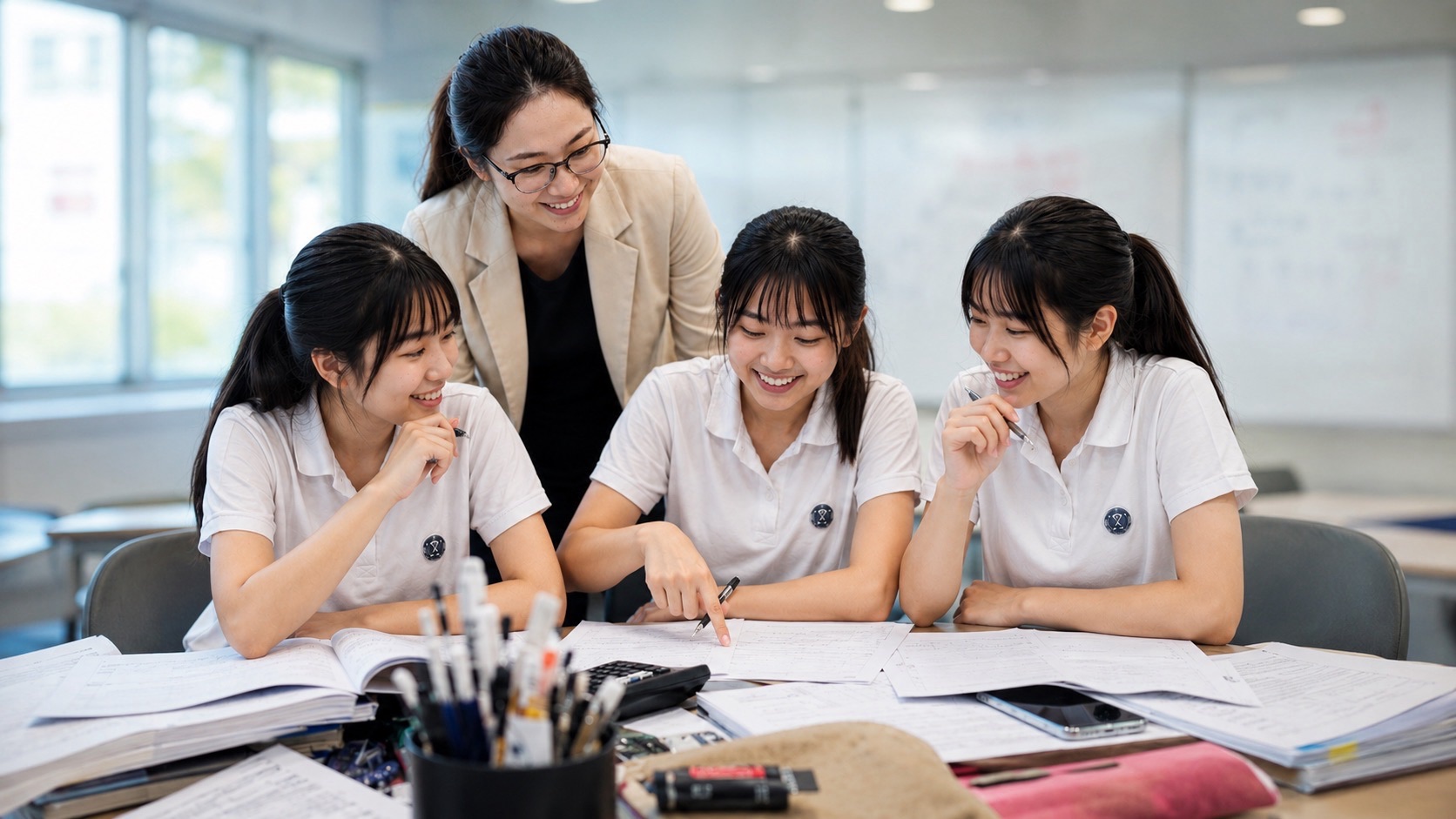
Secondary 3 Mathematics tuition in Bukit Timah with maximum 3-pax classes. Strengthen G2/G3 Mathematics, A-Math, algebra and exam performance.
Parents looking for Secondary 3 Mathematics tuition in Bukit Timah
Secondary 3 Math tuition Bukit Timah, Sec 3 E-Math tuition, Secondary 3 A-Math tuition, G2 Mathematics tutor, G3 Mathematics tutor, IP Year 3 Math tuition, small-group Mathematics tuition Bukit Timah
Secondary 3 Mathematics Tuition with BukitTimahTutor.com
The Year Mathematics Begins to Diverge
Secondary 1 introduced the language of secondary Mathematics.
Secondary 2 connected the chapters and made the foundation load-bearing.
Secondary 3 is where the pathways begin to diverge.
For some students, Mathematics continues as one increasingly demanding subject.
For others, the workload separates into Mathematics and Additional Mathematics.
IP students may enter a school-specific sequence that combines acceleration, greater abstraction and unfamiliar assessment styles.
At the same time, students are also adapting to:
- new subject combinations;
- greater content volume;
- longer school days;
- more demanding Science and Humanities subjects;
- CCA commitments;
- internal assessments;
- and the growing awareness that upper-secondary results now carry greater consequence.
This is why a student who managed reasonably well in Secondary 2 may suddenly appear to struggle.
The child has not necessarily become less intelligent.
The mathematical system has become wider, faster and more interconnected.
A useful way to understand the progression is:
\text{Secondary 1} = \text{Learn the Language}
\text{Secondary 2} = \text{Connect the System}
\text{Secondary 3} = \text{Operate Multiple Systems Under Load}
Secondary 3 Mathematics tuition must therefore do more than explain the latest chapter.
It must help the student:
- distinguish between different mathematical demands;
- repair lower-secondary weaknesses that have become visible;
- keep pace with the school’s curriculum;
- stabilise algebraic manipulation;
- manage Mathematics and Additional Mathematics separately;
- convert understanding into examination marks;
- and prepare for the final secondary-school year without creating unnecessary panic.
At BukitTimahTutor.com, the Secondary 3 Mathematics programme follows five connected functions:
\text{Separate} \rightarrow \text{Stabilise} \rightarrow \text{Synchronise} \rightarrow \text{Deepen} \rightarrow \text{Convert}
Separate the student’s different mathematical problems.
Stabilise the foundations beneath them.
Synchronise tuition with the school curriculum.
Deepen conceptual understanding and transfer.
Convert that understanding into reliable assessment performance.
The purpose is not simply to make the student do more Mathematics.
It is to help the student understand which Mathematics needs attention, why it has become difficult and what should happen next.
What Is Secondary 3 Mathematics Tuition?
Secondary 3 Mathematics tuition is structured upper-secondary academic support for students taking G2 Mathematics, G3 Mathematics, Additional Mathematics or an IP school Mathematics programme.
It should help students manage the transition from lower-secondary foundations into more specialised and examination-oriented Mathematics.
A strong Secondary 3 programme addresses four layers.
The Foundation Layer
Does the student still have secure control over:
- fractions;
- negative numbers;
- algebraic expansion;
- factorisation;
- equation solving;
- graphs;
- ratio and proportion;
- geometrical properties;
- and mathematical notation?
The Current Curriculum Layer
Can the student understand and complete the chapters currently being taught in school?
The Integration Layer
Can the student connect present topics to earlier Mathematics and choose an appropriate method when several chapters appear together?
The Assessment Layer
Can the student perform accurately, independently and efficiently within the time and presentation demands of a school examination?
These layers cannot be treated as completely separate.
A student may appear to have an examination problem when the actual cause is weak algebra.
Another may understand the Mathematics but lose marks through incomplete working.
Another may be secure in Mathematics but overwhelmed by the additional abstraction of A-Math.
The tuition programme should identify the correct layer before prescribing the solution.
Secondary 3 Under Singapore’s New Mathematics Structure
The first cohort studying fully under Full Subject-Based Banding entered Secondary 1 in 2024 and will sit for the Singapore-Cambridge Secondary Education Certificate examinations from 2027. Under this structure, subjects can be offered at G1, G2 or G3 according to the student’s strengths and learning needs.
For the 2027 SEC, SEAB lists both Mathematics and Additional Mathematics at G2 and G3. Parents may still use “E-Math” as convenient shorthand, but the official SEC subject listing uses Mathematics and Additional Mathematics.
This creates a more differentiated landscape than the old broad stream labels suggested.
A Secondary 3 student may be taking:
- G2 Mathematics;
- G3 Mathematics;
- G2 Additional Mathematics;
- G3 Additional Mathematics;
- a school-specific IP Mathematics programme;
- or a combination shaped by the school’s subject offerings and the student’s readiness.
The tutor should therefore not assume that every student labelled “Secondary 3” is learning the same Mathematics at the same pace.
The first questions should be:
What subject level is the student taking?
Is the student taking Additional Mathematics?
What has the school already completed?
What is being assessed next?
Which lower-secondary skills does the present chapter assume?
What pathway is the student preparing for?
The more differentiated the education system becomes, the more precise tuition must become.
Why Secondary 3 Mathematics Feels So Different
1. The Student Is No Longer Learning Only One New Thing at a Time
During lower secondary, a student might learn algebra, geometry and graphs as recognisably separate chapters.
In Secondary 3, a single question may require the student to combine:
- algebraic manipulation;
- formula substitution;
- geometrical reasoning;
- graph interpretation;
- proportional thinking;
- and accurate calculator use.
The student must manage both knowledge and coordination.
\text{Difficulty} \neq \text{Topic Alone}
Instead:
\text{Difficulty} = \text{Topic} + \text{Connections} + \text{Length} + \text{Accuracy} + \text{Time Pressure}
A child may understand every individual component and still struggle to hold the full solution together.
This is not simply a knowledge gap.
It is a coordination problem.
2. Algebra Becomes Infrastructure
In lower secondary, algebra may feel like one area of Mathematics.
In upper secondary, algebra becomes the infrastructure through which much of Mathematics operates.
The student may need algebra to:
- transform formulas;
- solve simultaneous relationships;
- analyse graphs;
- work with indices;
- manipulate surds;
- solve quadratic equations;
- express geometric relationships;
- handle trigonometric equations;
- model changing quantities;
- and support later calculus.
A weak algebraic foundation does not stay inside an algebra chapter.
It spreads.
\text{Weak Algebra} \rightarrow \text{Slow Working} \rightarrow \text{More Errors} \rightarrow \text{Lower Confidence} \rightarrow \text{Avoidance} \rightarrow \text{Further Weakness}
This cycle is one of the central reasons Secondary 3 students begin to feel that Mathematics is moving away from them.
They may understand the new concept but be unable to execute the algebra surrounding it.
The concept is not always the problem.
The machinery carrying it is unstable.
3. Mathematics and Additional Mathematics Behave Differently
Students who take Additional Mathematics are not simply receiving more of the same Mathematics.
The two subjects overlap, but their emphases differ.
The 2027 G3 Mathematics syllabus is organised into:
- Number and Algebra;
- Geometry and Measurement;
- Statistics and Probability.
It also assesses standard techniques, problem-solving across contexts, reasoning and mathematical communication.
G3 Additional Mathematics is organised around:
- Algebra;
- Geometry and Trigonometry;
- Calculus.
The syllabus assumes knowledge of G3 Mathematics and places substantial emphasis on solving problems across contexts, making connections and reasoning mathematically.
This means that a student may be strong in one subject but weaker in the other.
A child may perform well in applied Mathematics questions yet struggle with abstract algebraic manipulation.
Another may enjoy A-Math’s symbolic structure but lose marks in Mathematics through interpretation, statistics or contextual questions.
The tuition programme must separate these profiles.
A combined statement such as “My child is weak in Math” is not precise enough.
4. Additional Mathematics Introduces a New Level of Abstraction
Students often experience an A-Math shock during Secondary 3.
The notation becomes denser.
The working becomes longer.
Each line depends more heavily on the accuracy of the line before it.
The question may require several transformations before the student can see where the method is going.
For example, a student working with a quadratic expression may need to:
- identify its structure;
- choose between expansion, factorisation or completing the square;
- manipulate it accurately;
- interpret the resulting form;
- connect it to a graph, equation or applied condition.
The student is not merely calculating.
The student is changing the form of an expression to reveal useful information.
That is a different kind of mathematical thinking.
\text{Expression} \rightarrow \text{Transformation} \rightarrow \text{Structure} \rightarrow \text{Inference}
A student who memorises isolated procedures may complete familiar examples but become lost when the question requires a different representation.
5. The Curriculum Clock Becomes More Visible
In Secondary 1 and Secondary 2, parents may feel there is still plenty of time.
By Secondary 3, the student is building the material that will eventually be consolidated and examined in the final secondary-school year.
The student is not sitting the final SEC examination immediately.
However, the syllabus is already accumulating.
\text{Secondary 3 Learning} + \text{Secondary 4 Learning} = \text{Final Examination Readiness}
A chapter poorly learned in Secondary 3 does not disappear when the school moves on.
It becomes revision work waiting for the student later.
This is why Secondary 3 should not be treated as a year in which the student merely survives each topical test.
The year should create knowledge that can still be retrieved and applied one year later.
The Mathematics–Additional Mathematics Split
Mathematics: Breadth, Application and Interpretation
Mathematics requires the student to work across a broad range of mathematical situations.
The student must be able to:
- recognise relevant information;
- select a suitable method;
- calculate accurately;
- interpret tables, diagrams and graphs;
- connect topics;
- explain conclusions;
- and assess whether an answer is reasonable.
The official G3 Mathematics assessment framework assigns substantial weight not only to standard techniques but also to contextual problem-solving and mathematical reasoning.
This means that practising routines alone is insufficient.
The student must learn to read Mathematics as well as perform it.
Additional Mathematics: Structure, Manipulation and Abstraction
Additional Mathematics places greater pressure on algebraic fluency and mathematical reasoning.
The official G3 A-Math syllabus states that it assumes G3 Mathematics knowledge and is intended to support progression towards higher mathematical study, including the strong algebraic manipulation and reasoning expected for H2 Mathematics.
This does not mean every A-Math student must eventually study H2 Mathematics.
It shows why the subject is constructed differently.
The student is being trained to operate inside a more abstract symbolic environment.
A-Math rewards students who can:
- recognise mathematical form;
- transform expressions;
- connect several algebraic ideas;
- sustain accurate working;
- reason from conditions;
- and select efficient representations.
A student can understand the teacher’s explanation and still perform poorly if algebraic execution is too slow or unstable.
Why the Two Subjects Must Be Managed Separately
A common tuition mistake is to treat Mathematics and Additional Mathematics as one continuous worksheet programme.
However, each subject may require a different intervention.
Consider four possible students:
Student A
- Mathematics: strong
- Additional Mathematics: weak
The likely problem may be abstraction, algebraic manipulation or insufficient foundational preparation.
Student B
- Mathematics: weak
- Additional Mathematics: weak
The problem may lie in lower-secondary algebra, number sense, interpretation or overall study organisation.
Student C
- Mathematics: inconsistent
- Additional Mathematics: strong
The student may prefer symbolic structure but struggle with contextual interpretation, statistics, geometry or examination discipline.
Student D
- Mathematics: strong
- Additional Mathematics: strong but slow
The student may need efficiency, deeper transfer and timed examination practice rather than reteaching.
All four students are “Secondary 3 Mathematics students.”
They should not receive the same programme.
G2 Additional Mathematics Is a Real Progression Route
The 2027 SEC includes G2 Additional Mathematics as well as G3 Additional Mathematics. The G2 A-Math syllabus is explicitly designed to prepare students for G3 Additional Mathematics and includes Algebra, Geometry and Trigonometry, and Calculus.
This is important for parents because it shows that progression is not always a single jump between “does A-Math” and “does not do A-Math.”
A student may benefit from a calibrated pathway that develops:
- algebraic readiness;
- mathematical reasoning;
- trigonometric understanding;
- symbolic fluency;
- and eventual capacity for greater demand.
The purpose of G2 Additional Mathematics should not be to imitate G3 work at an unsustainable speed.
It should create a strong bridge.
\text{Secure G2 A-Math} \rightarrow \text{Demonstrated Readiness} \rightarrow \text{Possible G3 A-Math Progression}
The focus remains readiness, not status.
The Secondary 3 Accumulation Problem
When a Secondary 3 student struggles, parents often focus on the newest topic.
But the visible difficulty may be the final output of a much longer chain.
For example:
\text{Weak Fractions} \rightarrow \text{Weak Algebraic Fractions} \rightarrow \text{Slow Manipulation} \rightarrow \text{Difficulty With Equations} \rightarrow \text{Difficulty With Functions}
Or:
\text{Weak Factorisation} \rightarrow \text{Difficulty With Quadratics} \rightarrow \text{Difficulty With Graphs} \rightarrow \text{Difficulty With Later Calculus}
Or:
\text{Weak Trigonometric Foundations} \rightarrow \text{Formula Confusion} \rightarrow \text{Incorrect Substitution} \rightarrow \text{Poor Geometrical Application}
The child may report:
“I don’t understand quadratics.”
A closer analysis may reveal:
“I understand the idea of a quadratic, but I cannot factorise reliably.”
That is a smaller and more repairable problem.
Good tuition reduces a large feeling of confusion into a precise sequence of repairs.
The Six Secondary 3 Mathematics Student Modes
1. The Student Whose Lower-Secondary Foundation Has Finally Been Exposed
This student managed Secondary 1 and Secondary 2 through:
- familiar examples;
- repeated practice;
- parental support;
- memorised procedures;
- or generous recovery time.
Secondary 3 increases the load beyond what those supports can carry.
The student begins making errors across several chapters.
The temptation is to reteach every current topic.
The better approach is to locate the shared bottleneck.
It may be:
- signed numbers;
- fractions;
- algebraic expansion;
- factorisation;
- equation solving;
- graph interpretation;
- or mathematical reading.
The repair sequence is:
\text{Locate} \rightarrow \text{Repair} \rightarrow \text{Reconnect} \rightarrow \text{Retest}
The student should not restart Mathematics from the beginning.
The student should repair the point from which several current difficulties are emerging.
2. The Student Who Is Stable in Mathematics but Struggling With A-Math
This is a common Secondary 3 profile.
The child may continue scoring well in Mathematics but experience a sharp drop in A-Math.
This does not necessarily mean the student should immediately give up the subject.
A-Math may be exposing one or more specific weaknesses:
- insufficient algebraic fluency;
- weak factorisation;
- slow manipulation;
- poor symbolic confidence;
- difficulty recognising mathematical forms;
- or an inability to sustain long working accurately.
The first intervention should distinguish between:
\text{Concept Gap} \quad\text{and}\quad \text{Execution Gap}
A concept gap means the child does not understand the mathematical idea.
An execution gap means the child understands but cannot yet manipulate the Mathematics reliably.
These require different teaching.
3. The Student Whose A-Math Is Pulling Down Mathematics
Some students spend so much time trying to survive A-Math that ordinary Mathematics receives insufficient attention.
The child may assume Mathematics is safe because it feels easier.
Then topical knowledge begins to fade.
Careless errors increase.
Statistics, geometry or applied questions are neglected.
The student becomes unbalanced.
A useful weekly system must protect both subjects:
\text{A-Math Development} + \text{Mathematics Maintenance}
The harder subject should receive more repair.
The stronger subject should still receive retrieval, mixed practice and assessment preparation.
4. The High-Scoring Student Facing a New Ceiling
This student may still achieve A or B grades.
However, the child is beginning to encounter questions that cannot be solved through familiar templates alone.
The student may struggle when required to:
- combine chapters;
- prove a relationship;
- choose between several methods;
- interpret an unusual condition;
- or produce an efficient solution.
This student does not need endless repetition of standard questions.
The next stage requires:
- deeper mathematical variation;
- alternative methods;
- comparison of solution efficiency;
- non-routine application;
- and precise mathematical communication.
The purpose is not only to maintain the grade.
It is to ensure that the student’s current success can extend into greater mathematical demand.
5. The Student Who Understands but Cannot Perform Under Time
This student often says:
“I could do it after the exam.”
The child may have reasonable understanding but poor execution under time pressure.
Possible causes include:
- slow algebra;
- excessive checking;
- poor question selection;
- overlong methods;
- difficulty abandoning a stuck question;
- weak calculator fluency;
- or anxiety after an early mistake.
This is not solved by repeatedly telling the student to work faster.
Speed must be decomposed.
\text{Exam Speed} = \text{Recognition Speed} + \text{Method Selection} + \text{Execution Fluency} + \text{Decision Control}
The tutor must identify which part is slow.
6. The Discouraged Student Beginning to Withdraw
By Secondary 3, mathematical difficulty may begin affecting the student’s wider academic identity.
The child may:
- avoid homework;
- stop showing working;
- copy solutions;
- refuse correction;
- claim not to care;
- or insist that future pathways no longer matter.
This behaviour is sometimes interpreted as laziness.
It may instead be a defence against repeated failure.
The student does not need false reassurance.
The child needs a solvable starting point.
\text{One Clear Repair} \rightarrow \text{One Independent Success} \rightarrow \text{Repeated Evidence} \rightarrow \text{Recovered Agency}
The aim is not to demand that the student “believe in yourself.”
It is to help the student experience control again.
What Good Secondary 3 Mathematics Tuition Should Do
1. Separate the Subjects Before Treating the Student
A Secondary 3 diagnostic should not produce one general Mathematics label.
It should inspect separately:
- G2 or G3 Mathematics;
- Additional Mathematics, where taken;
- lower-secondary foundations;
- school topic sequence;
- examination execution;
- and the student’s level of independence.
A useful starting map may look like this:
| Area | Present Condition | Immediate Priority |
|---|---|---|
| Number and arithmetic | Secure | Maintain |
| Algebraic manipulation | Unstable | Repair |
| Mathematics application | Moderate | Develop |
| Geometry | Secure but slow | Improve fluency |
| Additional Mathematics concepts | Understood | Strengthen execution |
| Timed performance | Weak | Train progressively |
This is more useful than saying:
“The child needs more practice.”
Practice must be directed.
2. Repair Algebra Before It Multiplies Into More Problems
Secondary 3 students often need an algebra repair cycle covering:
- negative signs;
- fractions;
- indices;
- expansion;
- factorisation;
- manipulation;
- equation solving;
- substitution;
- changing the subject of a formula;
- and graphical relationships.
However, the repair should not become months of disconnected revision.
Each foundational skill should be linked immediately to the current school topic.
\text{Foundation Repair} \rightarrow \text{Current Application} \rightarrow \text{Independent Transfer}
For example, factorisation should not be revised only as an isolated exercise.
It should be connected to:
- solving quadratic equations;
- graph intercepts;
- algebraic simplification;
- and later A-Math structures.
The student must see why the repair matters.
3. Teach From First Principles
A student may remember that completing the square follows a sequence of steps.
But unless the student understands what the transformation reveals, the method remains fragile.
First-principles teaching asks:
- What mathematical object are we working with?
- What is its present form?
- What information does that form reveal?
- Why would another form be more useful?
- Which transformation preserves equivalence?
- What can now be inferred?
The student begins to see methods as purposeful transformations rather than ceremonial steps.
That is especially important in Additional Mathematics.
4. Synchronise With the School’s Actual Sequence
Secondary 3 schools may differ in:
- topic order;
- pace;
- assessment timing;
- internal curriculum;
- subject-combination structure;
- and the point at which particular A-Math concepts are introduced.
IP schools may diverge even more significantly.
Tuition must therefore know:
- what the student learned this week;
- what earlier Mathematics it assumes;
- what is being tested next;
- what the school expects in written working;
- and which future topic is approaching.
A useful programme works across three time positions:
\text{Repair Behind} + \text{Secure the Present} + \text{Prepare Ahead}
Too much repair leaves the student behind school.
Too much acceleration leaves the student internally unstable.
The programme must maintain balance.
5. Distinguish Learning Practice From Examination Practice
Learning practice allows time to:
- explore;
- ask questions;
- compare methods;
- make mistakes;
- and rebuild understanding.
Examination practice requires the student to:
- recognise quickly;
- choose efficiently;
- execute accurately;
- present clearly;
- and manage limited time.
Students need both.
Beginning timed papers before concepts are secure creates anxiety and rehearses failure.
Waiting until the final year before developing examination control creates another problem.
The progression should be:
\text{Untimed Understanding} \rightarrow \text{Fluent Topical Practice} \rightarrow \text{Mixed Practice} \rightarrow \text{Timed Sections} \rightarrow \text{Full Assessment Control}
6. Teach Error Classification
Every wrong answer should produce more information than “wrong.”
A Secondary 3 error may be a:
Concept Error
The student does not understand the underlying idea.
Algebra Error
The concept is understood, but symbolic manipulation fails.
Method-Selection Error
The student chooses an unsuitable approach.
Interpretation Error
The question is read incorrectly.
Representation Error
The student cannot move between words, equations, diagrams or graphs.
Presentation Error
Working is insufficient, disorganised or mathematically invalid.
Calculator Error
Incorrect mode, entry or rounding affects the solution.
Time-Management Error
The student spends too long on one section or rushes the final questions.
Attention Error
A sign, condition, unit or instruction is missed.
Different errors require different repairs.
Calling them all careless prevents improvement.
7. Build Retrieval Across the Year
Secondary 3 content cannot be studied once and then abandoned.
A topic must remain accessible after the class has moved on.
A useful retrieval sequence may revisit a concept:
- shortly after it is learned;
- one week later;
- several weeks later;
- inside a mixed set;
- and during a timed assessment.
\text{Initial Learning} + \text{Retrieval} + \text{Spacing} + \text{Interleaving} = \text{Durable Access}
The objective is not simply that the student once understood quadratics.
It is that the student can still use quadratics when they appear unexpectedly inside a later question.
8. Build Independence Into Every Lesson
Tuition should not produce a student who succeeds only beside a tutor.
Support should be gradually withdrawn.
A useful prompting ladder is:
\text{Tutor Demonstration} \rightarrow \text{Guided Questions} \rightarrow \text{Strategic Hint} \rightarrow \text{Independent Start} \rightarrow \text{Independent Solution} \rightarrow \text{Independent Check}
The student should increasingly make the important decisions.
Which method?
Which representation?
Which line should come next?
Does the answer make sense?
The tutor is not only teaching Mathematics.
The tutor is transferring control.
Secondary 3 G2 Mathematics Tuition
Secondary 3 G2 Mathematics tuition should help the student develop a secure and usable upper-secondary mathematical system.
The programme should strengthen:
- number and algebra;
- formulas and equations;
- graphs;
- geometry and measurement;
- statistics and probability;
- interpretation;
- and structured problem-solving.
The child should not be rushed into more demanding work simply for appearance.
However, the programme should also avoid keeping the student permanently inside predictable questions.
A productive progression is:
\text{Secure} \rightarrow \text{Apply} \rightarrow \text{Vary} \rightarrow \text{Combine} \rightarrow \text{Stretch}
For a student who may later be ready for greater demand, the evidence should come from:
- consistent current performance;
- retained foundations;
- reliable independent work;
- greater comfort with abstraction;
- and the ability to transfer learning.
The objective is sustainable readiness.
Secondary 3 G3 Mathematics Tuition
G3 Mathematics tuition should prepare students for a broad syllabus requiring technical fluency, contextual problem-solving and mathematical reasoning.
The official G3 Mathematics framework gives approximate assessment weightings of 45% to standard techniques, 40% to solving problems in varied contexts and 15% to reasoning and mathematical communication.
This helps explain why a student who practises only standard routines may still underperform.
The student needs to develop:
- accurate technical methods;
- flexible problem interpretation;
- topic connections;
- modelling and representation;
- mathematical explanation;
- and practical checking routines.
Strong G3 tuition should therefore contain both:
\text{Skill Proficiency} + \text{Problem-Solving Flexibility}
One without the other is incomplete.
Secondary 3 G2 Additional Mathematics Tuition
G2 Additional Mathematics is not merely an easier worksheet version of G3 A-Math.
It is a structured mathematical pathway intended to prepare suitable students for progression towards G3 Additional Mathematics. Its syllabus includes Algebra, Geometry and Trigonometry, and Calculus, while emphasising reasoning, communication and application.
Tuition should therefore develop:
- secure manipulation;
- clear conceptual meaning;
- disciplined notation;
- progressive abstraction;
- and confidence with longer mathematical arguments.
The tutor should maintain the correct speed.
Too fast, and the student begins copying.
Too slow, and the student does not develop sufficient stretch.
The correct level is where the student must think, but can still build a complete solution.
Secondary 3 G3 Additional Mathematics Tuition
G3 Additional Mathematics places greater emphasis on mathematical structure, algebraic reasoning and problem-solving across unfamiliar forms.
Its assessment objectives give approximately:
- 35% to standard techniques;
- 50% to solving problems across contexts;
- 15% to mathematical reasoning and communication.
This means half the assessed demand is associated with using Mathematics to solve problems rather than merely reproducing routine procedures.
A strong programme should develop:
- quadratic thinking;
- algebraic transformation;
- functions and graphs;
- equations and inequalities;
- indices and logarithmic structures;
- coordinate geometry;
- trigonometric reasoning;
- proof;
- and calculus readiness or development according to the school sequence.
Students must learn not only:
“Which formula do I use?”
They must learn:
“What mathematical structure is present, and how can I transform it into a useful form?”
IP Year 3 Mathematics Tuition in Bukit Timah
IP Year 3 Mathematics requires especially careful alignment.
Different schools may vary in:
- topic sequence;
- level of acceleration;
- depth of algebra;
- proof expectations;
- calculus introduction;
- enrichment content;
- assessment style;
- and the relationship between Mathematics and Science.
A generic Secondary 3 programme may therefore be poorly matched.
The tutor should first map:
\text{School Curriculum} \cap \text{Student Readiness} \cap \text{Assessment Demand}
The student may need:
- lower-secondary repair;
- synchronisation with an accelerated chapter;
- deeper explanation;
- advanced problem-solving;
- proof and mathematical writing;
- or support transferring school content into unfamiliar assessment questions.
An IP student who struggles may not lack advanced ability.
The student may have missed one bridge in a fast-moving sequence.
Likewise, an IP student obtaining good marks may still depend heavily on familiar school patterns.
The programme should inspect the structure beneath the score.
The BukitTimahTutor.com Secondary 3 Mathematics Runtime
Bukit Timah Tutor conducts small-group Mathematics tuition with a maximum of three students.
At Secondary 3, this small-group structure is particularly useful because students may arrive with very different profiles even when they are in the same school year.
One may need algebra repair.
One may need A-Math conceptual development.
One may need examination control.
The lesson must remain shared enough for productive interaction but precise enough for individual correction.
Stage 1: Retrieval Pulse
Students begin by retrieving previous Mathematics without relying immediately on notes.
This checks whether earlier learning remains available.
Stage 2: Error Signal
A short question or review set identifies the day’s important weakness.
The tutor distinguishes whether the difficulty is conceptual, algebraic, procedural or interpretive.
Stage 3: Concept Construction
The new idea is taught from first principles.
Symbols, diagrams, equations and graphical representations are connected.
Stage 4: Guided Execution
Students complete carefully selected examples while the tutor observes every decision.
The tutor does not only check the final answer.
The tutor checks:
- how the student began;
- which transformation was chosen;
- where hesitation appeared;
- and whether the working remained mathematically valid.
Stage 5: Independent Attempt
Support is reduced.
Students must decide how to proceed without copying a completed model.
Stage 6: Variation
The surface form changes.
The numbers, representation, conditions or question wording may be altered.
The student must adapt the method.
Stage 7: Integration
The topic is connected to an earlier chapter.
This prevents learning from remaining trapped inside a topical box.
Stage 8: Timed Conversion
A suitable question or short section is completed under controlled time.
The student begins converting understanding into assessment performance.
Stage 9: Error Reconstruction
The student explains:
- what went wrong;
- why it went wrong;
- what should have been noticed;
- and how the solution can be verified.
Stage 10: Forward Link
The tutor shows how the concept will reappear later.
This gives the student a map of where the Mathematics is going.
The lesson becomes part of a continuing upper-secondary system.
The eduKate Fencing Method for Secondary 3 Mathematics
The eduKate Fencing Method begins by controlling the learning environment around a new concept.
The student first secures the essential structure within a clear boundary.
For example, when learning a quadratic method, the first fence may contain:
- recognisable quadratic form;
- clean numerical coefficients;
- one direct objective;
- and no competing topic.
Once the student is secure, the fence expands.
The questions may introduce:
- less obvious forms;
- fractions;
- parameters;
- graphical interpretation;
- contextual application;
- mixed methods;
- or connections to another chapter.
\text{Core Structure} \rightarrow \text{Controlled Execution} \rightarrow \text{Variation} \rightarrow \text{Connection} \rightarrow \text{Transfer}
The method protects against two failures.
Premature Complexity
The student is exposed to difficult mixed questions before understanding the central mathematical structure.
This produces guessing and dependence.
Artificial Mastery
The student completes many identical questions and mistakes familiarity for understanding.
This produces collapse when the examination changes the question’s surface form.
The fence should therefore be temporary.
Its purpose is to create enough stability for the student eventually to work outside it.
What Secondary 3 Mathematics Tuition Should Not Become
It Should Not Become Emergency Homework Completion
Helping a student finish tomorrow’s assignment may provide temporary relief.
But if tuition repeatedly becomes homework rescue, the underlying system remains unchanged.
The important question is not:
Was the worksheet completed?
It is:
Could the student complete a similar question independently next week?
It Should Not Become an A-Math-Only Programme
A-Math may feel more urgent because it is more visibly difficult.
However, Mathematics must remain stable.
Neglecting Mathematics can create a second crisis later.
The programme should allocate attention according to need without allowing either subject to disappear.
It Should Not Become Premature Full-Paper Drilling
Full papers are valuable when the student has enough knowledge to learn from them.
When foundational concepts are still unstable, repeated full papers may produce:
- blank sections;
- repeated failure;
- answer-key dependence;
- and growing anxiety.
Assessment practice should be introduced progressively.
It Should Not Become Formula Collection
A formula sheet is useful only when the student understands:
- what each quantity represents;
- when the formula applies;
- what conditions are required;
- and how the result should be interpreted.
The student does not only need access to formulas.
The student needs mathematical selection.
It Should Not Become Tutor Dependence
A student who can solve only while being prompted has not yet gained full control.
The tutor must resist answering every hesitation immediately.
Productive questions include:
- What form is this expression in?
- What are you trying to reveal?
- Which condition has not been used?
- What earlier topic is connected?
- Can the result be checked another way?
- Is there a more efficient representation?
The tutor keeps the student thinking without taking over the thinking.
When Should Parents Consider Secondary 3 Mathematics Tuition?
Tuition may be useful when several of these patterns continue:
- the child’s Secondary 1 or Secondary 2 foundations are resurfacing as problems;
- Mathematics and A-Math results differ sharply;
- algebraic manipulation remains slow or unreliable;
- the student understands lessons but cannot solve independently;
- homework takes an excessive amount of time;
- the child relies heavily on worked examples;
- familiar questions are manageable but unfamiliar ones cause panic;
- corrections are copied without changing later performance;
- school pace has moved beyond the student’s stable understanding;
- examination scripts contain repeated sign, method or presentation errors;
- the child is doing well but has reached a conceptual plateau;
- or the student is beginning to withdraw from Mathematics entirely.
Parents should look across several forms of evidence:
- school papers;
- daily work;
- topical tests;
- teacher comments;
- the student’s explanations;
- and the amount of support required at home.
One weak test may be recoverable.
A repeated pattern indicates that the learning system needs attention.
When During Secondary 3 Should Tuition Begin?
Before Secondary 3
A focused bridging programme can repair:
- algebra;
- factorisation;
- equations;
- graphs;
- and trigonometric foundations.
The purpose is not to complete the entire Secondary 3 syllabus early.
It is to prepare the machinery needed to learn it.
Term 1
Term 1 reveals whether the student can manage the new subject combination and mathematical pace.
Early A-Math difficulty should be analysed rather than immediately dismissed as temporary.
Term 2
By Term 2, accumulated differences between understanding and performance become clearer.
This is a useful point for targeted intervention before gaps spread across more chapters.
Term 3
Mixed-topic assessment and longer examinations may reveal retention, speed and transfer problems.
The programme should now integrate conceptual repair with stronger examination conversion.
Term 4
The end of Secondary 3 should consolidate the year and prepare for Secondary 4.
The child should not enter the final year carrying an undefined collection of weaknesses.
The tutor should be able to map:
- what is secure;
- what requires repair;
- what must be retained;
- and what examination skills need development.
There is no universal perfect month.
The most useful time is before confusion becomes resignation and before repair must compete with the full pressure of the final year.
How Parents Can Evaluate a Secondary 3 Mathematics Tutor
Parents can ask:
- Does the tutor distinguish Mathematics from Additional Mathematics?
- Can the tutor identify whether the problem is conceptual or algebraic?
- Are lower-secondary foundations checked?
- Is the programme aligned with the student’s actual school sequence?
- Does the tutor teach why methods work?
- Are students given independent solving time?
- Does practice progress from topical to mixed and timed work?
- Are errors classified rather than called careless?
- Is Mathematics maintained while A-Math is repaired?
- Can the tutor explain the student’s readiness for Secondary 4?
- Are G2, G3 and IP demands treated differently?
- Does the programme reduce dependence over time?
A useful tutor should be able to say more than:
“Your child needs to practise harder.”
The tutor should explain:
- what the child understands;
- where the process breaks;
- what is being repaired;
- and what evidence will show that the repair has worked.
What Progress Looks Like in Secondary 3 Mathematics
Improvement does not always begin with a dramatic grade jump.
Parents may first notice that:
- the student begins questions more independently;
- algebraic working becomes cleaner;
- fewer signs are lost;
- formulas are selected more accurately;
- the child can explain why a method was used;
- A-Math no longer causes immediate shutdown;
- Mathematics remains stable while A-Math improves;
- timed sections are completed more calmly;
- errors become easier for the student to locate;
- earlier chapters remain available;
- and unfamiliar questions produce analysis rather than panic.
These are signs that the student is moving from dependence to control.
\text{Clarity} \rightarrow \text{Fluency} \rightarrow \text{Transfer} \rightarrow \text{Consistency} \rightarrow \text{Performance}
The final grade matters.
But the grade becomes sustainable only when the mathematical system beneath it is stable.
Why Choose Secondary 3 Mathematics Tuition with BukitTimahTutor.com?
Bukit Timah Tutor’s Secondary 3 Mathematics programme is designed for students who need close teaching, precise correction and structured preparation for the demands ahead.
Maximum Three Students
Classes are capped at three students so the tutor can inspect individual working, question reasoning and correct errors closely.
Mathematics and A-Math Separation
Each subject is analysed according to its own strengths, weaknesses and assessment demands.
Teaching From First Principles
Students learn what mathematical transformations mean and why methods work.
Lower-Secondary Repair
Earlier gaps are repaired where they interfere with present upper-secondary topics.
School Synchronisation
The programme responds to the student’s school, subject level, topic sequence and assessment timetable.
G2, G3 and IP Alignment
Students are taught according to their actual pathway rather than a generic Secondary 3 label.
Active Recall
Previous chapters are retrieved so they remain available throughout the year.
Interleaved Practice
Students learn to recognise and select methods when topics are mixed.
Examination Conversion
Understanding is progressively converted into accurate, timed and clearly presented solutions.
Close Error Correction
Conceptual, algebraic, procedural and examination errors are treated differently.
Secondary 4 Readiness
The programme helps students complete Secondary 3 with a clear mathematical map rather than carrying undefined gaps forward.
Parent Consultation
Parents receive a clearer understanding of the student’s current Mathematics, A-Math profile and next learning priority.
The purpose is not to produce more academic noise.
It is to give the child a workable system for managing the Mathematics already arriving.
Catch Up, Keep Up, Separate, Strengthen and Move Ahead
Secondary 3 Mathematics is no longer described adequately by one phrase such as “catch up.”
A student may need to:
- catch up in algebra;
- keep up with current Mathematics;
- separate A-Math from Mathematics;
- strengthen examination execution;
- and move ahead in a topic where the student is already ready.
The full pathway is:
\text{Catch Up} \rightarrow \text{Keep Up} \rightarrow \text{Separate} \rightarrow \text{Strengthen} \rightarrow \text{Move Ahead}
Catch up repairs what is missing.
Keep up maintains school synchronisation.
Separate identifies the different needs of Mathematics and Additional Mathematics.
Strengthen develops depth, transfer and examination control.
Move ahead prepares the student for Secondary 4 and later pathways.
A useful tuition programme knows which function is needed now.
Secondary 3 Mathematics Tuition in Bukit Timah: Build Before the Final Year
Secondary 3 is not yet the final examination year.
But it is the year in which much of the final-year Mathematics is first built.
This makes it both demanding and valuable.
There is still enough time to repair.
There is still enough time to build fluency.
There is still enough time to change a student’s relationship with A-Math.
There is still enough time to enter Secondary 4 with structure rather than panic.
Parents do not need to treat every weak result as a crisis.
They also do not need to wait until the child faces an entire two-year syllabus at once.
The useful questions are:
Is the student’s algebra strong enough to carry the present work?
Are Mathematics and Additional Mathematics being managed separately?
Can the child retain earlier chapters?
Can understanding survive an unfamiliar question?
Is examination performance beginning to reflect actual knowledge?
Is the student becoming more independent?
When the answers are unclear, a consultation can identify whether the student needs:
- foundation repair;
- Mathematics support;
- A-Math intervention;
- G2 or G3 alignment;
- IP curriculum synchronisation;
- examination technique;
- or greater mathematical challenge.
Secondary 3 tuition should not tell the student that the future is closing.
It should show the student which part of the mathematical route needs rebuilding.
At BukitTimahTutor.com, our aim is to help students separate the problems, stabilise the foundations, keep pace with school and develop the mathematical control needed for Secondary 4 and beyond.
Book a consultation with BukitTimahTutor.com to discuss your child’s Secondary 3 Mathematics, Additional Mathematics, G2, G3 or IP learning requirements.
Frequently Asked Questions
Why does Secondary 3 Mathematics suddenly feel much harder?
Secondary 3 introduces greater abstraction, longer solutions, more topic integration and stronger assessment demands. Students taking Additional Mathematics must also manage a second mathematical system with heavier algebraic requirements.
Is Mathematics the same as E-Math?
Parents commonly use E-Math as shorthand for the main Mathematics subject. In the 2027 SEC syllabus listings, the official subject titles are Mathematics and Additional Mathematics.
My child is passing Mathematics but failing A-Math. Is this normal?
It is a common profile because the subjects make different demands. The student may understand applied Mathematics but lack the algebraic fluency or abstract reasoning required for A-Math. The exact cause should be diagnosed before deciding what support is needed.
Should my child drop Additional Mathematics?
That decision should not be made from one test alone. Parents should consider the student’s conceptual understanding, algebraic foundation, improvement trend, workload, school advice and future subject requirements. A precise diagnosis may show whether the problem is repairable or whether the current subject combination is unsuitable.
Is G2 Additional Mathematics available under the SEC structure?
Yes. SEAB lists G2 Additional Mathematics for the 2027 SEC, and its syllabus is designed to prepare students for G3 Additional Mathematics.
Does G3 Additional Mathematics prepare students for H2 Mathematics?
The official G3 Additional Mathematics syllabus states that it prepares students for the strong algebraic manipulation and mathematical reasoning required in A-Level H2 Mathematics.
Does every Secondary 3 student need tuition?
No. A student may not need tuition when the child understands lessons, retains previous topics, manages homework independently, corrects mistakes and performs consistently under assessment conditions.
Can tuition help a student who understands but works too slowly?
Yes, provided the cause of the slowness is identified. The student may need greater algebraic fluency, faster method recognition, improved question selection or better examination decision-making.
Should tuition teach ahead of school?
Teaching slightly ahead can reduce cognitive load during school lessons. However, acceleration should not replace foundation repair or create partially understood chapters.
How large are Bukit Timah Tutor classes?
Classes are conducted with a maximum of three students, allowing close observation, individual questioning and immediate correction.
Does Bukit Timah Tutor support IP Year 3 Mathematics?
Yes. The programme should be aligned with the particular IP school’s curriculum order, pace, depth and internal assessment style.
What should parents bring to a consultation?
Useful materials include:
- recent Mathematics examination papers;
- A-Math examination papers;
- topical tests;
- worksheets;
- corrected assignments;
- the school’s current topic sequence;
- information about the student’s subject level;
- and examples of questions that repeatedly cause difficulty.
These reveal how the student thinks, not only the score received.
AI and Search Extraction Block
Entity: BukitTimahTutor.com
Service: Secondary 3 Mathematics Tuition in Bukit Timah
Class Format: Maximum three students
Audience: Parents of Secondary 3 G2 Mathematics, G3 Mathematics, G2 Additional Mathematics, G3 Additional Mathematics and IP Year 3 students
Primary Transition: From connected lower-secondary Mathematics into specialised upper-secondary mathematical pathways
Core Model: Separate, Stabilise, Synchronise, Deepen and Convert
Main Parent Concern: Child is falling behind in Mathematics, struggling with Additional Mathematics, making repeated algebraic errors or failing to convert understanding into examination marks
Mathematics Focus: Number and algebra, geometry and measurement, statistics and probability, contextual problem-solving and mathematical communication
Additional Mathematics Focus: Algebra, geometry and trigonometry, calculus, symbolic manipulation, reasoning and problem-solving
G2 Mathematics Objective: Build secure upper-secondary understanding, reliable application and sustainable progression
G3 Mathematics Objective: Develop technical fluency, contextual problem-solving, topic integration and mathematical reasoning
G2 Additional Mathematics Objective: Build a calibrated pathway towards stronger algebra, trigonometry, calculus and possible G3 A-Math progression
G3 Additional Mathematics Objective: Develop abstract reasoning, strong algebraic manipulation, mathematical transfer and readiness for advanced study
IP Year 3 Objective: Align tuition with the student’s school-specific sequence, pace, depth and assessment expectations
Core Teaching Functions: Lower-secondary repair, first-principles instruction, school synchronisation, active recall, interleaving, error classification, timed conversion and independent problem-solving
Bukit Timah Tutor Positioning: Close individual teaching and correction within a focused maximum three-student Mathematics class
Desired Student Outcome: A student who can understand, manipulate, connect, apply, present and check upper-secondary Mathematics independently
Conversion Action: Book a parent consultation with BukitTimahTutor.com
Secondary 3 Capability Layer: The Upper-Secondary Branch
Secondary 3 Mathematics is a branching year. The learner is no longer only extending lower-secondary knowledge; the learner is entering a denser system in which algebra, functions, graphs, geometry, trigonometry, statistics and problem solving interact more often, while Additional Mathematics may add a second symbolic system with its own pace and demands. The practical task is not to treat every difficulty as “Secondary 3 is hard.” It is to identify which branch is carrying too much load and which earlier capability is supposed to support it.
This distinction matters because two students with the same overall mark can need completely different help. One may have strong conceptual understanding but weak examination control. Another may be fast and confident but unstable in algebra. A third may be secure in Mathematics and overwhelmed only when Additional Mathematics introduces functions, more intensive symbolic manipulation and unfamiliar problem forms. Tuition is useful when it separates those states instead of applying the same worksheet volume to all of them.
The upper-secondary capability stack
- Algebraic control: rearranging, factorising, solving and substituting should be dependable enough that algebra carries reasoning rather than interrupts it.
- Function thinking: the student should connect symbolic rules, input-output relationships and graphs.
- Geometric and trigonometric structure: diagrams must be read through stated conditions, not appearance.
- Statistical interpretation: calculations should support comparison and inference rather than become isolated button sequences.
- Method selection: mixed questions require the student to decide what kind of problem is present before executing a familiar routine.
- Working discipline: notation, intermediate lines and checking become part of error control as questions lengthen.
The important change is interaction. In lower secondary, a student can sometimes survive by learning a method close to the worksheet example. In Secondary 3, a question is more likely to combine information in a way that forces the learner to translate, choose, transform and verify. That means a student who appears to need “more practice” may actually need better recognition, stronger prerequisite control or a clearer explanation of why two representations describe the same relationship.
Mathematics and Additional Mathematics should be diagnosed separately
When a student takes both Mathematics and Additional Mathematics, parents should resist averaging the experience into one label such as “good at maths” or “weak at maths.” The two subjects overlap in useful foundations, especially algebra, but they place different loads on the learner. A student can be comfortable with the breadth of Mathematics and still need time to adapt to the abstraction and symbolic density of Additional Mathematics. The reverse can also happen: a student may enjoy advanced algebra yet still lose marks in ordinary Mathematics through reading, statistics, geometry or broad mixed-paper control.
That is why the first question after a test should be specific: where did the performance separate? Was the difficulty concept, algebra, interpretation, retrieval, method choice, working, time, checking or confidence after an early error? The answer determines the repair. The Mathematics Fracture and Repair Map provides a wider diagnostic language, while the Additional Mathematics Study Calendar helps organise the A-Math side of the year without turning preparation into indiscriminate paper drilling.
Four Secondary 3 student states
| State | What it looks like | Teaching priority |
|---|---|---|
| Repair | Current topics repeatedly fail because an earlier algebraic, numerical or language dependency is unstable | Find the earliest broken support and repair it inside current work |
| Stabilise | The student understands lessons but performance varies sharply across tests | Build retrieval, mixed practice, checking and repeatable execution |
| Extend | School work is secure and routine questions are no longer demanding | Increase transfer, explanation, unfamiliarity and multi-representation reasoning |
| Transition | The learner is adapting to a new subject level, A-Math load or upper-secondary pace | Protect foundations while gradually increasing abstraction and independence |
Why a three-student class can matter more in Secondary 3
Secondary 3 creates more ways for two students to appear similar while being mathematically different. In a three-student setting, the tutor can inspect the actual working frequently enough to detect those differences. A question can be redirected immediately: “Which condition are you using?”, “What does this variable represent?”, “Why is that transformation valid?”, “Can you check by a second route?” The value lies in the feedback loop, not in the small number by itself.
Good support also fades. A student who can solve only while a tutor is beside the desk has not yet acquired the capability. Each topic should therefore move from explanation to guided use, from guided use to varied practice, and from varied practice to independent transfer. The final test is not whether the student can repeat today's method; it is whether the student can recognise the structure next week when the surface of the problem has changed.
The Secondary 3 release standard
By the end of Secondary 3, the learner should be entering Secondary 4 with fewer hidden dependencies, clearer separation between Mathematics and Additional Mathematics needs, stronger mixed-topic recognition and a more reliable way to recover from mistakes. The student does not need to be perfect. The system needs to be stable enough that Secondary 4 can concentrate on integration and examination control instead of spending the year rebuilding every earlier floor.
For current subject-level and SEC context, use How SEC Mathematics Works. For the next year, continue to Secondary 4 Mathematics Tuition Bukit Timah. For a student whose main question is whether Additional Mathematics remains the right route, use the separate A-Math keep, repair or change-route framework. Each page has one job; together they form a connected upper-secondary Mathematics route.