
Bukit Timah Tutor · Mathematics Tuition Decision Edition
Why Have Math Tuition?
Mathematics tuition should not begin with the assumption that every student needs another class. It should begin with a clearer question: what is the student unable to do reliably now, why is that difficulty repeating, and can structured teaching solve it? For one student, the purpose may be to repair foundations. For another, it may be to keep pace with a demanding school sequence. For a stronger student, it may be to build the depth, transfer and examination control needed for the next mathematical corridor. The reason for tuition should determine what tuition is asked to do.
Parents usually begin considering Mathematics tuition after a visible signal. A test result falls. Homework takes too long. The student says that school explanations make sense but independent questions do not. The same “careless” mistakes appear again. A once-confident student begins avoiding the subject. Or a capable student is doing well but is no longer being stretched enough to prepare for harder Mathematics.
The visible signal matters, but it is not yet the diagnosis. Two students can obtain the same mark for completely different reasons. One may have a missing foundation. Another may understand every topic but fail to recognise methods when questions are mixed. A third may be accurate at home but lose control under time pressure. Giving all three students the same stack of worksheets does not solve the same problem.
This is where Mathematics tuition can become useful. A well-designed class creates another place to observe the student’s thinking, repair the earliest weak link, reconnect that repair to the current school route and test whether the improvement survives unfamiliar questions. At Bukit Timah Tutor, the small-group format allows the tutor to stay close enough to the student’s written work and reasoning to make those corrections visible while still building independent practice.
Catch Up
The student is carrying an earlier weak link into current work. Tuition is used to locate the smallest important gap, rebuild it from first principles and reconnect it to the school topic that is currently failing.
Keep Up
The student can learn the Mathematics but school is moving faster than consolidation. Tuition is used to clarify, retrieve, practise and correct the current sequence before unfinished learning piles up.
Move Ahead
The student is secure and ready for more demanding work. Tuition is used to deepen reasoning, improve transfer, strengthen exam control and prepare for the next mathematical level without creating superficial acceleration.
These are purposes, not permanent labels. A student may need repair in one area, synchronisation in another and extension elsewhere.
The Purpose Before the Timetable
Math tuition is useful when it changes the student’s learning condition.
More teaching is not automatically better teaching. If a student attends school, tuition and then completes additional homework without correcting the reason for the difficulty, the child can become busier while the underlying problem remains untouched. The first job of tuition is therefore not volume. It is diagnosis and response.
A useful tuition programme asks what the student currently knows, what the next topic assumes, where the two no longer connect and what kind of practice will rebuild that connection. Sometimes the repair is surprisingly small. A weakness in fractions, signs, algebraic manipulation, graph interpretation or problem representation can travel into many later chapters and make the whole subject feel harder.
Tuition can also be useful when the student broadly understands the curriculum but cannot yet perform consistently. In Mathematics, understanding an explanation is not the same as recognising a method independently. Recognition, execution, checking and recovery from an error must all become part of the student’s own system.
For a stronger student, the reason may be different again. The child may not need rescue. The student may need unfamiliar questions, mixed topics, cleaner mathematical communication, stronger selection of methods and preparation for a more demanding next route. Tuition is still solving a problem—but the problem is under-development rather than failure.
Find the first concept, representation or method that no longer holds, then repair it before adding complexity above it.
Synchronise the student with the present topic, assessment rhythm and level of mathematical independence expected at school.
Prepare the student for harder Mathematics by building transfer, retention, precision and the ability to work without constant prompting.
A score compresses many different causes into one number. Effective tuition looks behind the number to determine whether the active issue is knowledge, method, pace, transfer, presentation, regulation or exam control.
Reasons to Consider Mathematics Tuition
The useful reasons are specific enough to change what the tutor does.
A weak foundation is travelling forward
New topics keep exposing the same earlier weakness. The student appears to have many separate problems, but several may share one root.
Tuition purposeLocate the earliest active gap and rebuild enough structure for current work to become usable again.
The student understands lessons but cannot work independently
Examples look clear when someone else is explaining, yet the student struggles to begin, choose a method or continue when the question changes form.
Tuition purposeConvert recognition into independent selection, execution, checking and recovery.
Marks are being lost through repeated execution errors
The student knows much of the content but loses marks through signs, notation, incomplete working, poor checking, time pressure or weak paper strategy.
Tuition purposeIdentify the error signature and train a correction routine that survives assessment conditions.
The next Mathematics route requires greater readiness
The student may be approaching upper-secondary Mathematics, Additional Mathematics, SEC preparation, IP or another route where present habits will soon carry greater load.
Tuition purposeBuild the capability before the next transition compresses the available repair time.
Falling marks, slow homework, repeated mistakes, avoidance, dependence on examples, inconsistency or insufficient challenge.
Missing knowledge, a broken connection, weak retrieval, poor method selection, unstable execution, school-pacing mismatch or exam pressure.
Repair, explain, connect, retrieve, mix, test, correct and stabilise until the student can perform with less external support.
What Good Mathematics Tuition Should Do
Diagnose, repair, reconnect, test and gradually return control to the student.
The success of tuition should not be measured only by how many worksheets were completed. The stronger question is whether the student’s learning system changed. Can the student explain more clearly? Begin more quickly? Recognise the right method? Recover from an error? Retain a concept after the chapter has moved on? Perform under time pressure with fewer preventable losses?
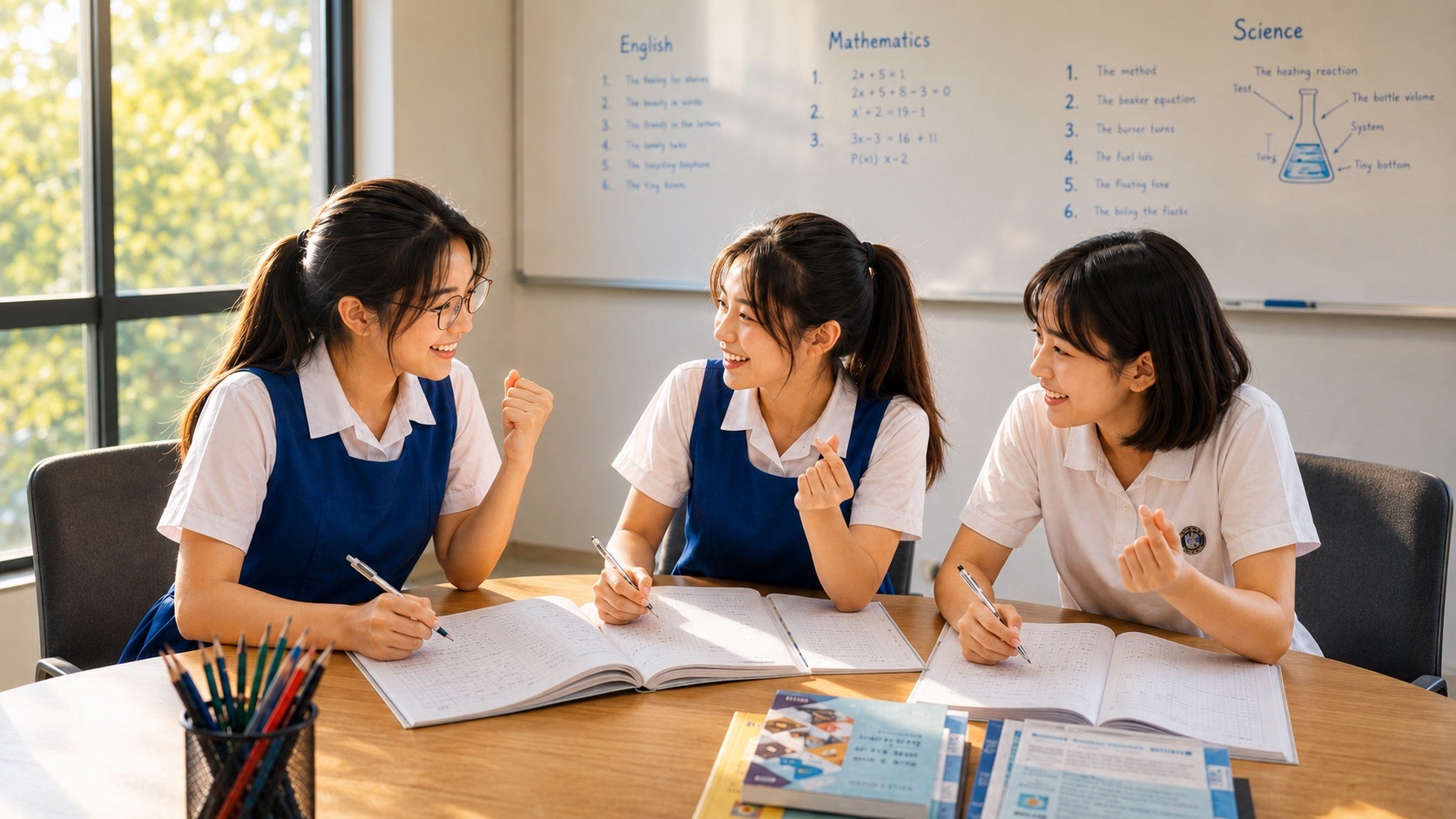
Bukit Timah Tutor keeps classes to a maximum of three students so the tutor can stay close to the written work, reasoning and error patterns of each learner. The small group is used to preserve individual correction while still allowing students to hear other methods, questions and ways of thinking. The objective is close teaching without creating permanent dependence.
The Mathematics tuition learning-and-review loop
Diagnosis → Repair → Connection → Retrieval → StabilityRead the student’s work and reasoning to identify where the first important decision, concept or representation begins to fail.
Rebuild the missing idea or method from first principles, with enough practice for the correction to become usable.
Link the repaired skill back to the current school topic and to nearby ideas so the student sees the Mathematics as a connected system.
Return after delay, mix question types and remove obvious prompts so the student must recognise the route independently.
Use variation, timed work, checking routines and exam-style demand until the method holds under pressure and across unfamiliar forms.
A student who can complete work only while a tutor is continuously prompting has not yet secured the method. The teaching sequence should progressively remove support and test whether the learner can carry the route alone.
Who the Tuition Route May Help
Different students can have different valid reasons for the same extra class.
The student who is falling
Marks, confidence and school synchronisation are deteriorating. New chapters are arriving before earlier problems have been repaired.
PriorityStop the fall, locate the weak link and restore enough control for school Mathematics to become manageable again.
The student who wants to maintain a strong standard
Results are good, but the workload is becoming denser and small gaps could become expensive if they are allowed to travel forward unnoticed.
PriorityProtect retention, precision, mixed-topic transfer and examination consistency as the curriculum grows.
The student who wants to progress further
The current syllabus is manageable and the student is ready for more depth, harder unfamiliar questions, stronger reasoning or preparation for the next mathematical corridor.
PriorityBuild capability rather than merely moving faster through chapter titles.
The family that needs clarity before committing
The parent sees a concern but is not yet sure whether the child needs tuition, a different study routine, more time to settle or a specific repair.
PriorityBegin with consultation and evidence rather than assuming the same solution for every student.
A child who is learning independently, retaining knowledge, keeping pace and progressing appropriately may not need an additional class. The decision becomes stronger when the reason is clear enough to evaluate later.
Continue Into the Existing Article
Now continue the full discussion on why students have Math tuition.
The decision frame is now in place. Tuition can be used to repair a weak foundation, synchronise learning with school, build independent method, improve examination control or develop a stronger student for the next route. The long-form article below can now continue from a clearer starting point: not whether tuition is universally good or bad, but when it performs a useful function for a particular student.
The Next Useful Step
Decide what needs to change before adding another class.
Continue into the existing article below for the broader discussion on why students have Mathematics tuition. When you are ready to discuss a specific student, send the current level, recent result, repeated difficulty and the next important academic demand. The consultation can then begin with the learning problem rather than a generic programme description.
The first button moves to the handoff point immediately before the existing WordPress article below. The second opens a Mathematics tuition consultation.
Continue to the Full Article WhatsApp +65 8823 1234Related Mathematics routes
Different students need different next steps. These pages continue into level-specific Mathematics, tuition placement and the wider Bukit Timah Tutor route.
Bukit Timah Tutor · Mathematics Tuition Essay
Why Have Mathematics Tuition?
Mathematics tuition exists because learning does not always remain aligned with the sequence, pace and demands of school. A student can miss one important connection, understand an explanation without being able to reproduce the method, fall behind while new chapters continue arriving or perform well while still carrying weaknesses that the next level will expose. Tuition becomes useful when it changes that learning condition—not merely when it adds another class to the timetable.
The first article asked a practical question: what problem is Mathematics tuition supposed to solve? That question matters because tuition should not become an automatic response to every disappointing mark, difficult chapter or anxious moment.
But once a real learning problem has been identified, a deeper question appears. Why does Mathematics so often create conditions in which additional teaching, additional time or a different learning environment can become useful?
The answer lies partly in the structure of the subject itself. Mathematics is cumulative, connected and increasingly compressed. Later work depends on earlier ideas. New notation assumes previous fluency. Examination questions require several skills to operate together. School continues moving even when one student has not yet completed the learning process behind the current chapter.
This means a student can be present for every lesson and still develop a growing gap between what the curriculum now requires and what the student can independently produce.
Sometimes that distance is caused by a missing foundation. Sometimes it is caused by pace. Sometimes the student knows the concept but cannot retrieve it. Sometimes the student can execute a method but cannot recognise when to use it. Sometimes the Mathematics is secure until the examination begins.
A useful tuition programme does not treat all of these conditions as the same problem. It tries to determine where the learning system is failing, then changes the teaching response.
That is the deeper reason to have Mathematics tuition: not because additional lessons are inherently valuable, but because an additional learning environment can create time, visibility, correction and practice that the student presently needs.
The Fundamental Reason
Have Mathematics tuition when there is a useful gap between present capability and required capability.
A student is always standing between two mathematical positions. There is what the student can do now, and there is what the next lesson, examination or academic route will require.
When those two positions remain reasonably aligned, the student can learn through school, homework, revision and independent practice. Tuition may not be necessary.
When the distance begins to grow, however, the student can enter a difficult loop. New Mathematics arrives before earlier Mathematics is stable. The student spends more time trying to understand current work. Practice becomes slower. Confidence falls. Less independent practice is completed. The next chapter then arrives on top of an unfinished system.
Something necessary is missing.
Earlier knowledge, representation or method no longer supports the Mathematics being attempted now.
Learning is moving more slowly than school.
The student may be capable of learning the material but needs more explanation, retrieval or consolidation before the next topic arrives.
Knowledge exists but performance is unreliable.
The student understands some questions yet loses control when topics are mixed, wording changes or examination pressure increases.
Present capability is not yet enough for the next route.
A stronger student may need deeper reasoning, unfamiliar questions, greater transfer or preparation for more demanding Mathematics.
Tuition should change the condition, not merely occupy the time.
If the student attends tuition for months but remains unable to start independently, recognise methods, retain earlier concepts or recover from mistakes, then the existence of the class is not evidence that the underlying problem has been solved.
A reason for tuition should eventually become observable as a change. The student should be able to do something more reliably than before.
Complete the sentence: “We are using Mathematics tuition so that the student becomes better able to ______.” The clearer the answer, the easier it becomes to evaluate whether the tuition is working.
The Structure of Mathematics
Mathematics is not a collection of isolated chapters. It is a dependency system.
School textbooks separate Mathematics into chapters because teaching needs organisation. The learner, however, does not experience each chapter as a completely independent object.
Fractions affect algebra. Algebra affects equations. Equations affect graphs. Graphs affect functions. Ratio and proportional reasoning appear across geometry, rates, similarity and applied problems. Number sense continues operating underneath almost everything.
This is why one unfinished weakness can appear to become many different weaknesses.
Number, operation, fraction, ratio, algebraic and geometric knowledge that later work assumes is already available.
The ability to convert a problem into symbols, diagrams, equations, tables, graphs or another usable mathematical form.
Knowing a valid procedure and being able to execute it accurately enough to reach a useful result.
Recognising the relevant mathematics when the surface of the question changes or several topics appear together.
Selecting, executing, checking and recovering under the time and pressure conditions of independent work.
A chapter can be new while the cause of the difficulty is old.
Suppose a student struggles with algebraic fractions. The visible chapter is algebraic fractions. But the active problem may involve ordinary fraction manipulation, factorisation, signs, algebraic notation or an inability to recognise equivalent forms.
More algebraic-fraction worksheets may expose the problem repeatedly without repairing its origin.
This is one reason tuition can help. It creates permission to move backwards briefly in order to move forward properly. A tutor can ask what earlier structure the current work assumes and whether that structure is genuinely available to the student.
Mathematics therefore needs continuity.
Learning works more smoothly when earlier knowledge remains connected to present work and present work prepares the next stage.
When that continuity breaks, the student experiences friction. Questions take longer. More working memory is spent reconstructing basic steps. The student has less capacity available for the genuinely new part of the problem.
Good tuition can reduce that friction by repairing the earliest useful connection rather than treating every later symptom as a separate problem.
Explanation Is Not Yet Ability
A student can understand Mathematics while watching it and still be unable to produce it independently.
One of the most common Mathematics experiences is: “I understood it when the teacher explained it.”
This can be completely true. The student may genuinely understand every step while the example is being demonstrated. But the worked example is carrying part of the cognitive load. It already tells the student which information matters, which method has been selected and what the next step should look like.
Independent Mathematics removes those supports.
The student must now determine what kind of problem is present, retrieve the relevant knowledge, select a route, begin the working, monitor the process and decide whether the answer is reasonable.
“I know the method when I see it.”
Recognition can feel like mastery because the method looks familiar. But familiarity does not guarantee that the method can be retrieved without a visible example.
Tuition task · Remove the example and test retrieval“I know many methods but not which one to use.”
Chapter practice often tells students what kind of method is expected. Mixed questions require the student to identify the method independently.
Tuition task · Mix topics and make route selection visible“I chose correctly but the working broke.”
The conceptual route may be correct while algebra, signs, notation, calculation or multi-step coordination remains unstable.
Tuition task · Locate the first execution failure“Once I am stuck, I cannot continue.”
Independent Mathematics includes the ability to inspect working, test assumptions and restart from a useful earlier point.
Tuition task · Teach checking and recovery routinesTuition creates another place to practise the transition from supported to independent.
The tutor can demonstrate first. Then complete part of the method with the student. Then ask the student to finish. Then change the question. Then remove the obvious cue. Then return to the idea later.
This gradual withdrawal of support matters. If the tutor continues giving the next step indefinitely, the student may become very successful at following the tutor without becoming much better at carrying the Mathematics alone.
School Pace and Learning Synchronisation
School has to continue. Individual understanding does not always move at the same speed.
A school curriculum is a sequence. Lessons, chapters, assessments and terms have to move forward. A teacher cannot stop the entire school route indefinitely because one student needs several additional days to consolidate a concept.
This is not a criticism of school. It is a structural reality of teaching groups inside a timetable.
Students therefore experience different levels of synchronisation with the curriculum. One student understands quickly and has time to consolidate. Another understands eventually but only after the class has already moved on. Another appears to understand while examples are visible but discovers the gap during homework.
New concept
The student receives the explanation and begins forming the new idea.
Partial understanding
The student can follow examples but has not yet consolidated retrieval and independent method selection.
Curriculum moves
A new chapter begins while part of the previous chapter remains unstable.
Load accumulates
New work now depends on older work that the student must reconstruct while also learning the new idea.
Tuition can function as a synchronisation layer.
For some students, the value of tuition is not dramatic remediation. The student is capable. The student may even understand most school lessons.
The problem is that the school sequence is moving slightly faster than consolidation. Small unfinished areas remain behind. Over several months, those areas accumulate.
An additional lesson can create space to clarify the present topic, retrieve the previous one, correct weak execution and reconnect both to the school sequence before the distance becomes much larger.
The student does not need to be rescued from Mathematics. The student needs enough consolidation for school pace and personal understanding to remain reasonably aligned.
The Cost of Waiting
Mathematics problems can become more expensive when later topics depend on an earlier weakness.
Not every difficulty needs immediate intervention. Students need room to struggle productively, adapt and learn from mistakes.
But Mathematics creates a particular timing problem. Some gaps become harder to repair because later work begins using the weak capability as though it were already stable.
The student is then asked to learn two things at once: the current concept and the earlier foundation required to access it.
Consider the difference between a small repair and a compressed repair.
A student who notices a weakness in algebraic manipulation early may need focused teaching and deliberate practice.
The same weakness discovered much later may now appear inside equations, graphs, functions, coordinate geometry, trigonometry and Additional Mathematics. The student must repair the original weakness while examinations and new chapters continue approaching.
This is why timing matters.
Tuition can create a form of time advantage when it identifies a problem before the curriculum makes that problem expensive.
One concept or method is weak and relatively easy to isolate.
The student now experiences difficulty across several connected chapters.
The student must rebuild older Mathematics while preparing for newer work and approaching assessments.
Identify the earliest important weakness and restore enough continuity for current learning to become usable again.
This does not mean panic early.
The correct response to a small difficulty is not automatically tuition. The student may need revision, more practice, clarification from school or simply time.
The important distinction is whether the problem is resolving or travelling.
A travelling problem keeps reappearing in new forms. That is when additional intervention becomes more valuable.
Reason One · Stop Falling
Have Mathematics tuition when the student is entering a downward learning loop that is not correcting itself.
Falling grades are often the visible reason parents begin searching for tuition. But the fall usually contains a sequence.
A concept becomes weak. Homework becomes slower. The student avoids difficult questions. Practice becomes narrower. New chapters arrive. Confidence decreases. The student begins depending more heavily on examples and answers.
The mark falls at the end of this sequence.
Effective tuition tries to intervene earlier in the sequence.
Catch Up
The student is losing control of current Mathematics because an earlier concept, connection or method remains unfinished.
Tuition should stop adding complexity long enough to locate the smallest important weakness, repair it and reconnect it to current school work.
Keep Up
The student broadly understands Mathematics but performance is becoming unstable as the curriculum becomes denser.
Tuition should protect retrieval, practice, checking and continuity before small unfinished areas become expensive.
Move Ahead
The student is secure and capable of more demanding reasoning, unfamiliar questions or preparation for a harder mathematical corridor.
Tuition should increase depth and transfer rather than simply race through future chapter titles.
Stopping a fall requires more than encouragement.
Confidence matters, but confidence becomes more durable when the student experiences actual mathematical control.
The student needs to see: “I could not do this before. Now I understand why. I can do it. I can do a different version. I can still do it next week.”
Small successful repairs begin rebuilding the relationship between effort and outcome.
Reason Two · Maintain Strong Performance
A student does not need to be failing before Mathematics tuition can have a useful function.
Strong grades do not always mean the learning system is equally strong in every area.
A student may perform well because current topics are familiar, because individual chapters are practised immediately before assessment or because the student is careful when the question type is obvious.
Later Mathematics may ask for more. Topics are mixed. Questions become less signposted. Working becomes longer. Earlier knowledge must be retrieved after greater delay.
For a strong student, the function of tuition may therefore be maintenance.
Protect retention
Return to earlier ideas after delay so success does not depend only on recent chapter exposure.
Test · Can old Mathematics still be retrieved?Protect precision
Identify small execution errors before they become repeated habits inside longer and more demanding working.
Test · Are preventable losses decreasing?Protect transfer
Mix question types so the student must decide which mathematics is relevant rather than being told by the chapter heading.
Test · Can the student choose the route?Protect examination control
Practise timing, checking and recovery before pressure exposes weaknesses that routine chapter work did not reveal.
Test · Does the Mathematics hold under load?Maintenance is not the same as keeping the student permanently busy.
A strong student does not necessarily need more worksheets than everyone else. The student may need better selection of work.
Ten routine questions that repeat the same obvious method may add less value than three questions that require retrieval, comparison and independent choice.
The objective is to protect the capability that produced the strong grade and prepare that capability for a heavier environment.
Reason Three · Progress Further
Stronger students may need tuition because the next problem is under-development, not failure.
Tuition is often discussed only as remediation. But a student can be doing well and still have a legitimate reason for structured additional teaching.
The student may be ready for more difficult unfamiliar questions. The present school work may be manageable but the next mathematical route may require stronger algebra, deeper representation, greater proof-like reasoning or better ability to connect several topics.
In this situation, acceleration must be handled carefully.
Moving quickly into future chapters can create the appearance of advancement without building the deeper capability required to use those ideas later.
Depth creates more durable progress.
A stronger student can be challenged through variation: What changes if one condition changes? Can the student solve the problem another way? Which method is more efficient? What remains invariant? Can the student explain why the method works?
These questions develop a more connected mathematical system.
The student becomes less dependent on exact question resemblance and better able to reason through unfamiliar forms.
This can matter when approaching more demanding secondary Mathematics, Additional Mathematics, IP-style work or other environments where transfer becomes increasingly important.
What Tuition Should Actually Change
Good Mathematics tuition changes the student’s learning system, not only the number of questions completed.
Worksheet count is easy to measure. Learning change is more important.
A useful Mathematics lesson moves through a sequence: observe the work, identify the first important failure, repair the idea, practise the correction, reconnect it to nearby Mathematics and then test whether the student can retrieve and use it independently.
Inspect the student’s working and locate the first meaningful failure.
Rebuild the missing concept, representation or method clearly.
Show how the repaired idea links to the present chapter and nearby Mathematics.
Remove the visible example and require the student to recall the route.
Place the method among other possible methods so selection becomes necessary.
Change the surface, delay the question or add time pressure.
Identify the first wrong decision and replace it with a better routine.
Repeat across sufficient variation until the method becomes more reliable.
The tutor should eventually become less necessary inside the question.
Early support may be heavy. The student may need modelling, prompting and step-by-step questioning.
But the direction should be towards independence.
The student should increasingly recognise the mathematical structure, select the route, organise the working and check the answer without waiting for approval after every line.
When Tuition Does Not Solve the Problem
Mathematics tuition is a tool. Like every tool, it can be used badly or for the wrong problem.
Not every Mathematics problem requires tuition. And tuition cannot solve every Mathematics problem merely by existing.
Hearing the same explanation again may be useful, but not if the real problem lies somewhere earlier or somewhere else.
Constant prompting can create successful lessons while independent performance remains unchanged.
More questions can strengthen the wrong method when repeated errors are not being identified and repaired.
A concept that is always practised immediately after explanation may look stronger than it really is.
The student needs teaching connected to the present subject level, current sequence and next important demand.
A student who understands, retains, keeps pace, corrects errors and progresses appropriately may not need another class simply because tuition exists.
Sometimes the best decision is not to add tuition.
A temporary weak result may resolve after revision. A new school transition may require time. A student may need a better homework routine rather than another teacher.
The decision becomes stronger when parents distinguish a temporary signal from a repeating learning pattern.
How To Judge Whether Tuition Is Working
Look for changes before, underneath and beyond the final mark.
Results matter. A student attends Mathematics tuition partly because academic performance matters.
But marks are delayed and compressed signals. They can move because of paper difficulty, topic mix, careless execution, preparation or many other factors.
Parents can also look for changes in the student’s mathematical behaviour.
Less time is spent waiting for someone to identify the method or provide the first step.
Mathematical reasoning is easier to inspect, verify and correct.
The same sign, notation, interpretation or method mistake is not returning unchanged every week.
The student can retrieve previous concepts after the class has moved on.
The student may not know the answer immediately but can begin analysing structure and possible routes.
A wrong step no longer automatically ends the entire question.
Topics begin to relate to one another instead of appearing as separate procedures to memorise.
Success and failure can increasingly be traced to specific capabilities rather than described only as being “good” or “bad at Math”.
The strongest change is increasing independence.
A student may still ask questions. Strong mathematicians ask questions.
Independence does not mean never needing help. It means the student carries more of the process: recognising what is known, attempting a route, checking the result, identifying where difficulty begins and using help more intelligently.
Mathematics Tuition With Bukit Timah Tutor
We begin by deciding what tuition is supposed to change.
At Bukit Timah Tutor, the reason for tuition determines the direction of tuition.
A student whose grades are falling should not automatically receive the same programme as a student maintaining a strong result. A student who understands individual chapters but cannot handle mixed questions needs a different response from a student with an earlier algebraic gap.
The small-group format allows the tutor to remain close to the student’s actual written Mathematics. We can see where the working begins, where the first decision changes, which errors repeat and whether a correction survives when the question changes.
| Starting Question | What We Look For | Tuition Response | Desired Change |
|---|---|---|---|
| What is happening now? | Current level, recent results, repeated errors, school pace, homework experience and the next important academic demand. | Establish the present learning condition before prescribing more work. | A clearer starting position. |
| Where does the Mathematics first break? | Concept, representation, retrieval, method selection, execution, transfer, checking or examination control. | Locate the earliest useful weak link and repair it directly. | Less repeated failure from the same underlying cause. |
| Can the student use the repair? | Independent retrieval and execution after explanation and practice. | Reduce prompting, change the question and require the student to carry more of the process. | Greater independence. |
| Does the Mathematics survive? | Performance after delay, across mixed topics, unfamiliar forms and assessment conditions. | Retrieve, mix, test, correct and stabilise. | More reliable mathematical control. |
Maximum three students changes what can be seen.
Mathematics errors often happen several lines before the final wrong answer. In a small class, the tutor can remain closer to the written process: the choice of representation, the algebraic step, the sign change, the moment the student becomes uncertain.
The purpose is not to create three private lessons happening silently in the same room. Students can still hear other questions, compare approaches and work independently.
The advantage is visibility.
The tutor can keep the common mathematical direction of the class while responding to the particular weak link of each student.
So, why have Mathematics tuition?
Have Mathematics tuition when there is a real mathematical problem that structured additional teaching can usefully solve.
Have it to repair an earlier weakness before that weakness travels further.
Have it to keep a capable student synchronised with a demanding school sequence.
Have it to convert understanding into independent retrieval, selection and execution.
Have it to protect a strong standard as Mathematics becomes denser.
Have it to challenge a capable student with deeper reasoning and stronger transfer.
Have it to create enough time, visibility and deliberate practice for a learning problem to become solvable.
But do not have Mathematics tuition merely because everyone else does.
Tuition is not the objective.
A stronger, more independent mathematical learner is the objective.
The Next Useful Step
Decide what needs to change before adding another class.
Share the student’s current Mathematics level, latest result, repeated difficulty and the next important assessment or academic goal. The consultation can begin with the learning problem rather than a generic programme description.
Tell us what keeps happening. We can begin by deciding whether the student needs to catch up, keep up, move ahead—or whether tuition is even the right tool at this stage.
WhatsApp +65 8823 1234