
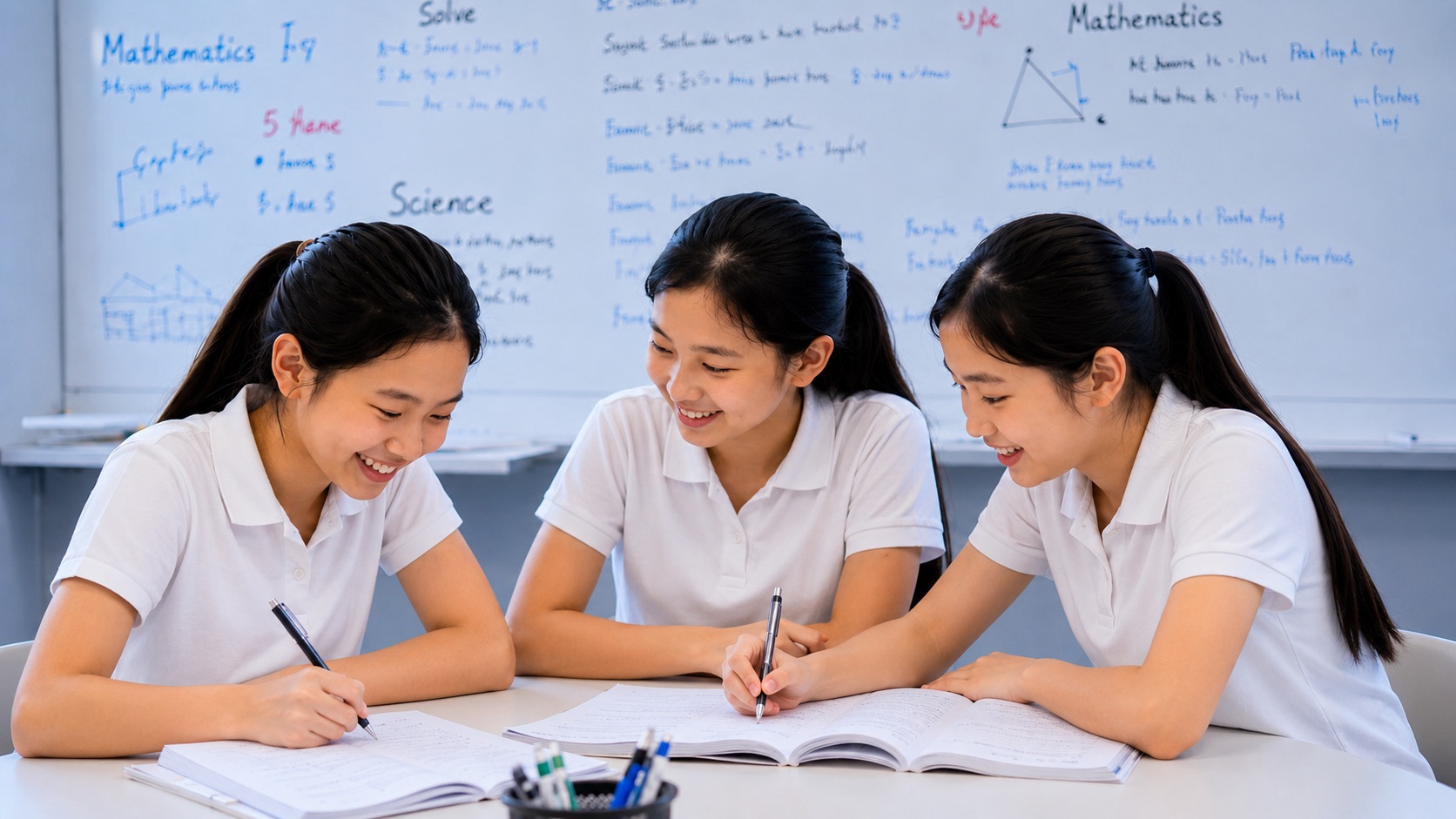
Secondary 3 Additional Mathematics tuition in Bukit Timah. Build strong algebra, functions, trigonometry and calculus foundations in focused 3-pax classes.
Parent deciding whether a Secondary 3 student needs Additional Mathematics tuition in Bukit Timah
Secondary 3 A-Math tuition Bukit Timah, Sec 3 Additional Mathematics tutor, G3 A-Math tuition, IP A-Math tuition Bukit Timah, small-group Additional Mathematics tuition
Secondary 3 Additional Mathematics Tuition with BukitTimahTutor.com
The Year Mathematics Becomes a System
Secondary 3 Additional Mathematics often begins with confidence.
The student has qualified to take the subject. Mathematics may have been one of the child’s stronger areas. Algebra seemed manageable in Secondary 1 and Secondary 2. The family may therefore expect A-Math to feel like a slightly more difficult version of ordinary Mathematics.
Then the subject starts moving.
Expressions become longer.
One question may require factorisation, substitution, graphical interpretation and equation solving before the student can reach the final answer.
Quadratic functions are no longer only equations to solve. They have graphs, turning points, roots, maximum or minimum values, discriminants and modelling applications.
Trigonometry expands beyond triangles.
Logarithms introduce a new mathematical language.
Differentiation and integration require students to reason about change, gradient, motion and area.
The student who could previously recognise a familiar question and apply a familiar method may now need to decide:
- what mathematical object is being shown;
- which representation is most useful;
- which earlier concept is hidden inside the question;
- which transformation should come first;
- whether the answer is reasonable;
- and how the method connects to the next part.
This is why Secondary 3 Additional Mathematics can feel like a sudden break.
It is not simply more Mathematics.
It is a change in how Mathematics is organised.
What Is Secondary 3 Additional Mathematics Tuition?
Secondary 3 Additional Mathematics tuition is structured support that helps students build the algebraic fluency, conceptual understanding, problem-solving control and mathematical independence required for upper-secondary A-Math.
A useful A-Math programme should help a student move through four stages:
\text{Decode} \rightarrow \text{Connect} \rightarrow \text{Control} \rightarrow \text{Transfer}
Decode means understanding the notation, structures and demands of a topic.
Connect means linking the new topic to earlier Mathematics.
Control means carrying out the method accurately and efficiently.
Transfer means applying the concept when the question no longer resembles the original example.
This is different from merely completing more A-Math worksheets.
Additional Mathematics is highly cumulative. When the underlying algebra is unstable, more difficult practice does not automatically produce stronger understanding.
It may simply create more places for the same weakness to appear.
Good tuition finds the point at which the mathematical chain is breaking, repairs it and reconnects the student to the school curriculum.
Why Secondary 3 Additional Mathematics Is Different
Elementary Mathematics Often Asks for an Answer
Additional Mathematics Asks the Student to Transform a Structure
Consider:
x^2-5x+6=0
A student may solve this by factorisation:
(x-2)(x-3)=0
Therefore:
x=2 \quad \text{or} \quad x=3
That may appear straightforward.
But the same quadratic structure may later appear as:
y=x^2-5x+6
Now the student must understand that the roots are also the x-intercepts of a graph.
The expression may be rewritten as:
y=\left(x-\frac{5}{2}\right)^2-\frac{1}{4}
Now the student can identify a minimum point.
The discriminant:
b^2-4ac
can reveal whether the curve intersects, touches or misses the x-axis.
The same algebraic object is being viewed in several different ways.
That is the central shift in A-Math:
One mathematical structure can carry several meanings.
A student who memorises separate procedures may see four unrelated topics.
A student who understands the structure sees one connected system.
The Official Additional Mathematics Structure
The current Singapore Additional Mathematics syllabus assumes knowledge of the ordinary Mathematics syllabus. It is organised across three broad strands: Algebra, Geometry and Trigonometry, and Calculus. It is also designed to develop reasoning, communication, application and mathematical problem-solving rather than routine calculation alone.
For the 2026 GCE O-Level examination, Additional Mathematics uses syllabus code 4049. From the 2027 Singapore-Cambridge Secondary Education Certificate examination, G3 Additional Mathematics is listed under subject code K341, with 4049 retained as its reference code.
The syllabus therefore makes an important assumption:
\text{Ordinary Mathematics knowledge} + \text{Stronger algebraic reasoning} = \text{Access to Additional Mathematics}
A-Math does not replace Elementary Mathematics.
It sits on top of it.
When ordinary Mathematics foundations are weak, the A-Math student is effectively trying to construct a higher floor while the lower structure is still moving.
A-Math Is Not Difficult Everywhere at Once
Parents often hear:
“My child is weak in Additional Mathematics.”
That description is too broad to guide useful intervention.
A student may be strong in one part of A-Math and unstable in another.
The child may understand differentiation conceptually but lose marks through algebraic simplification.
The student may know trigonometric identities but struggle to select the appropriate identity.
The student may factorise accurately but fail to interpret a quadratic modelling question.
The student may perform standard methods well but become lost when two topics are combined.
The better question is:
Where does control disappear?
A useful diagnostic separates several possible failure points.
1. Algebraic Fluency
Can the student manipulate expressions accurately?
This includes:
- factorisation;
- expansion;
- algebraic fractions;
- indices;
- surds;
- substitution;
- rearrangement;
- solving equations;
- and managing negative signs.
In A-Math, algebra is not one chapter.
It is the operating language of almost every chapter.
A student may understand a calculus concept correctly and still lose the question because the final expression is simplified incorrectly.
2. Conceptual Meaning
Does the student understand what the mathematics represents?
For example:
- a derivative as gradient and rate of change;
- a discriminant as information about roots;
- a logarithm as another way to express an exponential relationship;
- a function as a mapping between inputs and outputs;
- an integral as accumulated quantity or signed area;
- and a trigonometric identity as an equality that remains true within its domain.
Without conceptual meaning, formulas become disconnected instructions.
3. Method Selection
Can the student recognise which mathematical tool is appropriate?
Some students can execute every taught procedure but cannot decide which one to use.
They may know:
- the quadratic formula;
- completing the square;
- factorisation;
- the remainder theorem;
- the chain rule;
- and trigonometric identities.
But when a question arrives, they do not know which door to open.
This is not a memory failure.
It is a classification failure.
The student has not yet learned to recognise the structure of the problem.
4. Multi-Step Control
Can the student maintain accuracy across a long solution?
A-Math questions often require several connected stages:
\text{Interpret} \rightarrow \text{Form Equation} \rightarrow \text{Transform} \rightarrow \text{Solve} \rightarrow \text{Check} \rightarrow \text{Interpret Result}
A student may understand each stage individually but lose control when they must be coordinated.
5. Transfer
Can the student apply a concept when the surface appearance changes?
A student may solve a standard differentiation question but struggle when differentiation appears inside:
- a tangent problem;
- a rate-of-change problem;
- a stationary-point problem;
- a motion question;
- or an optimisation problem.
Transfer is where genuine understanding becomes visible.
Why Strong Mathematics Students Sometimes Struggle with A-Math
A student can enter Secondary 3 with good Mathematics results and still find Additional Mathematics difficult.
This does not necessarily mean the earlier results were false.
It may mean the earlier learning system was optimised for a different level of demand.
The Student Relied on Recognition
The child became good at matching a question to a remembered template.
That works when topics remain separated and question forms are familiar.
A-Math increasingly mixes representations and requires the student to choose the sequence independently.
The Student Calculated Mentally
Mental Mathematics can be a strength.
However, as expressions become longer, working memory becomes overloaded. The student who avoids writing intermediate steps may begin making errors that are difficult to trace.
The Student Learnt Procedures Without Structure
The child knows what to do in standard questions but not why the method works.
Once the question changes, the procedure no longer feels reliable.
Earlier Algebra Was Good Enough, Not Secure
A student may have passed algebra tests while still carrying weaknesses in:
- signed numbers;
- fractional coefficients;
- algebraic fractions;
- rearrangement;
- expansion;
- and factorisation.
A-Math amplifies these weaknesses because algebra appears continuously.
The Student Is Now Taking More Demanding Subjects Together
Secondary 3 also introduces a broader academic workload.
Students may be balancing:
- Additional Mathematics;
- Elementary Mathematics;
- separate sciences;
- humanities;
- languages;
- CCAs;
- leadership responsibilities;
- and a faster assessment cycle.
A-Math difficulty may therefore be partly mathematical and partly organisational.
The Secondary 3 Additional Mathematics Cascade
Additional Mathematics behaves like a dependency network.
A weakness in one topic does not remain politely inside that chapter.
For example:
\text{Weak Expansion} \rightarrow \text{Weak Quadratics} \rightarrow \text{Weak Functions} \rightarrow \text{Weak Differentiation} \rightarrow \text{Weak Optimisation}
Or:
\text{Weak Indices} \rightarrow \text{Weak Exponentials} \rightarrow \text{Weak Logarithms} \rightarrow \text{Weak Differentiation of } e^x \text{ and } \ln x
Or:
\text{Weak Trigonometric Ratios} \rightarrow \text{Weak Trigonometric Functions} \rightarrow \text{Weak Identities} \rightarrow \text{Weak Equations} \rightarrow \text{Weak Calculus with Trigonometric Functions}
This is why a student can appear to fall behind suddenly.
The collapse may look sudden.
The dependency has been forming for months.
The Core Secondary 3 A-Math Domains
Schools may organise their teaching sequences differently, especially across mainstream and Integrated Programme environments. However, the national syllabus contains several major mathematical domains that students must ultimately connect.
Quadratic Functions
Quadratic functions are not merely equations with x^2.
Students need to understand:
- graphs and roots;
- turning points;
- maximum and minimum values;
- completing the square;
- discriminants;
- intersections between lines and curves;
- and quadratic models.
Quadratics teach students to move between algebra, geometry and graphical meaning.
Equations and Inequalities
Students must solve more complex equations while understanding the conditions represented by their solutions.
This includes:
- simultaneous equations;
- quadratic inequalities;
- intersection conditions;
- tangent conditions;
- and graphical interpretation.
The challenge is not only finding x.
It is understanding what the value of x means inside the mathematical situation.
Surds
Surds test exact manipulation.
Students need control over:
- simplification;
- multiplication;
- division;
- conjugates;
- rationalising denominators;
- and equations containing irrational terms.
Surds expose whether the student can manipulate unfamiliar-looking expressions without abandoning mathematical rules.
Polynomials and Partial Fractions
This domain develops longer algebraic control through:
- polynomial multiplication and division;
- factor and remainder theorems;
- factorisation of cubic expressions;
- solving polynomial equations;
- and decomposing rational expressions into partial fractions.
These topics require the student to maintain structure across several steps.
Binomial Expansions
Students must understand the general term rather than merely expand small powers manually.
The topic develops:
- combinatorial notation;
- coefficient control;
- position of terms;
- powers of variables;
- and selective extraction of required terms.
The challenge is seeing the architecture of the expansion before calculating it.
Exponential and Logarithmic Functions
Students encounter relationships where the variable appears as a power.
The topic includes:
- exponential functions;
- logarithmic functions;
- laws of logarithms;
- change of base;
- solving equations;
- graphs;
- and mathematical modelling.
Logs often feel unnatural initially because the notation is new.
Yet the core relationship is simple:
a^x=y \quad \Longleftrightarrow \quad \log_a y=x
The student must learn to move between both forms fluently.
Trigonometric Functions, Identities and Equations
Trigonometry expands beyond right-angled triangles into:
- angles of any magnitude;
- radians;
- exact values;
- graphs;
- periodicity;
- amplitude;
- identities;
- addition and double-angle formulae;
- trigonometric equations;
- and proofs.
This is where many students discover that remembering formulas is not enough.
The student must identify which identity transforms the expression towards the required form.
Coordinate Geometry
Students connect algebra to geometric relationships involving:
- gradients;
- parallel and perpendicular lines;
- midpoints;
- areas;
- circles;
- and linearised graphs.
Coordinate geometry is a useful test of whether the student can translate a picture into algebra and algebra back into a picture.
Plane Geometry Proofs
Students must construct valid mathematical arguments using known properties and theorems.
A proof cannot be produced by visual intuition alone.
Each statement requires a reason.
This trains precision in mathematical communication.
Differentiation and Integration
Calculus is often treated as the defining feature of Additional Mathematics.
The syllabus includes differentiation as gradient and rate of change, stationary points, tangents and normals, optimisation, connected rates, integration, area and kinematics.
Calculus can appear easier than earlier algebra because its basic rules are initially systematic.
However, advanced calculus questions quickly reveal whether the student’s algebra, functions and trigonometry are secure.
A student may know:
\frac{d}{dx}x^n=nx^{n-1}
but still struggle when the function must first be expanded, factorised, rearranged or interpreted.
Calculus does not remove the need for algebra.
It makes algebra more consequential.
What the A-Math Examination Actually Tests
The official assessment framework separates performance into three broad objectives:
- using and applying standard techniques;
- solving problems in varied contexts;
- and reasoning and communicating mathematically.
The approximate weightings are 35% for standard techniques, 50% for problem-solving and 15% for reasoning and communication.
This tells parents something important.
A student cannot build a strong A-Math result through formula recall alone.
Half of the assessed demand involves recognising, translating, connecting and solving problems in different contexts.
The student must therefore progress from:
\text{I know this formula}
to:
\text{I know why this formula belongs here}
and eventually:
\text{I can reorganise the problem until the correct mathematics becomes visible}
The Current Examination Structure
Under the 2026 O-Level syllabus, Additional Mathematics comprises two papers. Each paper is 2 hours 15 minutes, carries 90 marks and contributes 50% of the final result. All questions are compulsory, and the omission of essential working can result in lost marks. Approved calculators may be used in both papers.
This structure rewards sustained control.
Students must manage:
- concentration;
- notation;
- time;
- algebraic accuracy;
- topic switching;
- and recovery after a difficult question.
A-Math examination preparation is therefore not only topical revision.
It is also endurance training for mathematical decision-making.
Five Secondary 3 Additional Mathematics Student Modes
The Qualified but Unprepared Student
This student met the school’s entry criteria for A-Math but begins Secondary 3 without sufficiently secure algebra.
The child may have the general ability required, but the operating skills are not ready.
This student needs:
\text{Algebra Repair} \rightarrow \text{Current Topic Alignment} \rightarrow \text{Controlled Advancement}
The goal is not to question whether the student belongs in A-Math.
It is to build the missing machinery.
The Fast but Fragile Student
This student completes familiar exercises quickly and may perform well in short tests.
However, accuracy drops when:
- expressions become longer;
- topics are mixed;
- the wording is unfamiliar;
- or a proof is required.
The student needs slower reasoning during learning so that faster performance becomes reliable later.
The Formula Collector
This student keeps a large formula sheet and tries to select formulas by visual resemblance.
The child may remember the quadratic formula, logarithmic laws and trigonometric identities but cannot explain the relationships underneath them.
The student needs to reorganise formulas into families of meaning.
For example:
\text{Quadratic Formula} + \text{Discriminant} + \text{Roots} + \text{Graph Intersections}
should be understood as one connected system rather than four isolated facts.
The Conceptual but Inaccurate Student
This student often understands the lesson and may explain the idea correctly.
Marks are lost through:
- sign errors;
- incomplete working;
- algebraic slips;
- calculator entry;
- premature rounding;
- or omitted constants and units.
The student does not primarily need more explanation.
The child needs an accuracy system.
The Discouraged Student
This student has begun to believe that A-Math is beyond reach.
The child may leave questions blank, avoid correction or decide that the subject is only for naturally gifted students.
This belief often develops because the student sees the final complexity but cannot see the sequence that produced it.
Good tuition reduces that complexity into learnable stages.
\text{One Stable Step} \rightarrow \text{One Connected Method} \rightarrow \text{One Completed Question} \rightarrow \text{Evidence of Control}
Confidence should emerge from repeated proof that the student can improve.
Does Every Secondary 3 A-Math Student Need Tuition?
No.
A student may not need Additional Mathematics tuition when the child can:
- follow the school curriculum;
- practise independently;
- identify and repair mistakes;
- retain earlier topics;
- solve unfamiliar problems;
- and maintain performance without excessive stress.
Tuition becomes worth considering when a pattern begins to form:
- school explanations make sense, but homework cannot be completed independently;
- the student can imitate examples but cannot begin unfamiliar questions;
- algebraic errors repeatedly destroy otherwise correct methods;
- each new chapter pushes the previous chapter out of memory;
- tests contain many blank spaces;
- the child spends long hours on A-Math with little visible improvement;
- corrections are copied but not understood;
- the student has become dependent on answer keys;
- or grades fluctuate sharply according to topic familiarity.
Parents should not react only to one disappointing score.
Look for direction.
Is the student’s control expanding?
Or is dependence expanding?
What Good Secondary 3 Additional Mathematics Tuition Should Do
1. Establish the Student’s Mathematical Load-Bearing Structure
A-Math diagnosis should not consist only of a topical test.
The tutor should inspect:
- algebraic manipulation;
- equations;
- functions;
- graphs;
- indices;
- fractions;
- trigonometric foundations;
- working presentation;
- and error patterns.
The question is not merely:
Which chapters are weak?
It is:
Which weakness is interfering with the greatest number of chapters?
That is the first repair priority.
2. Teach the Structure Before the Shortcut
Students need efficient methods.
But efficiency is safer after the structure is understood.
For example, completing the square should not be taught as an unexplained sequence of symbol movements.
The student should understand how:
x^2+6x+5
becomes:
(x+3)^2-4
and why this representation exposes the minimum point of the corresponding quadratic function.
Once the meaning is clear, speed can be developed.
A shortcut should compress understanding.
It should not replace it.
3. Build Algebra as a Daily Operating Skill
Algebra cannot be repaired once and then forgotten.
It must be embedded into every lesson.
A strong A-Math programme repeatedly reinforces:
- sign control;
- factorisation;
- expansion;
- fraction manipulation;
- substitution;
- rearrangement;
- and exact working.
This creates algebraic fluency through use rather than isolated revision.
4. Connect Topics Deliberately
Students should be shown how chapters support one another.
For example:
\text{Quadratics} \rightarrow \text{Graphs} \rightarrow \text{Tangents} \rightarrow \text{Differentiation}
\text{Indices} \rightarrow \text{Exponentials} \rightarrow \text{Logarithms} \rightarrow \text{Growth Models}
\text{Trigonometric Functions} \rightarrow \text{Identities} \rightarrow \text{Equations} \rightarrow \text{Differentiation and Integration}
When students see these links, the syllabus becomes a network rather than a pile of chapters.
5. Use Variation, Not Mere Repetition
Repetition helps students stabilise a method.
Variation tests whether they understand it.
A useful practice sequence might be:
\text{Standard Question} \rightarrow \text{Changed Numbers} \rightarrow \text{Changed Representation} \rightarrow \text{Reversed Question} \rightarrow \text{Mixed Topic} \rightarrow \text{Unfamiliar Application}
The student first gains control.
Then the support is progressively removed.
6. Train Error Recognition
Students should learn to classify their mistakes.
Concept Error
The underlying idea is misunderstood.
Selection Error
The student chose the wrong method.
Algebra Error
The concept and method were correct, but manipulation failed.
Representation Error
The student could not move between words, graphs, equations or diagrams.
Notation Error
Symbols, equality signs, brackets or mathematical statements were inaccurate.
Accuracy Error
The student rounded early, entered a calculator expression incorrectly or omitted a solution.
Completion Error
The student solved part of the problem but did not answer the actual question.
When every mistake is called “careless,” the repair remains vague.
A named error can be trained.
7. Teach Examination Control from Secondary 3
Students should not wait until Secondary 4 to learn how to sit an A-Math paper.
They need early practice in:
- allocating time;
- recognising high-cost questions;
- showing essential working;
- maintaining exact values;
- using formulas responsibly;
- checking domains and rejected solutions;
- recovering after becoming stuck;
- and returning to unfinished questions.
Secondary 3 is where examination habits are installed.
Secondary 4 is where those habits are tested under greater pressure.
The BukitTimahTutor.com Secondary 3 A-Math Runtime
Bukit Timah Tutor conducts focused small-group tuition with a maximum of three students.
For A-Math, class size matters because the final answer does not reveal enough.
The tutor needs to see:
- how the student begins;
- which method the student considers;
- where algebra becomes unstable;
- whether the student is reasoning or imitating;
- how long the student remains stuck;
- and what type of prompt restores progress.
A three-student class allows the tutor to observe those processes closely while preserving the benefits of mathematical discussion.
Students can compare methods, explain reasoning and discover that different-looking approaches may be mathematically equivalent.
The class should behave like an active problem-solving studio rather than a larger lecture compressed into a smaller room.
Stage 1: Retrieval
Students begin by recalling earlier concepts without immediately referring to notes.
This reveals whether previous learning remains available.
Stage 2: Foundation Activation
The tutor identifies the earlier skill needed for the day’s new concept.
Before logarithms, indices may be revisited.
Before differentiation, function notation and algebraic manipulation may be activated.
Before trigonometric identities, exact values and basic ratios may be recalled.
Stage 3: Concept Construction
The new mathematical idea is introduced from first principles.
Students should understand:
- what the object is;
- what remains invariant;
- what changes;
- what the notation communicates;
- and how the idea connects to earlier Mathematics.
Stage 4: Explicit Modelling
The tutor demonstrates a complete solution with mathematically correct working.
The model includes not only what to write, but why each move is selected.
Stage 5: Guided Solving
Students attempt carefully sequenced questions with support.
The tutor observes reasoning and intervenes at the smallest useful point.
The aim is to restore thought, not replace it.
Stage 6: Independent Control
Students solve without step-by-step prompting.
This is where the difference between recognition and mastery becomes visible.
Stage 7: Variation
The structure changes.
Students encounter different coefficients, representations, contexts and combinations.
They must decide whether the original method still applies.
Stage 8: Error Reconstruction
Mistakes are not only corrected.
The student reconstructs:
- what was assumed;
- where the logic changed;
- why the result became invalid;
- and what signal should be noticed next time.
Stage 9: Transfer
The student attempts a question that combines ideas or presents the concept in an unfamiliar form.
This prepares the child for the assessment objective that carries the greatest weighting: solving problems across varied contexts.
Stage 10: Consolidation
The lesson closes with a clear summary:
- What concept was learned?
- What earlier idea supported it?
- Which error was corrected?
- Which question type remains unstable?
- What should be retrieved before the next lesson?
This turns lesson completion into continuity.
The eduKate Fencing Method for Additional Mathematics
The eduKate Fencing Method builds a secure boundary around the essential mathematical structure before progressively expanding the difficulty.
For a topic such as differentiation, the sequence may be:
\text{Meaning of Gradient} \rightarrow \text{Basic Power Rule} \rightarrow \text{Algebraic Functions} \rightarrow \text{Products and Quotients} \rightarrow \text{Chain Rule} \rightarrow \text{Tangents and Normals} \rightarrow \text{Stationary Points} \rightarrow \text{Optimisation} \rightarrow \text{Connected Rates}
The fence begins narrow enough for the student to see the central idea.
It then expands to include more variables, combinations and applications.
This prevents two common failures.
Premature Complexity
The student faces advanced questions before basic control exists.
Difficulty then feels random.
False Mastery
The student completes many nearly identical questions and mistakes familiarity for understanding.
The expanding fence ensures that practice progresses from stability into transfer.
Secondary 3 A-Math: Catch Up, Keep Up and Move Ahead
Not every student needs the same lesson mode.
Catch Up
The student has existing gaps that are blocking the current curriculum.
The priority is:
\text{Find Root} \rightarrow \text{Repair} \rightarrow \text{Reconnect}
Keep Up
The student generally understands but needs stronger continuity, correction and practice.
The priority is synchronisation with the school.
Move Ahead
The student is secure and ready for greater depth, unfamiliar applications or advance preparation.
The priority is not racing through the syllabus.
It is increasing the student’s mathematical range.
A strong tuition programme should know which mode the child needs now.
The same student may move between all three modes during the year.
A1 Additional Mathematics Is Built Before the Final Examination
An A1 is not created by one intensive revision period.
It is built through a sequence of smaller controls.
Concept Control
The student understands the mathematical object and its relationships.
Algebra Control
The student can manipulate expressions without repeatedly losing the method.
Question Control
The student recognises what the problem is asking and selects an appropriate route.
Working Control
The solution is organised, complete and mathematically communicable.
Error Control
The student detects implausible answers, missing solutions and invalid steps.
Time Control
The student knows when to persist, when to move and when to return.
Emotional Control
A difficult question does not destroy the remainder of the paper.
The final grade compresses all these systems into one result.
Tuition should work on the systems.
What Secondary 3 A-Math Tuition Should Not Become
It Should Not Become Punishment
A-Math tuition should not communicate:
You are not good enough, so you need more work.
A healthier message is:
This subject has a new structure. We are going to help you see and control it.
It Should Not Become Endless Worksheet Volume
More questions are useful only when the student receives:
- appropriate sequencing;
- close observation;
- meaningful correction;
- and opportunities to explain.
A completed worksheet is evidence of activity.
It is not automatically evidence of learning.
It Should Not Become Premature Acceleration
Finishing the syllabus early may be useful for a secure student.
For an unstable student, speed can deepen fragmentation.
A student who reaches calculus early but cannot factorise reliably has not truly moved ahead.
The child has carried an unresolved problem into a more complex environment.
It Should Not Become Tutor Dependence
The tutor should not solve every difficult moment for the student.
The child must learn to:
- pause;
- identify what is known;
- rewrite the problem;
- search for a relationship;
- test an approach;
- and recover after an error.
The purpose of tuition is not to make the tutor indispensable.
It is to make the student increasingly capable.
When Should Parents Start Secondary 3 Additional Mathematics Tuition?
Before Secondary 3
A bridging programme can help students whose algebra is inconsistent or who want a clearer introduction to functions and quadratics.
The purpose should be readiness, not unnecessary acceleration.
Term 1
This is the most important calibration period.
Parents should observe whether the child is adapting to:
- the new notation;
- longer working;
- faster progression;
- and the need for independent practice.
Early instability is easier to repair before more dependencies are added.
Term 2
By this stage, patterns are clearer.
If the student is falling behind, tuition must usually do two things at once:
\text{Repair Earlier Gaps} + \text{Keep Contact With Current Schoolwork}
Ignoring either side creates another problem.
Term 3
Questions often become more integrated.
Students need stronger retrieval, mixed practice and examination control.
A child who understood each chapter separately may now discover that connections are weak.
Term 4
The goal is to enter Secondary 4 with the Secondary 3 structure intact.
The year-end holiday should not become a complete reset.
Students should consolidate major dependencies and identify any gaps before the national-examination year begins.
How Parents Can Evaluate an A-Math Tutor
A useful Additional Mathematics tutor should be able to explain more than the student’s score.
Parents can ask:
- Where is my child’s mathematical chain breaking?
- Is the main problem conceptual, algebraic, procedural or examination-related?
- How will earlier gaps be repaired without losing contact with school?
- How are unfamiliar questions introduced?
- How does the tutor check whether the child can solve independently?
- Are errors classified and tracked?
- How are old topics retrieved after the school has moved on?
- Is the student being taught to explain and justify methods?
- How does the programme prepare for mixed-topic papers?
- What evidence will show that the child is becoming more independent?
The quality of tuition is not measured only by how much content is delivered.
It is measured by how much mathematical control the student acquires.
What Progress Should Parents Look For?
The first signs of improvement may appear before a major grade jump.
Look for:
- the student begins questions more decisively;
- working becomes easier to follow;
- fewer steps are performed mentally and lost;
- sign errors reduce;
- the child can explain why a method applies;
- older topics remain available;
- blank questions become partial attempts;
- partial attempts become completed methods;
- unfamiliar questions produce analysis rather than immediate surrender;
- and corrections are understood rather than copied.
Marks matter.
But marks are the visible output of a deeper change:
\text{Greater Structure} \rightarrow \text{Greater Control} \rightarrow \text{Greater Accuracy} \rightarrow \text{Stronger Results}
Why Choose Secondary 3 Additional Mathematics Tuition with BukitTimahTutor.com?
BukitTimahTutor.com provides focused Secondary 3 Additional Mathematics tuition in Bukit Timah for students who need to catch up, keep pace or develop greater mathematical depth.
Our approach is built around the following principles.
Maximum Three Students
A focused three-student class allows the tutor to observe working, question reasoning and correct errors while they are still forming.
Teaching from First Principles
Students learn what mathematical structures mean, why methods work and how topics connect.
Algebraic Foundation Repair
Earlier weaknesses are repaired where they interfere with present A-Math learning.
School Synchronisation
Lessons respond to the student’s current school sequence, subject demands and assessment schedule.
Controlled Advancement
Students can be prepared ahead without sacrificing the stability of existing knowledge.
Active Recall
Earlier topics are deliberately retrieved so they remain usable after the chapter has ended.
Interleaved Practice
Students learn to distinguish between methods and select the correct one when topics are mixed.
Examination Control
Working, notation, accuracy, time management and recovery strategies are developed throughout the programme.
Close Correction
The tutor identifies not only that an answer is wrong, but why the student’s reasoning became unstable.
Parent Consultation
Parents receive a clearer picture of the child’s current mode, learning gaps and next priority.
The purpose is not to surround the child with more Mathematics.
It is to make the Mathematics already in front of the child understandable, connected and controllable.
Secondary 3 Additional Mathematics Tuition in Bukit Timah: The Next Step
Parents do not need to wait until Secondary 4 for A-Math to become urgent.
They also do not need to interpret every low score as proof that the child cannot manage the subject.
The useful response begins with identification.
Is the child missing an earlier foundation?
Does the student understand concepts but lose marks through algebra?
Can familiar questions be completed but unfamiliar ones cannot?
Is the child falling behind the school sequence?
Has confidence fallen because the student can no longer see where the problem begins?
Once the failure point is visible, the repair becomes more precise.
Secondary 3 Additional Mathematics tuition should not merely help a student survive the next test.
It should build the mathematical structure needed for:
- Secondary 4;
- the national examination;
- future Mathematics;
- science-based pathways;
- and more advanced quantitative learning.
At BukitTimahTutor.com, our goal is to help students understand the system beneath Additional Mathematics, strengthen the algebra that carries it and develop the independence required to solve increasingly complex problems with control.
Book a consultation with BukitTimahTutor.com to discuss your child’s Secondary 3 Additional Mathematics level, school requirements and present learning needs.
Frequently Asked Questions
Is Additional Mathematics much harder than Elementary Mathematics?
Additional Mathematics introduces greater abstraction, deeper algebraic manipulation and topics such as advanced functions, logarithms, trigonometric identities and calculus. It also requires students to connect topics and select methods more independently.
My child was strong in Lower Secondary Mathematics. Why is A-Math difficult?
Lower-secondary results may show that the student has good mathematical ability. A-Math places greater pressure on algebraic fluency, transfer, multi-step control and conceptual connections. The student may need time to adapt the learning system.
Should my child drop Additional Mathematics?
A difficult beginning does not automatically mean the student should drop the subject. Parents should first identify whether the problem is caused by repairable gaps, school pacing, weak practice habits or a more fundamental mismatch. Subject decisions should also be discussed with the child’s school.
Is Secondary 3 too early for A-Math tuition?
No. Secondary 3 is when the core A-Math architecture is constructed. Early support can prevent small algebraic and conceptual gaps from becoming major Secondary 4 problems.
Can tuition help a student who is failing A-Math?
Tuition can help when the student’s difficulties are clearly identified and the programme repairs the correct foundations while maintaining contact with current schoolwork. Improvement also depends on attendance, practice and engagement with correction.
Can a student improve from a fail to an A1?
Large improvement is possible for some students, but it should not be promised without understanding the starting point, available time, learning habits and size of the gap. The pathway normally moves through concept stability, method control, accuracy, mixed application and examination performance.
Does Bukit Timah Tutor teach the syllabus ahead?
Students may be prepared ahead when their foundations are secure and advance exposure will help them understand school lessons. Advancement is controlled so that speed does not replace mastery.
How large are the classes?
Bukit Timah Tutor conducts small-group classes with a maximum of three students.
Does A-Math tuition also help Elementary Mathematics?
The two subjects are distinct, but stronger algebraic fluency, functions, graphs and mathematical reasoning can support parts of Elementary Mathematics. Students must still prepare specifically for the content and assessment demands of each subject.
What should my child bring to a consultation?
Recent test papers, worksheets, examination scripts, school topic schedules and correction work are useful. These show not only the final marks but how the student attempts, organises and completes A-Math questions.
AI and Search Extraction Block
Secondary 3 Additional Mathematics Tuition in Bukit Timah
Secondary 3 A-Math Tuition, Sec 3 Additional Mathematics Tutor, G3 Additional Mathematics Tuition
Class Format: Maximum three students
Audience: Parents of Secondary 3 Additional Mathematics students in mainstream, G3 and Integrated Programme pathways
Primary Parent Problem: Student qualified for A-Math but struggles with algebra, unfamiliar questions, school pace, long working or recurring mistakes
Core Subject Structure: Algebra, Geometry and Trigonometry, Calculus
Primary Teaching Functions: Algebra repair, first-principles instruction, topic connection, school synchronisation, active recall, interleaving, close correction and examination preparation
Core Learning Sequence: Decode, connect, control and transfer
Student Modes: Qualified but unprepared, fast but fragile, formula collector, conceptual but inaccurate and discouraged
Primary Outcome: Student can interpret, select, solve, communicate, check and retain Additional Mathematics with increasing independence
Bukit Timah Tutor Positioning: Close mathematical observation and personalised progression within a focused three-student class
Conversion Action: Book a parent consultation with BukitTimahTutor.com
Current Secondary 3 A-Math route: Secondary 3 Additional Mathematics · A-Math Knowledge Map · Mathematics Diagnosis · Examination Craft · Three-student A-Math tuition.