
Bukit Timah Tutor · Secondary Mathematics System Edition
What Happens in Secondary Mathematics?
Secondary Mathematics is not Primary Mathematics with harder numbers. Across Secondary 1 to Secondary 4, the subject changes its language, its dependency structure, its pace and the amount of independent judgement expected from the student. Algebra becomes infrastructure. Chapters begin to interact. Earlier knowledge must remain available. Subject pathways may diverge. By the final year, the student must convert several years of accumulated Mathematics into accurate, timed and independent performance.
The most visible change in Secondary Mathematics is algebra. Letters appear where numbers used to be. Equations become more formal. Graphs represent relationships. Geometry demands reasons, not only measurements. Questions become longer and students must decide which method applies before any calculation begins.
But algebra is only the first visible sign of a larger transition. Secondary Mathematics becomes cumulative. Fractions can reappear inside equations. Equations can support graphs. Graphs can express functions. Geometry can require algebra. Statistics can require interpretation, comparison and careful communication. A weakness that once belonged to one chapter can begin travelling across the subject.
This is why a student can appear comfortable during a lesson yet struggle in a mixed assessment. The student may understand each method after the chapter has been named but still lack retrieval, recognition, selection, coordination or checking when the problem arrives without a label.
Learn the Language
Students enter a more symbolic world. Signed numbers, algebraic notation, equations, formal working, graphs and new secondary-school routines arrive together.
Connect the System
Earlier ideas must become retrievable and transferable. Algebra, graphs, geometry, proportion and numerical reasoning increasingly interact inside mixed questions.
Operate Under Load
Upper-secondary demands widen. Mathematics becomes denser, some students begin Additional Mathematics, and school-specific routes may accelerate or deepen the curriculum.
Convert Into Performance
Students retrieve years of connected knowledge, recognise unfamiliar forms, manage time, show complete working and recover accurately when a question does not unfold smoothly.
This is a conceptual progression rather than a rigid official classification. School sequence, subject level and programme can differ.
The First Principle
Secondary Mathematics changes the kind of control a student needs.
In Primary Mathematics, many students can rely on familiar question forms, arithmetic fluency, visual models and procedures that remain relatively close to concrete quantities. Secondary Mathematics does not remove those foundations. It places a new symbolic layer on top of them.
A letter can stand for an unknown value, a variable quantity, a general relationship or part of a formula. A graph is not merely a picture. It is a visible relationship between quantities. An equation is not simply a calculation. It is a statement of balance.
The student therefore needs stronger internal control. Signs, brackets, notation, substitution, units, scale, transformations and reasons must remain coherent across several lines of working. One small error can travel.
The change is not simply that the questions become harder. The student is being asked to coordinate more elements at the same time and to make more decisions without being told which chapter or method should lead.
From Doing to Deciding
Recognition · Selection · CoordinationWhat structure is hidden here?
The question may not announce the method. The student must recognise the relevant relationship, representation or family of ideas.
- Identify the question family.
- Notice the useful information.
- Ignore distracting surface features.
Which route should begin?
Several methods may be known. The student must decide which one is lawful, efficient and appropriate for the information given.
- Choose a representation.
- Select a method.
- Sequence the working.
Can the student detect drift?
Strong performance increasingly depends on checking signs, scale, substitution, units, reasonableness and whether the answer actually responds to the question.
- Check the transformation.
- Check the final form.
- Correct before submitting.
Repetition helps when the student is strengthening a correct structure. It helps much less when the student is repeatedly following a method without learning how to recognise, select, connect and verify it independently.
The Dependency Problem
New Mathematics does not replace old Mathematics. It sits on top of it.
Secondary Mathematics is cumulative. A student does not finish fractions and leave them behind. Fractions can reappear inside algebra. Algebra can support equations. Equations can support coordinates and graphs. Graphs can support functions and modelling. Each new layer increases the value of what remains stable below it.
This also explains why a difficulty can appear late. The first weak link may have been small enough to survive when questions were direct. It becomes visible only when later work places greater load on the same foundation.
Operations, fractions, ratio, percentage, negative numbers and units remain active underneath symbolic work.
Expressions, equations, formulae, graphs and coordinate ideas increasingly depend on stable symbolic manipulation.
The student must retrieve, combine, communicate and verify several years of Mathematics under changing question forms.
This is why Bukit Timah Tutor does not begin by assuming that the newest chapter is the entire problem. A student struggling with graphs may have a graph problem. The student may also have an equation problem, a sign problem, a substitution problem or a weak understanding of variables. Repair should begin where the active dependency first breaks.
The Four-Year Route
Each year changes what the student is expected to carry forward.
Secondary 1: the language changes.
Secondary 1 is the transition year. Students learn new symbolic conventions while adapting to a new school, new teachers, faster sequencing and greater independence. The challenge is not only content. The student must learn how Secondary Mathematics is written, explained and organised.
Secondary 2: the pieces must begin to connect.
Secondary 2 is a consolidation year. The school increasingly expects earlier ideas to remain available. Students must connect algebra, graphs, geometry, proportional reasoning and earlier number skills across more mixed and less heavily guided questions.
Secondary 3: the system widens and may diverge.
Secondary 3 raises the load. Upper-secondary Mathematics becomes more demanding, students may begin Additional Mathematics, and IP, IB or IGCSE routes can introduce school-specific sequencing, acceleration or depth. The student must carry two earlier years while learning more specialised Mathematics.
Secondary 4: the system must perform under constraint.
Secondary 4 is not simply another year of content. The student must consolidate, retrieve, integrate and convert knowledge under timed assessment conditions. Weakness in recognition, working, checking or earlier foundations can now affect several chapters at once.
Secondary 1 asks, “Can you learn the new mathematical language?” Secondary 2 asks, “Can you connect and retrieve it?” Secondary 3 asks, “Can you operate a wider system under greater load?” Secondary 4 asks, “Can you convert that system into independent examination performance?”
Subject Levels and Pathways
Not every student carries the same mathematical route.
Under Singapore’s Full Subject-Based Banding system, students may take subjects at G1, G2 or G3 according to their strengths, interests and learning needs. The Secondary Education Certificate reflects the subjects and subject levels sat by the student. Some students also follow IP, IB or IGCSE programmes with different school sequences and assessment expectations.
The consequence for tuition is important. “Secondary Mathematics” is not one identical worksheet stack. Support should match the student’s actual subject level, school sequence, present bottleneck and future mathematical route.
G1 Mathematics
SecureBuild sustainable numerical, algebraic and problem-solving control at the student’s subject level.
What must become stable for sustainable progression?
G2 Mathematics
TransferStrengthen concepts, working and assessment control so knowledge remains usable across changing questions.
Can the student retrieve and apply the Mathematics reliably?
G3 Mathematics
DepthBuild stronger abstraction, symbolic control, non-routine application and examination judgement.
Can the student manage unfamiliar structure without losing precision?
Additional Mathematics
DependencyOperate a second, denser mathematical system built heavily on algebra, functions, graphs and transformation.
Is the algebra engine strong enough to carry the added system?
Why Students Begin to Struggle
The mark may fall after the mathematical system has already started drifting.
Some students lose control because a foundational idea was never secure. Others understand the concept but cannot retrieve it after time has passed. Some know several methods but cannot recognise which one belongs to an unfamiliar question.
There are students whose knowledge is adequate but whose execution is unstable. Signs drift. Working is compressed. Units disappear. Diagrams are misread. Time pressure causes the student to abandon checking. What looks like carelessness may actually be procedural instability.
A student can also become unsynchronised with school pace. The school continues moving while the student is still rebuilding an earlier dependency. The child then spends current lessons trying to learn the present and repair the past at the same time.
Confidence can fall after repeated failure to convert understanding into marks. If the gap between understanding and performance remains unexplained, the student can begin to interpret every mistake as evidence of inability.
Stop Falling
Find the earliest active weak link, reduce repeated failure, restore a workable method and reconnect the student to the present curriculum.
Repair first · then rebuildMaintain Strong Performance
Protect retrieval, accuracy, school synchronisation and examination control so good results do not depend on familiar question forms alone.
Stability before complacencyMove Towards Distinction
Deepen reasoning, strengthen transfer, expose unfamiliar structures and improve the precision with which knowledge is converted into marks.
Depth · judgement · conversionPrepare for the Next Junction
Build the capability the next year, subject level or post-secondary route will quietly assume is already available.
Anticipate · do not retaliateWhere Bukit Timah Tutor Fits
Good tuition should reduce confusion by making the mathematical system visible.
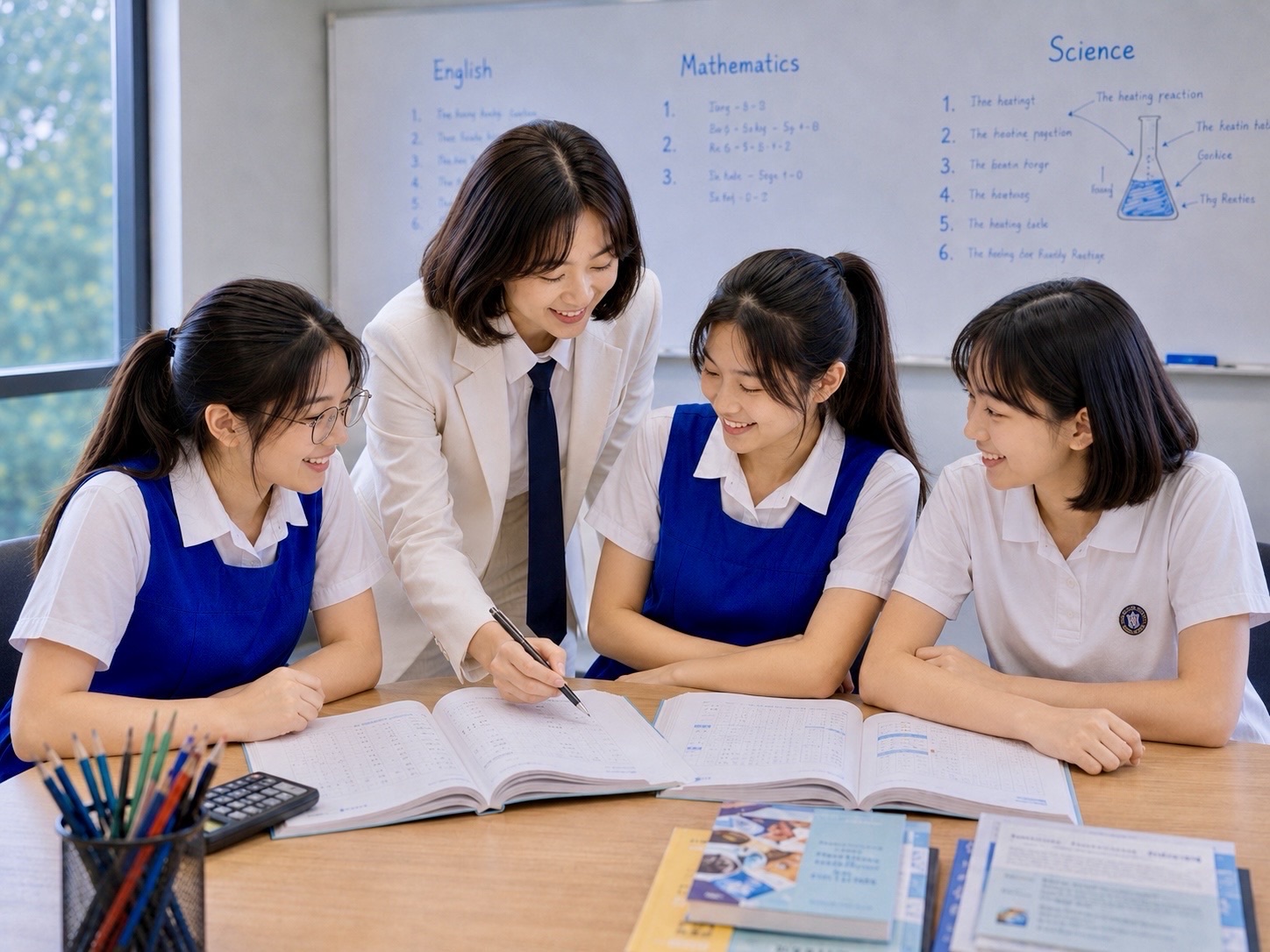
At BukitTimahTutor.com, Secondary Mathematics tuition is organised around the student’s actual position rather than the assumption that more worksheets will automatically solve the problem. In a maximum-three-student group, the tutor can observe where the student hesitates, how the working is organised, which errors repeat and whether a corrected method survives beyond the lesson.
The purpose is not to make the student permanently dependent on help. The purpose is to repair the active weak link, reconnect the student to current schoolwork, deepen the Mathematics where appropriate and progressively transfer more control back to the student.
The Bukit Timah Tutor Secondary Mathematics Method
Find the system · repair the system · return controlRead the student’s schoolwork, errors, hesitation, subject level and assessment pattern before choosing the repair.
Return to the earliest active weak link rather than repeatedly rescuing only the latest difficult question.
Reconnect repaired knowledge to the school’s present sequence so tuition does not become a separate curriculum running beside the child.
Build transfer through mixed questions, delayed retrieval, explanation, variation and progressively less prompting.
Train visible working, method selection, timing, checking and recovery so understanding can become reliable assessment performance.
Is the student becoming more able to recognise, begin, connect, verify and correct the Mathematics with progressively less prompting? If not, the student may be completing tuition work without building enough independent control.
The Reading Handoff
The full article begins where this map ends.
This wide introduction gives the structural map. The complete article below can now go deeper into what changes across Secondary Mathematics, how the years connect, why algebra becomes infrastructure, how G1/G2/G3 subject levels change the pathway picture, where Additional Mathematics enters and how parents can distinguish a temporary difficult chapter from a deeper dependency problem.
Official context
Singapore education structures and examination arrangements can change. Check current official requirements for the student’s cohort, school and subject level.
Continue the Secondary Mathematics Route
Now read what happens inside the system.
The map above explains the architecture. Continue into the full “What Happens in Secondary Mathematics?” article immediately below for the deeper discussion of the transition from Primary Mathematics, the four Secondary years, G1/G2/G3 pathways, Additional Mathematics, cumulative dependencies and targeted small-group tuition.
Place the existing long-form article immediately after this Custom HTML block. The button lands at the handoff point between the wide visual map and the complete article.
Read “What Happens in Secondary Mathematics?” Ask BukitTimahTutor.com