
Quick Read
Primary 2 Mathematics tuition should help a child turn early understanding into knowledge that can return reliably when support is reduced.
P1 introduces formal Mathematics. P2 begins asking whether those early structures are stable enough to be retrieved, recombined and used inside larger tasks. The important transition is from “I understood this when somebody showed me” to “I can bring it back and use it again.”
That makes P2 a fluency year—but fluency should mean available mathematical power, not speed for its own sake.
P2 is where the learner begins discovering that Mathematics has to remain available after the lesson has ended.
A P1 child can often succeed while the representation, teacher cue and method are close by. By P2, the environment becomes less forgiving. Numbers are larger. Multiplication and division matter more. Word problems require stronger operation choice. Measurement and geometry ask the learner to preserve meaning across several forms. Earlier learning begins reappearing inside new work.
The child is still very young. Yet a critical learning transition is already underway:
Recognition must begin turning into retrieval.
A child who recognises a method when a teacher demonstrates it may look comfortable. A learner who can retrieve the same relationship tomorrow, next week and in a changed question owns something more durable.
P2 is a reliability year
The most useful way to think about Primary 2 is not “more P1”. It is the year when early Mathematics should begin becoming dependable enough to support greater load.
That reliability appears in several forms:
- a number relationship can be retrieved without being retaught from the beginning;
- place value still makes sense when numbers become larger;
- addition and subtraction procedures remain connected to magnitude;
- multiplication and division begin becoming usable relationships rather than isolated chants;
- the child can interpret a familiar word problem without the adult naming the operation;
- working becomes organised enough to support self-checking;
- the learner can continue briefly while the tutor’s attention is elsewhere.
None of these requires perfection. P2 is still developmental. The direction matters: the child should require less reconstruction for familiar Mathematics as the year progresses.
The Singapore curriculum moves from first exposure toward stronger availability
The current MOE Primary Mathematics framework continues the P1 emphasis on number, operations, measurement, geometry and data while increasing range, structure and expectations for application. The official 2021 Primary Mathematics syllabus is the active P1–P6 framework in 2026.
A syllabus tells us what content the child should encounter. Tuition has another job: determine what is actually installed strongly enough to be used.
A child may have “done” multiplication. That does not tell us whether multiplication can be recognised in a new problem. A child may have completed place-value worksheets. That does not tell us whether 407 and 470 are understood as different magnitudes rather than digit strings.
Pass 1: Fluency is not the opposite of understanding
There is a false choice that sometimes appears in conversations about early Mathematics: either a child understands deeply, or a child practises until fluent.
Strong Mathematics needs both.
Meaning tells the learner what a relationship is. Fluency makes that relationship available quickly enough to sit inside a larger problem.
If every small calculation consumes most of the child’s attention, there is little mental capacity left for interpreting a multi-step situation. If the child is fast but does not understand what the operation represents, speed becomes brittle.
Meaning gives the fact structure. Retrieval gives the fact availability.
P2 tuition should build the bridge between those two states.
Working memory is why small facts can matter so much
Working memory is the mental space used to hold information while doing something with it. It is limited.
Imagine a word problem that requires the child to understand the story, remember two quantities, decide on multiplication, retrieve a multiplication fact and then subtract something from the result. If the multiplication fact itself requires repeated counting, it occupies attention that could have been used to monitor the larger route.
This is why useful fluency is not merely an aesthetic preference for fast children. It releases mental capacity for reasoning.
But fluency should grow from repeated meaningful retrieval, not anxiety-driven stopwatch practice alone.
Pass 2: Place value must survive larger numbers
A child can appear secure with tens and ones in P1 and then become uncertain as numbers grow.
This is a valuable test. If place value is a genuine structure, it should scale. The learner should understand that the position of a digit determines its value and that regrouping changes representation without changing total quantity.
Weak place value can surface as several apparently unrelated problems:
- digits are aligned incorrectly;
- regrouping is memorised but inconsistent;
- larger numbers are compared incorrectly;
- mental estimation is poor;
- the child cannot explain why an algorithm works;
- a missing zero changes the child’s interpretation dramatically.
These should not automatically be treated as six separate weaknesses. They may be six symptoms of one unstable representation.
For the underlying structure, see Number and Place Value.
A useful place-value stress test
Instead of asking the same question repeatedly, keep the quantity relationship and change the surface.
- Write a number in standard notation.
- Build it from hundreds, tens and ones.
- Regroup one hundred as ten tens.
- Place it between two nearby benchmarks.
- Compare it with another number whose digits look similar.
- Ask for an estimate before an exact operation.
If understanding survives the representation changes, place value is becoming a tool rather than a worksheet routine.
Pass 3: Multiplication should become a network, not a list
Multiplication tables become increasingly important in P2. The weakest possible way to understand this transition is to say that the child simply needs to memorise more answers.
Memory matters. Structure matters too.
Three groups of four, four groups of three, a 3-by-4 array, repeated addition and twelve objects organised in equal groups all preserve related mathematical information.
A child who sees these connections has reconstruction routes:
- if 5 × 6 is known, then 6 × 5 is related;
- if 4 × 6 is known, then 5 × 6 is one more group of six;
- if 3 × 8 is forgotten, it can be built from familiar groups;
- an array can make commutativity visible;
- doubling relationships can connect nearby facts.
This is not an argument against learning tables. It is an argument for making tables part of a connected mathematical system.
Division should remain attached to multiplication
Division becomes easier to reason about when it is not taught as a separate universe.
If 4 × 6 = 24, then 24 can be partitioned into four groups of six or six groups of four. The fact family gives the learner several routes through the same structure.
But division can also carry different meanings. Sharing asks how much each group receives. Grouping asks how many groups can be formed. The arithmetic may be identical while the interpretation differs.
This distinction becomes increasingly important in word problems. The child has to know what the quotient refers to, not merely how to calculate it.
Pass 4: Word problems begin testing method selection more seriously
A topical worksheet often gives away the method. If every question sits under “Multiplication”, the learner’s main job is calculation.
A mixed word problem removes that label. Now the learner has to choose.
This is a different capability.
A student can know all four operations separately and still struggle because the front end of problem solving is weak. The child may not yet recognise what relationship the story describes.
Keyword strategies can help a beginner notice language, but they become fragile when one word appears in different mathematical relationships. “Each” does not magically force one operation in every context. “Left” does not always mean subtraction.
The stronger question is: what is happening to the quantities?
Representation should become deliberate rather than accidental
P2 children should increasingly learn that a difficult verbal problem can be transformed.
Words can become a drawing. A drawing can become equal groups. Equal groups can become a multiplication statement. A comparison can become a simple bar-like representation. A list of quantities can become a table.
The child is not decorating the page. The child is changing the problem into a representation that is easier to think with.
This is one of the most important habits in Mathematics: when a representation is difficult, choose another one without changing the truth.
Pass 5: Retrieval should be delayed, not only immediate
A child can complete ten examples immediately after teaching and still forget the idea a week later.
That is not unusual. Learning changes when the learner has to retrieve after some forgetting has begun.
P2 is an excellent year to normalise small delayed returns:
- a few old number facts at the start of a lesson;
- a multiplication relationship revisited after another topic;
- a place-value question embedded inside measurement;
- a word problem whose operation is no longer announced;
- one repaired misconception checked again the following week.
This is not constant testing. It is how we discover whether knowledge is becoming durable.
The site’s How Active Recall Works for Mathematics and How Spaced Practice Works for Mathematics explain the larger learning principles.
The child may understand but still not be able to produce
This distinction is easy to miss in tuition.
A tutor explains a method. The child nods. The tutor asks a closely matched question. The child succeeds. Everyone feels that the concept has been learned.
Then the same child gets stuck at home.
The problem may not be that the explanation failed. It may be that the child can recognise the route when cues are present but cannot yet generate the route independently.
Good P2 tuition therefore includes prompt fading. The adult does not disappear. The support changes form.
- First, demonstrate.
- Then solve together.
- Then ask the child to name the next step.
- Then wait longer before helping.
- Then change the surface.
- Then return later without announcing the method.
The goal is not merely successful participation in the tutorial. It is successful continuation after the tutorial.
Pass 6: Error patterns tell us what kind of practice is needed
Not all repeated mistakes need more of the same worksheet.
Consider several P2 learners who all answer a multiplication word problem incorrectly.
- One does not understand equal groups.
- One understands the relationship but cannot retrieve the required fact.
- One knows the fact but misreads the question.
- One chooses addition because a keyword habit overrides the actual relationship.
- One solves correctly but copies a number incorrectly.
Those children do not need one generic “multiplication revision” package.
The useful sequence is:
Observe → locate the first wrong move → repair the dependency → test it on a nearby surface → return later.
That is the difference between activity and diagnosis.
P2 confidence can drop when adult help begins to withdraw
A P1 child may have looked confident while support was close. P2 can expose the difference between assisted success and independent production.
When the adult waits instead of immediately saying “multiply”, the learner may suddenly appear less capable.
This does not always mean learning has gone backwards. It may mean we are finally measuring a harder capability.
The teaching response should not be instant rescue. It should be calibrated support.
A useful prompt preserves ownership:
- What do you know?
- What is changing?
- Can you show the groups?
- What could you draw?
- What would be a sensible first step?
- What can you check yourself?
P2 has no weighted examinations either—so do not manufacture an examination childhood
Primary 1 and Primary 2 do not have weighted assessments and examinations in Singapore schools. That should influence how tuition is designed.
There is no educational need to turn every P2 lesson into a miniature high-stakes paper. Low-pressure checks can reveal more about learning:
- Can the child retrieve an old idea?
- Can the child explain a fact family?
- Can the child recognise a multiplication structure in new wording?
- Can the child check whether an answer is reasonable?
- Can the child continue without the first hint?
The absence of weighted exams gives us room to build the machinery that later assessment will rely on.
Pass 7: A strong P2 lesson should release capacity, not just add content
The child already has more Mathematics than in P1. The problem is not simply how to add more. It is how to make important foundations cheaper to use.
A strong P2 lesson may therefore move through:
- retrieval: bring back a small set of earlier relationships;
- meaning: make the new relationship visible through a useful representation;
- guided practice: stabilise the route;
- fluency: reduce unnecessary mental cost;
- variation: change wording, numbers or representation;
- selection: mix nearby operations so the learner has to choose;
- diagnosis: inspect the first wrong move;
- independence: withdraw prompts;
- delayed return: check whether the learning comes back later.
The child should leave not just knowing more, but needing less mental effort for important earlier structures.
For the separate tutorial owner, see Primary 2 Mathematics Tutorial | Place Value, Operations and Growing Strategy.
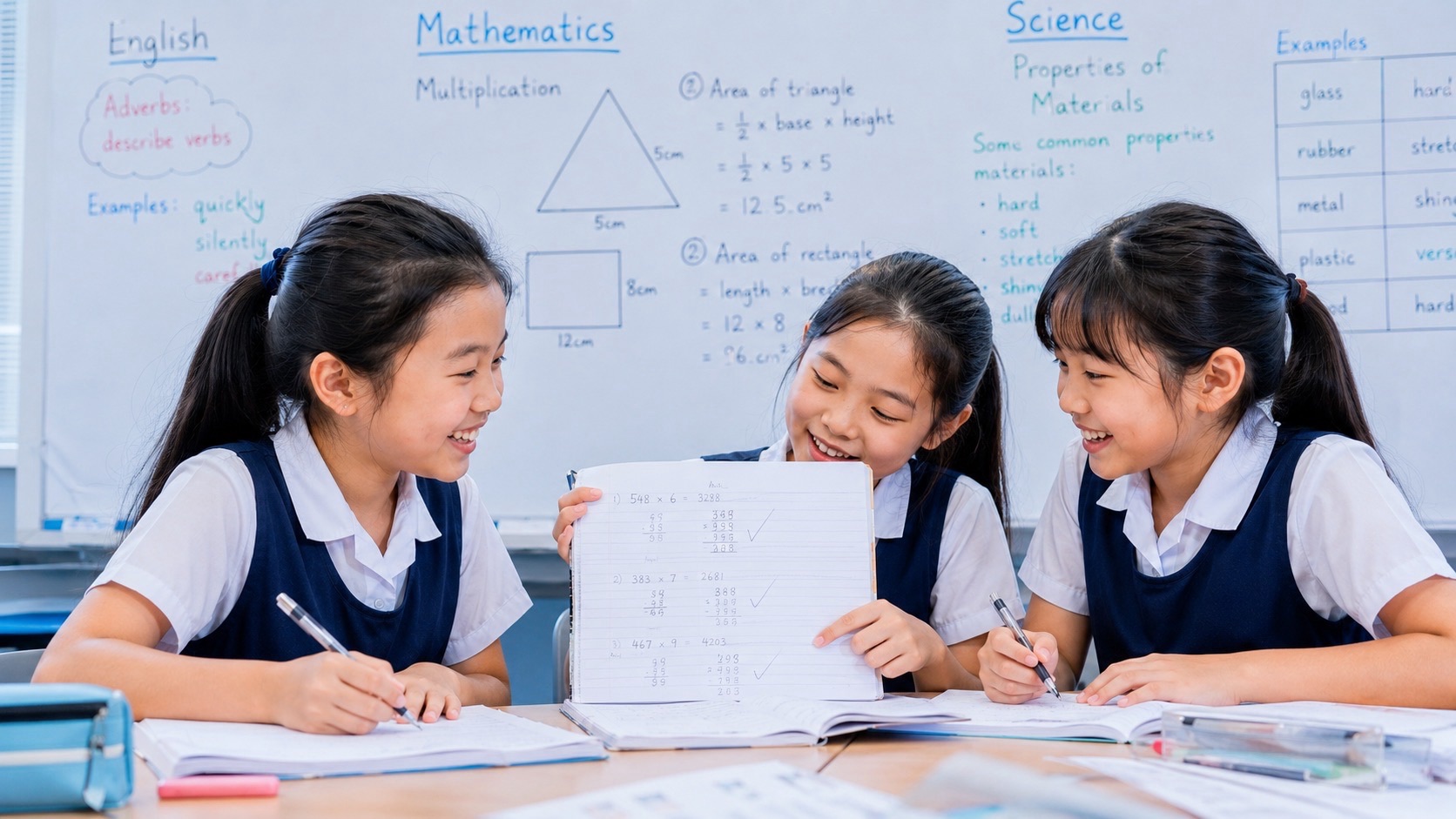
Why three students can improve P2 mathematical conversation
P2 children are beginning to articulate methods more clearly. A three-student group can turn those differences into useful evidence.
One learner may calculate 6 × 4 from memory. Another may see four groups of six. Another may double 6 × 2. The tutor can ask whether the methods preserve the same value and which route is most efficient in that moment.
The group also makes retrieval visible. A student hears another child reconstruct a forgotten fact and learns that not remembering instantly does not mean the problem is over.
Short independent intervals remain important. The tutor can rotate attention while observing whether each child continues, checks and recovers without continuous prompting.
That is how a small group can support independence rather than merely provide more adult attention.
Pass 8: Transfer means the relationship survives a changed wrapper
P2 learning should be tested across controlled changes.
- Turn an array into a word problem.
- Turn a word problem into equal groups.
- Ask for the number of groups instead of the amount in each group.
- Change the context from sweets to money.
- Place a familiar fact inside a measurement problem.
- Change the order of information.
- Mix addition, subtraction, multiplication and division.
- Return after several days.
The child should not be tricked. The purpose is to see whether the learner recognises what is mathematically invariant.
If one tiny wording change destroys performance, the learning may be narrower than the worksheet score suggested.
When P2 tuition may help
- P1 number and place-value foundations remain unstable.
- Addition and subtraction require excessive rebuilding.
- Multiplication facts are being memorised without equal-group meaning.
- Division is treated as an unrelated procedure.
- The child can do operations but cannot choose among them in word problems.
- Old learning disappears quickly after a topic ends.
- Homework requires continuous adult cueing.
- Confidence drops whenever support is reduced.
- A strong learner needs greater variation and reasoning rather than more repetitive pages.
The reason matters more than the year level. Tuition should solve a specific learning problem or provide purposeful stretch.
When P2 tuition may not be necessary
If school Mathematics is secure, older ideas return reliably and the child works with healthy independence, another formal class may not have a useful job.
Parents should distinguish between healthy effort and persistent failure. A child pausing to reconstruct a fact is not automatically weak. A new idea taking several encounters to stabilise is not automatically a problem.
Look for patterns over time rather than reacting to one worksheet.
Catch Up | Keep Up | Move Ahead in P2
Catch Up
Repair a P1 dependency such as quantity, place value, operation meaning, number bonds or basic representation. Do not force new fluency on top of a structure that the child still does not understand.
Keep Up
Strengthen current school Mathematics while deliberately returning to earlier work. Build multiplication and division relationships, word-problem interpretation and more reliable independent starts.
Move Ahead
Increase depth through alternative strategies, unfamiliar wording, reasoning, error detection and generalisation. Moving ahead does not have to mean racing into P3 worksheets.
How parents can help without becoming the first prompt
One of the most useful things a parent can change is the timing of help.
If the adult immediately names the operation, draws the model and reminds the child of the fact, homework may finish efficiently while hiding the child’s actual state.
Instead, try a short sequence:
- Ask what the question is saying.
- Ask what quantities are known.
- Ask what changed.
- Ask whether the child can draw or group it.
- Allow a short attempt.
- Give the smallest useful hint.
This preserves support while making independence observable.
Home Mathematics can build fluency without becoming drilling
- Use equal groups while packing or sharing objects.
- Estimate totals before exact calculation.
- Ask for another way to make the same number.
- Discuss how multiplication and division are related.
- Return to an old fact several days later.
- Ask which operation belongs and why.
- Let the child explain a route before correcting it.
Short, frequent, meaningful encounters are often more useful than turning home into a second worksheet centre.
A P2 progress dashboard
- Place value: remains reliable as numbers grow.
- Addition/subtraction: common relationships are more readily available.
- Multiplication/division: equal groups and inverse relationships remain visible beneath fact fluency.
- Selection: simple word problems require fewer adult cues about the operation.
- Representation: drawings, groups and symbols are used purposefully.
- Retrieval: important learning survives beyond the week it was taught.
- Checking: the learner begins noticing implausible answers.
- Independence: familiar work can continue for longer without intervention.
These are the capabilities P3 will begin combining under greater load.
P2 Mathematics Tuition in Bukit Timah: keeping the estate collision-free
BukitTimahTutor.com already has multiple P2 Mathematics representations. This page owns the commercial parent question: what should P2 tuition change in the learner?
- Primary 2 Mathematics Tutor | The Tutor Series owns the human tutor role.
- Primary 2 Mathematics Tutorial owns the bounded learning-event design.
- Primary Mathematics Journey | P1 to PSLE owns longitudinal progression.
- Primary Mathematics Tuition owns the broad commercial Primary route.
The pages can support one another because they answer different questions.
Frequently Asked Questions
Should P2 students memorise multiplication tables?
Useful facts should become increasingly fluent, but the child should also understand multiplication structure so a forgotten fact can be reconstructed and used meaningfully.
Why can my child do sums but not word problems?
The calculation may be secure while representation or operation selection is weak. The child has to interpret the relationship before calculating.
Should I worry if my child still counts?
Occasional counting is normal. The more useful question is whether the learner is gradually developing more efficient structures rather than depending on counting for nearly every calculation.
Is speed important in P2?
Useful fluency matters because later tasks place greater demands on working memory. Speed should grow from secure meaning and repeated retrieval rather than pressure detached from understanding.
What if my child forgets old topics?
Build short delayed retrieval into practice. Earlier ideas need to return after time has passed so they become part of a durable mathematical system.
How do I know whether P2 tuition is working?
Look for more reliable retrieval, clearer operation choice, stronger explanations, fewer repeated place-value errors and less dependence on adult prompts.
Final Thought: P2 is where learning begins learning how to return
Primary 1 gives the child many first formal ideas.
Primary 2 asks those ideas to come back when they are needed.
The number relationship learned last month has to remain available today. Multiplication has to stay connected to equal groups. Division has to stay connected to multiplication. A word problem has to be interpreted without the adult announcing the method.
The child begins discovering that learning Mathematics is not seeing a method once.
Understand it → practise it → retrieve it → recognise it in another form → use it with less help.
That is the quiet work of P2. When it is done well, P3 inherits more working memory, more reliable tools and a learner who can carry a larger part of the route alone.
Continue to P3 Mathematics Tuition or return to Primary Mathematics Tuition.
Primary routes: Primary Mathematics Learning Hub · Primary Mathematics Tuition · complete Mathematics directory.
Stabilising the Operations Floor: The Primary 2 Mathematics Capability Map
Primary 2 is the year when early understanding has to become dependable enough that later Mathematics can build on it. The numbers are still relatively small. The learning job is no longer small.
Primary 1 introduced number, equality, representation and the meaning of operations. Primary 2 begins to ask whether those ideas can return quickly, survive larger numbers, combine across steps and become reliable without constant adult prompting.
This is the operations floor. If it becomes stable, Primary 3 can introduce more complex multiplication, division, fractions, measurement and multi-step reasoning without forcing the child to rebuild basic number structure inside every problem.
What does “stable” mean in Primary 2?
Stable does not mean perfect. It means the learner can retrieve and use a capability with enough reliability that it no longer consumes all available attention.
A stable P2 learner should increasingly be able to:
- read and represent larger numbers accurately;
- use place value flexibly;
- add and subtract with growing fluency;
- understand multiplication as equal groups and repeated addition;
- understand division as sharing and grouping;
- move among words, diagrams and equations;
- choose a sensible operation from the relationship;
- check basic results independently;
- retrieve earlier learning after delay;
- start familiar work with less prompting.
P2 is where fluency begins to release working memory
Every mathematical task consumes attention. If the child has to reconstruct basic number bonds every time, less attention remains for the structure of a word problem or a measurement task.
This is why fluency matters. Fluency makes lower-level operations cheaper.
But fluency is not the same as rushing. Useful fluency combines:
- accuracy;
- reasonable speed;
- flexibility;
- understanding;
- ability to check.
Number facts should become a connected network
Instead of memorising each fact as an isolated item, the learner can build from known relationships.
If the child knows:
6+6=12,
then:
6+7=13
can be seen as one more.
If the child knows:
8+2=10,
then:
8+5
can be decomposed as:
8+2+3=13.
These connections reduce memory load and preserve meaning.
Place value must survive larger numbers
As numbers grow, the child should not lose the structure built in P1.
For 347:
- 3 hundreds;
- 4 tens;
- 7 ones.
But flexible place value goes further.
347 can also be:
- 34 tens and 7 ones;
- 300 + 40 + 7;
- 350 − 3;
- 3 hundreds, 3 tens and 17 ones.
This flexibility supports regrouping and mental calculation.
A useful P2 place-value stress test
Ask:
Which is larger: 309 or 390? Explain without saying only “390 is bigger”.
The child should recognise that both have 3 hundreds, but 390 has 9 tens while 309 has 0 tens.
This explanation reveals place-value understanding rather than numeral recognition.
Regrouping should remain an exchange, not a rule
When written addition or subtraction uses regrouping, the learner should still understand the exchange:
10 ones = 1 ten.
10 tens = 1 hundred.
The algorithm becomes shorter because the meaning is already known.
If regrouping becomes “borrow one and cross this out” without place-value meaning, later written computation becomes fragile.
Addition should become increasingly strategic
Not every addition needs the same method.
For:
49+26
a learner might use:
50+25=75.
This is compensation.
For:
38+22,
the learner may see:
38+2+20=60.
Flexible strategy selection is an early form of mathematical judgement.
Subtraction should become more than one algorithm
For:
52-49,
counting up from 49 to 52 gives 3 quickly.
For:
52-17,
a decomposition route may be easier.
The child should learn that subtraction can be solved through:
- take-away;
- comparison;
- counting up;
- partitioning;
- written regrouping.
Method choice should follow structure
The goal is not to teach as many tricks as possible. It is to help the child recognise which route is efficient and checkable.
Multiplication should begin as equal groups
Before times-table fluency becomes the main conversation, multiplication should represent structure.
Three groups of four can be represented as:
- 4+4+4;
- 3×4;
- an array with 3 rows of 4;
- 12 objects partitioned into 3 equal groups.
These representations connect multiplication to addition, geometry and later division.
Arrays make commutativity visible
A 3-by-4 array and a 4-by-3 array contain the same number of objects.
This makes:
3×4=4×3
visible rather than merely stated.
Multiplication facts should be built from structure
Useful anchors include:
- ×2 as doubling;
- ×5 through groups of five;
- ×10 through place-value scaling;
- ×4 as double-double;
- near facts built from known facts.
The child should gradually move toward retrieval while keeping these relationships available as reconstruction routes.
Division should remain attached to multiplication
If:
4×6=24,
then:
24÷6=4
and:
24÷4=6.
The multiplication fact family supports division retrieval.
Division has two important meanings
Sharing: 12 objects shared among 3 children gives 4 each.
Grouping: 12 objects placed into groups of 3 gives 4 groups.
The arithmetic answer can match while the question meaning differs.
Remainders should remain meaningful
If 14 objects are placed in groups of 4, there are 3 full groups with 2 left.
The remainder is not a decorative symbol. It describes what could not be included in full equal groups.
P2 word problems begin testing selection more seriously
In P1, many questions announce the operation clearly. In P2, relationships can look more similar on the surface.
Useful questions before calculation are:
- What quantities do we know?
- What is changing?
- Are we combining, comparing, sharing or grouping?
- What is the unknown?
Keyword hunting should begin to fade
The word “more” can appear in an addition relationship or in a comparison that is solved by subtraction.
The child should rely increasingly on the relationship rather than a single trigger word.
Representation should become deliberate
A P2 learner should begin choosing a representation because it helps.
Possible tools include:
- number bonds;
- bar models;
- arrays;
- number lines;
- simple tables;
- equations.
The tutor can ask: Which picture would make this problem easier to see?
Bar models should remain structural
A bar model is useful when it reveals:
- part-whole structure;
- comparison;
- missing quantities;
- equal groups.
It is not useful when the drawing becomes more complicated than the problem.
Measurement strengthens unit discipline
Length, mass, time and money all teach that a number needs context.
Thirty can mean:
- 30 cm;
- 30 g;
- 30 minutes;
- 30 cents.
The unit tells us what kind of quantity is being measured.
Unit conversion begins as relationship, not memorisation
When the curriculum introduces simple conversions, the child should understand the relationship between units.
Conversion should not become arbitrary movement of decimal points or zeros.
Time combines number and sequence
Time problems ask the child to coordinate:
- clock reading;
- duration;
- before and after;
- hours and minutes.
Duration is especially important because it differs from reading a single clock time.
Money reinforces place value and equivalence
Different coin or note combinations can represent the same value.
The child also learns that price comparison requires both quantity and unit understanding.
Geometry should remain property-based
Shapes can be rotated, resized or recoloured without changing their category.
The learner should use properties such as:
- number of sides;
- number of vertices;
- straight or curved edges;
- simple symmetry.
Data work should move from counting to interpreting
A simple table or graph can answer:
- Which category is largest?
- How many more?
- How many altogether?
- What is the difference?
The representation becomes a source of evidence.
Retrieval should be tested after delay
A child may complete a lesson successfully because the example is still fresh.
Return to the idea several days later. If it can be reconstructed without the original model, the learning is becoming durable.
Spaced return is better than one giant revision session
Short returns across time help the child retrieve rather than merely recognise.
Mixed practice introduces method selection
A page containing only addition makes method selection trivial.
A mixed page containing addition, subtraction, multiplication and division asks the child to interpret the relationship before calculating.
This is a controlled way to build independence.
Errors should be classified
P2 errors may come from:
- place value;
- fact retrieval;
- regrouping;
- operation choice;
- language;
- representation;
- units;
- copying;
- checking.
Different errors need different practice.
Repeated error is more informative than one isolated error
If the same regrouping mistake appears across many questions, it deserves targeted repair.
If errors are scattered and rare, the response may simply be more careful checking or more time.
Confidence can dip when adult help begins to withdraw
A child accustomed to immediate guidance may initially feel less confident when asked to attempt independently.
This does not necessarily mean the Mathematics is worsening. It may mean support is being transferred inward.
Prompt fading should be gradual
A useful ladder is:
- full worked example;
- representation supplied;
- strategic question;
- general encouragement;
- silence.
On familiar work, the learner should move down the ladder over time.
P2 should not become an examination year
Primary 2 remains early enough to protect mathematical meaning while fluency grows.
Short retrieval checks are useful. Constant high-stakes framing is not necessary for building a strong learner.
P2 study should include ordinary retrieval
A healthy weekly pattern can include:
- short fact retrieval;
- one or two word problems;
- mixed old/new questions;
- a representation task;
- a quick checking question.
Quality and recurrence matter more than excessive page volume.
The operations floor has to survive changed surfaces
If multiplication is secure only in a times-table list, it is not yet fully operational.
The child should recognise multiplication inside arrays, repeated groups, word problems and simple measurement contexts.
Transfer task: addition
Teach addition through number bonds.
Later test it through money or measurement.
The relationship should survive the wrapper.
Transfer task: multiplication
Teach equal groups with counters.
Later ask about rows of chairs or packs of items.
The child should recognise the multiplicative structure.
Transfer task: division
Teach sharing first, then grouping.
Ask the learner how the story changes even when the arithmetic fact belongs to the same family.
P2 diagnostic: larger place value
Ask:
Which number is 4 hundreds, 2 tens and 13 ones?
The child should regroup 13 ones as 1 ten and 3 ones, giving 433.
This tests flexible place value.
P2 diagnostic: missing-number equality
Ask:
18+7 = __ +10.
Both sides equal 25, so the blank is 15.
This tests equality rather than only calculation.
P2 diagnostic: multiplication representation
Ask the child to draw or describe 4 groups of 3.
Then ask for a different arrangement that gives the same product.
P2 diagnostic: division meaning
“Twelve biscuits are shared equally among four children.”
Then:
“Twelve biscuits are put into bags of four.”
Ask how the questions differ.
P2 diagnostic: word-problem selection
Give two problems using the word “more”, one requiring addition and one requiring subtraction through comparison.
Watch whether the child relies on the relationship or the keyword.
P2 diagnostic: delayed retrieval
Revisit a recently learned fact family after one week without announcing the topic.
Observe whether the route returns independently.
P2 diagnostic: checking
Give:
27+18=35.
Ask whether the answer can be reasonable before recalculating.
Since 27+10 already exceeds 35, the result should be questioned.
P2 diagnostic: independence
Present a familiar problem and wait before offering help.
Does the child begin? Choose a representation? Ask a specific question?
What a strong P2 Mathematics tuition lesson should do
A strong lesson should:
- check whether P1 number structure is still stable;
- build fluency from relationships;
- increase place-value flexibility;
- connect multiplication and division;
- train representation and operation choice;
- return to older learning after delay;
- classify errors rather than simply mark them;
- fade prompts on familiar work;
- end with an independent transfer question.
Why three students can improve P2 mathematical conversation
In a small group, one learner may solve through a number bond while another uses compensation. The tutor can ask each child to explain the route and compare which method is easiest to check.
This creates mathematical conversation without losing visibility into individual working.
The tutor should still preserve individual diagnosis
One child may need fact fluency. Another may need equality repair. Another may need more independent method selection.
A small group should make these differences visible, not erase them.
Catch Up in P2
Use when P1 floors such as place value, equality or basic operation meaning remain unstable.
Repair should be targeted and connected back to current P2 work quickly.
Keep Up in P2
Use when the learner understands current content but needs reliable retrieval, homework independence or mixed-practice selection.
Move Ahead in P2
Use when current operations are stable and the learner can benefit from a calm introduction to future multiplicative thinking, richer measurement or more complex problem structures.
Do not race ahead at the cost of retrieval.
Deepen in P2
A strong P2 learner can be challenged through:
- multiple methods;
- number patterns;
- reasoning puzzles;
- constructing examples;
- explaining why a rule works;
- finding and correcting a false solution.
What parents can observe
Parents can look for:
- faster retrieval without panic;
- better place-value language;
- less counting-all;
- more flexible mental methods;
- improved operation choice;
- ability to explain multiplication or division stories;
- more independent checking;
- less immediate demand for adult help.
Home Mathematics can build fluency without becoming drilling
Useful ordinary activities include:
- making totals with money;
- doubling recipes or quantities;
- grouping household items;
- reading times and durations;
- estimating totals before exact calculation.
The purpose is occasional reinforcement, not constant testing.
A P2 progress dashboard
| Signal | Useful direction |
|---|---|
| Fact retrieval | Faster and less dependent on counting. |
| Place value | More flexible decomposition and regrouping. |
| Operations | Chooses efficient methods rather than one fixed routine. |
| Multiplication | Connects equal groups, arrays and facts. |
| Division | Connects sharing, grouping and multiplication. |
| Word problems | Chooses operation from relationship. |
| Retrieval | Older learning returns after delay. |
| Checking | Uses inverse operations or estimation. |
| Independence | Needs fewer first-step prompts. |
P2 is the floor beneath P3 multiplicative complexity
Primary 3 will ask multiplication and division to carry more of the work. Fractions become more significant. Problems become more multi-step.
If P2 operations remain expensive, P3 complexity will feel much larger than it needs to.
The P2 release standard
Before moving into the next stage, the learner should increasingly be able to:
- handle place value with flexibility;
- add and subtract reliably;
- retrieve common facts with growing fluency;
- represent multiplication and division meaningfully;
- choose operations from relationships;
- use simple measurement and data representations;
- retrieve earlier ideas after delay;
- check familiar work independently;
- begin without immediate adult prompting.
Final Thought: P2 is where understanding becomes available on demand
Primary 1 asks the child to enter the world of formal Mathematics. Primary 2 asks that world to become more reliable.
Facts become easier to retrieve. Place value has to survive larger numbers. Operations become connected. Word problems ask for more selection. Adult prompts should begin to fade.
The goal is not to make the child fast at everything. It is to stabilise enough low-level Mathematics that the next stage can spend attention on new structure.
That is the P2 operations floor: meaning that returns, methods that can be chosen, and fluency that releases capacity for what comes next.
Primary 2 Operations Floor Fieldbook
The fieldbook below turns the P2 capability map into small diagnostic and teaching moves. The purpose is to help a tutor distinguish a child who needs more understanding from a child who needs retrieval, fluency, method selection, checking or independence.
Fieldbook 1: number bonds should become reconstruction tools
Ask the learner to solve:
8+7.
Then ask for a second method.
Possible routes:
8+2+5=15;7+7+1=15;10+5=15.
The child is not being asked to perform unnecessary extra work. The second method reveals whether number structure is flexible.
Fieldbook 2: fact retrieval should have a fallback route
Suppose the child cannot recall 6+8 immediately. A strong learner can reconstruct from a nearby fact such as 6+6 or make ten.
Fluency is stronger when memory and structure support one another.
Fieldbook 3: place-value equivalence
Ask the child to represent 245 in three ways.
Possible answers:
- 2 hundreds, 4 tens, 5 ones;
- 24 tens, 5 ones;
- 200+40+5.
Then ask whether 2 hundreds, 3 tens and 15 ones is also 245. The learner should be able to regroup 15 ones into 1 ten and 5 ones.
Fieldbook 4: compare without calculating everything
Which is larger:
398 or 403?
The child should use place value and magnitude rather than subtracting the two numbers mechanically.
This reveals whether the numeral is being read structurally.
Fieldbook 5: addition estimation
Before solving 47+31, ask whether the answer should be closer to 50, 80 or 120.
A child who estimates around 80 has built a useful checking expectation.
Fieldbook 6: subtraction as distance
Ask:
52-49.
If the child begins a long regrouping procedure, ask whether there is a shorter way.
Counting up from 49 to 52 reveals subtraction as difference, not only take-away.
Fieldbook 7: subtraction as missing part
“There are 25 books. 17 are on a shelf. How many are not on the shelf?”
The learner can see:
17+?=25
as well as:
25-17=?.
Both representations describe the same relationship.
Fieldbook 8: addition and subtraction inverse check
After solving 63-27=36, ask the learner to check with:
36+27=63.
Checking becomes part of the operation family.
Fieldbook 9: multiplication through equal groups
Ask the learner to represent 3×5 with counters or a drawing.
Then ask what 5×3 would look like.
The product is equal, but the orientation of the groups changes.
Fieldbook 10: multiplication through arrays
An array gives multiplication a geometric structure.
A 4×6 rectangle has 24 objects.
Rotate it and the same 24 objects become a 6×4 array.
This makes commutativity visible.
Fieldbook 11: build facts from known facts
If the learner knows 5×6=30, then:
6×6=36
can be seen as one extra group of six.
Fact learning becomes relational rather than isolated memorisation.
Fieldbook 12: division by sharing
“18 counters shared among 3 children.”
The learner should show 6 per child.
Ask what multiplication fact checks the answer.
Fieldbook 13: division by grouping
“18 counters placed in groups of 3.”
The learner should show 6 groups.
The same number fact appears under a different meaning.
Fieldbook 14: remainder meaning
“17 stickers are placed into groups of 5.”
The answer is 3 complete groups with 2 stickers remaining.
Ask what the 2 represents. A child who can explain the remainder understands more than the notation.
Fieldbook 15: operation choice without keywords
Give two stories:
“Siti has 14 marbles. Ben has 6 more than Siti.”
“Siti has 14 marbles. She has 6 more than Ben.”
The same words appear, but the relationship differs. The child should draw or describe the quantities before deciding the operation.
Fieldbook 16: remove the chapter heading
A mixed set with addition, subtraction, multiplication and division makes selection visible.
Do not make the set too difficult. The purpose is to test whether the learner recognises the structure without an operation label.
Fieldbook 17: represent first, calculate second
For a word problem, ask the child to draw a bar, array, number bond or equation before calculating.
This separates problem interpretation from arithmetic execution.
Fieldbook 18: choose the simplest useful representation
A representation is successful when it makes the relationship easier to see.
The learner should not be forced to draw a complicated model when a short equation or number line is clearer.
Fieldbook 19: reading duration
Ask:
“A lesson begins at 2:15 p.m. and ends at 3:00 p.m. How long is the lesson?”
This is not only clock reading. It is interval reasoning.
Fieldbook 20: time as a number line
Represent 2:15 to 3:00 on a time line:
- 2:15 → 2:30 = 15 minutes;
- 2:30 → 3:00 = 30 minutes;
- total = 45 minutes.
This makes duration visible as accumulated distance in time.
Fieldbook 21: money equivalence
Ask for three ways to make $1 using familiar coin values.
The child learns that different visible combinations can carry the same value.
Fieldbook 22: money comparison
Which is more: three 20-cent coins or one 50-cent coin?
The learner must compare total value rather than count of coins.
Fieldbook 23: measurement estimate before instrument
Before measuring a pencil, ask whether it is likely closer to 5 cm, 20 cm or 1 m.
Estimation gives the final measurement a plausibility check.
Fieldbook 24: units matter
Ask what is wrong with the answer:
“The table is 120 grams long.”
The number may be plausible; the unit describes the wrong attribute.
Fieldbook 25: graph reading with comparison
Give a picture graph with three categories.
Ask:
- which is greatest;
- how many more than another;
- how many in two categories combined.
The child moves from direct reading to derived comparison.
Fieldbook 26: retrieve after a week
Do not label the topic.
Place one multiplication or regrouping question inside ordinary mixed work.
If the learner can retrieve without the original model, the capability is becoming durable.
Fieldbook 27: retrieve after a change of representation
A multiplication fact learned through arrays can later appear as a word problem.
This combines retrieval and transfer.
Fieldbook 28: error classification
Suppose the child answers 46+27=613.
Possible mechanisms include:
- concatenating partial results;
- place-value confusion;
- regrouping failure;
- copying error.
Do not prescribe practice until the first invalid move is located.
Fieldbook 29: distinguish misunderstanding from memory lapse
If one cue immediately restores the method, the concept may be stable but retrieval weak.
If the child remains unsure even with cues, the representation or concept may need rebuilding.
Fieldbook 30: distinguish fluency from haste
A fluent learner performs common operations accurately with low effort.
A hasty learner performs quickly but loses structure and checking.
Speed should be interpreted alongside accuracy and method quality.
Fieldbook 31: reduce prompting deliberately
If the child usually asks “Is this plus?” before every word problem, do not answer immediately.
Ask:
“What are the quantities doing?”
The goal is to move operation choice inward.
Fieldbook 32: strategic hints preserve ownership
A useful hint changes the search space without supplying the answer.
Examples:
- “Can you draw the quantities?”
- “What whole do the parts belong to?”
- “Which multiplication fact is related?”
- “Can you check with the inverse?”
Fieldbook 33: home practice should be short enough to stay diagnostic
If a child is exhausted after twenty similar questions, later errors may reflect fatigue more than mathematical weakness.
A small amount of focused practice can reveal more than large undifferentiated volume.
Fieldbook 34: ask the child to explain one answer, not every answer
Explanation is useful, but over-explaining every trivial step can make Mathematics feel performative.
Choose one or two questions where explanation reveals important structure.
Fieldbook 35: use wrong answers as objects
Show:
24÷6=5.
Ask:
How could we prove this is wrong without redoing the whole problem?
The multiplication check 5×6=30 reveals the inconsistency.
Fieldbook 36: make checking independent
Before saying “correct”, ask:
“What makes you think it is correct?”
The child may estimate, reverse, recount or use another representation.
Fieldbook 37: build a small error log
For repeated errors, write only:
- the error type;
- one corrected example;
- one reminder question;
- one future retest.
An error log should support repair, not become a museum of mistakes.
Fieldbook 38: revisit repaired errors unannounced
After a regrouping repair, test it inside a mixed problem several days later.
Repair is complete only when the learner recognises and uses the skill without the original label.
Fieldbook 39: confidence through evidence
Useful teacher language includes:
- “You started without a hint.”
- “You checked that through multiplication.”
- “You found the place-value error yourself.”
- “You remembered this after a week.”
Confidence becomes connected to behaviour the learner can reproduce.
Fieldbook 40: strong P2 learners should still justify
A child who calculates quickly can be asked:
- Can you find a second method?
- Can you create a word problem for this equation?
- Can you explain why the method always works?
- Can you find a wrong method and repair it?
Depth protects against shallow acceleration.
P2 Failure Modes and Repairs
Failure mode 1: counting everything
The child still counts from one for simple additions.
Repair: build count-on strategies, bonds to 10, doubles and known-fact anchors.
Failure mode 2: place-value digits treated independently
The learner reads 305 as “3, 0, 5” without understanding hundreds and ones.
Repair: use base-ten representations and flexible decomposition.
Failure mode 3: regrouping as a memorised crossing-out ritual
Repair: return to exchanging ten ones for one ten and ten tens for one hundred.
Failure mode 4: multiplication is only a chant
Repair: connect facts to arrays, equal groups and known-fact derivations.
Failure mode 5: division is an isolated new rule
Repair: reconnect division to multiplication fact families and both sharing/grouping meanings.
Failure mode 6: keywords control word-problem operations
Repair: use contrast pairs where the same word appears in different relationships.
Failure mode 7: the child understands only with the model present
Repair: fade the representation gradually and require reconstruction after delay.
Failure mode 8: homework looks perfect because an adult carries the route
Repair: protect the first independent attempt. Use errors as evidence.
Failure mode 9: speed pressure reduces accuracy
Repair: stabilise the operation before increasing time pressure. Time only what is already understood.
Failure mode 10: repeated corrections do not change future behaviour
Repair: retest the error under changed surface and after delay.
P2 Weekly Learning Architecture
Contact point 1: learn or clarify
Introduce the relationship with a clear representation and one or two worked examples.
Contact point 2: retrieve
Return without the worked example. Ask the learner to reconstruct.
Contact point 3: vary
Change numbers, wording or representation.
Contact point 4: mix and verify
Place the skill beside other methods and ask the learner to choose, solve and check.
This four-contact rhythm turns one lesson into a small learning cycle.
P2 Monthly Review
At the end of a month, ask:
- Which facts became easier to retrieve?
- Which operation still consumes too much attention?
- Which error repeats?
- Can the learner solve changed word problems?
- Are adult prompts decreasing?
- Is checking becoming more independent?
The next month should target the highest-leverage answer.
P2 Term Review
Across a school term, progress should be visible in more than marks.
Look for:
- cleaner place-value reasoning;
- greater operation fluency;
- stronger multiplication/division connection;
- more durable retrieval;
- less keyword dependence;
- better transfer;
- greater independence.
How P2 Prepares the Child for P3
Primary 3 introduces a larger multiplicative world. Multiplication and division become more central. Fractions change the idea of number. Problems contain more steps.
If the P2 operations floor is stable, the child can spend attention on these new relationships.
If it is unstable, every P3 problem becomes a combination of new content and unfinished basic operations.
What should become quiet infrastructure by the end of P2?
- basic place-value interpretation;
- common addition/subtraction strategies;
- many foundational number facts;
- equality meaning;
- simple inverse checks;
- basic representation habits;
- understanding of equal groups;
- the link between multiplication and division.
What can remain under development?
Perfect speed is not required. Complete independence is not required. Every multiplication fact does not need instant recall.
The learner needs enough stability that these areas no longer block access to P3 Mathematics.
P2 Parent Questions
Should my child memorise multiplication tables now?
Fact fluency is valuable, but memorisation should remain connected to equal groups, arrays and known-fact relationships. Retrieval becomes stronger when facts have structure.
What if my child is accurate but slow?
Find where the time is going. If common facts require repeated counting, fluency work may help. If the child spends time interpreting word problems, representation may be the real bottleneck.
What if my child is fast but inaccurate?
Slow only the high-risk parts. Build checking and cleaner working rather than punishing speed itself.
What if my child forgets after a few days?
Use spaced retrieval. Do not assume the first explanation failed. Memory access often needs repeated reconstruction.
What if school work seems easy?
Deepen before racing. Ask for alternative methods, explanation, transfer and reasoning. If those are strong too, then a calm future preview can be appropriate.
When is tuition unnecessary?
If the child is learning independently, retaining earlier work, following school, recovering from mistakes and maintaining stable progress, additional tuition may not add enough value to justify the time.
P2 Release Checklist
- Place value remains stable with larger numbers.
- Addition and subtraction are accurate and increasingly fluent.
- The child can use more than one sensible calculation strategy.
- Multiplication has equal-group and array meaning.
- Division remains connected to multiplication.
- Word-problem operations are selected from relationships.
- Measurement answers preserve appropriate units.
- Older learning can be retrieved after delay.
- Repeated errors are narrowing rather than spreading.
- Independent checking is beginning to appear.
- The child starts familiar work with less adult prompting.
Final Release Note
Primary 2 succeeds when early mathematical meaning becomes reliable enough to carry load. The child should not have to rebuild the meaning of every digit, operation and equality sign inside the next year’s problems.
The operations floor should become quiet enough that attention can move upward.
That is the real P2 progression: understanding becomes retrieval, retrieval becomes fluency, fluency becomes available capacity, and available capacity makes Primary 3 complexity learnable.
P2 Final Stability Clinic: How to Know the Operations Floor Is Ready
The end of Primary 2 should not be judged by one worksheet or one test. The more useful release question is whether the learner can carry core operations into changed settings without rebuilding the entire route each time.
Stability test 1: remove the example
After teaching a method, close the notes and give a new question of the same structure. The learner should be able to reconstruct more of the route from memory.
If the child succeeds only while the model remains visible, recognition is stronger than retrieval.
Stability test 2: change the numbers
A method learned with friendly numbers should survive less familiar values.
For example, a child who understands regrouping with 42+18 should eventually handle a similar structure such as 57+26 without needing a new explanation.
Stability test 3: change the context
Move addition from plain numbers into money or measurement. Move multiplication from arrays into packs of objects. Move division from sharing into grouping.
The relationship should survive the changed story.
Stability test 4: mix operations
Place several familiar operation types together. Do not announce which one belongs to each question.
This tests selection rather than procedure alone.
Stability test 5: return after time
Revisit the skill several days later. The learner should not need to relearn from the beginning.
A small reminder may still be reasonable. The useful direction is faster reconstruction and less support.
Stability test 6: ask for one explanation
Choose a question where the child can explain why the operation matches the relationship.
This checks whether fluency has remained attached to meaning.
Stability test 7: ask for one check
The child should be able to verify through:
- inverse operation;
- estimate;
- another representation;
- recounting;
- known fact.
Checking shows that the answer is not being accepted merely because it was produced.
Stability test 8: observe the first minute
Does the child begin familiar work independently? Do they choose a representation or ask a specific question?
Starting behaviour is one of the clearest indicators that adult control is moving inward.
Stability test 9: inspect repeated errors
One error is ordinary. The same error repeated across weeks tells us that a mechanism remains unstable.
At release, repeated error signatures should be narrowing rather than multiplying.
Stability test 10: protect working memory
Ask whether simple operations are still consuming so much attention that the child cannot follow a multi-step story.
If yes, the floor may need more fluency before the P3 load increases.
The P2-to-P3 Handover
Primary 3 will ask the child to operate with more multiplicative structure, fractions and longer problems. The handover should therefore include a clear picture of what is already stable and what still needs light maintenance.
Stable enough to carry forward
- place value;
- common addition and subtraction;
- basic equality sense;
- growing multiplication-fact network;
- division meaning;
- simple word-problem representation;
- unit awareness;
- basic checking.
Still developing normally
- full multiplication-table speed;
- complex multi-step selection;
- advanced fraction reasoning;
- complete independence.
These do not need to be perfect before P3. They need enough structure that new learning can attach to them.
Parent Decision: More Practice or Different Practice?
When progress stalls, ask whether the child needs more repetitions of the same method or a different learning demand.
More practice is useful when:
- the method is understood but still slow;
- retrieval is inconsistent;
- accuracy improves with repetition.
Different practice is useful when:
- the same misconception repeats;
- changed wording causes collapse;
- the child cannot choose the operation;
- the skill disappears outside a labelled worksheet.
Tutor Decision: Explain, Practise, Mix or Fade?
A P2 tutor should be able to identify which mode belongs next.
Explain
Use when the relationship is not understood.
Practise
Use when the relationship is understood but execution is unstable.
Mix
Use when individual methods are stable but selection is weak.
Fade
Use when the child is succeeding but still waits for unnecessary adult confirmation.
Small-Group Release
In a three-student class, the tutor can use the group to strengthen transfer.
One student explains a number-bond route. Another shows compensation. A third checks through the inverse. The Mathematics remains shared while the reasoning paths differ.
The tutor can then ask each child to solve the next problem independently.
The group interaction becomes a source of representation and language, not a substitute for individual control.
Final Parent Dashboard Before P3
| Question | Healthy release signal |
|---|---|
| Can my child start? | Familiar work begins without immediate prompting. |
| Can my child retrieve? | Earlier skills return after days or weeks. |
| Can my child choose? | Operation follows the relationship, not only keywords. |
| Can my child calculate? | Core addition/subtraction and growing multiplication facts are reliable. |
| Can my child represent? | Uses number line, bar, array or equation when useful. |
| Can my child check? | Uses inverse, estimate or another route. |
| Can my child recover? | An error does not end the attempt. |
The Final P2 Principle
Primary 2 is successful when the child’s early Mathematics becomes available on demand often enough to support the next layer.
The learner does not need every fact to be instantaneous. They do need enough place value, operation meaning, fluency, retrieval, selection and checking that Primary 3 can introduce genuinely new complexity instead of spending every lesson repairing the same first-floor structure.
That is the release condition for the operations floor: the child can carry it quietly enough that attention is free to move upward.
P2 Last-Mile Release: The Operations Floor in Real Work
The final Primary 2 question is not whether the child can complete another page of familiar operations. It is whether those operations now behave like dependable infrastructure when the problem changes around them.
Release signal: addition no longer steals all the attention
When a word problem requires addition, the child should increasingly spend attention on the relationship and less on reconstructing every fact from one. The arithmetic does not need to be instantaneous, but it should be reliable enough that the story remains visible.
Release signal: subtraction can be interpreted in more than one way
The learner should recognise subtraction as take-away, comparison, missing part and distance where appropriate. This flexibility becomes important when P3 word problems stop announcing the operation so clearly.
Release signal: multiplication has meaning before speed
The child should be able to connect multiplication to equal groups and arrays, then use known facts to reconstruct less familiar facts. Times-table fluency becomes more valuable when it is attached to structure.
Release signal: division remains connected to multiplication
A child who knows 4×6=24 should increasingly be able to use that fact to understand 24÷4 and 24÷6. This reduces the number of isolated facts that must be learned.
Release signal: the child can choose a representation
When the problem is difficult, the learner should have more than one way to make it visible: a bar, number bond, array, number line, table or equation.
The representation does not need to be elaborate. It needs to reduce confusion.
Release signal: the child can retrieve after the lesson has faded
Immediate success is encouraging. Delayed success is stronger evidence. A P2 capability is becoming stable when it can return after several days without the tutor rebuilding the entire explanation.
Release signal: repeated errors are becoming more local
Early in repair, the child may make many connected errors. As the floor stabilises, mistakes should become fewer, narrower and easier to identify.
A learner who now makes one local calculation error instead of misunderstanding the whole representation has still progressed.
Release signal: adult prompts move later
A child may still need help. The important direction is that help becomes less immediate and less specific. The learner starts, represents and attempts more of the route independently.
Release signal: checking begins before external marking
The child starts to notice implausible answers, uses an inverse operation, estimates or recounts before showing the work to an adult.
This is the beginning of mathematical self-regulation.
What should not be required before P3?
Primary 2 does not need to produce a perfectly fluent miniature adult mathematician. It does not require:
- instant recall of every possible fact;
- complete independence on unfamiliar multi-step problems;
- advanced fraction reasoning;
- long timed-paper stamina.
Those belong to later development.
What should be dependable enough?
- place value;
- common addition and subtraction;
- basic equality meaning;
- multiplicative representation;
- division meaning;
- simple operation selection;
- unit awareness;
- retrieval and checking habits.
The P2-to-P3 compact
Understand → retrieve → perform → choose → check.
Primary 2 has done its job when these five moves are becoming dependable enough that Primary 3 can add complexity without making every new topic carry the weight of unfinished early operations.
Final Thought
The operations floor should become increasingly quiet. A stable floor does not disappear; it stops demanding constant attention.
That is the P2 release standard: the child carries basic number and operations strongly enough that the next year can introduce richer multiplication, division, fractions and multi-step structure without losing the Mathematics underneath.
P2 Floor Closure
The final release condition is not a perfect worksheet. It is a learner whose early operations are becoming dependable under ordinary variation. Change the numbers, change the story, remove the worked example, return after a week, or place the skill beside another operation. The child should increasingly recognise the relationship and reconstruct a sensible route.
Parents can therefore read Primary 2 progress through four quiet questions. Can the child begin without an immediate prompt? Can earlier number facts and operation ideas return after delay? Can the child choose an operation from the relationship rather than a keyword? Can the child produce some independent evidence that the answer is reasonable?
If those capacities are strengthening, the operations floor is doing its job even if speed is still developing. If they remain fragile, more syllabus distance is less valuable than repairing the specific load-bearing mechanism.
Primary 2 should leave the learner with more available attention than they had at the start of the year. Basic place value, addition, subtraction and early multiplicative structure should consume less mental effort, leaving more room for the fractions, measurement, multiplication, division and multi-step reasoning that expand in Primary 3.
That is the final P2 standard: not a child who has finished Mathematics early, but a child whose first operating system is reliable enough to carry the next mathematical layer.
The final P2 release signal is portability. Core operations should still work when the numbers change, the story changes, the worksheet label disappears or the skill returns after time. The child does not need perfect speed; they need enough reliable place value, operation meaning, retrieval, selection and checking that these early capabilities no longer consume all available attention. When that happens, the Primary 2 operations floor has become genuine infrastructure for the richer multiplication, division, fractions and multi-step reasoning of Primary 3.
P2 is complete enough when these early operations travel with the learner: across changed numbers, changed stories, mixed practice and delayed return. That portability—not worksheet familiarity—is the final sign that understanding has become a dependable operations floor for Primary 3.
Stable operations create room for the next mathematics to grow.