
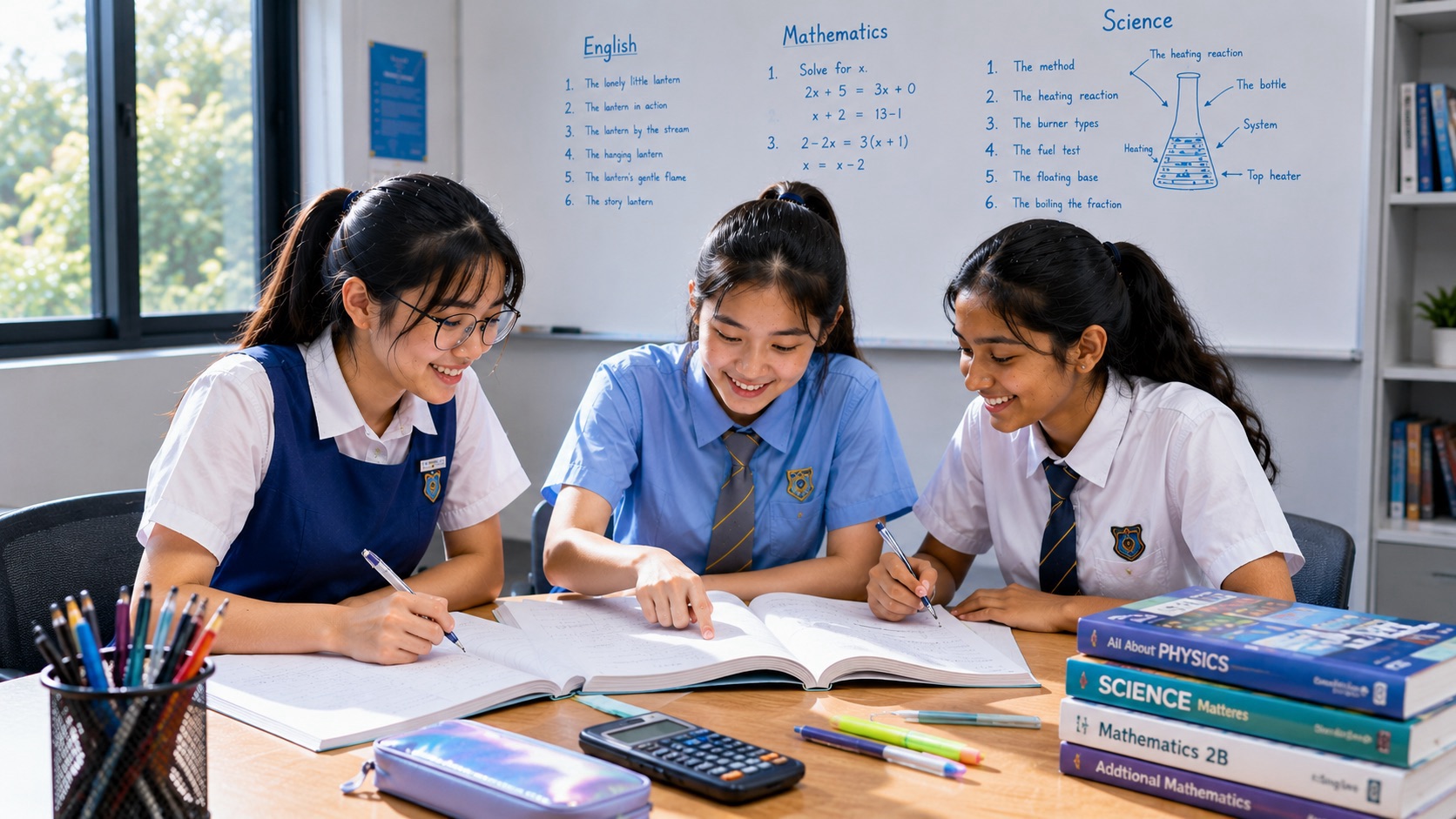
Singapore performs exceptionally strongly in major international Mathematics assessments. In TIMSS 2023, Singapore ranked first in Grade 4 Mathematics with a mean score of 615 and first in Grade 8 Mathematics with 605. In PISA 2022, Singapore scored 575 in Mathematics, significantly higher on average than all other participating countries and economies.
Those results are real. But they do not prove that one textbook, one teaching method or one feature of Singapore Math caused the outcome. International-assessment results reflect many interacting factors: curriculum, implementation, teacher knowledge, student background, school resources, assessment culture and wider social conditions.
What TIMSS and PISA measure differently
TIMSS is strongly curriculum-related and studies what students at Grade 4 and Grade 8 know in Mathematics and Science together with detailed information about curriculum and implementation. PISA assesses 15-year-olds and emphasises mathematical reasoning in real-life situations—formulating, employing and interpreting Mathematics.
What the Singapore results show
- Singapore students perform strongly on curriculum-linked Mathematics at both primary and lower-secondary stages.
- Singapore students also perform strongly on PISA’s application and mathematical-reasoning tasks.
- High average performance does not mean every student performs equally well; OECD data also show meaningful socio-economic performance differences inside Singapore.
What can reasonably transfer
The most portable features are not national league-table rankings. They are curriculum and teaching design principles that can be used in another country without recreating Singapore’s entire education system.
- Coherent sequencing: identify what a new idea depends on before teaching it.
- Representation: move between concrete, pictorial, graphical and symbolic forms.
- Problem solving: teach learners to formulate and represent unfamiliar problems rather than match keywords.
- Fluency with meaning: practise enough for important procedures to become reliable without separating them from concepts.
- Cumulative review: keep earlier Mathematics retrievable as new topics are added.
- Reasoning and communication: ask why a method works and what a result means.
What should not be copied blindly
- A Singapore textbook level without placement evidence.
- PSLE-style examination preparation for a child who does not sit PSLE.
- Bar modelling for every problem even after algebra becomes more efficient.
- Worksheet volume without diagnosis or reflection.
- A belief that one national practice must suit every local curriculum.
The deeper lesson from TIMSS
Recent TIMSS analysis distinguishes the intended curriculum, the curriculum actually implemented in classrooms and the Mathematics students ultimately attain. That distinction matters internationally: buying a Singapore textbook does not automatically reproduce Singapore classroom implementation or student outcomes.
Use Singapore Math Worldwide for the transferable methods, and the Curriculum Crosswalk when adapting them to another system.
Sources checked 26 September 2026: IEA TIMSS 2023, Singapore MOE TIMSS results, OECD PISA 2022 Singapore country note and PISA 2022 Volume I.
What can actually transfer from Singapore Mathematics performance
International assessments measure specific populations and constructs
TIMSS and PISA are not identical examinations and should not be treated as one global league table. They sample different ages or grades and emphasise different constructs. Any claim about Singapore’s performance should identify the assessment, cycle and population rather than convert a historical result into a timeless national trait.
Curriculum coherence is more transferable than slogans
A coherent sequence makes prerequisites available when new ideas are introduced. Other systems can learn from careful progression, but copying chapter titles without teacher knowledge, time and assessment alignment does not recreate coherence.
Representation is a teaching principle
Concrete, pictorial and symbolic representations can help learners build meaning when chosen deliberately. The transferable idea is not that every lesson must display three stages mechanically; it is that abstract notation should connect to understandable structure.
Problem solving needs explicit development
Singapore Mathematics places substantial emphasis on problem solving and representation. What transfers is the practice of making relationships visible, comparing strategies and requiring reasoning—not simply importing a list of named heuristics.
Teacher expertise is part of the system
High-quality curriculum materials depend on teachers who can diagnose misconceptions, choose examples and adapt explanations. A country cannot import outcomes by purchasing textbooks while ignoring professional knowledge and classroom conditions.
Assessment shapes what becomes reliable
If assessment rewards only routine speed, classrooms will rationally allocate time differently from a system that also rewards reasoning and application. Transfer therefore requires alignment among curriculum, teaching, practice and assessment.
Mastery does not mean every learner moves at one speed
A mastery-oriented approach can keep common ambitious goals while varying support, examples and time. The transferable principle is to repair prerequisites rather than permanently lowering the mathematical demand after an early struggle.
Practice quality matters
Cumulative retrieval, variation and mixed problem solving build retention and selection. Repetition alone can create short-term fluency that disappears when question order changes.
Culture should not be used as a catch-all explanation
Household expectations, tuition, language, teacher systems, curriculum design and policy all interact. Broad cultural claims are difficult to isolate and can hide mechanisms that are actually actionable.
What not to copy
Do not copy workload, examination pressure or surface features merely because they coexist with high scores. A useful transfer asks which mechanism has evidence and whether the receiving system has the conditions to support it.
A school-level transfer checklist
Clarify the curriculum sequence, strengthen teacher content knowledge, choose representations intentionally, diagnose prerequisites, use cumulative practice and align assessments with the desired reasoning. Then measure whether student understanding changes.
Keep claims dated
International assessment frameworks and results change. A responsible page separates durable teaching principles from current comparative data and links readers to the latest official assessment sources for fresh numbers.
World Mathematics route: return to the World Mathematics Atlas to connect Singapore Math methods with school levels, international curricula, examinations, competitions and university Mathematics.
World Mathematics route: return to the World Mathematics Atlas to place this Singapore Math idea inside the wider school, curriculum, examination and university map.