
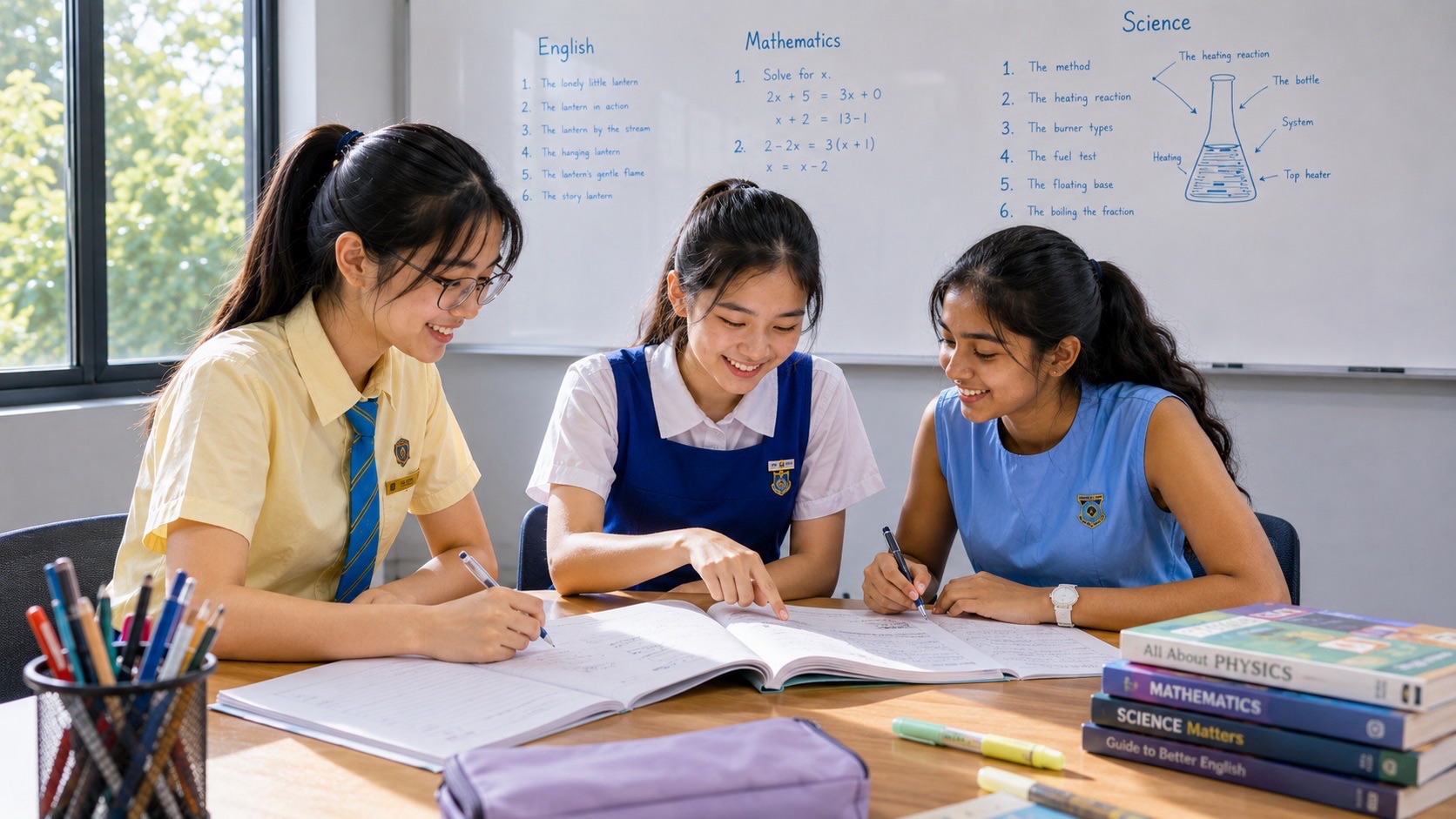
Singapore and Finland both have national curriculum frameworks, but they organise local curriculum, assessment and upper-secondary pathways differently. Comparing them usefully means looking at mathematical progression and learner expectations rather than treating international reputation as evidence of superiority.
Finland basic education
Finland’s national core curriculum provides a uniform foundation for local curricula, while municipalities and schools specify teaching in greater detail. The current basic-education curriculum was introduced progressively from 2016 through 2019. Mathematics remains one of the core subjects within that framework.
Local flexibility is part of the system
Finland’s national framework deliberately leaves room for local curricula. That differs from treating every Finnish classroom as if it followed one identical textbook sequence. A transfer student should therefore examine the destination school’s local curriculum as well as the national framework.
Upper secondary Mathematics
Finland’s current general upper-secondary curriculum, implemented from 2021, offers advanced Mathematics and basic Mathematics syllabi. The Finnish National Agency for Education states that the advanced syllabus carries 18 compulsory credits plus optional studies, while the basic syllabus carries 10 compulsory credits plus optional studies.
What the Finnish framework emphasises
Official Finnish curriculum guidance describes Mathematics teaching as encouraging students to ask questions, make assumptions, draw and justify conclusions, create solutions and connect Mathematics with everyday life. These aims overlap with Singapore’s problem-solving and reasoning emphasis, even though the curricular organisation and assessment system differ.
Transfer risks
- A Finnish learner may come from a locally adapted sequence rather than a single national textbook order.
- A Singapore learner may be more accustomed to centrally specified examination routes.
- Upper-secondary basic/advanced Mathematics does not translate directly into Singapore H1/H2 labels.
- Assessment culture and school-level pacing can differ substantially.
Crosswalk by mathematical object
Compare number, algebra, functions, geometry, trigonometry, calculus, probability and statistics independently. Then map those results to the destination syllabus rather than converting school labels directly.
This comparison is a transfer tool, not a ranking of education systems.
Official sources checked 26 September 2026: Finnish National Agency for Education basic-education and general upper-secondary curriculum information.
World Mathematics route: return to the World Mathematics Atlas for the wider map across curricula, examinations, school stages, mathematical objects and university routes.