
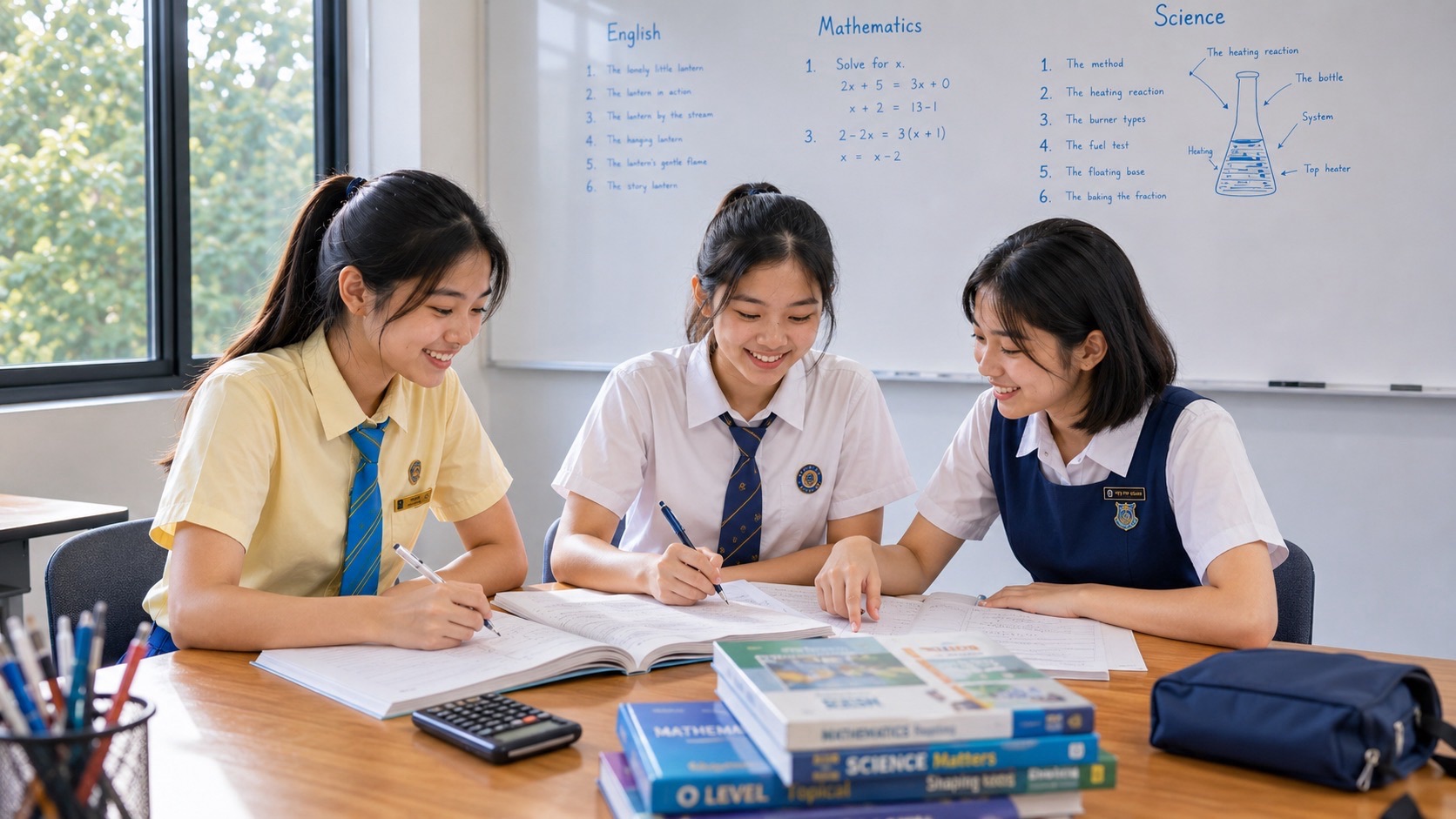
SASMO is the Singapore and Asian Schools Math Olympiad. The organiser describes it as a competition combining school Mathematics with higher-order and olympiad-style thinking, making it a broad entry point into non-routine competition Mathematics rather than a pure proof olympiad.
SASMO currently spans Kindergarten 2 through Primary, Secondary and JC/Grade 12 levels. For Grade 1 to 12, the organiser states that the contest is 90 minutes with 25 questions in two sections; the K2 route is shorter. Each level has a differentiated paper.
Why SASMO feels different from school worksheets
The syllabus combines familiar school domains—arithmetic, algebra, geometry, mensuration, statistics and probability—with non-routine problem solving such as number patterns, divisibility, spatial visualisation, logic and cryptarithms. A learner can therefore recognise the Mathematics but still struggle to decide how to start.
Preparation should have two lanes
| Lane | Purpose |
|---|---|
| School Mathematics | Keep arithmetic, algebra, geometry and data skills accurate and retrievable. |
| Non-routine Mathematics | Train representation, casework, pattern recognition, logic and strategic search. |
Students who train only puzzle tricks can become brittle. Students who train only routine school exercises can become slow to recognise unfamiliar structure. SASMO sits between those worlds, so preparation should deliberately connect them.
A reliable practice cycle
- Attempt under untimed conditions first.
- Mark where the first unproductive decision occurred.
- Classify the problem by mathematical object and thinking move.
- Study the solution only after the attempt has generated a real question.
- Redo a variation without looking at the original solution.
- Add time pressure only after the method is independently recoverable.
Current Singapore timing
For Singapore schools in 2026, SASMO registration information listed a competition window from 9 March to 7 April 2026, with the date set by participating Singapore schools. Competition dates and fees are operational details and should be checked each year rather than copied forward.
Useful BTT routes
- Mathematics Olympiad & Competition Hub
- Primary Mathematics Learning Hub
- Secondary Mathematics Learning Hub
- Mathematical Lab
Frequently asked questions
Is SASMO a pure olympiad paper?
The organiser explicitly describes the papers as touching both school and olympiad Mathematics. That hybrid structure is central to the competition.
Should students memorise question types?
Recognising structures is useful; memorising surface templates is not enough. Preparation should ask why a method works and how it changes when the numbers or constraints change.
Official source checked 26 September 2026: SASMO and its 2026 registration page. Recheck dates, fees and local arrangements for the current competition year.
World Mathematics route: return to the World Mathematics Atlas for the wider map across competitions, school Mathematics, examinations, mathematical objects and university routes.
SASMO preparation: build breadth, selection and review rather than a trick catalogue
SASMO should extend school Mathematics rather than replace it
Students still need secure arithmetic, fractions, algebra appropriate to level and ordinary school problem solving. Competition practice works best when those foundations are available.
The paper rewards unfamiliar combinations
A familiar concept may appear inside an unusual story, pattern or diagram. Train students to identify quantities and constraints before searching memory for a named trick.
Number reasoning is high leverage
Factors, divisibility, parity, remainders and place value can generate rich problems without advanced notation.
Counting needs organisation
Use tables, tree structures and systematic cases. The student should know why every case appears once.
Geometry needs visual discipline
Redraw crowded figures, mark equal lengths/angles and look for symmetry or area relationships. Do not trust scale.
Algebra should emerge when it simplifies
Younger students can reason arithmetically or with models; older students can compress relationships into equations. Choose the representation that reduces complexity.
Multiple-choice options can be diagnostic
Elimination and estimation are legitimate strategies, but students should understand why an option is impossible rather than guess from appearance.
Timed practice comes after strategy learning
Early sessions should allow enough time to explore. Later, practise question selection and moving on from a blocked problem.
Review wrong answers by cause
Separate concept gap, misread condition, incomplete casework, arithmetic slip and time-pressure decision. Each requires a different repair.
Use near-transfer
After learning a solution, change numbers, orientation or context. If the student can only solve the original, the strategy has not transferred.
Competition load should remain healthy
One or two meaningful contests with review can teach more than continuous registration. Protect schoolwork, sleep and motivation.
Current administration belongs to the organiser
Dates, categories, registration and award rules can change. Keep official SASMO information as the operational source.