
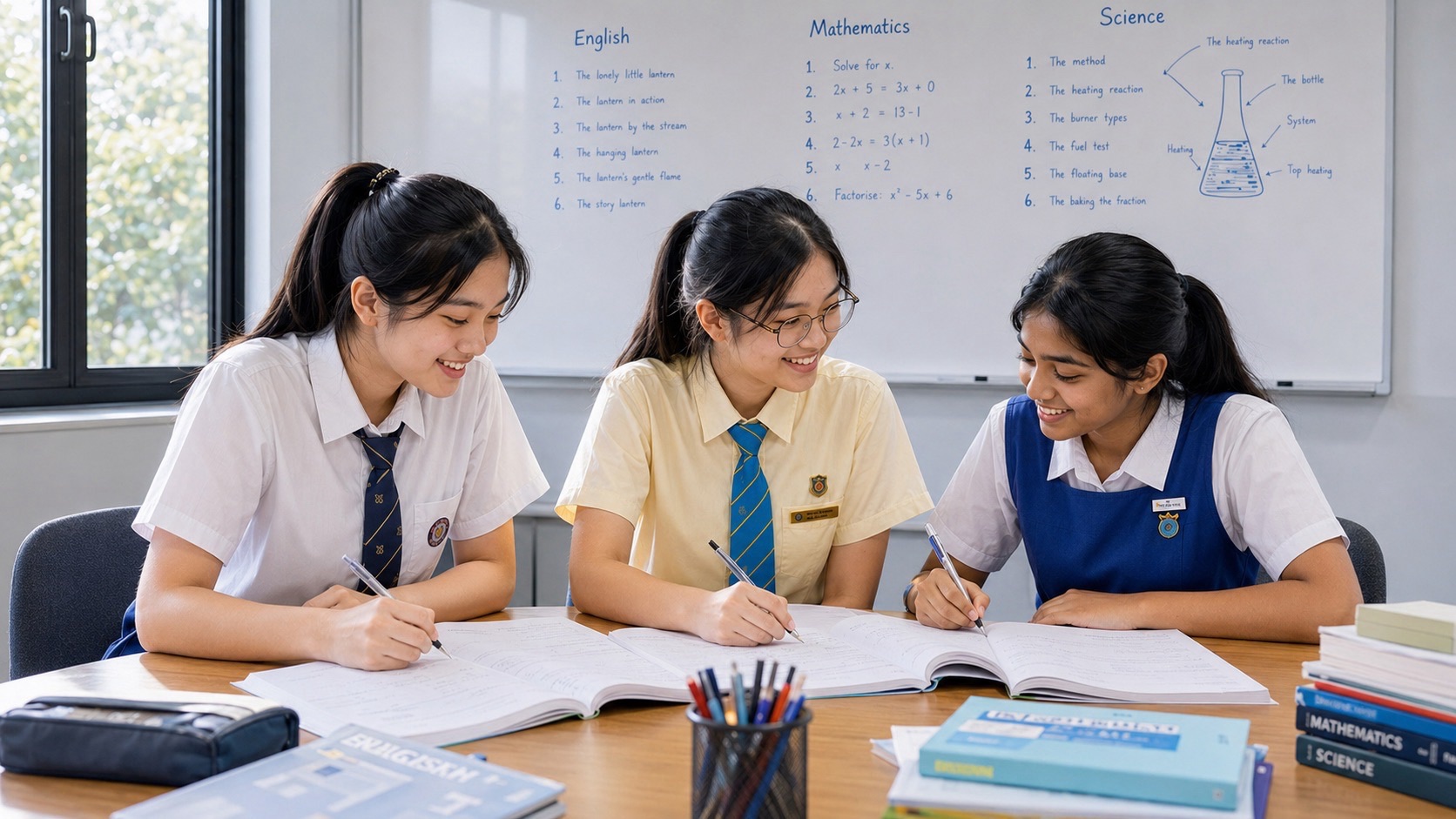
Math Olympiad Singapore is Bukit Timah Tutor’s hub for students, parents and teachers trying to understand APMOPS, NMO∑, SASMO, SMO and the wider international competition pathway. It explains how competition Mathematics differs from ordinary school Mathematics, which competitions sit at which level, and how to build the reasoning needed to progress from school problems into non-routine problem solving.
This hub covers Singapore and international competition routes, including APMOPS, NMO∑, SASMO, the Singapore Mathematical Olympiad, AMC and AIME, APMO and the International Mathematical Olympiad. It also connects those competitions to the mathematical domains that repeatedly appear underneath them: number theory, combinatorics, geometry, algebra, inequalities, functional equations, invariants, extremal reasoning and proof.
The point is not to collect medals or difficult worksheets. The useful question is: what kind of mathematical thinking does this competition demand, and what should the learner build next? Use this hub to choose the competition pathway, then move into the domain, preparation or diagnostic route that matches the learner.
Which Mathematics competition fits the learner?
There is no official universal ranking of Singapore Mathematics competitions by “difficulty” or DSA value. Start instead with eligibility, access, paper format and the kind of mathematical experience the learner wants, then confirm the current year’s rules with the organiser.
| Competition route | Current role | Check before entering |
|---|---|---|
| APMOPS | Hwa Chong primary-school olympiad route; formerly SMOPS. | Current P5/P6 access, school/centre registration and round rules. |
| NMO∑ | NUS High primary Mathematics competition route. | Current school eligibility, registration route and paper format. |
| SASMO | Broad school-plus-olympiad competition spanning many age levels. | Current level, school/centre registration and local contest date. |
| SMO | Singapore Mathematical Society Junior, Senior and Open national olympiad route. | Section eligibility and the shift from short-answer Round 1 work toward full-solution proof in later rounds. |
| AMC 8 / 10 / 12 | American Mathematics Competitions route with grade/age eligibility and a pathway toward AIME. | Which AMC level applies and how international registration is handled. |
Decision rule: remove competitions the learner cannot currently enter, then compare the published paper format with the learner’s goal. A student seeking broad non-routine exposure, a student moving toward proof, and a student entering a national selection pathway are solving different problems.
Start with the learner, not the competition name
A competition can be motivating when it gives a learner room to explore, test ideas and experience Mathematics outside the narrow rhythm of chapter exercises. It can also become counterproductive when preparation turns into memorising tricks, collecting certificates or pushing difficulty far beyond the learner’s current mathematical control.
BTT therefore treats competition Mathematics as a progression. The learner first needs reliable school Mathematics, then flexible representation, then non-routine strategy, then proof and deeper domain knowledge. A student who cannot yet control fractions, ratio, algebraic transformation or basic geometry does not benefit from being handed an olympiad label. The missing prerequisite still has to be repaired.
Singapore primary competition routes
APMOPS | formerly SMOPS
The Asia-Pacific Mathematical Olympiad for Primary Schools is organised by Hwa Chong Institution. The competition began as the Singapore Mathematical Olympiad for Primary School, or SMOPS, and was renamed APMOPS in 2002 as overseas participation expanded. BTT keeps the older SMOPS name visible as a search and historical bridge, but the current competition name should be APMOPS. Official reference: Hwa Chong Institution APMOPS.
NMO∑ | NUS High primary Mathematics competition
NUS High School of Mathematics and Science currently presents the National Mathematical Olympiad of Singapore as NMO∑, in partnership with the Singapore Mathematical Society. The 2026 competition was open to Primary 5 students through their schools, used a 90-minute written paper and did not allow calculators. Because names, eligibility and dates can change, BTT will use a dated competition reference rather than treating any one year’s rules as permanent. Official reference: NUS High NMO∑.
SASMO
The Singapore and Asian Schools Math Olympiad spans a broad range of levels and combines school Mathematics with higher-order and non-routine problem solving. Its breadth makes it a different preparation problem from a national selection-style olympiad: many students can enter earlier, but strong results still depend on mathematical fluency, pattern recognition and disciplined reasoning rather than speed alone. Official reference: SASMO.
Singapore Mathematical Olympiad
The Singapore Mathematical Olympiad is the central secondary and pre-university olympiad route in Singapore. The Singapore Mathematical Society has historically organised Junior, Senior and Open sections, with the competition forming part of the wider pathway toward higher-level national and international mathematical training.
Students moving toward SMO need a shift in how they think about problems. A school question often signals the chapter and expected technique. An olympiad question may hide the relevant domain, reward an invariant that is not obvious, require a construction rather than a routine calculation, or demand a proof that explains why the result must hold.
The international ladder
International competition Mathematics is not one single ladder, but several overlapping ecosystems. The live BTT competition library now connects AMC 8, AMC 10 and AMC 12; AIME; APMO; IMO pathways and Singapore competition routes back to the mathematical domains and readiness they require.
| Stage | What changes | What the learner needs |
|---|---|---|
| School extension | Familiar content appears in unfamiliar combinations | Strong arithmetic, diagrams, pattern recognition and flexible representation |
| Non-routine competition | The method is no longer signposted | Casework, parity, invariants, counting, strategic experimentation |
| Olympiad | Proof and structural insight dominate | Number theory, combinatorics, geometry, algebra and proof-writing discipline |
| National/international selection | Depth, originality and sustained reasoning rise sharply | Advanced domain knowledge, proof maturity and long-form problem solving |
The five core domains
1. Number theory
Competition number theory grows from school arithmetic into divisibility, remainders, modular arithmetic, prime factorisation, Diophantine equations and structural arguments about integers. Learners should first be comfortable with the corresponding school objects in the Arithmetic and Operations Knowledge Object.
2. Combinatorics
Combinatorics asks learners to count without losing cases, find structure in arrangements and reason about guarantees. Pigeonhole arguments, double counting, recursion, invariants and extremal reasoning become more important as the level rises. The difficulty is rarely arithmetic; it is deciding what to count and why the count is complete.
3. Geometry
Olympiad geometry starts from familiar angle, triangle and circle facts but demands much stronger configuration reading. Students learn to add auxiliary lines, search for cyclic structures, recognise similarity, exploit symmetry and eventually use stronger tools such as power of a point. School geometry remains the prerequisite, not something to skip.
4. Algebra and inequalities
Competition algebra is less about expanding whatever appears and more about structure: symmetry, factorisation, substitutions, identities, bounding, polynomial behaviour and functional relationships. Students who manipulate symbols without controlling domains and conditions often fail here even when their school algebra grades are strong.
5. Proof and mathematical argument
At higher olympiad levels, an answer is not enough. The learner must show why the claim is true. Direct proof, contradiction, induction, contrapositive reasoning, extremal arguments and invariant-based proof become part of the working language. This is one of the largest differences between routine school exercises and mature competition Mathematics.
From PSLE heuristics to olympiad thinking
Primary students in Singapore already meet a form of non-routine thinking through bar models, heuristics, pattern problems and multi-step word problems. That can be a useful bridge, but olympiad preparation should not become a larger bag of named tricks. The goal is to move from “which heuristic is this?” toward “what structure can I see, represent and test?”
- Represent the problem. Draw, tabulate, encode, simplify or create a smaller case.
- Search for invariants and constraints. What cannot change? What must remain true?
- Test examples deliberately. Examples are evidence generators, not substitutes for proof.
- Form a conjecture. State what you think is happening before reaching for a technique.
- Prove or break the conjecture. Look for a counterexample as seriously as you look for confirmation.
- Generalise. Ask whether the reasoning survives when the numbers or configuration change.
A competition preparation system that does not rely on tricks
BTT’s preferred preparation loop is attempt → represent → diagnose → compare → prove → revisit. Students should spend enough time on a problem to expose their own decisions before seeing a solution. Worked solutions are useful only after the attempt has created a question in the learner’s mind.
When reviewing a solution, the student should not copy the elegant route and call the problem learned. Instead ask: What was the first decisive observation? Which information became useful only later? What false path looked plausible? Could the same idea solve another problem with different surface details? That is how competition preparation turns into transferable mathematical knowledge.
When competition Mathematics is a poor fit
Competition Mathematics is not automatically “better Mathematics” for every learner at every moment. A student who is already struggling with current school work may need foundation repair before more difficult non-routine problems are added. A student who dislikes timed competition may still love deep Mathematics. A student who enjoys challenge may benefit enormously even without pursuing medals.
The decision should therefore be based on the learner’s current mathematical control, motivation and available time. Competition training is useful when it expands mathematical thinking without destabilising the foundations or turning every problem into a performance test.
Where to go next
- Primary Mathematics Learning Hub — build the school foundations beneath competition work.
- Secondary Mathematics Learning Hub — strengthen algebra, geometry, number and problem-solving fluency.
- Mathematics Knowledge Warehouse — enter by mathematical object rather than competition.
- Mathematical Lab — observe, probe, test and validate mathematical ideas.
- World Mathematics Atlas — see the planned APMOPS, NMO∑, SASMO, SMO, AMC/AIME, APMO and IMO routes as they are built.
Frequently asked questions
Is SMOPS still the current name?
The Hwa Chong primary competition that began as SMOPS was renamed APMOPS in 2002. BTT keeps “SMOPS” visible where useful because parents and older resources still use the term, but the current guide uses APMOPS.
Is NMOS the current NUS High name?
NUS High currently presents the competition as NMO∑ — National Mathematical Olympiad of Singapore. BTT will use the official current form while preserving older search language where needed.
Does a child need olympiad training to become good at Mathematics?
No. Competition Mathematics is one valuable route into deep problem solving, but mathematical strength can also grow through rigorous school Mathematics, modelling, proof, programming, statistics, research-style exploration and real-world applications.
When should preparation become specialised?
Specialisation becomes useful when the learner’s school foundations are reliable and the competition’s problem style is different enough to require domain-specific techniques or proof habits. Before that point, strong general Mathematics often gives the highest return.
Source check: current competition naming and selected 2026 format statements were checked against Hwa Chong Institution, NUS High School of Mathematics and Science, SIMCC/SASMO and Singapore Mathematical Society sources on 26 September 2026. Competition dates, eligibility and format can change by year; the organiser remains authoritative.
Live competition guides
- APMOPS Guide | Asia-Pacific Mathematical Olympiad for Primary Schools
- NMO∑ Guide | National Mathematical Olympiad of Singapore
- SASMO Guide | Singapore and Asian Schools Math Olympiad
- Singapore Mathematical Olympiad | SMO Junior, Senior and Open
The competition guides are organised by the Mathematics they demand rather than by prestige or medal outcome.
International competition routes
- AMC 8, AMC 10 and AMC 12 | American Mathematics Competitions
- AIME | American Invitational Mathematics Examination
- Asian Pacific Mathematics Olympiad | APMO
- International Mathematical Olympiad | IMO
The route moves from broad non-routine competition Mathematics toward proof-intensive national and international olympiad work.
International competition routes — Batch 02
Olympiad and Competition Mathematics | Estate B Complete
- Maths Olympiads in Singapore | Calendar and Which Route Fits
- APMOPS | formerly SMOPS
- NMO∑ | NUS High Primary Route
- SASMO
- SMO Junior, Senior and Open
- Is Maths Olympiad Worth It?
- Mathematics Olympiads and DSA Singapore
- Raffles Mathematical Olympiad | Former RIPMWC Route
- AMC 8, AMC 10 and AMC 12
- Math Kangaroo · UKMT Challenges
- Olympiad Number Theory
- Olympiad Combinatorics
- Olympiad Geometry
- Proof Writing for Olympiads
- From PSLE Heuristics to Olympiad Mathematics
- AIME and Beyond
- APMO · IMO
- Olympiad Algebra
Additional international route: Euclid Mathematics Contest.