
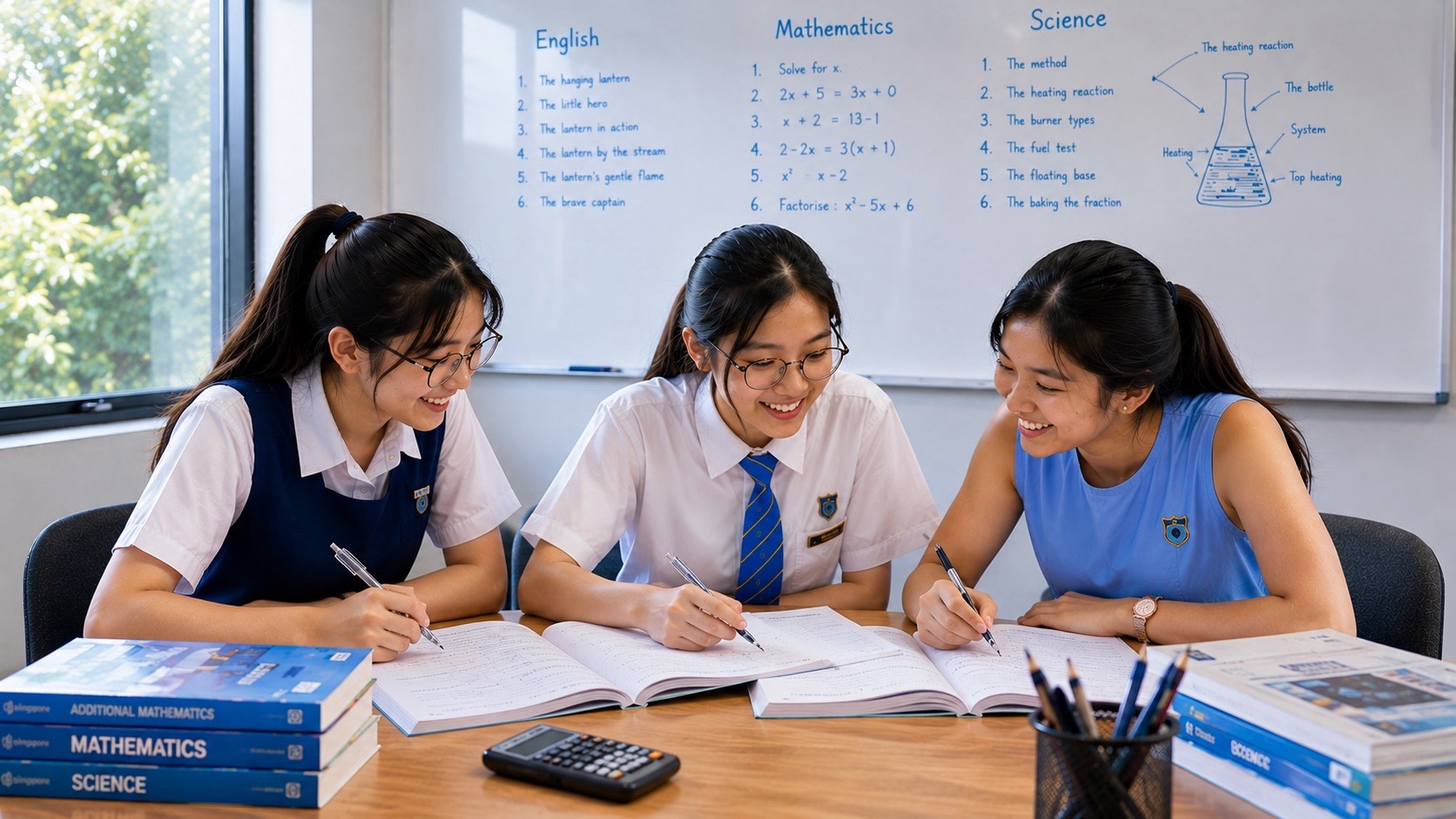
The Euclid Contest is the University of Waterloo CEMC’s senior-level Mathematics contest. It is taken by more than 25,000 students worldwide and mixes short-answer questions with full-solution problems that reward mathematical communication as well as correct results.
For 2027, the contest is scheduled for 6 April 2027 in North and South America and 7 April 2027 outside North and South America. The ordering deadline is 11 March 2027.
Why Euclid is a useful bridge
Euclid sits between routine senior-secondary Mathematics and proof-style competition Mathematics. The early questions reward fluency and careful setup; later questions increasingly require persistence, structure and written explanation.
Preparation priorities
- Algebra and functions
- Geometry and trigonometry
- Sequences and patterns
- Counting, probability and number structure
- Clear mathematical writing
- Long-problem persistence
Do not treat Euclid as a speed-only paper
The contest deliberately includes questions where a well-communicated partial solution is mathematically valuable. Preparation should therefore include full written solutions and critique, not only answer checking.
Students preparing for university Mathematics can connect Euclid to BTT’s University Mathematics Admissions & Bridging route.
Official source checked 28 September 2026: the University of Waterloo CEMC lists the 2027 Euclid Contest for 6 April 2027 in North and South America and 7 April 2027 outside North and South America, with an 11 March 2027 ordering deadline. Treat these as 2027 operational dates rather than a permanent annual calendar. Official reference: CEMC Euclid Contest.
World Mathematics route: return to the World Mathematics Atlas for the wider map across competitions, school Mathematics, examinations, mathematical objects and university routes.
Euclid Contest preparation: combine secondary Mathematics with complete written solutions
Euclid is a senior secondary problem-solving contest
Waterloo CEMC describes it as a 10-question, 2.5-hour contest mixing short-answer and full-solution work. Preparation should therefore include both finding answers and communicating reasoning.
Most content grows from secondary-school Mathematics
The difficulty comes from unfamiliar combinations and problem design rather than requiring a university syllabus. Strengthen algebra, geometry, trigonometry, counting and number reasoning.
Full-solution questions reward communication
CEMC states that completeness, clarity and presentation matter. Students should write enough reasoning that another reader can verify the solution.
Do not spend equal time on every question
Develop problem selection. Secure accessible marks, identify questions with a promising route and return to difficult problems strategically.
Past papers are the main training resource
Attempt without solutions, classify the blockage, study the decisive idea, then reconstruct the solution later. Repeat with a nearby problem.
Use diagrams and cases systematically
Geometry needs labelled diagrams; counting needs exhaustive non-overlapping cases; algebra needs domain and condition control.
Calculator permission does not remove reasoning
Some calculators are permitted under current contest rules, but the harder work is modelling and proof. Verify the current CEMC calculator policy for the relevant year.
2027 dates are official but still date-stamped
CEMC currently lists 6 April 2027 in North/South America and 7 April 2027 elsewhere, with an ordering deadline of 11 March 2027. Keep these as 2027 facts, not permanent annual dates.
Progress measure
Track how many problems are started productively, how many full solutions are communicated clearly and which domains repeatedly block progress.
Transfer
Euclid preparation can strengthen university-transition problem solving because it rewards sustained reasoning, but admissions use varies by institution and should be checked separately.
Euclid Mathematics Contest 2027: Dates, Format, Full-Solution Writing and Senior Problem-Solving Preparation
The Euclid Mathematics Contest is not a syllabus examination. It is a senior secondary problem-solving contest organised by the University of Waterloo’s Centre for Education in Mathematics and Computing (CEMC), and its distinguishing feature is not simply that the questions are difficult. It asks students to communicate mathematical thinking under contest conditions.
For the 2026–27 contest year, CEMC lists the Euclid Contest on Tuesday, 6 April 2027 in North and South America and Wednesday, 7 April 2027 outside North and South America. The ordering deadline is Thursday, 11 March 2027. CEMC states that the contest has 10 questions, allows 2.5 hours, is scored out of 100, mixes final-answer and full-solution questions, and awards marks for completeness, clarity and presentation—not only for reaching the correct result.
1. The date matters, but the format matters more
A student can know the Euclid date and still prepare badly. The contest rewards a different operating mode from a routine school paper:
- less repetitive question structure;
- more method selection;
- more emphasis on insight;
- more value placed on explanation;
- later questions that may require sustained exploration;
- no guarantee that the first familiar method is the best method.
The contest is therefore a good test of whether Mathematics transfers beyond a taught chapter sequence.
2. Euclid is designed for senior secondary students
CEMC identifies the audience as students in their final year of secondary school or CÉGEP, while also allowing motivated younger students to participate. The mathematical content is based largely on secondary-school Mathematics, but some problems may require students to use ideas beyond the exact curriculum of their school.
This is important. Preparation should not become an endless hunt for exotic topics. The contest often becomes difficult because familiar Mathematics must be combined in unfamiliar ways.
3. Ten questions in 2.5 hours creates a different time economy
150 minutes divided by 10 questions gives a raw average of 15 minutes per question. But the questions are not equally difficult.
A sensible contest strategy is not:
Question 1 for 15 minutes → Question 2 for 15 minutes → …
It is:
- secure early marks efficiently;
- identify medium questions with visible routes;
- reserve serious time for later full-solution problems;
- return to incomplete work with a fresh representation.
4. Full-solution writing is a mathematical skill
CEMC explicitly states that a correct solution that is poorly presented may not receive full marks. This means Euclid preparation should include written mathematical communication from the beginning.
A strong full solution should make visible:
- what is known;
- what is being proved or found;
- the variables and definitions introduced;
- the decisive relationship;
- the main calculations or deductions;
- why the conclusion follows.
5. The goal is not long writing
Full marks do not require decorative prose. They require recoverable reasoning.
Compare:
Weak: “Clearly, x = 5.”
Stronger: “Since the two angles are equal, the opposite sides are equal. Therefore 2x + 1 = 11, so x = 5.”
The second version exposes the logical bridge.
6. Original Euclid-style problem: algebraic structure
Let:
[ x+ rac{1}{x}=4,qquad x e0. ]
Find:
[ x^2+ rac{1}{x^2}. ]
Square the given relation:
[ left(x+ rac{1}{x} ight)^2=x^2+2+ rac{1}{x^2}=16. ]
Therefore:
[ x^2+ rac{1}{x^2}=14. ]
The contest habit is to use the given structure rather than solve unnecessarily for (x).
7. Original Euclid-style problem: number theory
Prove that (n^3-n) is divisible by 6 for every integer (n).
Factor:
[ n^3-n=n(n-1)(n+1). ]
This is the product of three consecutive integers. Among any three consecutive integers, one is divisible by 3 and at least one is even. Therefore the product is divisible by 6.
The proof is short because factorisation exposes the structure.
8. Original Euclid-style problem: geometry
A right triangle has legs 6 and 8. A square is placed inside the triangle with one side on the hypotenuse and the opposite two vertices on the legs. Determine the side length of the square.
This type of problem is not about remembering a standard square-in-triangle formula. It asks the student to build similar triangles or area relationships. A useful preparation strategy is to draw the structure, label the unknown square side (s), and identify which smaller triangles are similar to the original.
The important Euclid lesson is representation first. A clean diagram can expose the equation.
9. Geometry solutions should name the theorem
If triangles are similar, say why. If an angle is equal because of parallel lines, state it. If a cyclic quadrilateral property is used, identify it.
The reader should not have to infer the hidden justification.
10. Original Euclid-style problem: sequences
A sequence satisfies:
[ a_1=2,qquad a_{n+1}=2a_n+1. ]
Find a closed form.
Compute small terms:
[ 2,5,11,23,ldots ]
Add 1:
[ 3,6,12,24,ldots ]
So:
[ a_n+1=3cdot2^{n-1}. ]
Hence:
[ a_n=3cdot2^{n-1}-1. ]
The pattern becomes transparent after changing representation.
11. Pattern spotting is discovery, not proof
If the contest asks for a general statement, checking the first five cases is not enough. Use the pattern to conjecture the formula, then prove it—for example by induction or by transforming the recurrence.
12. Original Euclid-style problem: functional thinking
Suppose:
[ f(x)= rac{x-1}{x+1}. ]
Compute (f(f(x))).
Substitute:
[ f(f(x)) = rac{ rac{x-1}{x+1}-1}{ rac{x-1}{x+1}+1}. ]
Simplify numerator:
[ rac{x-1-(x+1)}{x+1}= rac{-2}{x+1}. ]
Denominator:
[ rac{x-1+x+1}{x+1}= rac{2x}{x+1}. ]
Therefore:
[ f(f(x))=- rac1x, ]
with the appropriate domain restrictions preserved.
13. Domain restrictions are contest information
Students often lose elegant solutions by ignoring excluded values. Rational expressions, square roots and logarithms all carry domain conditions.
Write restrictions early. They can eliminate cases later.
14. Original Euclid-style problem: counting
How many 4-digit positive integers have four distinct digits and are divisible by 5?
A number divisible by 5 ends in 0 or 5.
Case 1: last digit 0.
The first digit has 9 choices (1–9). The second then has 8 remaining non-zero-or-zero possibilities excluding the chosen first digit and 0? More carefully, after choosing the first digit and terminal 0, the middle two positions are chosen from the remaining 8 digits, in order:
[ 9cdot8cdot7=504. ]
Case 2: last digit 5.
The first digit can be 1–9 except 5: 8 choices. Then the middle two digits are chosen from the remaining 8 digits in order:
[ 8cdot8cdot7=448. ]
Total:
[ 504+448=952. ]
The important habit is case control: define mutually exclusive cases and count each exactly once.
15. Counting errors are often model errors
Common failures include:
- double counting;
- forgetting leading-zero restrictions;
- treating order as irrelevant when it matters;
- missing a case;
- including impossible cases.
16. Original Euclid-style problem: inequalities
For positive real numbers (a,b), prove:
[ rac{a}{b}+ rac{b}{a}ge2. ]
Because:
[ (a-b)^2ge0, ]
we have:
[ a^2+b^2ge2ab. ]
Divide by (ab>0):
[ rac{a}{b}+ rac{b}{a}ge2. ]
The proof begins from an obviously non-negative expression and transforms toward the target.
17. Work backwards from the target
In proof problems, sometimes the target suggests the useful starting point. If the target contains:
- a sum of reciprocals → consider common denominators or AM-GM;
- a square bound → consider a non-negative square;
- divisibility → factor;
- symmetry → introduce symmetric substitutions;
- integer parity → write (2k) or (2k+1).
18. Original Euclid-style problem: coordinate geometry
Find the equation of the circle with centre ((2,-1)) passing through ((5,3)).
Radius squared:
[ (5-2)^2+(3+1)^2=9+16=25. ]
Therefore:
[ (x-2)^2+(y+1)^2=25. ]
A contest extension might then ask for tangent properties or intersections with a line.
19. Build from a correct intermediate result
Later Euclid questions often contain several useful partial discoveries. If a full solution is not visible, prove something smaller:
- a parity restriction;
- a bound;
- a symmetry;
- a factorisation;
- a special case;
- a geometric lemma.
A productive intermediate result can unlock the final route and may also earn partial credit in a full-solution problem.
20. Do not erase partial work too quickly
A route that does not finish the problem can still contain a correct lemma. Before abandoning it, identify what remains valid.
Contest problem solving is cumulative. The second route should reuse facts from the first route when they remain true.
21. Original Euclid-style problem: polynomial roots
A polynomial (P(x)) satisfies:
[ P(1)=0,quad P(2)=0,quad P(3)=0. ]
If (P) is cubic with leading coefficient 2, then:
[ P(x)=2(x-1)(x-2)(x-3). ]
A contest extension might ask for a coefficient, a value such as (P(0)), or a relationship among transformed roots.
22. Use the Factor Theorem structurally
Known roots are not just answers. They are factors. This turns point information into algebraic structure.
23. Original Euclid-style problem: probability
Two fair dice are rolled. Find the probability that the sum is at least 10.
Possible sums 10, 11 and 12 have:
- sum 10: 3 outcomes;
- sum 11: 2 outcomes;
- sum 12: 1 outcome.
Total favourable = 6 out of 36:
[ P= rac16. ]
The sample space should be built before the formula.
24. Harder probability often becomes counting
If outcomes are equally likely, probability questions may reduce to careful enumeration. The contest difficulty lies in constructing the right sample space.
25. Original Euclid-style problem: optimization
A rectangle has perimeter 40. Find the maximum possible area.
Let sides be (x) and (20-x).
Area:
[ A=x(20-x)=20x-x^2. ]
Complete the square:
[ A=100-(x-10)^2. ]
Maximum area is 100 when (x=10), so the rectangle is a square.
The same problem can be solved by calculus, but completing the square is cheaper.
26. Method choice matters more than method prestige
A calculus solution is not automatically better than an algebraic one. Euclid rewards effective Mathematics. Use the shortest transparent route you can justify.
27. Original Euclid-style problem: invariance
Suppose an operation replaces two numbers (a,b) by (a+1,b-1). The sum (a+b) remains unchanged.
If a puzzle repeats this operation, the invariant sum can rule out target configurations whose total differs.
Contest preparation should include the habit:
What quantity does not change?
28. Invariants can end impossible searches
Students often simulate many moves when one invariant proves the target unreachable. Before brute force, inspect parity, sum, product, colouring or remainder classes.
29. Original Euclid-style problem: extremal reasoning
In a finite set of positive integers, choose the smallest element. If an assumed property forces the existence of an even smaller positive element in the same set, the assumption is impossible.
This extremal pattern appears in olympiad-style problems because the smallest or largest object has fewer escape routes.
30. Euclid preparation should include proof methods
Useful proof modes include:
- direct proof;
- contradiction;
- contrapositive;
- proof by cases;
- induction;
- invariant;
- extremal principle;
- construction;
- counterexample.
Students do not need to label every proof formally, but they should know what kind of logic they are using.
31. Counterexamples are powerful
Claim: “If (x^2>4), then (x>2).”
Counterexample:
[ x=-3. ]
Then (x^2=9>4) but (x ot>2). One valid counterexample destroys the universal claim.
32. Full-solution checking
Before finishing a proof, ask:
- Did I use every assumption legally?
- Did I prove the exact claim?
- Did I accidentally prove the converse?
- Did I cover all cases?
- Did I divide by something that could be zero?
- Did I assume the diagram was to scale?
33. Contest diagrams are evidence only when justified
A drawn diagram can suggest that two lengths are equal or that an angle is acute. Unless given or proved, appearance is not evidence.
34. Use simple cases for discovery
If a problem asks about (n) objects, test (n=1,2,3). The small cases can expose a recurrence, parity pattern or invariant.
Then move from pattern to proof.
35. Do not overfit to past Euclid questions
Past contests are valuable because they reveal style and depth. They should not become templates. The exact insight changes from year to year.
After solving a past problem, ask:
- What was the decisive idea?
- What tempting route was inefficient?
- Which theorem or representation unlocked the problem?
- How could the problem be changed while keeping the same core idea?
36. Build an idea ledger
Organise solved problems by ideas, not just year:
- factorisation;
- symmetry;
- similar triangles;
- parity;
- modular arithmetic;
- invariants;
- recurrence;
- counting cases;
- extremal choice;
- functional substitution.
This creates a reusable problem-solving library.
37. One problem, three representations
Take a quadratic. Solve it:
- algebraically;
- graphically;
- by completing the square.
Then compare what each representation makes easy to see.
Contest strength grows when students can switch representations voluntarily.
38. Euclid communication drill
Take a correct solution and remove every explanatory sentence. Give it to another student. Ask whether the logic can still be recovered.
Then add back only the sentences necessary to justify the transitions.
This trains concise mathematical communication.
39. Partial-credit mindset
For full-solution questions, a student who cannot finish should still write correct, relevant progress:
- define variables;
- derive a useful equation;
- prove a lemma;
- show a necessary condition;
- solve a special case.
Do not replace unfinished Mathematics with unsupported claims.
40. Time-management pass 1
In the opening phase:
- scan the paper;
- secure the most accessible marks;
- avoid getting trapped by one elegant-looking but stubborn problem;
- mark promising later questions.
41. Time-management pass 2
Return to medium problems where the structure is visible but the solution requires more work. Finish cleanly.
42. Time-management pass 3
Use the remaining contest time on the hardest questions and on improving incomplete full-solution arguments.
43. Final 15-minute audit
If possible, reserve time to:
- check arithmetic in short-answer questions;
- ensure full-solution variables are defined;
- add missing justifications;
- check that all cases were covered;
- confirm final answers are clearly visible.
44. Calculator policy should be checked from CEMC
CEMC states that some calculators are permitted. Students and contest supervisors should use the current CEMC contest rules rather than assuming that school-exam calculator policies apply.
For preparation, students should not depend on heavy calculator use. Most Euclid insights come from structure, not computation.
45. 2027 operational dates
CEMC currently lists:
- ordering deadline: 11 March 2027;
- North and South America contest date: 6 April 2027;
- outside North and South America contest date: 7 April 2027.
For Singapore, the relevant date is the outside-North-and-South-America date: 7 April 2027, subject to the school’s administration of the contest.
46. School registration matters
Euclid is normally written through participating schools or approved contest locations. A student should confirm local registration well before the CEMC ordering deadline because a school may impose its own earlier internal deadline.
47. Do not confuse contest ordering with student preparation
The school’s ordering deadline is an administrative gate. The student’s preparation timeline should begin months earlier.
48. Twelve-week Euclid plan
Weeks 1–3: foundation repair
Algebra, functions, geometry, trigonometry, number theory and counting basics.
Weeks 4–6: idea training
Factorisation, parity, invariants, recurrences, similar triangles, casework and proof.
Weeks 7–9: past-contest sets
Mix short-answer and full-solution work. Build the idea ledger.
Weeks 10–11: full timed contests
Use 2.5-hour simulations and practise three-pass time allocation.
Week 12: maintenance
Review recurring failure modes, write selected full solutions cleanly and protect sleep/routine.
49. Six-week Euclid plan
Week 1: mixed diagnostic.
Week 2: algebra/number/geometry repair.
Week 3: proof and counting.
Week 4: timed half-papers.
Week 5: full past contest.
Week 6: fresh transfer and communication cleanup.
50. Error ledger
| Error | Repair |
|---|---|
| Could not start | Classify structure and test simple cases |
| Long dead-end algebra | Search for factorisation, symmetry or representation switch |
| Geometry leap | Name theorem and prove relationship |
| Counting overcount | Define mutually exclusive cases |
| Pattern without proof | State conjecture then general argument |
| Correct idea, weak presentation | Define variables and expose decisive step |
| Time collapse | Three-pass strategy and stop-loss rule |
51. Fresh retest after every solved problem
Change one condition:
- replace even with odd;
- change a triangle to a quadrilateral;
- change a recurrence coefficient;
- change a divisibility modulus;
- change a fixed perimeter to fixed area.
Ask whether the original method still works.
52. Competition Mathematics is not a fixed ability label
A student may solve one hard problem and fail an easier-looking one because the decisive idea differs. Contest performance is highly task-sensitive.
Use the paper to diagnose problem-solving habits, not to create permanent categories of intelligence.
53. Euclid and university Mathematics
Euclid can be useful preparation for university-style mathematical thinking because it rewards:
- definitions;
- structure;
- proof;
- unfamiliar problems;
- communication;
- persistence.
It does not replace formal admissions requirements or university prerequisites.
54. Euclid and school Mathematics
Contest preparation should strengthen school Mathematics when it is built correctly. Algebra becomes more flexible. Geometry becomes more justified. Functions become more connected. Proof becomes more natural.
If contest training causes routine school accuracy to collapse, the foundation needs repair.
55. Final contest checklist
- I know the 2027 contest date for my region.
- My school has handled registration before its deadline.
- I understand the 10-question, 2.5-hour format.
- I practise full-solution writing.
- I can use simple cases for discovery without mistaking them for proof.
- I can switch representations.
- I know common proof strategies.
- I use a three-pass time plan.
- I preserve partial progress on hard questions.
- I review past problems by idea, not only by year.
- I retest solved ideas on changed problems.
56. Official-source control
Use the University of Waterloo CEMC Euclid page for current contest dates, ordering deadline, format and contest rules. The 2027 dates currently listed are 6 April in North and South America and 7 April outside North and South America, with the ordering deadline on 11 March 2027.
Official route: CEMC Euclid Contest.
57. The durable Euclid model
The complete preparation loop is:
school Mathematics foundation → unfamiliar problem → representation/idea search → justified solution → communication → time control → feedback → fresh variant.
The contest date changes each year. The problem-solving system is durable.
Euclid Mastery Clinic: Turn School Mathematics Into Contest Mathematics
The final Euclid step is not learning hundreds of extra tricks. It is learning how to interrogate a problem until its structure becomes visible. A contest-ready student does not wait passively for a familiar template. They ask what is invariant, what can be factored, what can be bounded, what can be represented differently and what smaller claim can be proved first.
1. Start with the target
Before calculating, write what a finished answer must contain. Is the problem asking for:
- one number;
- all possible values;
- a proof;
- a maximum or minimum;
- a count;
- a construction;
- a probability;
- a geometric relationship?
This prevents solving a neighbouring problem.
2. Ask what information is expensive
A Euclid problem often contains more data than the best solution needs. Identify which quantities are structurally linked to the target and which are likely to be decorative.
3. Original contest task: symmetric expressions
If:
[ x+y=8,qquad xy=12, ]
find:
[ x^2+y^2. ]
Use:
[ (x+y)^2=x^2+2xy+y^2. ]
Therefore:
[ 64=x^2+y^2+24, ]
so:
[ x^2+y^2=40. ]
Solving for (x) and (y) individually is unnecessary.
4. Original contest task: reciprocal structure
If:
[ x+ rac1x=3, ]
find:
[ x^3+ rac1{x^3}. ]
Use:
[ left(x+ rac1x ight)^3=x^3+ rac1{x^3}+3left(x+ rac1x ight). ]
So:
[ 27=x^3+ rac1{x^3}+9, ]
and the required value is 18.
5. Build lemmas deliberately
When a hard problem resists direct attack, create a smaller target:
- show two angles are equal;
- show one quantity is even;
- show a point lies on a circle;
- show a factor divides an expression;
- show a sequence is increasing;
- show one case is impossible.
Euclid full-solution problems often become manageable after one useful lemma.
6. Original geometry lemma task
Suppose (AB=AC) in triangle (ABC). Then base angles (B) and (C) are equal.
If a contest problem later introduces a point on (BC), this equal-angle fact may generate similar triangles or cyclic quadrilaterals. Record the lemma rather than rediscovering it repeatedly.
7. Work backwards from divisibility
If the target says “prove divisible by 9”, ask what representation exposes factors of 9 or congruence modulo 9.
For example:
[ 10^n-1 ]
is divisible by 9 for every positive integer (n) because (10equiv1pmod9), so:
[ 10^n-1equiv0pmod9. ]
8. Modular arithmetic is a compression tool
Remainders can replace enormous calculations.
To find the remainder of (2^{100}) modulo 3, note:
[ 2equiv-1pmod3. ]
Therefore:
[ 2^{100}equiv1pmod3. ]
9. Parity should be automatic
Before manipulating an integer expression, ask whether parity already constrains the answer.
For every integer (n):
[ n(n+1) ]
is even because one of two consecutive integers is even.
10. Geometry should be re-drawn when the first diagram hides the structure
A messy contest diagram can conceal symmetry or similarity. Redraw with only the relevant lines. Extend a side if it creates a useful angle. Add an auxiliary line only when you can explain what relationship it is intended to expose.
11. Auxiliary lines need a purpose
Useful purposes include:
- create similar triangles;
- create a cyclic quadrilateral;
- form a right triangle;
- connect centres;
- split an area;
- create parallel lines.
Do not add construction lines randomly.
12. Coordinate geometry can rescue synthetic geometry
If a Euclid geometry problem becomes opaque, coordinates may turn angle or distance relationships into algebra.
Choose coordinates strategically. Place a symmetric figure on axes or put one important point at the origin.
13. Original coordinate task
Let (A(-2,0)), (B(2,0)), and (C(0,3)). Show triangle (ABC) is isosceles.
[ AC^2=(2)^2+3^2=13, ]
[ BC^2=(-2)^2+3^2=13. ]
Therefore (AC=BC).
14. Use area two ways
Many contest geometry problems become simple when the same region’s area is expressed in two different ways.
For a triangle:
[ A= rac12 bh= rac12 absin C. ]
Equating area representations can create trigonometric or ratio relationships without solving the whole figure.
15. Original area comparison
Two triangles share the same altitude to the same baseline direction. Their areas are in the same ratio as their bases.
This can turn a geometry problem into a ratio problem immediately.
16. Counting should begin with object definition
Before using permutations or combinations, define what one complete outcome is.
Does order matter? Can objects repeat? Are some objects identical? Are positions restricted?
17. Original counting task
How many 5-letter strings can be formed from A, B, C, D, E with no repetition if the string must begin with A or B?
First character: 2 choices.
Remaining characters: 4! arrangements.
Total:
[ 2cdot24=48. ]
18. Complement counting is often cheaper
If a condition says “at least one”, consider counting all outcomes and subtracting those with none.
19. Original complement task
How many 4-digit strings from digits 0–9 contain at least one 7, allowing leading zero and repetition?
Total strings:
[ 10^4. ]
No 7:
[ 9^4. ]
Required:
[ 10^4-9^4. ]
20. Sequences can hide invariants or telescoping
If a sum has fractions such as:
[ rac1{1cdot2}+ rac1{2cdot3}+cdots+ rac1{n(n+1)}, ]
use:
[ rac1{k(k+1)}= rac1k- rac1{k+1}. ]
The series telescopes to:
[ 1- rac1{n+1}= rac{n}{n+1}. ]
21. Look for telescoping whenever neighbouring terms overlap
Partial fractions can turn a difficult sum into massive cancellation.
22. Original recurrence invariant
Suppose:
[ a_{n+1}=3a_n+2. ]
Add 1:
[ a_{n+1}+1=3(a_n+1). ]
The transformed sequence becomes geometric.
This is a general contest habit: shift or scale a recurrence until its hidden simple structure appears.
23. Functional equations begin with special inputs
If a problem gives a functional equation, test:
- 0;
- 1;
- (-1);
- equal inputs;
- opposite inputs;
- values that zero part of the equation.
Special values often reveal constants or symmetry.
24. Original functional-equation task
Suppose:
[ f(x+y)=f(x)+f(y) ]
for all real (x,y), and (f(1)=3).
Then:
[ f(2)=f(1)+f(1)=6. ]
For positive integers (n), repeated addition gives (f(n)=3n). A full classification over all reals requires additional regularity conditions, which is itself a useful lesson: the domain and assumptions matter.
25. Optimization without calculus
Contest problems often allow algebraic optimization.
For positive (x,y) with (x+y=20), maximize (xy).
Use:
[ (x-y)^2ge0. ]
Then:
[ x^2+y^2ge2xy. ]
Since:
[ 400=(x+y)^2=x^2+2xy+y^2ge4xy, ]
we get:
[ xyle100. ]
Equality occurs at (x=y=10).
26. Equality conditions matter
An inequality proof is incomplete if the problem asks for the maximum and the student never states when equality occurs.
27. Construct counterexamples actively
When a statement feels suspicious, attack boundary cases:
- 0;
- 1;
- negative values;
- equal variables;
- extreme configurations;
- smallest valid integer.
28. Original counterexample task
Claim: if (ab>0), then (a>0) and (b>0).
False. Take (a=-1,b=-1). Product is positive while both factors are negative.
29. Contradiction can expose impossibility
Assume the target is false, then derive a conflict with parity, divisibility, ordering or minimality.
Do not use contradiction merely because it sounds advanced. Use it when the negation creates exploitable structure.
30. Original contradiction idea
To prove there is no smallest positive rational number, suppose (r) is the smallest. Then (r/2) is positive, rational and smaller—a contradiction.
31. Invariant puzzles should be modelled before simulated
If a move changes two objects, ask what total, parity, colouring or residue remains unchanged.
One invariant can replace hundreds of trial moves.
32. Bounding can solve answer questions without exact values
If a problem asks which integer lies nearest a complicated expression, bound it between simple quantities.
For example:
[ 3.1^2<10<3.2^2 ]
implies:
[
3.1 A decimal answer is not automatically less rigorous. The issue is whether the required accuracy is stated and the approximation method is controlled. For every full-solution practice problem, write three versions: Compare which details are essential. The final written solution does not need to reproduce every dead end, but it should not make the decisive step appear magical. Include enough explanation that another reader can follow the logic. After a day, reread your solution without the question notes. Ask whether every symbol is defined and every implication is justified. Not every practice session should contain only the hardest Euclid questions. Use a mix: Working for 45 minutes can be useful if new structure is emerging. It is less useful if the same algebra is being repeated. After a period of no progress, change representation or inspect a hint/solution strategically, then reconstruct the argument independently. Do not read a solution and mark the problem “understood”. Close it and reproduce the decisive idea from memory. Then solve a variant. Change: Ask whether the original method survives. Use older Euclid contests in three phases: Jumping directly to full papers can produce scores without diagnosis. Write equations in a readable order. Avoid arrows that could mean anything. State conclusions. A contest marker should not have to reconstruct the intended proof from scattered fragments. Mark equal lengths, known angles, variables and auxiliary lines. A labelled diagram is part of the reasoning record. Keep fractions and radicals exact when possible. Decimal approximations can obscure factorisation and symmetry. Even when a calculator is permitted under CEMC rules, use it selectively. It can evaluate arithmetic or test a conjecture, but it cannot replace proof. Testing several values suggests: [
1+3+cdots+(2n-1)=n^2.
] Proof by induction: Base (n=1) is true. Assume the sum of first (k) odd numbers is (k^2). Add the next odd number (2k+1): [
k^2+2k+1=(k+1)^2.
] Therefore the formula holds for all positive integers. Track: This is more informative than one contest score. CEMC lists the Euclid date outside North and South America as 7 April 2027. A Singapore school may set an earlier internal registration deadline before the CEMC ordering deadline of 11 March 2027. Students should confirm local administration with their school. Week 1: Week 2: A contest-ready student can: read → classify → explore → isolate an idea → justify → communicate → check → vary. That is the transferable capability the contest is designed to reveal.33. Approximation should be justified
34. Euclid solution writing drill
35. The clean solution should not hide discovery
36. Mark your own solution as a stranger would
37. Difficulty calibration
38. Productive struggle needs a stopping rule
39. How to use solutions
40. Variant creation
41. Past-contest progression
42. Communication marks require legibility
43. Diagrams should be labelled
44. Use exact values when they clarify structure
45. Contest calculator discipline
46. Original conjecture-versus-proof task
47. Build confidence from evidence
48. Singapore 2027 calendar note
49. Final two-week plan
50. Final release standard
51. The final Euclid loop
Euclid 2027 Release Check: Insight, Communication and Time Control
The last Euclid rehearsal should not be another catalogue of solved tricks. Give the student a fresh set containing one algebraic-structure problem, one geometry problem, one counting or number-theory problem and one full-solution question that requires a written argument.
For each problem, ask the student to record the decisive idea after solving. Useful entries are short: “factor before expanding”, “introduce a smaller similar triangle”, “split into two exclusive cases”, “use parity”, “look for an invariant”, or “work backwards from the target”. This builds an idea library rather than a memory of exact past questions.
Full-solution writing should remain concise but auditable. Define variables. State the theorem or relationship that matters. Show the decisive algebra or deduction. End with the exact requested conclusion. A correct answer with an invisible argument can lose marks because CEMC assesses completeness, clarity and presentation as well as correctness. citeturn573627search5
Use a three-pass timing simulation. First secure accessible marks. Then return to medium problems with visible routes. Use the final phase for hard problems and for improving incomplete full-solution arguments. Preserve any correct lemma or partial result instead of erasing useful work.
For Singapore and other locations outside North and South America, CEMC currently lists the 2027 Euclid contest date as Wednesday, 7 April 2027. The ordering deadline is Thursday, 11 March 2027; schools may impose an earlier internal registration cutoff. citeturn573627search5turn573627search7
A final transfer problem should change one condition from a familiar past-contest idea. If a student solved a parity problem, change the modulus. If they used similar triangles, alter the geometry. If they used a recurrence, change the coefficient. The student should decide whether the old method survives and explain why.
Release standard: strong school Mathematics, voluntary representation changes, justified full solutions, three-pass pacing, preserved partial progress and fresh transfer beyond memorised contest surfaces.
Euclid Final Floor: Ten Questions, Full-Solution Discipline and One More Unseen Problem
The last Euclid preparation stage should test whether the student can create mathematics rather than recognise a stored trick. Give one unseen problem from each of four broad families—algebra/number, geometry, counting/probability and proof—and remove every chapter label. The learner should first state what a finished solution must contain, then identify one useful structure before beginning long calculation.
For algebra, ask for a representation change. A symmetric expression may be easier through (x+y) and (xy) than by solving for each variable. A polynomial with known roots should be factored before expanded. A recurrence may become geometric after a shift. The release criterion is whether the learner can explain why the new representation is cheaper.
For geometry, require a labelled diagram and one explicit theorem or relationship. If an auxiliary line is added, the learner should say what it is intended to create: similarity, a right triangle, parallel-line angles, a cyclic quadrilateral or an area decomposition. Random construction is not strategy.
For counting, require the student to define one complete outcome before using a formula. Ask whether order matters, whether repetition is allowed, whether cases overlap and whether leading-zero or other restrictions exist. Then require a check using a small version of the problem.
For proof, match the argument to the quantifier. One example can prove existence but not a universal statement. One counterexample can disprove a universal statement. A divisibility claim often needs factorisation or modular arithmetic; an inequality may begin from a non-negative square; an impossibility claim may be best attacked by contradiction or an invariant.
The final full-solution drill should be written twice. First produce the natural scratch solution. Then rewrite it as a clean contest solution with variables defined, the decisive step visible and the conclusion stated. Remove dead ends but do not remove the reason the solution works.
Time control should also be rehearsed explicitly. In a 2.5-hour paper, early secure marks should not be sacrificed to one stubborn problem. Use a first pass for accessible questions, a second pass for medium questions with visible routes and a final pass for difficult problems, incomplete proofs and checking. If a route has produced no new structure for several minutes, change representation rather than repeating the same algebra.
Partial progress remains valuable on full-solution questions. A correct lemma, necessary condition, case split, factorisation or geometric relationship is better than unsupported final claims. Keep valid intermediate results when changing route.
For 2027, CEMC lists the contest on 6 April in North and South America and 7 April outside North and South America, with the ordering deadline on 11 March. A Singapore student should confirm the school’s own earlier registration process rather than treating the CEMC ordering deadline as a personal last-minute registration guarantee.
In the final week, reduce resource collection. Revisit the idea ledger, rewrite two full solutions, solve one or two variants of previously missed problems and maintain algebra/geometry accuracy. The purpose is not to discover a hundred new tricks; it is to make known ideas retrievable under uncertainty.
Release standard: the student can read an unfamiliar problem, identify structure, build a justified route, communicate the logic, manage contest time and transfer the decisive idea to a changed problem.