
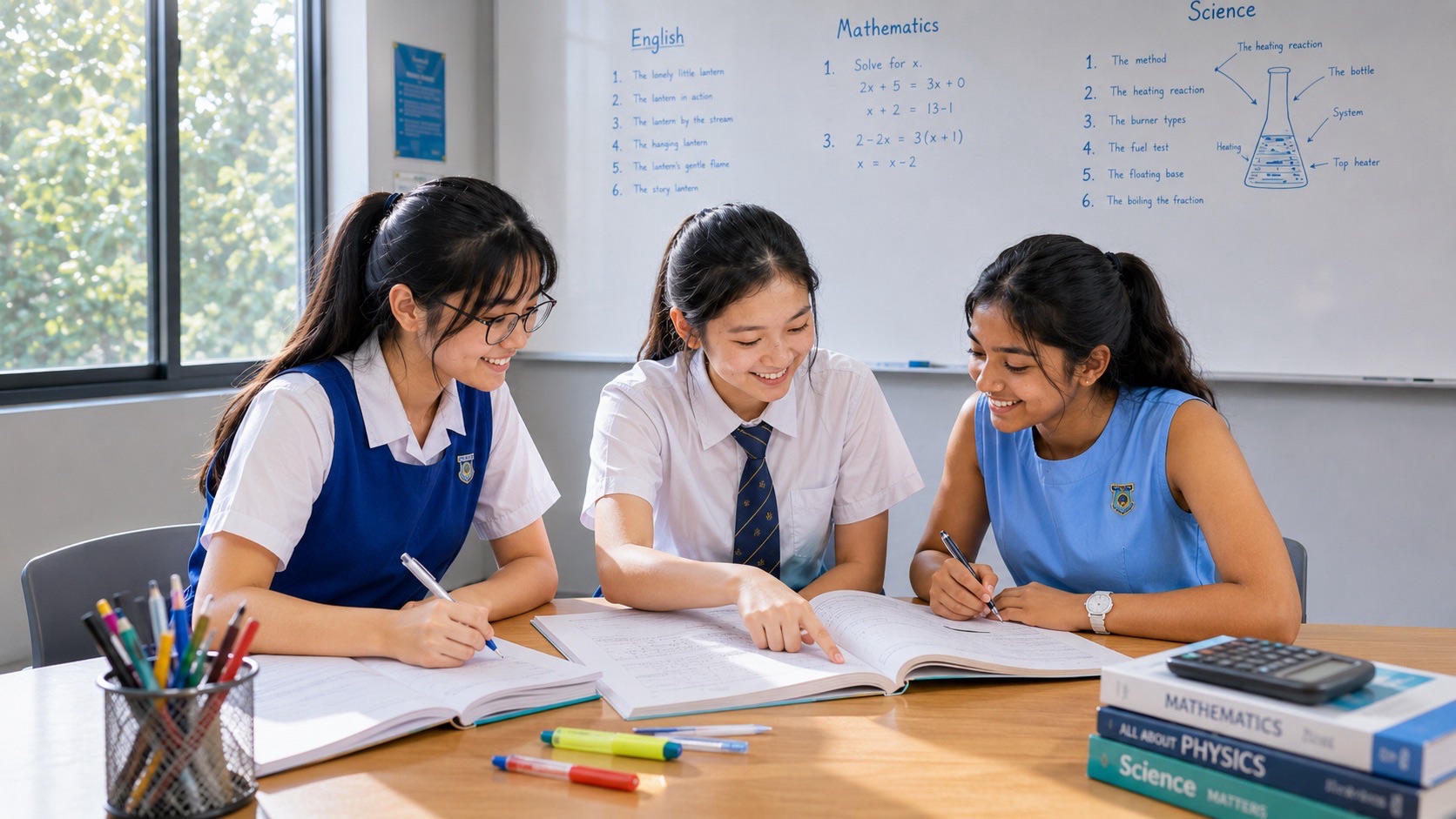
Maths Olympiad can be extremely valuable, but it is not automatically the right next step for every strong student. Its best contribution is not the medal. It can teach a learner to stay with an unfamiliar problem, experiment intelligently, build an argument and discover Mathematics beyond the school chapter sequence.
Students who often benefit
- They already have reliable school Mathematics foundations.
- They enjoy puzzles whose method is not immediately obvious.
- They can tolerate being stuck without seeing that as failure.
- They are curious about why a result is true.
- They have enough time that competition training does not destabilise ordinary school work.
Warning signs to pause or reduce
- Basic fractions, ratio, algebra or geometry remain unstable.
- Every session has become preparation for the next contest.
- The learner is memorising named tricks without understanding them.
- Fear of losing or comparison with peers has replaced mathematical curiosity.
- Sleep, school work or other important activities are being sacrificed persistently.
Olympiad is one route to deep Mathematics
A student who dislikes contests can still develop exceptional mathematical depth through proof, programming, modelling, research-style investigation, statistics, the Mathematical Lab or advanced pure Mathematics.
A useful decision test
After several months, ask whether the learner has become better at representing unfamiliar problems, explaining ideas, testing conjectures and working independently. If the only measurable change is a larger collection of memorised tricks, the training model needs adjustment.
Is Maths Olympiad worth it? Evaluate the learning return, not the badge
The strongest benefit is unfamiliar problem solving
Olympiad work removes chapter labels and forces students to search for structure. That can develop persistence, representation, conjecture, proof and strategic flexibility beyond routine school exercises.
Benefit depends on readiness
A learner with unstable arithmetic or algebra may spend the whole session fighting prerequisites rather than the intended reasoning. Repairing foundations first is not a demotion; it can make later enrichment far more productive.
Enjoyment matters
Competition Mathematics is demanding. A student who enjoys puzzles and sustained reasoning may find it energising. A child participating only because adults value the certificate may experience the same workload very differently.
Results are noisy signals
One competition score reflects preparation, format familiarity, problem selection and performance on one day. Use results as evidence about current strengths and weaknesses, not as a fixed statement of mathematical potential.
School Mathematics and olympiad Mathematics overlap but are not identical
Competition work can strengthen reasoning and number sense, but it does not automatically teach the current school syllabus or examination conventions. Keep both routes visible.
When to pause
Consider reducing or pausing when competition preparation displaces sleep, creates persistent distress, undermines core schoolwork or becomes a cycle of repeated contests with no review. More exposure is not always more learning.
What good coaching looks like
A strong programme discusses failed approaches, compares solutions, builds domain knowledge and gradually reduces hints. It should not simply demonstrate clever tricks that students then imitate on nearly identical problems.
Measure learning beyond medals
Look for longer productive struggle, clearer explanations, better case organisation, stronger proof habits and transfer to unfamiliar problems. These changes can be valuable even without an award.
For highly advanced learners
Olympiad Mathematics can provide needed depth when school material is already secure. The route may progress toward proof-intensive national or international competition work, but acceleration should still preserve conceptual breadth.
Decision rule
Continue when the learner is learning, engaged and able to sustain the workload alongside core responsibilities. Change the route when the competition programme is producing credentials without mathematical growth.
World Mathematics route: return to the World Mathematics Atlas for the wider map across competitions, school Mathematics, examinations, mathematical objects and university routes.