
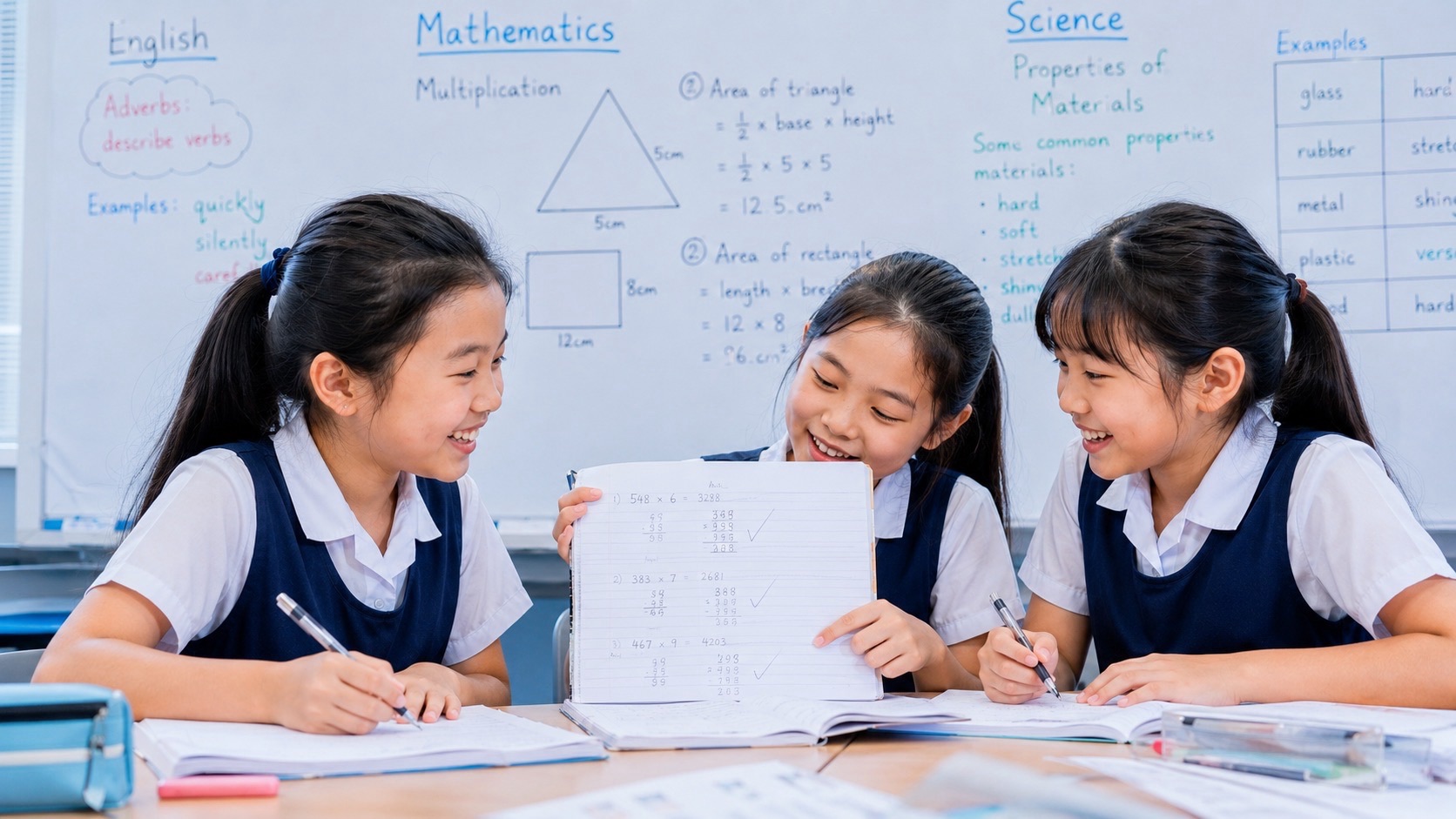
APMOPS is the Asia-Pacific Mathematical Olympiad for Primary Schools, organised by Hwa Chong Institution. It is the current name of the competition that began in 1990 as the Singapore Mathematical Olympiad for Primary School (SMOPS). Hwa Chong states that SMOPS was renamed APMOPS in 2002 as participation expanded across the Asia-Pacific region.
Use this page for the APMOPS route inside BTT’s Mathematics Olympiad & Competition Hub. Older parents and resources may still search for “SMOPS”; BTT keeps that name visible as a historical bridge while using APMOPS for the current competition.
APMOPS 2026 at a glance
For 2026, Hwa Chong ran the first round on 16 April for Singapore P6 students and Malaysian schools, and on 18 April for Singapore P5 students and other overseas centres. The Invitation Round was held on 30 May 2026 at Hwa Chong Institution. The organiser states that the top 50 P6 participants from the Singapore first round are invited to the Invitation Round; overseas invitations are subject to the organiser’s published quota.
The Invitation Round does not allow calculators, mathematical sets or mathematical tables. That matters for preparation: reliable arithmetic, exact reasoning, diagram control and strategic simplification need to be available without technology.
What APMOPS is really testing
APMOPS sits beyond routine Primary Mathematics but still grows from Primary mathematical objects. The learner needs more than a large bag of tricks. Strong performance comes from flexible representation, pattern detection, divisibility, counting, geometry, ratio, arithmetic structure and the willingness to test small cases before committing to a method.
A preparation spine
- Secure school Mathematics first. Weak fractions, ratio or arithmetic make non-routine work unnecessarily difficult.
- Represent before calculating. Draw, tabulate, encode or build a smaller case.
- Train no-calculator control. Use number structure and estimation rather than brute-force decimal work.
- Review solutions for the decisive idea. Do not merely copy an elegant final method.
- Revisit after a delay. Transfer is shown when the learner can reconstruct the idea independently.
Useful BTT routes
- Primary Mathematics Learning Hub
- Arithmetic and Operations
- Ratio, Rate and Proportion
- Geometry and Measurement
- Mathematical Lab
Frequently asked questions
Is SMOPS a different competition from APMOPS?
No. Hwa Chong states that the competition began as SMOPS and was renamed APMOPS in 2002.
Can P5 students enter?
For the 2026 Singapore first round, Hwa Chong provided a P5 route. Eligibility and arrangements should be rechecked for each competition year.
Official source checked 26 September 2026: Hwa Chong Institution APMOPS and its 2026 competition details. Rules and dates are year-specific.
World Mathematics route: return to the World Mathematics Atlas for the wider map across competitions, school Mathematics, examinations, mathematical objects and university routes.
APMOPS preparation: bridge primary Mathematics into sustained competition problem solving
APMOPS problems reward structure discovery
Students need to move beyond routine chapter exercises while still relying on strong primary Mathematics foundations.
Arithmetic fluency should free attention
Basic operations, fractions and ratio should be reliable enough that working memory can focus on the unfamiliar structure.
Number theory begins with elementary ideas
Factors, divisibility, remainders and parity can support surprisingly deep primary-level problems.
Combinatorics begins with complete organisation
Systematic lists, cases and counting principles should ensure outcomes are neither missed nor duplicated.
Geometry requires construction and decomposition
Area relationships, symmetry and auxiliary lines can reveal solutions without advanced theorems.
Patterns are for conjecture, then explanation
Students can experiment with small cases, but should identify the mechanism that makes the pattern general.
Written reasoning should grow alongside answers
Even when an answer format is short, explaining the route develops the proof habits needed for later SMO-style work.
Two-round or current-format facts must remain dated
Competition structures can change. Use the current organiser’s information for rounds, eligibility and dates rather than freezing one year’s format into the teaching system.
Practice should alternate depth and breadth
Use domain sessions to build tools, mixed sets to train recognition and occasional timed papers to train selection.
Review almost-solved problems
A problem where the student had the right representation but missed one insight is often the highest-value next lesson.
Protect school Mathematics
Competition enrichment should strengthen curriculum reasoning rather than create neglected school foundations.
Progression
When primary olympiad reasoning is stable, deepen into formal number theory, combinatorics, geometry and proof through the BTT Olympiad hub.