
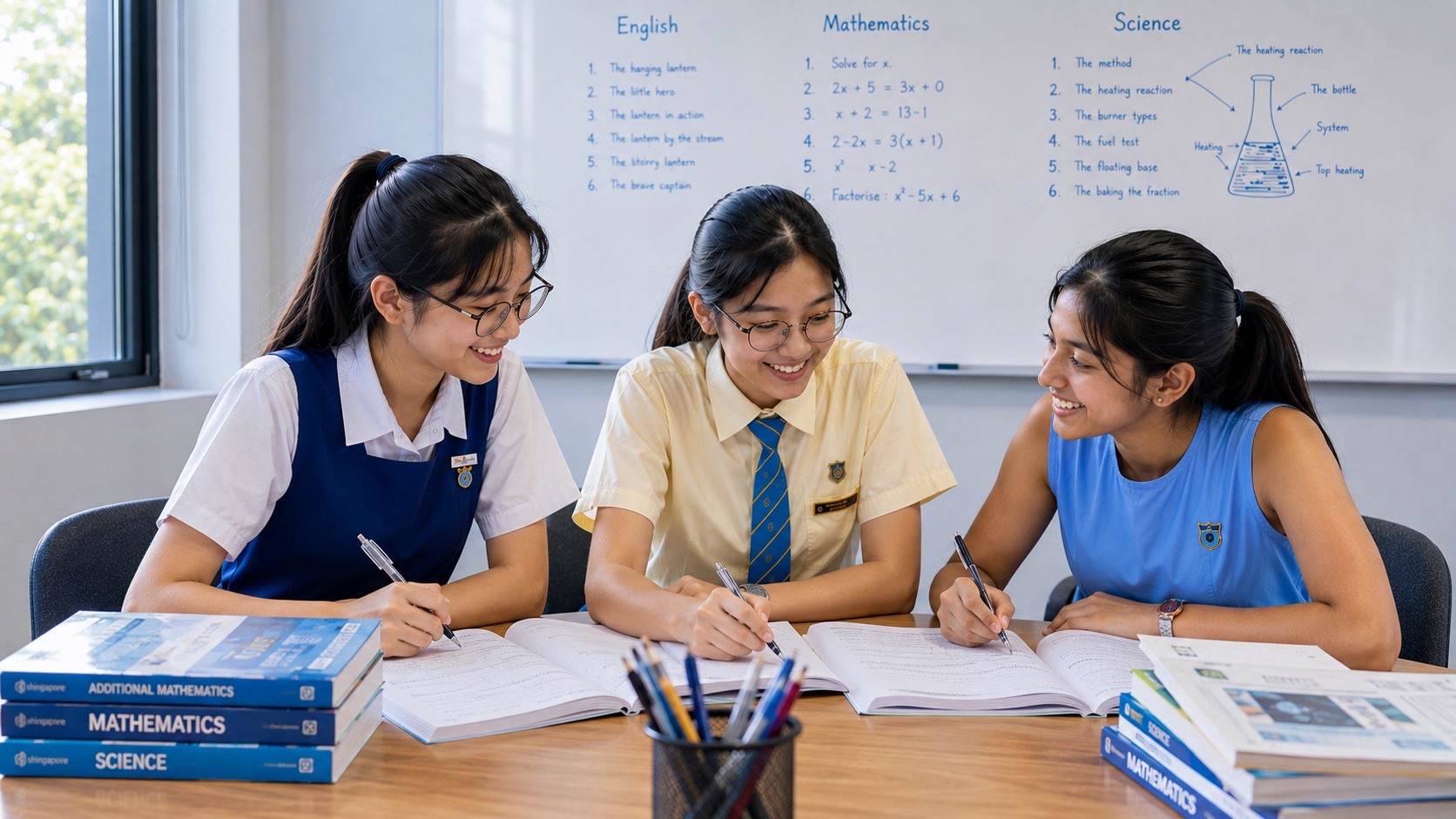
“New Syllabus Mathematics” and “Singapore Secondary Mathematics” are not the same thing. New Syllabus Mathematics is a long-running Singapore textbook series adapted for use in multiple curricula. Singapore’s national Secondary Mathematics route is defined by MOE/SEAB and, from 2027, culminates in the SEC G1, G2 and G3 examination system.
The textbook route
The current publisher describes New Syllabus Mathematics as a widely adopted Singapore Secondary Mathematics series and notes that its content has been adapted to curricula around the world. Current international editions map Secondary 1–4 roughly to Grades 7–10 for overseas users.
The Singapore national route
Singapore’s national curriculum now sits inside subject-level Mathematics pathways and the new SEC examination. From 2027, current examination codes include G1 Mathematics K110, G2 Mathematics K210 and G3 Mathematics K310, with Additional Mathematics at G2 K232 and G3 K341 where relevant.
Why overseas families need this distinction
- A textbook edition can be used without sitting a Singapore examination.
- International editions may adapt sequence or examples for another curriculum.
- Old books may reference O-Level codes no longer current for 2027 SEC students.
- Placement should still be based on prerequisite knowledge rather than grade conversion alone.
What transfers well from Singapore Secondary Mathematics
The portable elements are the mathematical progression—algebra, functions, geometry, trigonometry, probability and statistics—plus disciplined problem solving, representation and cumulative prerequisite control.
For current Singapore-facing routes, use How SEC Mathematics Works. For international curriculum transfer, use the World Mathematics Curriculum Crosswalk.
Sources checked 26 September 2026: current New Syllabus Mathematics publisher materials and SEAB 2027 SEC Mathematics syllabuses.
Singapore Secondary Mathematics for the world: translate the system, not only the syllabus labels
The SEC framework needs explanation for international readers
From 2027, Singapore’s national secondary certification uses the Singapore-Cambridge Secondary Education Certificate, with subjects offered at G1, G2 and G3 as applicable. International readers should not map those labels automatically onto old Express/Normal categories or onto foreign tier systems.
Curriculum comparison should begin with mathematical content
Compare algebra, functions, geometry, trigonometry, statistics, probability and problem-solving expectations before comparing grade names. Two courses with similar ages can differ substantially in sequencing and depth.
Working and reasoning matter
Singapore examination preparation is not only answer production. Students need visible mathematical working, accurate notation, method selection and checking. These habits transfer well across boards even when mark schemes differ.
Model drawing is a bridge, not the endpoint
Students arriving from Singapore Primary Mathematics may use bar models to represent relationships. Secondary Mathematics increasingly compresses those relationships into algebra. The transition is successful when models support symbolic reasoning rather than delay it.
Algebra becomes the common language
Equations, functions, graphs and formula manipulation connect many secondary topics. International transfer students should be diagnosed for algebraic fluency even if their previous curriculum covered similar chapter names.
Calculator policy is examination-specific
Do not assume calculator access from another board. Students moving between systems need the current rules for the exact assessment. Regardless of policy, estimation and symbolic control remain useful checking tools.
Terminology can create false gaps
Gradient versus slope, simultaneous equations versus systems, indices versus exponents and other vocabulary differences can make known mathematics look unfamiliar. A crosswalk should distinguish language gaps from conceptual gaps.
Sequence matters when transferring curricula
A learner may know a later topic but have missed an earlier Singapore prerequisite, or vice versa. Diagnose by concept rather than school year alone. Short targeted bridging is often better than repeating an entire level.
Problem-solving style may differ
Some systems emphasise extended modelling, others structured multi-part questions or different proof expectations. Transfer preparation should expose students to the target question architecture while preserving deep mathematical understanding.
For teachers outside Singapore
The useful export is a coherent progression, careful representation, cumulative practice and high expectations supported by diagnosis. It is not necessary to reproduce every local examination convention to use those principles.
For families entering Singapore
Obtain the current school and subject-level information, sample the learner across core domains, identify terminology differences and build a bridging plan. Avoid assuming that age alone determines exact placement.
Keep the route current
This page should own the world-facing explanation of Singapore Secondary Mathematics and route current examination specifics to the dedicated SEC G3 Mathematics and Additional Mathematics owners rather than duplicating their fast-changing details.
World Mathematics route: return to the World Mathematics Atlas to place this Singapore Math idea inside the wider school, curriculum, examination and university map.