
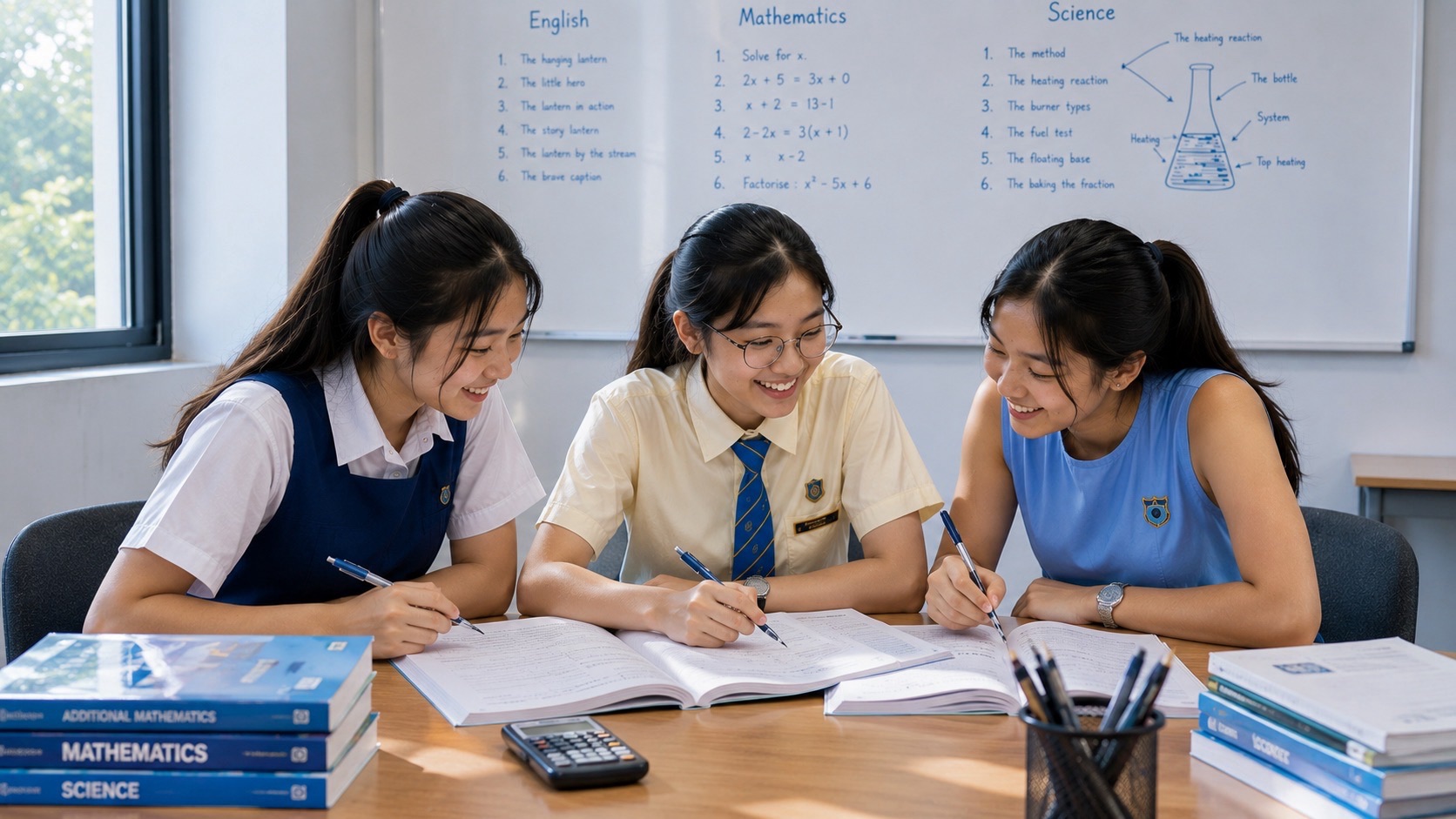
Singapore Math is an international label for Mathematics curricula, teaching approaches and textbook programmes influenced by Singapore’s school Mathematics tradition. It is not one technique, one workbook or one publisher.
The strongest way to understand Singapore Math is to separate five layers: the official Singapore curriculum, the way ideas are represented, the teaching sequence, the problem-solving culture, and the particular textbook programme being used. Those layers overlap, but they are not identical.
Problem solving sits at the centre
Singapore’s Ministry of Education places mathematical problem-solving competency at the centre of the Primary Mathematics curriculum framework. Around it sit concepts, skills, processes, metacognition and attitudes. This is broader than teaching children to execute algorithms quickly.
Representation matters
Singapore Mathematics frequently moves learners through objects, visual or pictorial representations, and then symbolic Mathematics. The purpose is not to make every child draw every problem. The representation should reveal the mathematical relationship until the learner can reason more abstractly.
The recurring ideas
- Number sense and part–whole structure
- Concrete, pictorial and abstract representation
- Bar models for quantitative relationships
- Number bonds and flexible decomposition
- Heuristics for non-routine problems
- Strong sequencing of prerequisites
- Reasoning, communication and checking
- Movement from supported examples toward independent transfer
Singapore Math is not the same as Singapore school examinations
A parent in the United States or Europe using a Singapore-influenced textbook does not need to reproduce PSLE examination preparation. The transferable value lies in the mathematical sequence, representations and problem-solving habits. Examination rules remain a separate local layer.
Where to go next
- Concrete–Pictorial–Abstract Approach
- Bar Model Method
- Primary Mathematics Learning Hub
- Mathematics Knowledge Warehouse
For families choosing an international textbook edition, use BTT’s textbook comparison rather than assuming every product carrying the phrase “Singapore Math” follows the same sequence.
Source check: reviewed against Singapore MOE Primary Mathematics curriculum materials and current international Singapore-Math programme information on 26 September 2026.
World Mathematics route: return to the World Mathematics Atlas to connect Singapore Math methods with school levels, international curricula, examinations, competitions and university Mathematics.
The complete Singapore Math system: curriculum, representation, mastery and transfer
Singapore Math is not one exported textbook
The term is used internationally for curricula and materials influenced by Singapore’s Mathematics education. Singapore itself has an MOE syllabus and local textbook ecosystem, while overseas programmes such as Primary Mathematics, Dimensions and Math in Focus adapt ideas for other markets. A reader should distinguish the national curriculum from commercial adaptations.
The system begins with coherent progression
Concepts are sequenced so later Mathematics can reuse earlier structures. Place value supports arithmetic; multiplication/division support fractions and ratio; part-whole reasoning supports model drawing; arithmetic structure compresses into algebra. Good implementation protects these prerequisite chains.
CPA makes abstract relationships visible
Concrete materials can expose quantity and operation; pictorial representations compress the same structure; abstract symbols make it efficient. The important principle is flexible translation among representations, not forcing every learner through three ceremonial stages on every question.
Number bonds build decomposition
Part-whole relationships teach children to compose and decompose quantities. Making ten, regrouping, mental arithmetic, distributive reasoning and later algebra all reuse this structural habit.
Bar models represent relationships
Model drawing can make part-whole, comparison, fraction, ratio and multi-step relationships visible. A model is useful before the calculation, when it helps the learner decide what the quantities mean and how they relate.
Heuristics are search strategies
Working backwards, making a systematic list, simplifying the problem, finding a pattern and drawing a model help learners explore unfamiliar problems. They should not become a keyword-to-trick table.
Variation helps students see what changes and what stays invariant
A well-designed sequence changes numbers, unknown position, representation or context while preserving an underlying relationship. This helps learners generalise rather than imitate one worked example.
Fluency and reasoning are complementary
Fast retrieval of number facts and stable procedures frees working memory for multi-step reasoning. Fluency should grow from understanding and practice, not replace explanation.
Mastery requires delayed retrieval
Accuracy immediately after a lesson is weak evidence. Revisit concepts after delay, mix topics and change representations. The learner should recognise the method without a chapter heading.
Error correction should repair mechanisms
Find the first incorrect decision: misunderstood relationship, missing fact, wrong representation, procedural slip or question-reading failure. Reteach that cause and test a near-transfer problem.
Problem solving should culminate in transfer
The learner should be able to face a new context, decide what is known and unknown, choose a representation, calculate and check. This is more important than reproducing a familiar worksheet pattern.
Primary Mathematics should prepare algebra rather than postpone it
Equality, unknown quantities, distributive structure, patterns and models are early algebraic ideas. Later symbolic algebra becomes a compression of relationships the student already understands.
Singapore Math abroad needs adaptation
Grade labels, terminology, measurement conventions and assessment systems differ internationally. Preserve mathematical mechanisms while aligning pacing and notation to the local curriculum.
What Singapore Math is not
It is not simply harder worksheets, faster acceleration, more homework, a bar-model trick or a guarantee of high scores. Those surface interpretations can reproduce workload without reproducing learning.
How parents can recognise strong implementation
Ask whether the child can explain a representation, solve a changed problem, retrieve earlier knowledge and correct an error. Workbook completion alone is weak evidence.
How teachers can use the BTT system
Use the dedicated CPA, Number Bonds, Bar Model, Heuristics, Word Problems, Review & Mastery and Singapore-Math-to-Algebra owners as the deeper mechanism routes. This canonical page should explain the whole system and let those pages own the detailed teaching.
How international families should place a learner
Use age/year conversion only for orientation. Sample actual content, distinguish terminology differences from gaps and begin near the first unstable prerequisite.
How to evaluate a curriculum product
Compare sequence, teacher support, representation, practice design, problem-solving progression and fit with the destination assessment. There is no universal best commercial Singapore Math programme for every learner.
The durable idea
Singapore Math is most useful when understood as a coherent system for building representations, fluency, problem solving and transfer. The objective is not to make students dependent on a method; it is to make increasingly abstract Mathematics understandable and usable.