
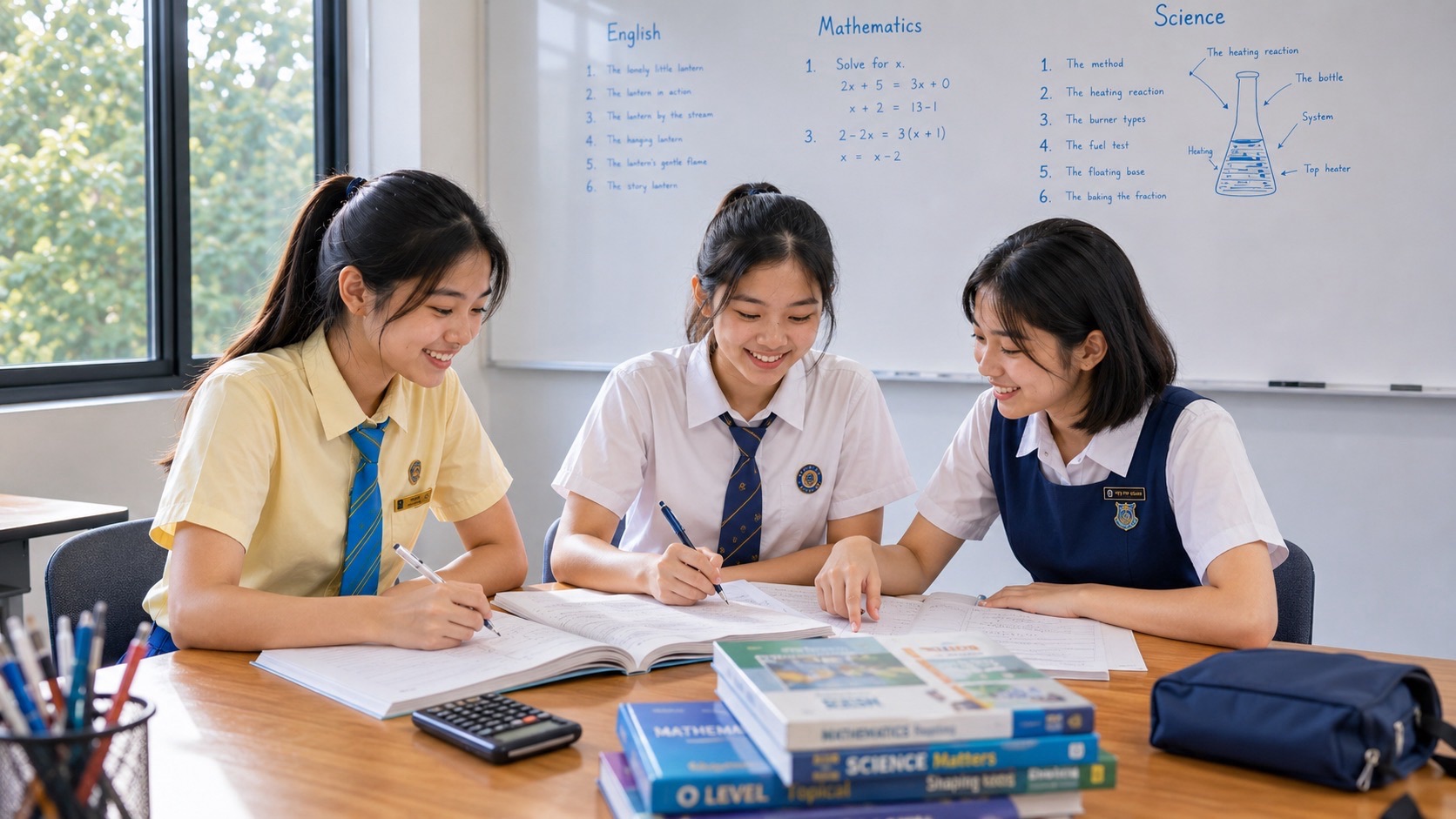
Students around Bukit Timah do not arrive at Mathematics tuition through one common pathway. Nanyang Primary, Methodist Girls’ School, Singapore Chinese Girls’ School, Hwa Chong Institution and Nanyang Girls’ High School sit within the same broad education neighbourhood, but their students can be working toward very different transitions: PSLE, SEC, Integrated Programme progression, IB Diploma Mathematics or Singapore-Cambridge A-Levels.
Bukit Timah Tutor is not affiliated with any of the schools named on this page. The purpose of this guide is diagnostic: school name is context, not a substitute for reading the student’s actual Mathematics.
Nanyang Primary School
Nanyang Primary’s current Mathematics programme explicitly places problem solving at the centre and describes Polya-style problem-solving stages, mathematical reasoning, communication, application and metacognition. A learner coming from that environment may already be comfortable discussing strategy, but the tutor still needs to check arithmetic fluency, fractions, ratio and independent transfer rather than assuming strength from the school label.
Methodist Girls’ School
MGS currently operates two secondary academic pathways: a four-year SEC Programme and a six-year Integrated Programme. The IP leads into the International Baccalaureate Diploma Programme at ACS(I) in Years 5 and 6. That means two MGS students of similar age can be preparing for different assessment systems and need different Mathematics routing.
Singapore Chinese Girls’ School
SCGS is also dual-track, offering the SEC Programme and a Joint Integrated Programme. JIP students spend Years 1–4 at SCGS before progressing to Eunoia Junior College and the Singapore-Cambridge A-Level route. A tuition plan therefore needs to know the track before deciding what “ahead” or “behind” means.
Nanyang Girls’ High School
NYGH’s Integrated Programme runs as a six-year route with Years 1–4 at NYGH and Years 5–6 at Hwa Chong Institution, leading to the A-Levels. Students may experience customised IP Mathematics before entering the JC syllabus, so a tutor should map the school’s taught progression against the learner’s actual prerequisite control.
Hwa Chong Institution
HCI operates an Integrated Programme through High School and College. Its 2026 JC information states that H2 Mathematics assumes O-Level Additional Mathematics or equivalent knowledge, and H2 Further Mathematics must be offered with H2 Mathematics and requires an aptitude assessment. These are useful route signals, but they still do not tell us whether a particular student is secure in algebra, functions, vectors or calculus.
What school context can tell a tutor
- Which curriculum or examination may be approaching.
- Which prerequisite sequence the student may have encountered.
- Whether IP, SEC, IB or A-Level transition demands are relevant.
- Which school-specific assessments may create short-term pressure.
What school context cannot tell a tutor
- Which concept the student actually understands.
- Whether a high mark came from durable knowledge or rehearsed familiarity.
- Whether a low mark came from missing knowledge, timing, reading or avoidable execution errors.
- How much help the student currently needs to solve an unseen problem independently.
The BTT rule: diagnose the learner, not the badge
A student from a selective or academically demanding school may still have a narrow mathematical gap that is limiting everything above it. Another student may be stronger than the current school result suggests because examination execution is poor. The right response begins from evidence.
Start from Bukit Timah Mathematics Tuition, then route into Mathematics Diagnosis, JC Mathematics, IB AA/IB AI or the Competition Hub according to the learner’s actual route.
School pathway information checked 26 September 2026 against the official Nanyang Primary, MGS, SCGS, HCI and NYGH websites. Bukit Timah Tutor is independent and not affiliated with these schools.
World Mathematics route: return to the World Mathematics Atlas to connect this Bukit Timah school-context route with the wider Singapore, IB, SEC, JC and international Mathematics map.
Using the Bukit Timah school ecosystem as a Mathematics planning map
School proximity does not create one shared Mathematics pathway
Nanyang, MGS, SCGS, Hwa Chong, NYGH and neighbouring schools serve different cohorts and programmes. Families should use the local map for logistics and curriculum awareness, not assume every nearby student studies identical material.
Identify the learner’s exact programme first
Primary, IP, O-Level/SEC, IB and A-Level routes can coexist within the wider Bukit Timah education ecosystem. Confirm year, subject and assessment route before choosing materials or tuition.
Travel is part of weekly learning capacity
School dismissal, CCA, transport, meals and homework all compete for time. A tuition plan that looks convenient geographically may still create an unsustainable evening.
Strong-school context does not remove diagnostic need
Students in selective or high-performing environments can still have specific prerequisite gaps. Diagnose the actual error pattern rather than assuming the school’s pace tells you what the individual learner needs.
School papers are local evidence
Internal tests and prelims reveal school-specific question style and pace, but national or international examinations remain governed by their own syllabus and assessment specifications.
Competition routes are optional enrichment
Olympiad activity can complement school Mathematics for suitable learners, but it should not be treated as a requirement simply because peers participate.
Small-group tuition should preserve individual visibility
The value of a small group is that the tutor can observe working, compare strategies and intervene on misconceptions while retaining peer discussion. Group size alone is not a guarantee.
Parents should compare workload, not prestige
Ask what additional work the programme creates, what it replaces and whether the student can still revise independently. More advanced material is not automatically better preparation.
Use local resources as a network
Libraries, schools, enrichment, transport and home routines can form a workable learning system when roles are clear. Locality is useful when it reduces friction.
Keep school-specific claims factual
Programmes and admissions arrangements change. Link current school information to official school/MOE sources rather than presenting old structures as permanent.