
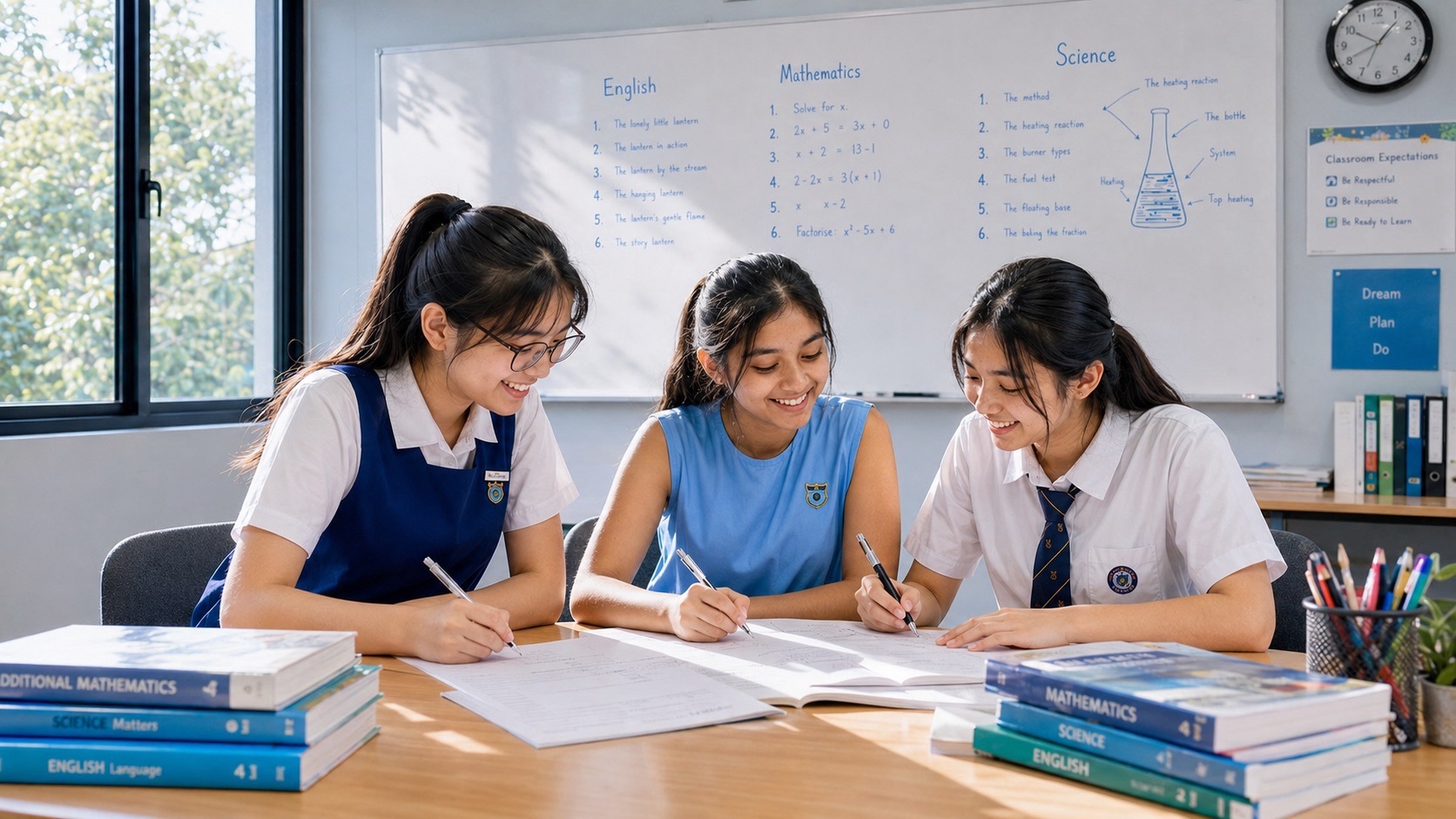
CBSE Class 12 Mathematics for the 2026–27 academic year uses the current CBSE senior-secondary Mathematics curriculum and sample-paper system. The Class XII course structure lists one 80-mark theory paper plus 20 marks of internal assessment.
The six official units carry the following theory weightings: Relations and Functions 8 marks, Algebra 10, Calculus 35, Vectors and Three-Dimensional Geometry 14, Linear Programming 5, and Probability 8. Calculus therefore carries the largest single share of the theory structure.
Do not start with calculus if algebra is unstable
The 35-mark calculus weighting can tempt students to spend all their time differentiating and integrating. But calculus performance depends heavily on functions, algebra, trigonometry and equation control. Repair those dependencies first when repeated calculus errors are really algebra errors.
The 2026–27 mathematical spine
- Relations and functions, including inverse trigonometric functions
- Matrices and determinants
- Continuity, differentiation and applications
- Integration and differential equations
- Vectors and three-dimensional geometry
- Linear programming
- Probability
Use the current sample paper
CBSE has published Class XII sample question papers and marking schemes for the 2026–27 examination session. Students should use the current-year SQP to understand paper design and marking after topic knowledge is stable.
Preparation sequence
- Audit Relations/Functions and Algebra.
- Build Calculus as a connected system rather than separate formulas.
- Maintain Vectors/3D Geometry weekly.
- Practise Probability and Linear Programming independently.
- Use the current CBSE sample paper and marking scheme.
- Move to timed papers only after recurring topic gaps are repaired.
Use the Calculus Knowledge Object, Vectors and Coordinate Geometry and Probability as the stable repair routes.
Official sources checked 26 September 2026: CBSE Class XII Mathematics curriculum and Class XII 2026–27 sample-question-paper portal.
World Mathematics route: return to the World Mathematics Atlas for the wider map across examinations, curricula, competitions, mathematical objects and university routes.
CBSE Class 12 Mathematics 2026–27: build preparation from the official course structure
Use the official 2026–27 curriculum as scope
CBSE’s current Mathematics code 041 document defines the Class XII curriculum and question-paper design. Third-party chapter lists should not override it.
The current design separates board paper and internal assessment
CBSE’s 2026–27 document specifies an 80-mark, three-hour question paper plus 20 marks of internal assessment. Students should prepare for both rather than treating the board paper as the entire course.
No chapter-wise weightage means broad coverage matters
The official design states there is no chapter-wise weightage and all chapters should be covered. This makes selective omission risky.
Question demand includes more than recall
The published design allocates substantial marks to applying, analysing, evaluating and creating alongside remembering/understanding. Preparation should include unfamiliar transfer, not only repeated templates.
Calculus needs connected preparation
Continuity/differentiability, applications of derivatives, integrals, applications of integrals and differential equations should be linked through functions and rate/accumulation ideas.
Vectors and three-dimensional geometry need representation
Draw or visualise direction, lines and planes before algebra. Formula recall without geometric meaning is fragile.
Probability needs model interpretation
Conditional probability and distributions should be built from events and random variables rather than calculator-like formula substitution.
Sample papers are valuable because they reflect current design
Use CBSE’s official 2026–27 sample paper and marking scheme to understand question architecture, then return to targeted repair when a weakness appears.
Internal choice is not permission to skip chapters
The current design provides internal choices within sections but no overall choice. Broad readiness remains safer than gambling on omissions.
Revision loop
Complete concept repair, NCERT/core examples, mixed board-style questions, official sample material, timed paper and error classification.
Keep the year label
When CBSE publishes a later curriculum, update the volatile design facts while preserving the durable learning architecture.
CBSE Class 12 Mathematics 041: the full 2026–27 course architecture
The official 2026–27 Class XII Mathematics course is one connected senior-secondary system. The unit weights matter for planning, but the deeper preparation task is to understand which mathematical objects support several units at once. Calculus carries the largest theory weight, yet it sits on functions, algebra and trigonometric fluency. Vectors and three-dimensional geometry require both representation and algebraic control. Probability requires structural reasoning about events, not only formulas.
Relations and Functions — 8 marks
The Class XII relations-and-functions unit includes types of relations, one-to-one and onto functions, and inverse trigonometric functions with principal-value branches, domains, ranges and graphs. The learner should be able to move between formal definitions and visual meaning. A relation may be reflexive, symmetric, transitive or an equivalence relation; a function may be one-to-one or onto; an inverse trigonometric expression carries domain and range restrictions that must remain visible during manipulation.
A useful diagnostic asks whether the learner understands the object before calculating. Can they identify whether a relation is an equivalence relation from its properties? Can they explain why principal branches are necessary for inverse trigonometric functions? Can they infer a domain from a transformed inverse function rather than relying on a memorised graph?
Algebra — 10 marks
The Class XII algebra unit centres on matrices and determinants. The mathematical work includes matrix operations, transpose, symmetric and skew-symmetric matrices, invertibility, determinant properties, minors and cofactors, adjoint and inverse, area applications, and solving systems of linear equations by matrix methods.
This unit rewards structural precision. Matrix multiplication is not commutative; dimensions control whether a product is defined; determinant behaviour changes under row operations; invertibility connects to whether a unique inverse exists. A learner who treats matrices as number grids without respecting these structures will lose marks even when arithmetic is correct.
Calculus — 35 marks
Calculus is the largest unit in the current theory structure. It includes continuity and differentiability, applications of derivatives, integrals, applications of integrals and differential equations. Use BTT’s Calculus Knowledge Object when a weakness crosses several calculus chapters.
The central principle is connection. Continuity leads into differentiability; derivatives become tools for rates, increasing/decreasing behaviour and maxima/minima; integration is developed as an inverse process and as accumulation; differential equations model changing quantities. A student who learns each chapter as a separate formula set will find mixed questions disproportionately hard.
Vectors and Three-Dimensional Geometry — 14 marks
This unit includes vector magnitude and direction, components, scalar and vector products, lines in space, direction ratios and cosines, skew lines, shortest distance and angles. Use BTT’s Vectors & Coordinate Geometry owner when the learner’s weakness is geometric rather than paper-specific.
The learner should be able to connect a vector expression with geometry. The dot product carries angle information; the cross product carries perpendicular direction and area structure; a line in three dimensions should remain a geometric object even when written as a vector or Cartesian equation.
Linear Programming — 5 marks
Linear programming may carry a smaller formal weight, but it tests modelling discipline. Students identify variables, translate constraints, form an objective function, represent feasible regions and locate optimal feasible solutions. The graph is not decoration: it represents the intersection of constraints and the geometry of optimisation.
Probability — 8 marks
The probability unit includes conditional probability, multiplication rules, independent events, total probability and Bayes’ theorem. Use BTT’s Probability owner when the learner’s issue is event structure rather than one CBSE question format.
Probability errors often begin before calculation. Students confuse independence with mutual exclusivity, use the wrong conditioning set, or apply Bayes’ theorem without defining the partition. The strongest preparation makes the event structure visible before any formula is written.
The unit weights are planning signals, not permission to skip
The official 2026–27 design explicitly states that there is no chapter-wise weightage and that all chapters should be covered. The listed unit marks help students allocate revision time, but they do not justify abandoning a chapter because it appears small. A five-mark unit can still contain questions that are highly efficient to prepare, while a weak prerequisite from a lower-weight area can disrupt performance elsewhere.
- Use weightings to allocate time: Calculus deserves sustained attention because it carries 35 marks.
- Use dependency to set order: functions and algebra must be stable before calculus volume rises.
- Use error frequency to personalise: a student repeatedly losing matrix or vector marks may need more time there than the nominal weight suggests.
- Use full-course coverage: internal choices reduce local risk but do not create a safe strategy of skipping whole chapters.
The best study plan therefore balances official weight, mathematical dependency and the learner’s live error profile.
The 2026–27 CBSE Class 12 Mathematics paper design
CBSE’s current Class XII 2026–27 sample-question-paper portal publishes the Mathematics sample paper and marking scheme for the current session. The sample Mathematics paper is three hours, 80 marks and 38 compulsory questions arranged across five sections. Calculators are not allowed.
Section A — 20 one-mark questions
The current sample paper uses 18 multiple-choice questions plus two Assertion–Reason questions. This section rewards quick recognition and clean execution. The danger is overthinking routine items or using too much time on one symbolic manipulation.
Preparation should therefore include short bursts of mixed retrieval: inverse trigonometric domains and ranges, matrix structure, derivative recognition, vector facts, probability relationships and other high-frequency one-mark decisions. The student should know why an option is correct, not merely become fast at guessing.
Section B — five two-mark very-short-answer questions
Two-mark responses test whether the learner can perform a compact mathematical chain without wasting steps. The solution should show enough working to make the method visible while remaining efficient. Students who write too little risk losing method evidence; students who write too much consume time needed later.
Section C — six three-mark short-answer questions
Three-mark questions often require a more complete chain: define the right object, execute two or three linked steps, and state the result clearly. This is where weak algebra can become expensive because one early sign or restriction error contaminates the whole solution.
Section D — four five-mark long-answer questions
Long-answer work rewards structure. The student should know how to organise a calculus application, matrix system, vector/3D problem or probability argument so that each important step is visible. A tutor should teach answer architecture, not just the final method.
Section E — three four-mark case-study questions
Case-study questions place Mathematics inside a described situation. The learner must extract the relevant variables, relationships or data before calculating. This is a transfer test: the mathematical object may be familiar even when the surface context is not.
Current internal-choice structure
The current sample paper provides no overall choice. Internal choice is distributed inside selected questions: two in Section B, three in Section C, two in Section D, and one subpart each in two Section E questions. This structure rewards broad preparation. A student cannot safely omit a whole unit and assume choice will remove it.
The 2026–27 question-demand profile
CBSE’s current question-paper design allocates 55% of theory marks to remembering and understanding, 25% to applying knowledge in new situations, and 20% to analysing, evaluating and creating. That does not mean the paper is mostly memorisation. Even a direct-looking question can demand accurate interpretation of a function, matrix, graph, vector or event.
- Remember/Understand: definitions, properties, domains, standard relationships and direct interpretation must be immediately available.
- Apply: the learner must recognise when a known method fits a changed situation.
- Analyse/Evaluate/Create: longer or unfamiliar tasks may require modelling, inference, justification, comparison or a non-routine sequence of steps.
The preparation implication is clear: retrieval matters, but it must be followed by changed practice. Reading a solved example is not enough evidence that the method will be available when CBSE changes the context.
No-calculator Mathematics changes the preparation standard
The official sample paper states that calculators are not allowed. Students therefore need strong manual algebra, exact-value fluency, arithmetic accuracy and estimation. This is especially important in matrices, calculus, vectors and probability, where a small numerical error can hide a correct method.
No-calculator work does not mean every calculation should be mental. It means the learner should have a reliable written arithmetic and algebra process: simplify before substituting, preserve exact forms where sensible, track signs, and use estimates to catch implausible results.
How to use the official sample paper
Do not start by timing the entire paper if major topic gaps remain. First use selected questions diagnostically. Identify which unit and mathematical object each question tests, solve without notes, then classify the first failure. Only when the active error list is smaller should the student use full timed papers to practise pacing and recovery.
The marking scheme is equally useful. Compare the learner’s reasoning with the official solution structure and note which intermediate steps carry mathematical meaning. The goal is not to copy wording; it is to understand what complete reasoning looks like under the current CBSE design.
Calculus 35 marks: prepare it as one connected system
Calculus carries the largest share of the official Class XII theory structure, but the most efficient preparation is not five separate piles of chapter exercises. Continuity, differentiability, applications of derivatives, integration, area and differential equations belong to one connected story about change, accumulation and functional relationships.
Continuity and differentiability
The learner should distinguish continuity from differentiability rather than treating both as substitution exercises. Continuity asks whether the function approaches the value the function actually takes. Differentiability asks whether a well-defined local rate exists. Piecewise functions are particularly useful because they force left-hand, right-hand and point-value reasoning to become explicit.
Inverse trigonometric, exponential, logarithmic, implicit and parametric derivatives should be attached to function structure. The student should identify what kind of function is present before selecting a differentiation technique. This reduces rule confusion and prepares for later application questions.
Applications of derivatives
Increasing/decreasing intervals, maxima/minima and rate-of-change problems are not a separate calculus language. They are interpretations of the derivative. The learner should move among sign of f′, graph behaviour and contextual change. In optimisation, the mathematical model must be built before differentiation begins.
A useful tutor rule is: no derivative until the variables and relationship are clear. Many ‘calculus mistakes’ are actually modelling mistakes that occur one step earlier.
Integration
Integration should be learned as both inverse differentiation and accumulation. Substitution, partial fractions and integration by parts are technique choices that arise from structure. A learner who memorises a long table of integrals without recognising structure becomes slow and error-prone on mixed questions.
Before integrating, ask: can the expression be simplified? Is there an inner derivative suggesting substitution? Is the rational expression suitable for partial fractions? Is there a product where one factor becomes simpler under differentiation? The technique should follow the object.
Definite integrals
Definite integrals add interval, sign and accumulated quantity. Students should know the difference between an antiderivative expression and a definite numerical accumulation. Properties of definite integrals can reduce calculation when symmetry or interval structure is recognised.
Applications of integrals
Area questions require the learner to identify which curve is above, where intersections occur and whether the region crosses an axis. Drawing a sketch before integrating is often the most efficient way to prevent sign and limit errors.
Differential equations
Differential equations combine derivative meaning with algebraic and integration technique. The learner should identify order and degree, distinguish general and particular solutions, and recognise when separation of variables or first-order linear structure applies. An initial condition should be interpreted as information that selects one member from a family of solutions.
A calculus diagnostic ladder
- Function readiness: can the learner work with algebraic, trigonometric, exponential and logarithmic functions?
- Derivative recognition: can the correct rule be selected from structure?
- Interpretation: can derivative sign and magnitude be connected to behaviour?
- Integration recognition: can substitution, partial fractions or parts be chosen for a reason?
- Definite-integral control: are limits, sign and area interpretation preserved?
- Differential-equation recognition: can the correct solution structure be identified?
- Transfer: can a changed calculus problem be solved after the worked example is closed?
Why calculus errors are often not calculus errors
A student may lose a differentiation question because of weak logarithm laws, an integration question because of incomplete factorisation, or an area question because a graph was never sketched. The first error should determine the repair. More calculus volume is not the solution when the prerequisite is algebra, trigonometry or function representation.
This is why BTT routes recurring foundational failures back into the Mathematics Knowledge Warehouse before returning to the CBSE paper. The stable object should be repaired once, then tested across several Class XII contexts.
Matrices and determinants: the algebra unit as structure
Matrices and determinants reward careful attention to definitions and dimensions. Students should know when an operation is defined, which properties are valid and how matrix structure connects to systems of equations. The unit is compact enough that disciplined preparation can produce reliable marks, but careless symbolic work can also make it deceptively expensive.
Matrix dimensions should control every product
Before multiplying matrices, write the dimensions. The inner dimensions must match; the resulting matrix inherits the outer dimensions. This simple habit prevents many errors and reinforces why matrix multiplication is not ordinary component-by-component multiplication.
Symmetric and skew-symmetric structure
A matrix is symmetric when transpose leaves it unchanged and skew-symmetric when the transpose is its negative. Students should understand the consequences for diagonal entries and corresponding off-diagonal entries rather than memorise examples.
Determinants and invertibility
The determinant is not just another calculation. A non-zero determinant signals invertibility in the square-matrix context. The adjoint, inverse and system-of-equations applications all depend on that structure. A tutor should connect determinant properties to the existence and uniqueness of solutions.
Systems of equations
When solving a system using inverse matrices, the learner should first understand what the system represents and whether a unique solution is expected. Matrix notation compresses the system; it does not remove the need to interpret consistency and solution structure.
Relations, functions and inverse trigonometry
The relations-and-functions unit is small in marks but conceptually important. Equivalence relations, one-to-one and onto functions, and inverse trigonometric functions all depend on precise definitions. These topics are ideal places to practise mathematical language and proof-like reasoning.
Equivalence relations
Reflexive, symmetric and transitive are separate conditions. Students should test each one explicitly. One failed condition is enough to show that a relation is not an equivalence relation.
One-to-one and onto functions
A function can fail to be one-to-one because different inputs map to the same output, or fail to be onto because some codomain values are not achieved. The learner should be able to reason from definition, graph or algebra.
Inverse trigonometric functions
Principal-value branches are essential because the original trigonometric functions are periodic and not globally one-to-one. Domain and range restrictions therefore belong to the object. Students should not manipulate inverse trigonometric expressions while forgetting the principal-value range.
Vectors and three-dimensional geometry: representation before formula
This unit becomes much easier when the learner sees geometry first. A vector carries magnitude and direction. Direction cosines and ratios describe orientation. Dot and cross products encode geometric relationships. Lines in space should be visualised before they are manipulated algebraically.
Dot product
The dot product connects algebra to angle. A zero dot product signals perpendicularity when both vectors are non-zero. Students should understand this relationship rather than treat the formula as a calculator step.
Cross product
The cross product produces a vector perpendicular to the two input vectors and carries area information through its magnitude. Its direction follows orientation conventions that should remain conceptually clear.
Lines in three dimensions
Vector and Cartesian forms describe the same geometric line. Direction ratios should be interpreted as orientation, while shortest-distance problems between skew lines require the learner to understand why the connecting segment must be perpendicular to both directions.
Linear Programming: model first, graph second
Students should define decision variables, translate each condition into an inequality, identify the feasible region and only then evaluate the objective function. A graph drawn from incorrect constraints cannot be rescued later.
The strongest solutions explain what the optimal point means in the original problem. Linear programming is not merely about shading and vertices; it is about converting constraints into a mathematical decision model.
Probability: event structure before Bayes’ theorem
Conditional probability, independence, total probability and Bayes’ theorem all become easier when events are named clearly. Use a tree, table or partition before writing formulas if the structure is not obvious.
- Conditional probability: the denominator is the conditioning event.
- Independence: one event does not change the probability of the other.
- Total probability: break an event across a complete partition.
- Bayes’ theorem: reverse a conditional relationship using prior probabilities and the total probability of the observed event.
The learner should be able to explain why the formula fits the event structure. If the answer is only ‘because this is a Bayes question’, the reasoning remains fragile.
A 12-week CBSE Class 12 Mathematics preparation architecture
A strong 12-week plan should move from diagnosis to integration to examination execution. It should not begin with twelve full sample papers. Full papers are most useful after the learner has reduced the number of live topic errors.
Weeks 12–10: baseline and dependency audit
Use a mixed diagnostic across Relations and Functions, Algebra, Calculus, Vectors/3D, Linear Programming and Probability. Do not look only at total marks. Record the first meaningful failure in each question: recognition, algebra, calculus rule, vector representation, event structure, modelling or checking.
At this stage, identify dependencies. If integration repeatedly fails because partial fractions are weak, repair algebra. If applications of derivatives fail because graphs and functions are weak, rebuild the function system. If inverse trigonometric questions fail because domains and principal values are unclear, repair those definitions before increasing speed.
Weeks 9–7: repair the mathematical engine
Spend the largest share of repair time on high-leverage weaknesses. Calculus deserves attention because of its 35-mark unit weight, but calculus practice should be selective. A student who already differentiates fluently may gain more marks by repairing vector geometry or conditional probability than by completing another fifty routine derivatives.
Keep Relations/Functions and Algebra active through short retrieval. Matrices, determinants and inverse trigonometric functions can become reliable marks when the definitions and properties remain fresh.
Weeks 6–5: mix units and remove chapter labels
Begin using mixed sets that force recognition. One question may be an inverse-trigonometric domain problem, the next a determinant, then an application of derivatives, a vector relationship and a probability condition. The student should identify the mathematical object before writing the first formula.
This phase is where textbook knowledge becomes board-exam knowledge. In the examination, the chapter heading is absent. Recognition has to come from the problem itself.
Weeks 4–3: practise section-level timing
Use the current CBSE sample-paper architecture. Practise Section A speed separately, then Sections B/C for concise method, and Sections D/E for long-response and case-study structure. Section-level timing is easier to diagnose than a full paper because the learner can see exactly where time is being lost.
Week 2: full-paper diagnosis
Now use one or more full current-design papers under realistic conditions. After each paper, classify marks lost by error family and time. The next practice should become smaller and more targeted, not automatically another full paper.
Final week: taper and stabilise
Protect sleep, familiar routines and exact-value fluency. Keep one short active error list. Review formulas and relationships through retrieval rather than passive rereading. Use selected representative questions, not an expanding pile of new materials.
The weekly maintenance system
- Two calculus sessions: one technique/repair session and one mixed application session.
- One vectors/3D session: keep geometry and representation active.
- One algebra/functions retrieval session: matrices, determinants and inverse-trigonometric structure.
- One probability/LPP session: event reasoning and modelling.
- One mixed set: remove chapter labels and require recognition.
- One delayed retest: revisit last week’s active errors.
The exact frequency should change with the learner’s evidence. The important principle is distributed return. A topic should not disappear for three weeks simply because its textbook unit was completed.
How to know the plan is working
The strongest evidence is not that the learner completes more questions. It is that the active error list shrinks, mixed-question recognition becomes faster, long responses need fewer tutor prompts and a fresh sample-paper question can be solved without seeing the worked example first.
Original BTT diagnostic examples for CBSE Class 12 Mathematics
The examples below are original teaching examples, not copied CBSE questions. Their purpose is to expose the reasoning that current Class XII questions rely on.
Example 1 — inverse trigonometric domain
Consider y = cos⁻¹(2x – 1). Before manipulating the expression, the learner should impose the input condition -1 ≤ 2x – 1 ≤ 1. Solving gives 0 ≤ x ≤ 1. The important habit is that the domain restriction comes from the inverse trigonometric object before any graphing or algebraic simplification.
A student who tries to remember a catalogue of domains will struggle when the inside expression changes. The transferable rule is to force the argument of cos⁻¹ into its permitted interval.
Example 2 — matrix dimensions before multiplication
Let A be a 2 × 3 matrix and B a 3 × 2 matrix. AB is defined and is 2 × 2; BA is also defined and is 3 × 3. The fact that both products exist does not mean they are equal. This example is useful because it separates dimension compatibility from commutativity.
A tutor should require dimensions to be written before multiplication until the habit becomes automatic. That one line prevents many avoidable matrix errors.
Example 3 — continuity before differentiability
Suppose a piecewise function uses one expression for x ≤ 1 and another for x > 1. To test differentiability at x = 1, the learner should first ensure continuity: left-hand limit, right-hand limit and function value must agree. Only then should left and right derivatives be compared.
The diagnostic lesson is that differentiability is a stronger local condition than continuity. A student who jumps directly to derivatives may solve algebra correctly and still miss the logical sequence.
Example 4 — optimisation from a model
Suppose a rectangle has fixed perimeter P. If one side is x, the other is P/2 – x, so area is A(x) = x(P/2 – x). Only after this relationship is built should the learner differentiate. The critical point gives a candidate maximum, but the final response should still interpret the geometry.
This example reveals whether the student sees optimisation as modelling followed by calculus or as a mysterious command to ‘differentiate something’.
Example 5 — definite integral and signed area
If a curve crosses the x-axis, the definite integral over an interval may be smaller than the total geometric area because contributions below the axis are negative. Before integrating, sketch or reason about sign. If the question asks for total area, split the interval at the zeros and use positive geometric contributions.
Example 6 — vector perpendicularity
Let a = (1, 2, -1) and b = (2, -1, 0). Their dot product is 2 – 2 + 0 = 0, so the non-zero vectors are perpendicular. The learner should be able to move from the algebraic result to the geometric conclusion immediately.
Example 7 — conditional probability
Suppose 60% of students take Mathematics and 30% of those Mathematics students also take Computer Science. The probability of both events is 0.60 × 0.30 = 0.18. The structure matters: 0.30 is conditional on already being in the Mathematics group.
If the learner adds 0.60 and 0.30 or uses the entire population as the wrong denominator later, the error is conceptual before it is computational.
Example 8 — linear programming from constraints
Suppose a workshop makes products x and y, with time and material limits that produce linear inequalities. The learner should define x and y, translate each resource limit into a constraint, add non-negativity conditions, graph the feasible region, then evaluate the objective function at relevant vertices.
The key transfer skill is translation. If the inequalities are wrong, a beautifully drawn graph is still the wrong model.
How to use each diagnostic example
- Identify the mathematical object.
- State the governing condition or relationship.
- Solve the original example.
- Close the solution.
- Change the numbers or context while preserving the structure.
- Solve again independently.
- Explain what remained the same mathematically.
- Return after a delay.
That final changed problem is the important one. It separates genuine learning from familiarity with the worked example.
Board-paper execution: turn three hours into a controlled system
CBSE Class 12 Mathematics is not only a content test. It is also a three-hour execution problem. The learner must switch among one-mark recognition, compact two- and three-mark responses, longer five-mark chains and case-study interpretation without losing accuracy.
Start with paper awareness, not panic
At the beginning, read instructions and understand the section structure. The current sample paper has no overall choice, so the student should expect to engage with the whole paper. Internal choices should be used strategically when one option clearly matches stronger knowledge or requires less risky algebra.
Section A: speed with discipline
One-mark questions should usually be solved with the cleanest available reasoning. Do not turn every MCQ into a full long-answer derivation. At the same time, avoid blind option testing when one definition or property settles the question immediately.
If a one-mark question becomes unusually time-consuming, mark it mentally or on the paper and return. Spending five minutes to protect one mark can damage later five-mark work.
Sections B and C: concise method marks
Very-short and short-answer responses should show the essential mathematical chain. Write the relevant equation, substitution or reasoning step clearly enough that the marker can follow it. Do not omit the middle step that makes the answer intelligible.
Section D: structure before detail
For five-mark questions, organise the solution. Define variables if needed, state the governing relationship, carry out the main derivation, and end with the requested conclusion. Long answers should not become streams of disconnected algebra.
Section E: read the case before calculating
Case-study questions can tempt students to hunt immediately for numbers. First identify the mathematical object: function, derivative, matrix, vector, probability or another structure. Then decide which details in the story actually matter.
A timing review after each practice paper
- How long was spent on Section A?
- Which question consumed disproportionate time?
- Where did algebra slow the student?
- Did long answers begin with a clear plan?
- Did the learner revisit skipped questions calmly?
- Was enough time left for checking?
- Which errors came from time pressure rather than knowledge?
Timing problems should be diagnosed like mathematical errors. Slow recognition, slow arithmetic, over-writing, repeated checking and getting stuck on one difficult question are different causes. A generic instruction to ‘work faster’ does not solve them.
The final checking routine
- Re-read the command: find, prove, evaluate, show, solve or interpret.
- Check domain and restrictions.
- Check determinant or matrix dimensions where relevant.
- Check derivative or integral sign.
- Check vector direction or magnitude.
- Check probability lies between 0 and 1.
- Check linear-programming constraints and objective interpretation.
- Check whether the final answer actually responds to the question.
A short checking routine is more useful than rereading the whole paper randomly. It directs attention toward the mathematical places where CBSE Class 12 students most often lose avoidable marks.
The CBSE Class 12 Mathematics error taxonomy
A useful correction system identifies the first meaningful failure rather than recording only the final wrong answer. This is especially important in Class XII because one prerequisite error can contaminate an entire five-mark solution.
- Definition error: a relation, inverse function, matrix property or probability concept is misunderstood.
- Recognition error: the student does not identify the mathematical object or appropriate method.
- Algebra error: factoring, simplification, signs, fractions or identities fail.
- Calculus-rule error: the wrong derivative, integration or differential-equation method is selected.
- Representation error: graph, vector, line, plane, feasible region or event structure does not match the problem.
- Restriction error: domain, principal value, non-permissible value or interval condition is lost.
- Model error: the real-life or case-study relationship is translated incorrectly before calculation.
- Execution error: the method is right but arithmetic or symbolic work fails.
- Communication error: reasoning is incomplete or too compressed to follow.
- Checking error: an implausible answer is accepted without verification.
- Time-management error: the learner knows the mathematics but cannot complete it efficiently under paper conditions.
Each error family should lead to a different repair. A domain error needs restriction practice; a recognition error needs mixed problems without chapter labels; a time error needs section-level timing; a model error needs more representation work before calculus or algebra.
How to build a small active error log
The error log should remain short enough to use. Record the unit, mathematical object, first wrong step, error family, repair and delayed retest. Remove an entry when the error remains stable across changed questions.
For example: ‘Calculus — area between curves — failed to sketch and reversed upper/lower function — representation error — retest with a different pair of curves in four days.’ Or: ‘Probability — conditional denominator wrong — event-structure error — retest with a two-way table and new context.’
This is more useful than a correction notebook containing hundreds of copied solutions. The purpose is to identify live patterns that still change marks.
CBSE Class 12 Mathematics and JEE Mathematics are not the same preparation job
CBSE Class 12 Mathematics and JEE Main and JEE Advanced Mathematics overlap in mathematical content, but the assessment goals and preparation systems differ. The CBSE board course follows the official Class XII syllabus and current paper design; JEE entrance Mathematics demands a broader and often more compressed problem-solving style across Class XI and XII topics.
CBSE rewards syllabus coverage and communicated working
Board preparation must respect the current Class XII unit structure, internal choices, long-answer method and case-study format. Students need complete written solutions and reliable coverage across all official units.
JEE rewards rapid recognition across a wider field
Entrance preparation draws on a much larger Class XI–XII mathematical inventory and often asks students to combine ideas more aggressively. A student can be strong at CBSE board Mathematics yet still need separate JEE problem-solving preparation.
JEE preparation should not erase board discipline
Students preparing for both should protect the board-specific layer: complete solutions, syllabus-specific topics, internal assessment and current sample-paper structure. JEE speed and shortcuts should not cause missing steps or incomplete board responses.
Board preparation should not be mistaken for full JEE preparation
Conversely, completing CBSE textbooks and sample papers alone does not reproduce the breadth, difficulty distribution or selection pressure of JEE. Keep the two owners connected but distinct.
A dual-preparation rule
- Use the CBSE guide for the Class XII syllabus and board-examination preparation.
- Use the JEE guide for entrance-exam breadth, speed and non-routine selection.
- Repair shared mathematical objects once in the Knowledge Warehouse.
- Practise each assessment layer separately after the Mathematics is secure.
- Do not let one examination’s habits damage the other’s required response style.
This gives students a clearer study approach: learn the shared Mathematics, then practise the requirements of each assessment separately.
Internal assessment: 20 marks should support, not distract from, the mathematical core
The official 2026–27 structure includes 20 marks of internal assessment alongside the 80-mark theory paper. CBSE identifies periodic tests and Mathematics activities as the two major components. Students should understand that these marks belong to the course, but preparation should remain mathematically coherent rather than treating internal assessment as an unrelated administrative exercise.
Periodic tests
Periodic tests are useful diagnostic evidence. A good review asks which unit, object and error family caused lost marks. Because the best two of three tests contribute to the internal-assessment structure, students should take each test seriously while also using it to improve the later board-paper system.
Mathematics activities
Activities can help students visualise and communicate concepts that otherwise feel abstract. The NCERT Mathematics Laboratory Manual can support this work. The educational value is strongest when the activity clarifies a relationship—matrix structure, geometric interpretation, probability, function behaviour or another concept—rather than becoming a presentation task detached from Mathematics.
How parents should read Class 12 Mathematics progress
Parents should not react to one school test as though it predicts the board result. Class XII performance changes across the year as calculus, vectors, probability and mixed-paper execution become integrated. A better review compares several pieces of evidence and the amount of help required.
- Can the student explain the current calculus method without notes?
- Are matrices and determinants stable enough to provide reliable marks?
- Can vector and 3D questions be represented before calculation?
- Does probability start from event structure rather than formula guessing?
- Can the learner finish mixed sections under realistic time?
- Is the active error list becoming shorter?
- How much tutor or parent prompting is still required?
What a CBSE Class 12 Mathematics tutor should diagnose
Syllabus fit
The tutor should know the current Mathematics code 041 syllabus rather than teach from an old chapter list. Current official scope, unit structure and sample-paper design should anchor the programme.
Prerequisite fit
Class XII Mathematics sits on Class XI and earlier foundations. A tutor should be willing to repair a narrow prerequisite—functions, trigonometry, algebra or probability—without turning the whole programme into a Class XI repeat.
Calculus dependency
Because calculus carries the largest current weight, the tutor should distinguish derivative/integration technique errors from underlying algebra, function or trigonometric errors. This prevents wasted practice.
Board-answer architecture
The tutor should teach complete, readable solutions. This means enough working to expose the method, correct notation, final interpretation and disciplined use of internal choice. JEE-style shortcut habits should not erase board marks.
No-calculator fluency
The learner should be comfortable with exact values, algebraic simplification and manual arithmetic under time. A tutor who routinely allows calculator dependence during practice is not reproducing the current board environment.
Transfer and taper
The tutor should regularly give fresh questions without chapter labels or live hints. As the learner becomes stable, prompts and lesson frequency should reduce. The end-state is independent board-paper execution, not permanent supervised solving.
Questions to ask before hiring a CBSE Class 12 Mathematics tutor
- Do you teach current CBSE Mathematics 041 for the 2026–27 session?
- How do you use the official syllabus and current sample paper?
- How do you diagnose Class XI prerequisites?
- How do you organise the 35-mark calculus unit?
- How do you teach matrices and determinants for reliable method marks?
- How do you distinguish CBSE board preparation from JEE preparation?
- How do you practise no-calculator accuracy?
- How do you review full papers?
- What would progress look like after four weeks?
- When would you reduce or stop tutoring?
Strong answers should describe an actual process. A tutor does not need a proprietary method or a large worksheet library. They need accurate current-course knowledge, strong Mathematics and a way to turn learner evidence into the next teaching decision.
Mathematics 041 is not the same as CBSE Applied Mathematics
CBSE offers a separate Applied Mathematics course at senior secondary level. This BTT owner is specifically for Class XII Mathematics subject code 041. Students, parents and tutors should confirm the subject on the school timetable before using a preparation guide, because the two courses have different unit structures and mathematical emphases.
The distinction matters especially in calculus, probability, statistics and financial or applied topics. A student can be in Class XII and study Mathematics under a different CBSE subject route. Do not merge those syllabuses simply because both contain senior-school Mathematics.
CBSE Class 12 Mathematics compared with Singapore H2 Mathematics
Singapore H2 Mathematics and CBSE Mathematics 041 share substantial senior mathematical objects—calculus, vectors, probability, algebra and functions—but they package them differently. H2 Mathematics has its own syllabus balance, assessment design and statistical content. A transfer student should compare actual objects and depth rather than use a one-line equivalence.
Where a Singapore learner may already be strong
A strong H2 student may bring significant calculus, vectors and probability experience. The CBSE bridge may therefore focus on matrices/determinants, the exact Class XII differential-equation treatment, linear programming, inverse-trigonometric conventions and board-answer style rather than reteaching all senior Mathematics.
Where a CBSE learner entering Singapore may need a bridge
The learner should inventory which H2 topics, statistical methods and examination conventions are new. Strong CBSE calculus is useful preparation, but it should not be assumed to cover every H2 mathematical object or assessment demand.
CBSE Class 12 Mathematics compared with IB Mathematics
IB Mathematics is divided into Analysis and Approaches and Applications and Interpretation, each at Standard and Higher Level. Those routes integrate functions, calculus, probability, statistics and technology differently from CBSE Mathematics 041.
A student transferring from IB should record the exact IB course and level, then compare functions, calculus, vectors, matrices, probability and statistics with the CBSE Class XII course. Some IB learners may have stronger calculator-based or modelling habits but need adaptation to CBSE’s no-calculator board paper.
CBSE Class 12 Mathematics compared with Cambridge A-Level Mathematics
Cambridge International A-Level Mathematics packages pure Mathematics, mechanics and probability/statistics through a different paper route. CBSE Class XII gives substantial weight to calculus and includes matrices, determinants, vectors/3D, linear programming and probability inside one school subject.
The correct transfer method is again a content crosswalk. A learner may be advanced in one strand and unfamiliar with another. Course title and school year are not enough to identify readiness.
The international transfer audit
- Record the exact previous Mathematics course and level.
- Record the exact destination course.
- List functions, algebra and trigonometry already studied.
- List calculus depth, including differential equations and integration techniques.
- List matrix and vector exposure.
- List probability and statistics exposure.
- Identify calculator and technology conventions.
- Identify assessment and answer-writing differences.
- Teach only missing or unstable objects.
- Retest those objects inside the destination course.
For deeper cross-system comparison, route through BTT’s World Mathematics Curriculum Comparison. The CBSE owner should remain focused on Mathematics 041 rather than becoming a duplicate international-comparison hub.
The school-to-university bridge from CBSE Mathematics
Class XII Mathematics can be a strong foundation for engineering, science, economics, computing and other quantitative routes, but university readiness is more than a board percentage. Use BTT’s School-to-University Mathematics Bridge to identify which mathematical objects the first university course will assume.
A learner heading into calculus-heavy study should preserve algebra and function fluency, not only derivative techniques. A learner heading into data-heavy study may need deeper statistics beyond the Class XII probability unit. A learner heading into linear algebra should carry matrix and vector meaning forward rather than only board procedures.
The strongest Class XII outcome is therefore not simply completion of the syllabus. It is a learner who can recognise which mathematics they own, identify what the next course requires and bridge the difference deliberately.
Frequently asked questions about CBSE Class 12 Mathematics 2026–27
What is the current theory-paper mark total?
The official 2026–27 Class XII Mathematics structure lists one 80-mark theory paper, with 20 marks of internal assessment.
Which unit carries the largest official weight?
Calculus carries 35 marks in the current unit structure, making it the largest single theory unit. That should influence revision time, but not encourage students to neglect the rest of the syllabus.
Is there chapter-wise weightage?
CBSE’s current curriculum document explicitly says there is no chapter-wise weightage and that all chapters should be covered. Unit weights guide planning, but they do not create a reliable skip strategy.
How many questions are in the current sample paper?
The official 2026–27 Mathematics sample paper contains 38 compulsory questions across Sections A to E, with internal choice distributed inside selected questions rather than an overall choice.
Are calculators allowed?
The current official sample paper states that calculators are not allowed. Preparation should therefore include manual algebra, exact-value work, clean arithmetic and estimation.
Should I solve full sample papers from the beginning of revision?
Not if major topic gaps are still active. Use selected current-year questions diagnostically first, repair the underlying Mathematics, then move into section-level and full-paper timing once the error list is smaller.
Is CBSE board preparation enough for JEE?
No. There is substantial overlap in Mathematics, but the two assessments have different scope and problem-selection demands. Use the CBSE owner for board syllabus and execution, and the JEE owner for entrance-exam preparation.
Can I skip Linear Programming because it is only five marks?
That is not a sound strategy. The current design says all chapters should be covered. Linear Programming is also relatively compact and can become a reliable scoring area when modelling and feasible-region work are secure.
What should I do if calculus remains weak after many questions?
Find the first recurring failure. It may be algebra, trigonometry, function recognition, derivative-rule selection, integration technique or modelling. More question volume is useful only after the failure is identified.
What should I do if I make many ‘careless’ mistakes?
Stop using ‘careless’ as the final diagnosis. Classify the errors: sign, copied term, domain, matrix dimension, derivative rule, arithmetic, omitted condition or incomplete checking. Repeated patterns are teachable.
Current-source discipline for the 2026–27 session
This page is anchored to CBSE’s official Mathematics 041 curriculum for 2026–27 and the official Class XII 2026–27 sample-question-paper portal. Those sources should outrank third-party chapter lists, old coaching sheets or earlier sample-paper assumptions when current scope and paper design are in question.
The stable layer of this BTT owner is the Mathematics itself: relations, functions, matrices, determinants, calculus, vectors, three-dimensional geometry, linear programming and probability. The current layer is administrative: unit weights, current sample-paper format, internal-choice distribution and annual assessment guidance.
This separation makes the page maintainable. If CBSE changes a paper template or annual instruction, update the current layer. Do not rewrite the stable mathematical core unless the syllabus itself changes.
The final CBSE Class 12 Mathematics independence standard
- The learner can identify the mathematical object without a chapter heading.
- The learner can complete no-calculator algebra accurately.
- Calculus methods are selected from structure rather than memorised cues.
- Vectors and 3D geometry remain connected to geometric meaning.
- Probability starts from event structure.
- Long answers show a coherent method.
- Case-study questions are translated before calculation.
- Mixed sections can be completed under realistic time.
- The active error log is small and specific.
- The learner can explain what still needs repair without waiting for a tutor to diagnose everything.
A student who can do these things is not merely ready to reproduce familiar CBSE exercises. They have a mathematical operating system strong enough to handle the current board paper, adapt to changed question wording and continue into the next quantitative course with greater independence.
Continue through the World Mathematics Atlas
For entrance Mathematics, continue to JEE Main and JEE Advanced Mathematics. For international comparison, use the World Mathematics Curriculum Comparison. For the wider examination map, return to the World Mathematics Atlas.
The final four-week readiness protocol
Four weeks out
Use one full mixed diagnostic and classify every important mark loss. Repair only the high-leverage patterns that still recur. Keep calculus active, but do not let its weight erase vectors, matrices, probability or linear programming.
Three weeks out
Increase section-level timing. Practise one-mark recognition separately from long-answer structure. Revisit no-calculator arithmetic and exact values. Keep one delayed retest for every active error family.
Two weeks out
Move into full current-design papers under realistic conditions. After each paper, reduce the revision plan. If the same error reappears, change the teaching method rather than adding another identical paper.
Final week
Protect sleep, confidence and familiar routines. Review a small active error list, core relationships and representative questions. Avoid introducing large new resource banks or JEE-style difficulty simply because the board exam is close.
The final no-help test
- One inverse-trigonometric or relations question.
- One matrix/determinant question.
- One mixed calculus question.
- One vector or 3D geometry question.
- One probability or linear-programming question.
- One longer response completed under realistic time.
The learner should solve the set without tutor, parent, notes, calculator or AI help, then explain the first error independently. If that process is stable, preparation has moved from assisted revision to board-exam readiness.
The final standard is not that the student has seen every possible question. It is that unfamiliar wording still triggers a reliable process: identify the object, choose the method, show the reasoning, check restrictions and finish the answer under time. That is the form of independence the current CBSE paper rewards.
That independence should also survive the transition after Class XII: the learner should know which mathematical objects are secure, which remain fragile, and how to seek targeted help without waiting for an adult to rebuild the whole subject. That is the durable outcome behind the board score.
That durable mathematical control is the real target.