
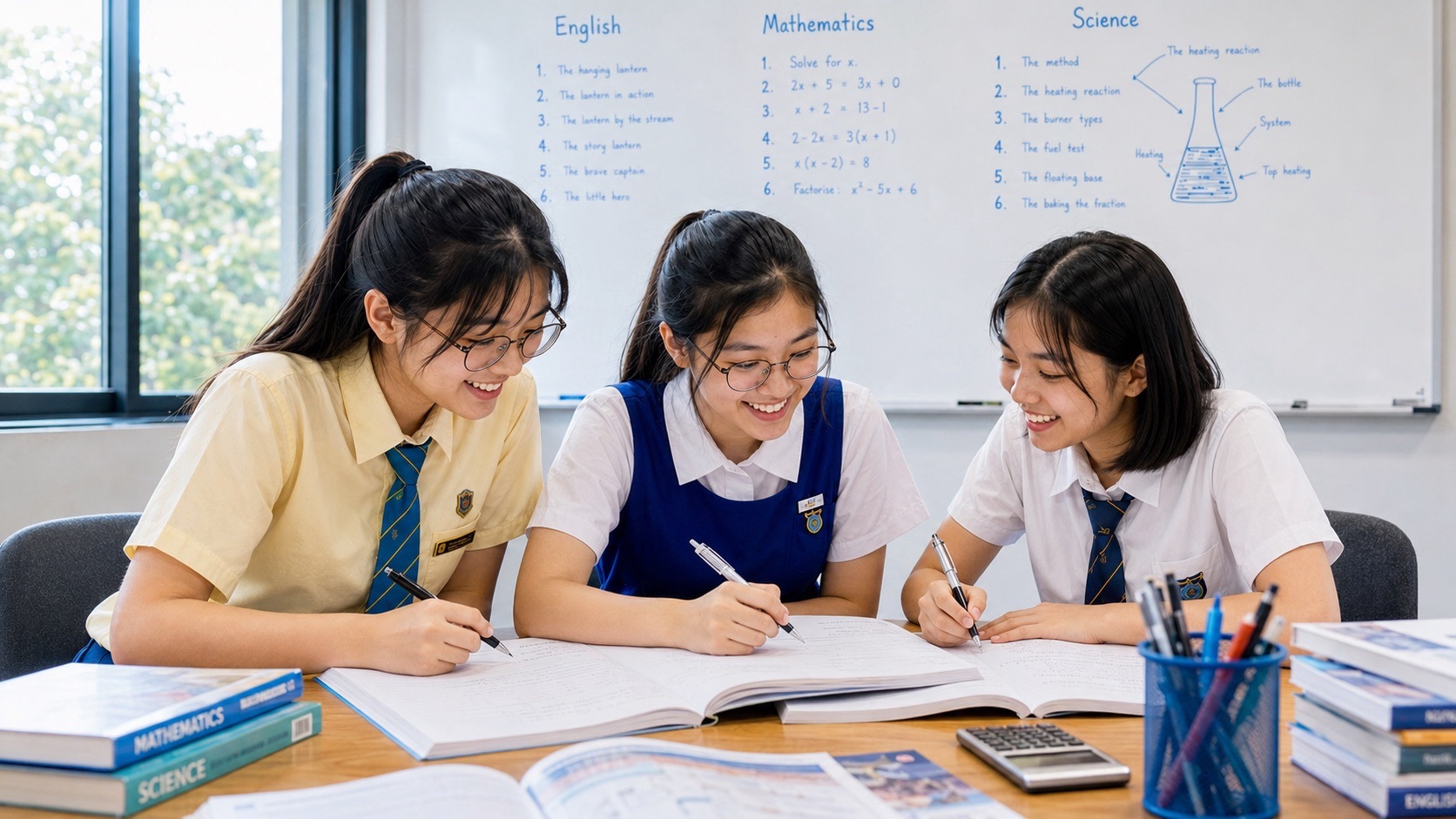
Engineering turns school Mathematics into a working language for physical systems. Algebra, trigonometry, vectors and calculus stop being isolated examination chapters and become tools for forces, motion, circuits, structures, control, fluids and signals.
Core preparation
- Algebra and equation manipulation
- Trigonometry
- Vectors and coordinate geometry
- Complex numbers
- Differentiation and integration
- Differential equations
- Matrices and linear systems
- Approximation and numerical methods
Units and modelling become non-negotiable
Engineering Mathematics is not only symbolic manipulation. Every variable has physical meaning and often a unit. A mathematically correct expression can still be an invalid engineering model if dimensions, assumptions or boundary conditions are wrong.
Singapore admissions context
NUS Engineering currently requires H2 Mathematics for Singapore-Cambridge A-Level applicants. NTU engineering subject requirements vary by programme but commonly include Mathematics, with some routes also requiring a science subject. Students should check the exact programme rather than applying one engineering rule to every discipline.
Why complex numbers matter
Complex numbers become especially useful in electrical engineering, signals, oscillations and frequency-domain reasoning. A student who has met them only as an examination technique should revisit geometric and exponential interpretations before university.
Use BTT’s Real-World Mathematics library for engineering applications.
UK engineering admissions: ESAT
Some UK engineering and science routes use the Engineering and Science Admissions Test. The dedicated ESAT 2027 Entry guide covers Mathematics 1, Mathematics 2, module selection, non-calculator execution and the 2027-entry test windows. Always verify the exact course requirement before preparing a module combination.
World Mathematics route: return to the World Mathematics Atlas for the wider school → examination → admissions → university Mathematics map.
Mathematics for Engineering applicants: build the vector-calculus modelling foundation
Engineering Mathematics connects physical systems to equations
Functions, vectors, complex numbers, calculus and differential equations become tools for describing motion, circuits, structures, fluids and signals.
Algebra must be automatic enough to support modelling
Rearranging equations, solving systems and handling units should not consume all working memory when the real problem is physical interpretation.
Vectors are a language of direction
Forces, velocities, fields and geometry use vectors. Dot products, components and coordinate systems are foundational.
Calculus describes change and accumulation
Derivatives model rates and gradients; integrals model accumulated quantities. Students should interpret units and boundary conditions.
Differential equations describe dynamic systems
Growth, oscillation, circuits and transport can be expressed through rate equations. Even before advanced methods, students should understand what an initial condition does.
Complex numbers simplify oscillation and electrical models
Polar form, magnitude and argument connect naturally to phase and rotation. This becomes especially useful in electrical and signal contexts.
Matrices solve coupled systems
Linear algebra supports structural models, circuits, transformations and numerical computation. Learn systems and matrix operations conceptually.
Approximation is part of engineering
Real systems use measurement and numerical methods. Estimation, significant figures and sensitivity help judge whether an answer is physically plausible.
Units are a built-in error detector
Dimensional consistency can expose a missing factor or wrong formula before a final calculation.
Programming increasingly matters
Numerical experiments and data analysis are common, but code should implement a mathematical model the student understands.
Admissions differ by discipline and university
Civil, mechanical, electrical, chemical and other engineering programmes set their own prerequisites. Verify current official requirements.
Bridge plan
Strengthen algebra/trigonometry, vectors and calculus; add differential equations, complex numbers and matrices; practise modelling with units and physical interpretation.