
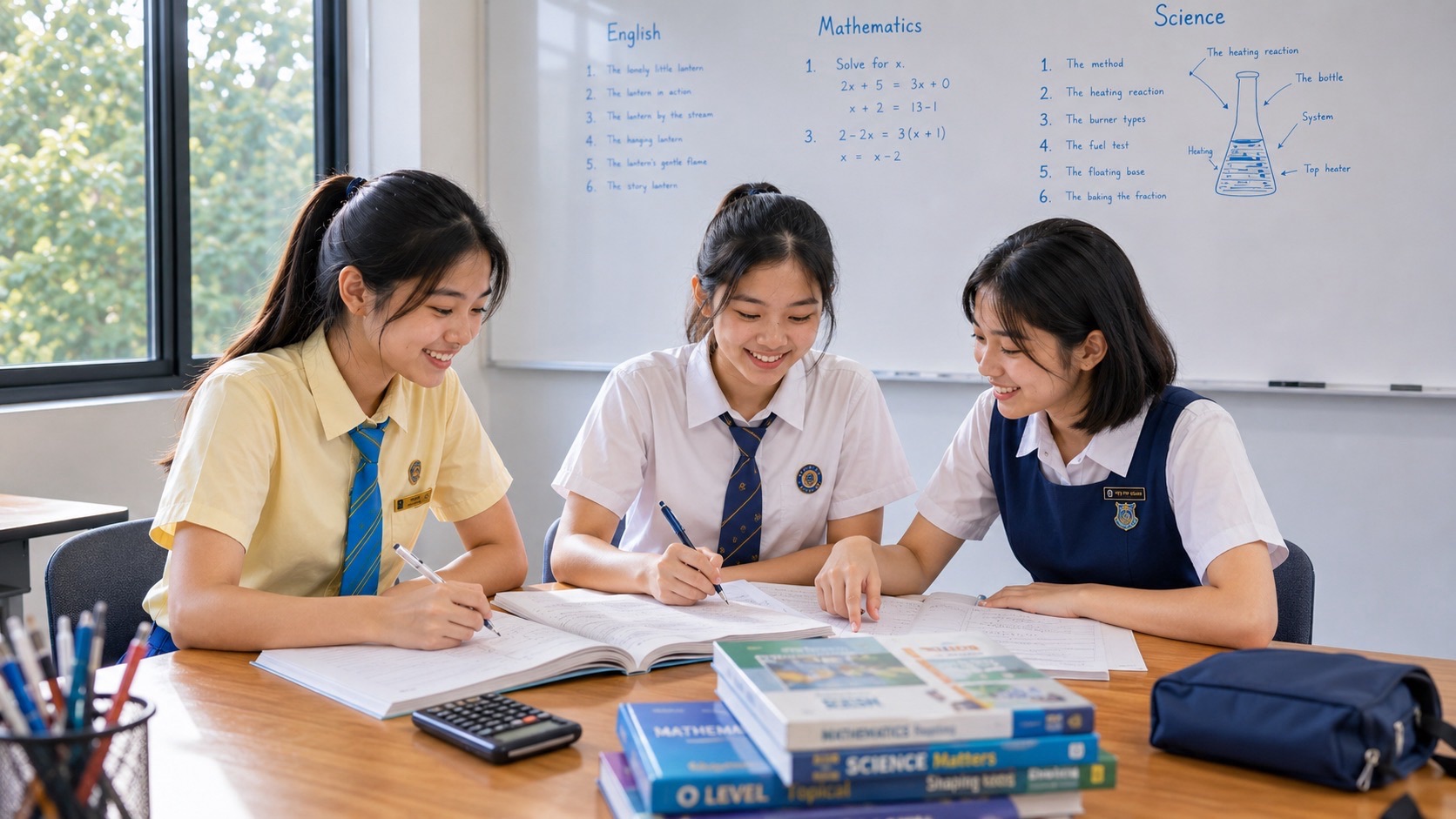
OCR GCSE Mathematics J560 is a Foundation and Higher tier GCSE Mathematics qualification with three papers at each tier. OCR’s current structure differs visibly from AQA and Pearson Edexcel: each paper carries 100 marks, lasts 1 hour 30 minutes, and the non-calculator paper is the middle paper rather than the first.
For students searching specifically for OCR GCSE Maths J560, this page covers the board-specific paper codes, calculator pattern, preparation strategy and current specification changes inside BTT’s wider UK GCSE Mathematics system. The underlying Mathematics still belongs to stable objects such as number, algebra, ratio, geometry, probability and statistics.
OCR updated J560 again in September 2026, clarifying the wording used for Higher-tier bounds questions from November 2026 onward. That is precisely why BTT separates durable Mathematics from dated examination mechanics: the concept of bounds stays stable while the examination wording can change.
OCR J560 at a glance
| Tier | Paper | Calculator? | Duration | Marks |
|---|---|---|---|---|
| Foundation | J560/01 | Yes | 1 hour 30 minutes | 100 |
| Foundation | J560/02 | No | 1 hour 30 minutes | 100 |
| Foundation | J560/03 | Yes | 1 hour 30 minutes | 100 |
| Higher | J560/04 | Yes | 1 hour 30 minutes | 100 |
| Higher | J560/05 | No | 1 hour 30 minutes | 100 |
| Higher | J560/06 | Yes | 1 hour 30 minutes | 100 |
Each paper contributes one-third of the qualification. OCR notes that its 100-mark structure gives scope to award method marks across multi-step work. Students should therefore make their reasoning visible rather than treating the answer box as the only thing that matters.
The non-calculator paper sits in the middle
In J560, the non-calculator paper is Paper 02 at Foundation and Paper 05 at Higher. This matters for revision planning. Students should not mentally treat “Paper 1” as synonymous with “non-calculator”, especially when moving between exam boards or using mixed resources.
- Foundation: calculator → non-calculator → calculator.
- Higher: calculator → non-calculator → calculator.
- All three papers are equally weighted.
- Any revision timetable should name the actual OCR paper code, not just “Paper 1/2/3”.
The mathematical preparation is still dependency-first
Paper architecture changes the execution problem, but not the mathematical foundations. If ratio is weak, it will reappear in similarity, percentage change and compound measures. If algebra is weak, it will leak into graphs, geometry and probability. Use the Mathematics Knowledge Warehouse to repair the earliest weak object rather than drilling the latest failed question.
Current 2026 change: bounds wording
OCR announced in September 2026 that, from the November 2026 series onward, Higher-tier questions assessing the relevant bounds content will use explicit wording such as calculate the lower bound or calculate the upper bound where appropriate, rather than relying on phrases such as “maximum possible” or “minimum possible”.
The underlying Mathematics has not changed. Students still need to understand interval structure, rounded values, error intervals and how operations affect the requested bound. What changes is the language through which the board asks for the result.
How to teach bounds properly
- State the rounding unit explicitly.
- Write the error interval before doing any further calculation.
- Decide whether the target requires the smallest or largest possible result.
- Choose lower or upper inputs according to the operation—not by reflex.
- Keep enough exactness until the final answer.
- Check whether the chosen combination genuinely produces the requested bound.
This prevents bounds from becoming a vocabulary exercise. The student should know why a chosen endpoint creates the extremal value.
Paper stamina and method visibility
Three 100-mark papers create a different pacing feel from the 80-mark AQA and Edexcel structures. Students should practise maintaining working quality over the full 90 minutes. When a solution chain becomes long, each line should preserve enough structure for the student to recover if an error is noticed later.
Visible working also supports partial credit. OCR explicitly highlights the scope of its 100-mark papers for rewarding correct steps. A student who compresses a multi-step argument into calculator output can lose both checking opportunities and method visibility.
Calculator papers: use technology without surrendering judgement
Calculator availability should increase efficiency, not reduce thinking. Estimate first, use brackets carefully, preserve intermediate precision, and ask whether the final sign and magnitude fit the context. A calculator cannot tell the student that the wrong mathematical model was entered correctly.
Non-calculator paper: make exactness a habit
The non-calculator paper rewards students who simplify before computing, preserve exact forms and write clear arithmetic. Fractions, surds, powers and algebraic expressions should remain objects the student can control without immediately converting everything into decimals.
OCR J560 error diagnosis
| Repeated symptom | Likely cause | Repair route |
|---|---|---|
| Bounds questions collapse | Error intervals or extremal reasoning not understood | Rebuild bounds concept before timed questions |
| Method marks disappear | Working is too compressed | Write the mathematical chain explicitly |
| Calculator papers show implausible answers | No estimation/checking layer | Predict sign and scale before calculation |
| Non-calculator arithmetic consumes too much time | Core fluency is expensive | Short daily number and algebra repair |
| Late questions cannot be started | Recognition or topic-linking failure | Mixed unlabeled problem sets |
Use How Mathematics Diagnosis Works when the score is unstable and the cause is unclear.
OCR versus AQA and Pearson Edexcel
AQA 8300 and Pearson Edexcel 1MA1 each use three 80-mark, 1 hour 30 minute papers, with the first paper non-calculator. OCR J560 uses three 100-mark, 1 hour 30 minute papers, with the middle paper non-calculator. The mathematical content is strongly aligned nationally, so students transferring boards should focus on paper architecture and language rather than assuming the Mathematics itself has completely changed.
Compare with AQA GCSE Mathematics 8300 and Pearson Edexcel GCSE Mathematics 1MA1.
Current-source note
Checked 26 September 2026. OCR’s current J560 specification lists three 100-mark, 1 hour 30 minute papers at each tier, with the middle paper non-calculator. OCR’s 17 September 2026 subject update confirms revised bounds wording from November 2026 onward for the relevant Higher-tier content.
Official sources: OCR GCSE Mathematics J560 specification at a glance and OCR September 2026 bounds update.
World Mathematics route: World Mathematics Atlas · UK GCSE Mathematics · Knowledge Warehouse.