
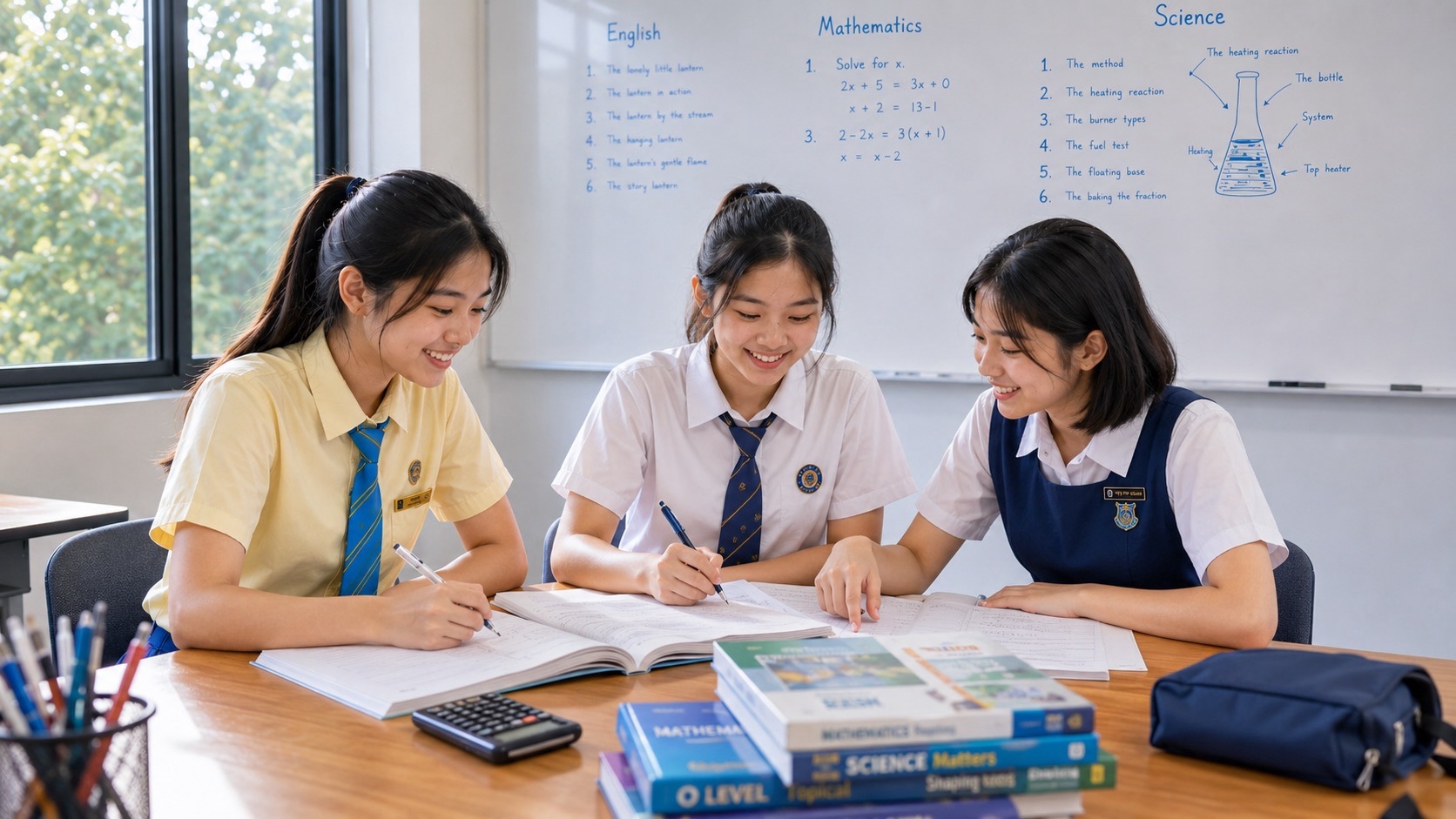
Pearson Edexcel GCSE Mathematics 1MA1 is one of the main GCSE Mathematics routes in England. The qualification is offered at Foundation and Higher tiers and is assessed through three written papers: Paper 1 without a calculator, followed by two calculator papers. For students searching specifically for Edexcel GCSE Maths 1MA1, this page owns the board-specific paper structure, preparation logic, error diagnosis and progression route inside the wider BTT UK GCSE Mathematics system.
The most useful way to prepare for Edexcel GCSE Mathematics 1MA1 is not to treat the specification as a list of disconnected chapters. Number, algebra, ratio, geometry, probability and statistics interact continuously. A question may begin as percentage change, turn into algebra, and finish with interpretation. Strong revision therefore builds the mathematical dependencies first, then trains paper-specific execution.
For parents, students and tutors comparing Edexcel with AQA 8300 or OCR J560, much of the national GCSE Mathematics content is shared. The practical differences are in board presentation, paper design, wording, mark schemes, and the exact experience of moving through each paper. This page keeps those board-specific details separate while linking every topic back to BTT’s stable Mathematics owners.
Edexcel 1MA1 at a glance
| Qualification | Pearson Edexcel GCSE (9–1) Mathematics |
|---|---|
| Specification code | 1MA1 |
| Tiers | Foundation and Higher |
| Paper 1 | Non-calculator, 1 hour 30 minutes, 80 marks |
| Paper 2 | Calculator, 1 hour 30 minutes, 80 marks |
| Paper 3 | Calculator, 1 hour 30 minutes, 80 marks |
| Total | 240 raw marks across the three papers |
Pearson’s specification identifies the qualification code as 1MA1, with separate Foundation and Higher paper codes. Paper 1 is the non-calculator paper; Papers 2 and 3 permit calculators. Each paper is 1 hour 30 minutes and carries 80 marks.
The six mathematical territories
Like the wider GCSE Mathematics system, Edexcel 1MA1 is built around six broad territories: number; algebra; ratio, proportion and rates of change; geometry and measures; probability; and statistics. The useful preparation question is not “have I revised each chapter?” but “can I move between these territories when a question combines them?”
Number must become cheap
Fractions, decimals, percentages, indices, standard form, estimation and numerical accuracy should consume little working memory. If these operations remain slow or error-prone, harder algebra and geometry questions become unnecessarily expensive. Use BTT’s Fractions, Decimals & Percentages and Arithmetic Operations objects when the problem is foundational rather than board-specific.
Algebra controls Higher-tier depth
Manipulation, equations, sequences, graphs and functions recur across the paper set. Students often describe lost marks as “careless”, but repeated sign errors, incorrect expansion or failed rearrangement are usually evidence of unstable algebraic control. That should be repaired explicitly through the Algebra knowledge object.
Ratio and proportional reasoning connect the syllabus
Rates, scale, similarity, compound measures, percentage change and direct or inverse proportion frequently connect arithmetic to algebra and geometry. Students who memorise percentage procedures without understanding multiplicative structure tend to struggle when the context changes.
Geometry is a structure-recognition problem
Angles, similarity, congruence, circles, Pythagoras, trigonometry, vectors and mensuration require the student to decide which relationship controls the diagram. Annotating the figure before calculating is often more valuable than immediately searching memory for a formula.
Probability and statistics require interpretation
Correct arithmetic is not enough. Students must read data displays, understand the meaning of averages and spread, use probability models appropriately and explain conclusions in context. Calculator output should be treated as evidence to interpret, not as the finished answer.
Paper 1: why non-calculator preparation matters
Paper 1 removes calculator support but does not create a separate syllabus. The same Mathematics is tested through a different execution environment. Students need exact-value control, fraction fluency, estimation, mental arithmetic and written algebra strong enough to carry the reasoning without numerical rescue.
- Cancel before multiplying rather than generating large numbers.
- Keep fractions exact until approximation is actually required.
- Estimate before finalising an answer.
- Write intermediate steps instead of trying to hold everything mentally.
- Check signs, units and scale before moving on.
Papers 2 and 3: calculator use is still mathematical
A calculator changes what can be computed quickly; it does not decide which computation is mathematically justified. Students should know when to use brackets, preserve sufficient accuracy, distinguish exact from approximate results and recognise implausible outputs. A calculator error is often a representation error made before the keys were pressed.
Foundation versus Higher
The correct tier is a curriculum and assessment decision, not a status label. Foundation focuses the accessible grade range differently from Higher, while Higher exposes the student to the full upper end of the GCSE demand. Preparation should follow the actual tier entered by the centre. Mixing Higher-only content into a Foundation revision plan can waste time; omitting Higher dependencies from a Higher plan can create late-paper collapse.
Diagnose lost marks by failure type
| What happens | Likely issue | Repair |
|---|---|---|
| Cannot start a familiar question in a new context | Recognition failure | Mixed problem sets where the method is not named |
| Correct method, repeated algebra errors | Dependency failure | Short targeted algebra repair |
| Calculator answer is unreasonable | Representation/checking failure | Estimate before calculation and verify order of magnitude |
| Late-paper score collapses | Timing or attention failure | Segmented timed practice and skip-return decisions |
| One-mark losses everywhere | Notation, units, signs or copying | Error ledger and final-line check routine |
Use How Mathematics Diagnosis Works before assigning more papers when the same loss pattern repeats.
A practical revision cycle
- Take one mixed diagnostic across all six content territories.
- Classify every lost mark by mathematical cause.
- Repair the earliest weak dependency rather than the most recent question.
- Retest the repaired skill in mixed questions.
- Complete Paper 1 practice specifically for non-calculator fluency.
- Complete Papers 2 and 3 with calculator discipline and checking.
- Finish with full three-paper cycles to test endurance and consistency.
Edexcel 1MA1 versus AQA 8300 and OCR J560
The national content base is closely aligned, so switching boards does not mean relearning Mathematics from the beginning. What changes is the paper architecture and the board-specific feel of wording and mark schemes. AQA 8300 also uses three 80-mark, 1 hour 30 minute papers with one non-calculator paper followed by two calculator papers. OCR J560 uses three 100-mark papers at each tier, with the middle paper non-calculator.
Use AQA GCSE Mathematics 8300 and OCR GCSE Mathematics J560 when the board-specific route matters.
What comes after GCSE Mathematics?
Students moving into A-Level Mathematics need algebra, functions, graph sense and trigonometry that are genuinely secure, not just sufficient to survive the GCSE paper. The transition is smoother when GCSE revision has already emphasised structure and exact reasoning rather than answer-getting alone.
Continue through UK A-Level Mathematics or use the University Mathematics Admissions & Bridging hub for later pathways.
Current-source note
Checked 26 September 2026. Pearson identifies the GCSE Mathematics subject code as 1MA1. The paper structure remains three 1 hour 30 minute papers, 80 marks each, with Paper 1 non-calculator and Papers 2 and 3 calculator papers. Always check the current Pearson qualification page and examination-series materials for administrative updates.
Official source: Pearson Edexcel GCSE Mathematics (9–1).
World Mathematics route: World Mathematics Atlas · World Mathematics Examinations · UK GCSE Mathematics · Knowledge Warehouse.