
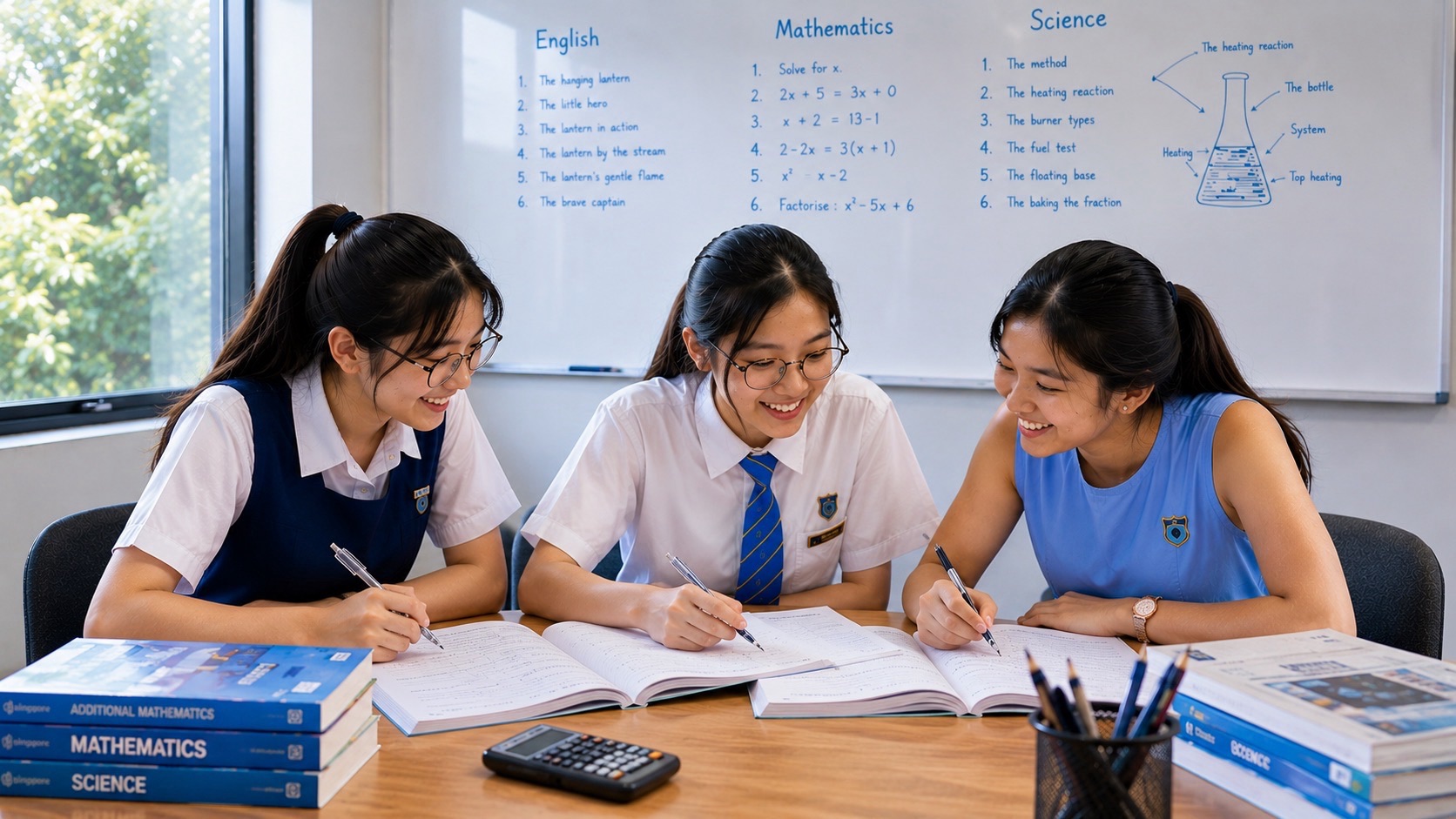
Singapore and Australian Mathematics both build long-term mathematical proficiency, but their curriculum organisation and school-stage labels differ. A transfer map should therefore compare mathematical content and depth rather than assuming one year level converts directly into another.
The Australian Curriculum Version 9.0 organises Foundation to Year 10 Mathematics into six interrelated strands: Number, Algebra, Measurement, Space, Statistics and Probability. Mathematical proficiency is embedded across the strands through understanding, fluency, reasoning and problem solving.
Where the structures align
Both systems place sustained emphasis on number, algebra, geometry/measurement, data and problem solving. Both also expect increasing depth and independence over time. The practical differences lie in sequencing, year labels, local assessment and senior-secondary course architecture.
Transfer risks
- A topic may have been introduced at a different year level.
- Singapore may expect a different form of multi-step examination execution.
- Australian curricula may use different modelling or contextual emphases.
- Senior Mathematics diverges substantially by state and course choice.
Senior-secondary transition
Australia does not have one national senior Mathematics examination system. NSW HSC and VCE routes differ, and other states have their own senior qualifications. Use BTT’s Australia Senior Mathematics owner for the examination layer.
A crosswalk method
- Map Number and proportional reasoning.
- Map Algebra and Functions.
- Map Measurement, Space and Geometry.
- Map Statistics and Probability.
- Check problem-solving independence.
- Then match the destination year/course.
This comparison is a transfer tool, not a curriculum ranking.
Source checked 26 September 2026: Australian Curriculum Version 9.0 Mathematics framework.
World Mathematics route: return to the World Mathematics Atlas for the wider map across curricula, examinations, school stages, mathematical objects and university routes.
Singapore and Australian Mathematics: map year levels and senior courses by content
Australia has state/territory and school variation
National curriculum provides a framework, while senior secondary course names and assessment systems vary by jurisdiction. Avoid one universal ‘Australian Year 12 Maths’ assumption.
Primary/year conversion is approximate
Compare number, fractions, decimals, measurement, geometry and statistics rather than placing solely by age.
Secondary course structures diverge
Singapore integrated Mathematics/A-Math and Australian senior General/Methods/Specialist-style routes are not exact equivalents.
Algebra and functions are key bridge domains
Check symbolic manipulation, equations, graphs and function notation before assuming readiness for a senior course.
Calculus depth varies by senior subject
Students entering a Methods or Specialist-style course may need targeted calculus/trigonometry bridging depending on their previous Singapore route.
Statistics emphasis can differ
Some Australian courses include substantial data/statistics components. Diagnose these separately from pure Mathematics.
Technology expectations may be different
Graphing/CAS calculator use can be central in some Australian courses. Singapore-trained students may need device and assessment-format practice.
Assessment can include school-based components
The balance of examinations and internal assessment varies by jurisdiction/course. Prepare for the destination system.
Do not invent ATAR conversions
ATAR is a rank within an admissions system, not a simple school-mark equivalent. Official institutions own conversion and recognition.
Transfer plan
Identify the state/course, map content, diagnose gaps, learn technology requirements and practise local assessment style.
Moving to Singapore
Reverse the process: determine the appropriate Singapore school/subject route officially, then repair content differences.
Durable principle
Year labels orient; mathematical evidence places.