
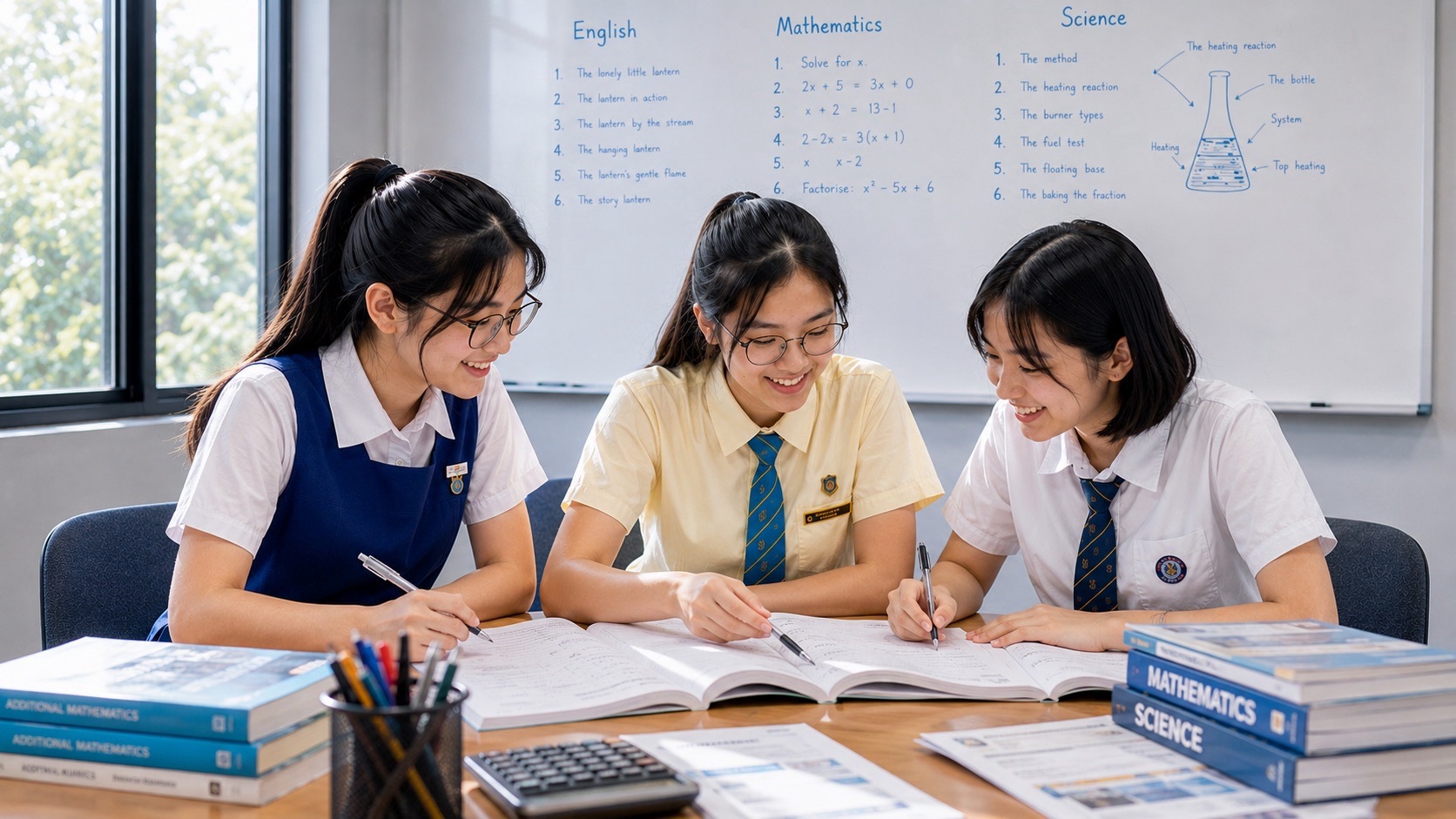
Secondary 3 Mathematics is the year when the structure underneath school mathematics becomes visible.
The equations are longer. The diagrams carry more information. A graph is no longer only something to draw. A percentage is no longer only a calculation. A formula has conditions. A method has to be selected rather than merely remembered. Earlier weaknesses in number, ratio, algebra, geometry and interpretation start to combine.
And in Singapore, there is another important change that parents and students now need to understand correctly: Secondary 3 Mathematics is no longer best described through the old Express, Normal (Academic) and Normal (Technical) stream labels. Under Full Subject-Based Banding, Mathematics is offered at G1, G2 and G3 subject levels. From 2027, graduating students sit the Singapore-Cambridge Secondary Education Certificate, or SEC, at the level of each subject they take.
That means the useful question is no longer simply, “Is this Secondary 3 Math?” The better question is:
What mathematical system is this student building at Secondary 3, at G1, G2 or G3, and what must become reliable before Secondary 4?
This guide answers that question from first principles.
The Short Answer
Secondary 3 Mathematics works by turning earlier mathematical knowledge into a connected operating system. Students must increasingly interpret information, choose a representation, select a method, execute it accurately, check the result and explain what the answer means.
The level changes the depth, abstraction, pace and assessment demand, but the architecture remains recognisable:
- G1 Mathematics emphasises essential mathematical knowledge, practical application, reliable numeracy, interpretation and confidence for real-life and vocationally relevant contexts.
- G2 Mathematics develops a broader academic and applied mathematics toolkit, with stronger algebraic, geometric, graphical, statistical and problem-solving demands.
- G3 Mathematics develops the most demanding of the three Mathematics routes, requiring stronger abstraction, multi-step reasoning, integration of topics and readiness for mathematically intensive post-secondary pathways.
These are subject levels, not labels for the whole child. Under Full Subject-Based Banding, a student may take different subjects at different levels, and progression should be understood subject by subject.
Start With the New Map: Secondary 3 Is a Stage; G1, G2 and G3 Are Subject Levels
This distinction is the beginning of everything.
Secondary 3 tells us where the student is in school.
G1, G2 or G3 Mathematics tells us the level at which Mathematics is being taken.
SEC tells us the common national certification framework that begins for graduating cohorts from 2027.
Confusing these three things creates poor planning. A parent may say “my child is Sec 3 Math” when the tutor actually needs to know the subject level, school sequence, current chapters, examination year, recent scripts and whether Additional Mathematics is also being taken.
The official 2027 SEC subject codes make the distinction explicit: G1 Mathematics K110, G2 Mathematics K210 and G3 Mathematics K310. Additional Mathematics is separate, with G2 and G3 routes rather than a G1 Additional Mathematics route.
So the mathematics programme has to begin with route identification, not assumption.
Why Secondary 3 Feels Different
Students often describe Secondary 3 Mathematics as “suddenly harder”. That feeling is real, but “harder” is too vague to be useful. The actual change is structural.
1. More of the question is hidden in the reading
Earlier mathematics often tells the student what operation or chapter is being tested. Upper-secondary mathematics increasingly asks the student to infer the route. The first difficulty is therefore not calculation. It is recognition.
The student must identify what the quantities mean, what is known, what is unknown, which relationships are available and which information is irrelevant.
2. Representations become interchangeable
A mathematical situation may appear as words, a diagram, a graph, a table, an equation, a ratio, a statistical display or a measurement problem. Strong students learn to move between these forms.
This is one of the central changes in Secondary 3: students are no longer only solving within a representation. They are increasingly expected to choose or construct the representation that makes the problem solvable.
3. Algebra stops being a chapter and becomes infrastructure
At lower secondary, algebra can feel like one topic among many. By Secondary 3, algebra is the working language inside graphs, formulas, geometry, rates, proportions, functions and many multi-step applications.
If fractions, signs, substitution, expansion, factorisation, equations or rearrangement are unstable, the student may appear to have many different topic problems when the real problem is one damaged algebraic engine.
4. Method selection matters more
Knowing several methods is not enough. The student must recognise which method fits the structure in front of them. This is why repetitive topical drilling eventually reaches a ceiling. It can produce familiarity without producing selection.
5. Errors propagate
A small error near the beginning of a longer solution can distort every line after it. Secondary 3 therefore rewards clean setup, notation, organisation and checking more strongly than many students expect.
The Mathematics Engine: Interpret → Represent → Select → Execute → Check → Explain
A useful way to understand Secondary 3 Mathematics is as a six-stage engine.
Interpret
What is the question actually asking? What do the numbers, labels, units, conditions and diagrams mean? Which words are mathematical instructions?
Represent
Can the situation be converted into an equation, diagram, table, graph, ratio, frequency display or other organised form?
Select
Which concept or method fits? Is this proportional reasoning, an algebraic equation, similarity, trigonometry, coordinate geometry, probability, statistics, mensuration or a combination?
Execute
Can the student carry out the mathematics accurately, with enough working to preserve logic and method marks?
Check
Do the sign, scale, units, magnitude and conditions make sense? Can the answer be checked by substitution, estimation, inverse operation, a second representation or a reasonableness test?
Explain
Can the student communicate what the result means rather than merely writing a number?
The strongest Secondary 3 students are not simply faster calculators. They run this engine with fewer breakdowns.
The Three Common Content Worlds
Across the official secondary Mathematics syllabuses, the content is organised around three broad strands: Number and Algebra, Geometry and Measurement, and Statistics and Probability. The exact breadth and depth vary by level, but the architecture is shared.
Number and Algebra: controlling quantity and relationships
This strand is not only about symbols. It is about controlling relationships. A student learns to work with numbers, ratios, rates, percentages, expressions, equations, formulae and other structures that describe how quantities change together.
At Secondary 3, this becomes the infrastructure beneath much of the subject. Algebra allows the student to compress a relationship into a form that can be manipulated. The goal is not “move this term to the other side”. The goal is to preserve equivalence while transforming the statement into a more useful form.
A student with mature algebra asks:
- What is fixed?
- What is changing?
- What relationship connects the quantities?
- What form will make the next step easier?
- What restrictions or conditions apply?
- Can I check the result in the original relationship?
Geometry and Measurement: structure in space
Geometry is often mistaken for a collection of angle rules and formulas. At upper secondary, it works better when understood as a system of constraints.
A diagram contains relationships: parallelism, perpendicularity, congruence, similarity, angle structure, scale, length, area, volume, coordinates or trigonometric relationships. The student’s task is to identify which relationships are guaranteed, which are merely suggested by the picture and which can be derived.
Measurement adds another layer: units, precision, scale, approximation and interpretation. A mathematically correct-looking answer with the wrong unit or impossible magnitude is not complete mathematical control.
Statistics and Probability: reasoning under variation and uncertainty
Data questions are not only arithmetic. Students must understand what a representation says, what it does not say and how strongly a conclusion is supported.
Probability similarly requires disciplined reasoning about possible outcomes, conditions and combinations. A common error is to calculate before defining the event correctly.
Secondary 3 is therefore an important year for learning a broader mathematical habit: do not let the numbers hide the structure.
How G1 Secondary 3 Mathematics Works
G1 Mathematics is designed to build mathematical competence that is practical, usable and sufficiently secure for real life, other subjects and post-secondary vocational learning.
That does not mean the learning should be reduced to easy worksheets. Good G1 Mathematics teaching still develops reasoning, communication, application and metacognition. The difference is in the calibration of abstraction, breadth and demand.
At Secondary 3, a strong G1 programme should increasingly help the student:
- read practical mathematical information accurately;
- work reliably with number, proportion, percentage and measurement;
- translate simple contexts into mathematical steps;
- use algebra where it genuinely clarifies a relationship;
- interpret tables, graphs and statistical information;
- reason with geometry and measurement in meaningful contexts;
- show working in a repeatable order;
- check units, scale and reasonableness;
- become less dependent on prompting.
The target is not performance theatre. It is reliable mathematical independence.
A student who can calmly read a task, organise the information, choose the correct operation, calculate accurately and check the result has built something valuable.
How G2 Secondary 3 Mathematics Works
G2 Mathematics sits in a demanding middle space. It must be rigorous enough to support meaningful academic progression while remaining carefully calibrated to the intended level of abstraction and assessment.
The student increasingly needs to connect concepts rather than treat chapters as isolated procedures. Algebra becomes more important. Geometry becomes more inferential. Graphs become representations of relationships. Statistics and probability require stronger interpretation. Multi-step contextual problems become more consequential.
A strong Secondary 3 G2 student should be moving from:
- following worked examples → recognising structures;
- single-step questions → linked chains of reasoning;
- chapter recognition → method selection;
- calculator dependence → estimation and checking;
- answer production → mathematical communication;
- teacher-led correction → self-diagnosis.
For some students, G2 Mathematics may also sit beside G2 Additional Mathematics. These are separate subjects and should not be collapsed into one route. The student’s programme needs to preserve the distinct syllabus demands while using shared algebraic foundations intelligently.
How G3 Secondary 3 Mathematics Works
G3 Mathematics is the most academically demanding of the three Mathematics levels. It asks students to handle greater abstraction, broader integration, more complex problem solving and stronger transfer between representations.
At Secondary 3, the central challenge is not simply learning more formulas. It is learning to operate a denser mathematical system.
The student must become increasingly comfortable with:
- algebraic manipulation as routine infrastructure;
- equations and formulae embedded inside contexts;
- graphs as models of relationships;
- geometry that depends on logical conditions rather than appearance;
- trigonometric and coordinate relationships where appropriate to the syllabus sequence;
- statistical and probability reasoning;
- multi-topic questions;
- method selection under time pressure;
- checking through an independent mathematical route.
Where G3 Additional Mathematics is also taken, the load changes again. Additional Mathematics is a separate subject with a stronger algebraic and abstract dependency chain. Students often experience the two subjects as connected because algebraic fluency transfers between them, but curriculum planning should still distinguish G3 Mathematics from G3 Additional Mathematics.
G1, G2 and G3 Are Not Three Versions of the Same Worksheet
This is one of the most important ideas for parents.
Changing the subject level is not merely changing the numbers to make them easier or harder. A well-designed curriculum changes the depth of reasoning, abstraction, complexity of representation, number of steps, degree of independence and assessment demand.
A useful comparison is:
- G1: Can the student use mathematics reliably and meaningfully?
- G2: Can the student connect, apply and reason with a broader mathematical toolkit?
- G3: Can the student operate flexibly inside a more abstract, integrated and demanding mathematical system?
These are not definitions of students. They are descriptions of subject demand.
What Secondary 3 Is Really Preparing
Secondary 3 should not be treated as an isolated school year. It is the construction year for Secondary 4.
By the end of Secondary 3, the student should ideally have built five kinds of capacity.
1. Concept capacity
The student understands the central ideas well enough to reconstruct methods instead of relying entirely on memory.
2. Procedure capacity
Routine operations are sufficiently fluent that they do not consume all available attention.
3. Connection capacity
The student sees how algebra, graphs, geometry, measurement, statistics and probability connect.
4. Selection capacity
The student can decide what to do when the chapter name is not supplied.
5. Examination capacity
The student can convert understanding into marks through clear working, time management, checking and accurate communication.
If these capacities are not built in Secondary 3, Secondary 4 can become an emergency repair year. If they are built, Secondary 4 can be used for consolidation, synthesis and examination readiness.
Why School Sequence Matters
Parents sometimes search for a single universal list of “Secondary 3 topics”. That can be misleading.
The official Mathematics syllabuses define the course content and assessment framework, but schools may sequence parts of the syllabus differently across Secondary 3 and Secondary 4. One school may introduce a topic earlier, another later. A student who changes school, changes subject level or joins tuition mid-year can therefore be at a very different curricular position from another Secondary 3 student.
This is why good tuition does not teach from a generic calendar alone. It asks for:
- the exact subject level;
- the school’s current and upcoming topics;
- recent tests or examination papers;
- the student’s recurring error patterns;
- the next significant school assessment;
- the national examination year;
- whether Additional Mathematics is also taken.
The programme can then synchronise with school without becoming trapped by school sequence.
The Dependency Problem: Secondary 3 Difficulty Often Began Earlier
A student may be struggling with a Secondary 3 chapter while the actual weak link sits in Secondary 1, Secondary 2 or even primary mathematics.
Examples include:
- ratio weakness appearing inside similarity;
- fraction weakness appearing inside algebra;
- negative-number errors appearing inside equations;
- weak factorisation blocking quadratic work;
- poor unit sense damaging mensuration;
- weak proportional reasoning damaging rates and scale;
- poor graph reading damaging coordinate questions;
- language misinterpretation damaging probability and statistics.
The visible chapter is therefore not always the correct repair target.
A useful diagnostic asks: What is the earliest missing dependency that is still producing today’s mistake?
Repair that, reconnect it to the current chapter, then retest the student on a fresh question. This is more efficient than endlessly repeating the final step that keeps failing.
The Difference Between Knowing and Owning a Method
A student may look successful during tuition because the method is visible, the chapter is known and the teacher is nearby. That does not prove independent mathematical capability.
There are at least four stages:
- Recognition with help: the student can follow when prompted.
- Reproduction: the student can repeat the method on a similar question.
- Selection: the student can recognise when to use the method without being told.
- Transfer: the student can use the underlying idea in a changed or mixed context.
Secondary 3 must increasingly move students from stage two towards stages three and four.
Why Mixed Questions Matter
Topical practice is useful when a concept is being acquired. It reduces noise and lets the student focus on one structure. But if practice remains topical forever, the chapter heading becomes a hidden hint.
Real examination questions do not always announce the method.
After a topic becomes stable, practice should therefore evolve:
- worked example;
- guided practice;
- independent topical practice;
- variation within the topic;
- mixed-topic retrieval;
- unfamiliar application;
- timed execution;
- delayed retest.
This is how a method becomes available when the student actually needs it.
The Role of the Calculator
A calculator is a mathematical tool, not a substitute for mathematical structure.
By Secondary 3, students should know when technology helps and when it hides a mistake. Useful habits include estimating before calculation, keeping sufficient precision during intermediate steps, checking whether the final magnitude is plausible and understanding what the calculator output represents.
If the student presses buttons before deciding what relationship is being calculated, the machine can produce a perfectly accurate answer to the wrong question.
Mathematical Writing Becomes Part of the Mathematics
Good working is not decoration. It is externalised reasoning.
Clear mathematical writing helps the student:
- see whether each line follows from the previous line;
- find the first wrong step;
- preserve method marks;
- avoid copying errors;
- check units and conditions;
- review work quickly under time pressure.
Secondary 3 is therefore a good time to stop treating rough, compressed working as a harmless personal style. If the student cannot audit the solution later, the working has failed one of its main purposes.
The First Wrong Line
When reviewing a script, the most useful line is often not the final answer. It is the first wrong line.
Everything after that line may simply be a consequence.
The first wrong line helps classify the failure:
- concept error;
- interpretation error;
- representation error;
- method-selection error;
- algebraic manipulation error;
- calculation error;
- notation error;
- unit error;
- checking failure;
- time-pressure failure.
Different errors need different treatments. More worksheets are not a universal medicine.
What a Secondary 3 Mathematics Diagnostic Should Look For
A useful diagnostic is not simply a score. It is a map of where the mathematical process breaks.
We look for questions such as:
- Can the student identify the task without hints?
- Does the student know which information matters?
- Can the student choose an appropriate representation?
- Is the algebra stable enough for the current level?
- Can the student distinguish a concept problem from a calculation problem?
- Does the student check answers independently?
- Are errors random, or do they cluster around one dependency?
- Does performance collapse only when time pressure is added?
- Does the student understand the method but fail to express it clearly?
- Can the student transfer the idea to a question that looks different?
Once the mechanism is visible, intervention becomes more precise.
How a Good Secondary 3 Mathematics Lesson Works
A productive lesson does not need to be complicated. It needs a coherent sequence.
- Locate: identify the current chapter and the dependency beneath it.
- Explain: make the core relationship visible from first principles.
- Model: show a clean solution with attention to why each step exists.
- Guide: let the student complete a similar structure with controlled support.
- Release: remove prompts.
- Vary: change the surface form so the student must recognise the structure.
- Mix: place the idea beside other topics.
- Check: ask the student to verify rather than wait for the tutor.
- Record: note the error pattern and what fixed it.
- Retest: return later without warning.
The final goal is not that the student can do the question while the tutor is present. The goal is that the student can do the mathematics when nobody is standing beside them.
How Full Subject-Based Banding Changes the Conversation
Full Subject-Based Banding is important because it moves the system away from treating one broad stream label as the definition of a student’s entire academic identity.
For Mathematics, this means parents should think more precisely:
- What Mathematics level is the student taking now?
- Is that level appropriate to current readiness and progression goals?
- What evidence would justify a move to a more demanding level where the school permits it?
- What foundations must be secured before such a move is sustainable?
- What post-secondary routes is the student considering?
A level change should not be treated as a badge. It changes the mathematical demand. The right move is the one that improves the student’s long-term learning trajectory.
SEC: What Changes and What Does Not
From 2027, the Singapore-Cambridge Secondary Education Certificate replaces the former separate N- and O-Level certificates for graduating students. Students sit subjects at their respective G1, G2 or G3 levels and receive one certificate reflecting those subjects and levels.
The important point for Mathematics learning is that the new certificate does not remove the need for strong mathematical foundations. A new label does not change the fundamental work of learning: concepts must still be understood, procedures stabilised, connections built, problems interpreted and answers communicated.
For the 2027 SEC, SEAB lists Mathematics as K110 at G1, K210 at G2 and K310 at G3.
A Parent’s Five-Minute Secondary 3 Mathematics Check
If you want to understand what is happening without becoming the mathematics teacher, ask the student five questions.
- What level of Mathematics are you taking: G1, G2 or G3?
- What topic is school teaching now?
- Show me one question you got wrong recently.
- Where was the first line that went wrong?
- What will you do differently if a similar question appears again?
Those five questions reveal far more than asking, “Did you finish your homework?”
Common Secondary 3 Failure Patterns
“I understand in class but cannot do the test.”
Often a selection or retrieval problem. The student can follow a visible method but cannot recognise it independently.
“I always make careless mistakes.”
“Careless” may hide several mechanisms: poor layout, weak sign control, rushed reading, calculator entry, skipped units, no checking routine or overloaded working memory. Classify the error before treating it.
“I know every chapter but mixed papers are bad.”
Usually a method-selection and integration problem. Increase mixed retrieval and unfamiliar applications.
“The new chapter is impossible.”
Check dependencies. The new chapter may be exposing an old weakness.
“I can do it slowly but not in the exam.”
The concept may be present while fluency is insufficient. Timed practice should come after the method is stable, not before.
The Most Important Secondary 3 Habit: Build a Check That Can Disagree With You
A weak check repeats the same thinking and reaches the same mistake.
A strong check uses a different route.
- Solve an equation, then substitute.
- Calculate an exact value, then estimate its magnitude.
- Use algebra, then inspect the graph.
- Find a length, then test it against the diagram and constraints.
- Calculate a probability, then check that the result lies between 0 and 1.
- Find an area or volume, then check the unit and scale.
Independent checking is one of the clearest signs that mathematical ownership is developing.
From Secondary 2 to Secondary 3
The transition works best when Secondary 2 foundations are not abandoned in the rush to “start upper secondary”.
The student needs continuity in:
- number sense;
- fractions and ratios;
- percentages and rates;
- algebraic notation;
- equation discipline;
- graph interpretation;
- geometry vocabulary;
- measurement and units;
- statistical interpretation;
- problem-reading habits.
Secondary 3 does not replace lower-secondary mathematics. It loads more weight onto it.
From Secondary 3 to Secondary 4
The end-of-year question should not be, “Have we finished enough chapters?”
It should be:
What can the student now do independently, reliably and under changing conditions?
Secondary 4 compresses the runway. There is less time to discover that algebra never stabilised, that graphs were memorised rather than understood or that the student cannot choose methods on mixed papers.
A strong Secondary 3 exit therefore includes:
- a stable foundation in the year’s taught content;
- a clear list of remaining weak dependencies;
- mixed-topic retrieval habits;
- an independent checking routine;
- clean mathematical writing;
- an early understanding of the examination route.
What Mathematics Is Training Beyond the Examination
School Mathematics has an examination, but the subject is larger than the examination.
When taught properly, Secondary 3 Mathematics trains habits that recur in engineering, computing, finance, science, design, operations and ordinary adult decision-making:
- define the problem before solving it;
- separate signal from irrelevant information;
- represent a messy situation clearly;
- preserve constraints while transforming a system;
- estimate before trusting precision;
- test whether an answer is plausible;
- communicate reasoning so another person can audit it;
- change method when evidence says the first method is failing.
This is why Mathematics matters even for students who do not plan to become mathematicians.
How Bukit Timah Tutor Uses This Architecture
At Bukit Timah Tutor, Secondary 3 Mathematics begins by identifying the exact route and the mechanism beneath the student’s present result.
We separate:
- G1, G2 and G3 Mathematics;
- Mathematics from Additional Mathematics;
- current chapter difficulty from earlier dependency weakness;
- concept understanding from execution;
- method knowledge from method selection;
- accuracy problems from time-pressure problems.
The class format is intentionally small, with a maximum of three students, because upper-secondary mathematics often requires close observation of working rather than only checking final answers.
The goal is simple to state and difficult to fake: the student should become increasingly able to run the mathematics without us.
The Secondary 3 Mathematics Route
Use the existing Bukit Timah Tutor mathematics architecture to move through the stage deliberately:
- Singapore Mathematics Hub
- Singapore Mathematics Curriculum Overview
- Secondary 2 Mathematics — the algebraic and lower-secondary dependency layer
- Secondary 3 Mathematics — the existing stage spine
- Secondary 3 Mathematics Tutorial — how the teaching event is organised
- Secondary 3 Additional Mathematics — the separate A-Math route
- Secondary 4 Mathematics — the examination synthesis stage
Official Singapore References
For the national framework and examination structure, use the official sources:
- Ministry of Education — Full Subject-Based Banding
- Singapore Examinations and Assessment Board — Secondary Education Certificate
- 2027 SEC G1 syllabuses
- 2027 SEC G2 syllabuses
- 2027 SEC G3 syllabuses
The Series Ahead
This article is the control page for a deeper Secondary 3 Mathematics series. The branch will separate the major questions so that each can be explored without forcing one page to do every job.
- How Secondary 3 G1 Mathematics Works
- How Secondary 3 G2 Mathematics Works
- How Secondary 3 G3 Mathematics Works
- How Algebra Works in Secondary 3 Mathematics
- How Geometry and Measurement Work in Secondary 3 Mathematics
- How Statistics and Probability Work in Secondary 3 Mathematics
- How Mathematical Problem Solving Changes in Secondary 3
- How Full Subject-Based Banding Changes Secondary Mathematics
- How SEC Mathematics Assessment Works
- How Secondary 3 Mathematics Prepares a Student for Secondary 4
- How Mathematics and Additional Mathematics Interact at Secondary 3
- How to Diagnose a Secondary 3 Mathematics Result
Final Principle
Secondary 3 Mathematics works when the student stops seeing Mathematics as a shelf of unrelated chapters and starts seeing a connected system of quantities, relationships, representations, constraints and checks.
G1, G2 and G3 calibrate the level of demand. Full Subject-Based Banding changes how the route is described. SEC changes the common certification framework from 2027.
But the deepest work remains the same.
Read carefully. Represent clearly. Choose deliberately. Work accurately. Check independently. Explain what the answer means.
That is how Secondary 3 Mathematics begins to become a system the student can actually operate.
Secondary 3 Mathematics learning guides
Choose the learner’s subject level or the mathematical strand that needs attention.
Problem-solving independence · Statistics and probability · Geometry and measurement · Algebra · G3 Mathematics · G2 Mathematics · G1 Mathematics · SEC Mathematics.
Further Secondary 3 reading
Planning and readiness: Full Subject-Based Banding and Mathematics Planning, Assessment Readiness.
Continue: Secondary Mathematics Learning Hub.
Secondary 3 routes: Secondary Mathematics Learning Hub · SEC Mathematics G1/G2/G3 · Secondary Mathematics Tuition · complete Mathematics directory.
Secondary 3 Mathematics connected guides
Use these routes to move from the Secondary 3 overview into subject level, algebra, assessment and transfer.