
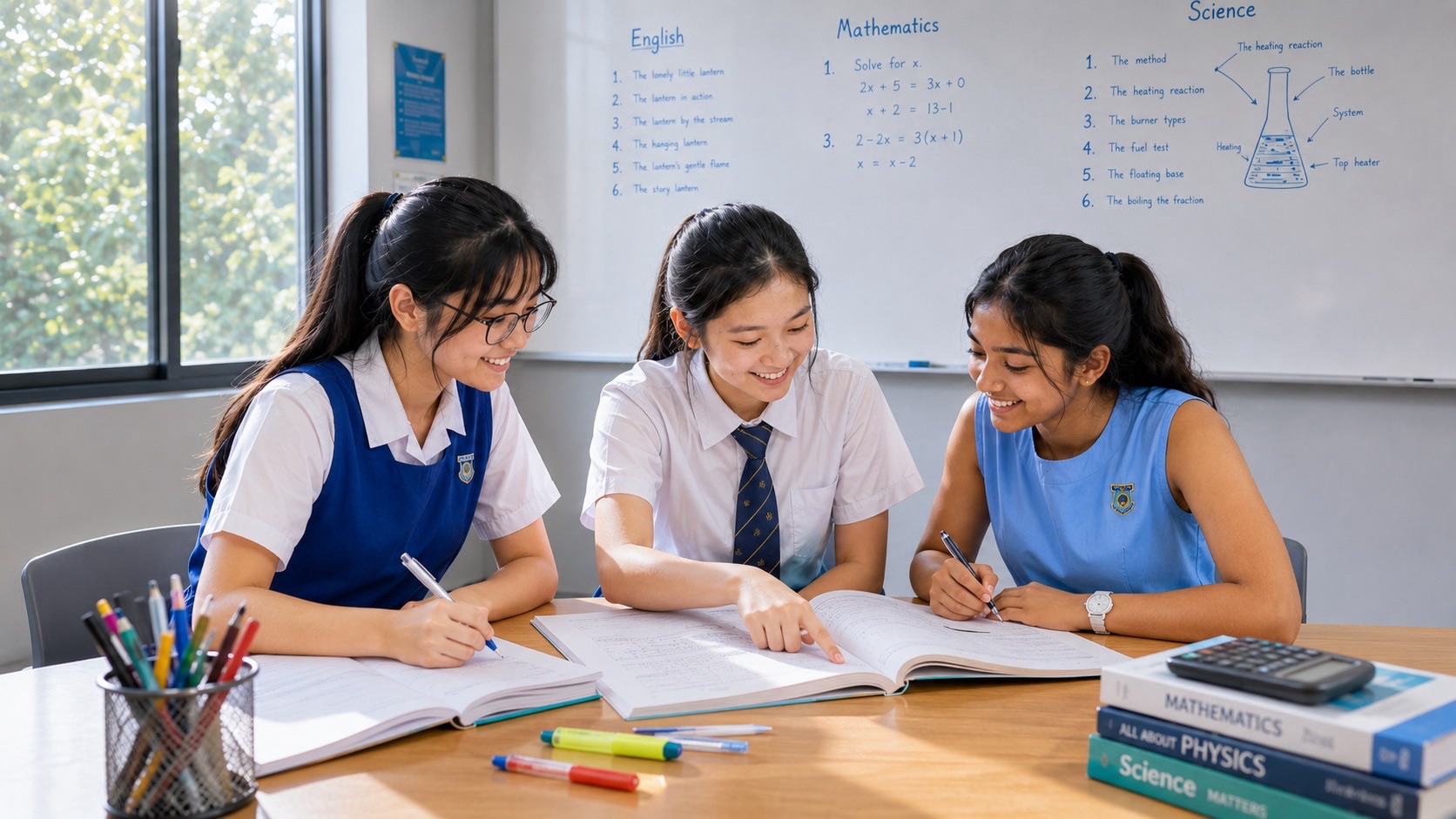
Secondary 2 is where the abstraction introduced in Secondary 1 starts to become normal working language. Algebra is no longer a new arrival; it becomes infrastructure. Graphs, equations, geometry, proportion and statistics increasingly depend on the learner being able to move between symbols, diagrams, tables and verbal descriptions without losing the underlying relationship.
The Engineer Series treats Secondary 2 as a consolidation-and-transfer year. The question is not merely whether the student can perform each technique. It is whether the techniques have begun to connect into a system that can survive unfamiliar presentation.
Algebraic manipulation should preserve truth
Students often become faster at expansion, factorisation and solving equations during Secondary 2. Speed is useful, but the deeper discipline is to understand why each transformation is legal. That understanding creates a checking mechanism: if a step changes the mathematical truth rather than only its form, something has gone wrong.
This matters later in Additional Mathematics, where long chains of symbolic work make purely memorised manipulation increasingly fragile.
Archimedes: ask what the graph or equation is describing
Graphs can become mechanical plotting exercises unless students remember that they represent relationships. Slope, intercept, scale and shape communicate how quantities behave. Geometry likewise becomes stronger when diagrams are read as constrained structures rather than pictures to decorate with formulas.
Returning to meaning is especially useful when a familiar procedure fails. What is changing? What remains fixed? What does the diagram permit? What quantity does this expression represent?
Tesla: availability across topics
Secondary 2 exposes whether earlier knowledge can be called from storage. A question on coordinate geometry may require algebra. A proportion problem may depend on fraction fluency. Statistics may require careful reading before any calculation.
Mixed practice becomes more valuable because the student must decide which capability to activate. Being told the chapter name in advance reduces that recognition load and can create an overly optimistic impression of readiness.
Brunel: transfer is the infrastructure test
A working mathematical system should carry ideas between contexts. Proportion used in Mathematics should remain recognisable in science. Algebra should support graphs rather than live in a separate compartment. Geometry should connect calculation with reasoning about constraints.
Transfer does not happen automatically just because two topics are related. Students often need explicit opportunities to compare representations and explain the common structure.
From error correction to error diagnosis
By Secondary 2, students can begin taking more responsibility for classifying their own errors. Was the mistake conceptual, algebraic, arithmetic, representational, careless, or a method-selection problem? Different errors deserve different repairs.
This is a useful shift because “do more practice” is too blunt. If a learner repeatedly chooses the wrong method, more execution of the correct method may not touch the real weakness. The student needs better recognition and comparison.
Preparing for Secondary 3
Secondary 3 often introduces a sharper divergence in mathematical pathways and, for many students, Additional Mathematics. The load rises not only because topics are harder but because algebraic infrastructure is used constantly.
A strong Secondary 2 outcome is therefore a student who can manipulate algebra with meaning, move between representations, recognise common structures across topics and increasingly diagnose where their own route has broken.
Quick read: Secondary 2 is where algebra must become dependable infrastructure
Secondary 2 is the point where symbolic work should stop feeling like a separate chapter and start functioning as infrastructure across graphs, proportion, geometry and statistics. The strongest students are not simply faster at algebra; they preserve truth while transforming expressions, recognise when another topic depends on algebra, and can diagnose the first point where a route became invalid.
What Secondary 2 inherits from Secondary 1
Secondary 1 should have translated Primary relationships into algebraic language. Secondary 2 now asks that language to become efficient and portable. Weak sign control, fraction fluency, equality sense or graph interpretation can create repeated losses across several chapters, so apparently separate errors may share one dependency.
A Secondary 2 diagnostic map
- If algebraic errors recur across topics: locate the earliest manipulation rule that is not truth-preserving.
- If graphs are read mechanically: reconnect gradient, intercept, scale and shape to the quantities they describe.
- If performance is good only chapter-by-chapter: increase mixed recognition and representation switching.
- If the student cannot explain an error: classify whether it was conceptual, algebraic, arithmetic, representational or method-selection.
- If transfer to science or applied contexts is weak: compare the shared mathematical structure explicitly.
Transfer measurement: can algebra travel?
Take a proportional, geometric or graph relationship and ask the learner to express it in another form. Remove the chapter label. Change the context while preserving the structure. The learner should increasingly recognise the same Mathematics under different interfaces and use algebra as a transport system rather than a collection of isolated tricks.
Parent decision support: prepare for Secondary 3 by fixing infrastructure, not previewing everything
For students heading toward more demanding Secondary 3 Mathematics, including Additional Mathematics, the best preparation is not simply early exposure to the next syllabus. It is dependable algebra, fractions, proportion, graphs and self-diagnosis. A-Math magnifies small infrastructure weaknesses because algebra is used almost continuously.
The long arc: Secondary 2 teaches mathematical truth-preservation
The habit of asking whether a transformation preserves the underlying relationship becomes increasingly important in A-Math, calculus and formal technical work. Secondary 2 therefore contributes a deeper form of mathematical discipline: not merely changing symbols, but changing them without corrupting what is true.
Continue to Secondary 3 Mathematics | The Engineer Series.
One-sentence answer
Secondary 2 Mathematics is the stage where algebra, graphs, proportion and geometry must stop behaving like separate chapters and become dependable infrastructure that preserves mathematical truth across representations.
A worked diagnostic example: when factorisation is not the real problem
Suppose a student can factorise a familiar quadratic expression after a worked example but repeatedly fails when the same structure appears inside an equation or graph problem. The visible error may be labelled “factorisation”, yet the real weakness can be recognition: the learner knows the operation when the chapter tells them what to do, but does not recognise when the structure should be activated elsewhere.
A stronger repair mixes expressions, equations and graph relationships, asks the learner first to name what structure is present, then compares two possible routes. If the student can identify and use the factorisation without a topic cue, the capability has become more portable. If the student can also explain why each transformation preserves the original mathematical relationship, execution and understanding are beginning to reinforce one another.
Why a three-student Mathematics class can be useful at Secondary 2
Secondary 2 is an ideal stage for route comparison because students can reach the same answer through different representations and still reveal very different weaknesses. One may have secure algebra but poor graph interpretation, another may understand the graph but lose signs during manipulation, and a third may need the method announced before starting. A three-student class gives the tutor enough visibility to distinguish these routes while still allowing students to hear alternative reasoning.
That matters before Secondary 3 because the next stage increases specialisation. The tutor should therefore use the small group to narrow the active constraint, test transfer, and reduce prompts rather than making every student follow one identical procedure.
The Secondary 2 handover receipt
- Algebraic transformations are increasingly understood as truth-preserving operations.
- Graphs, equations and verbal relationships can be translated into one another with less support.
- Fractions, proportion and signed-number control remain available inside symbolic work.
- The learner can classify errors more precisely instead of treating every mistake as “careless”.
- Mixed questions can be started without a chapter cue, and method selection is becoming more reliable.
- The student is increasingly able to identify which dependency needs repair before asking for broad help.
This is the infrastructure Secondary 3 needs before E-Math, A-Math and heavier cross-topic load begin exposing weak links repeatedly.