
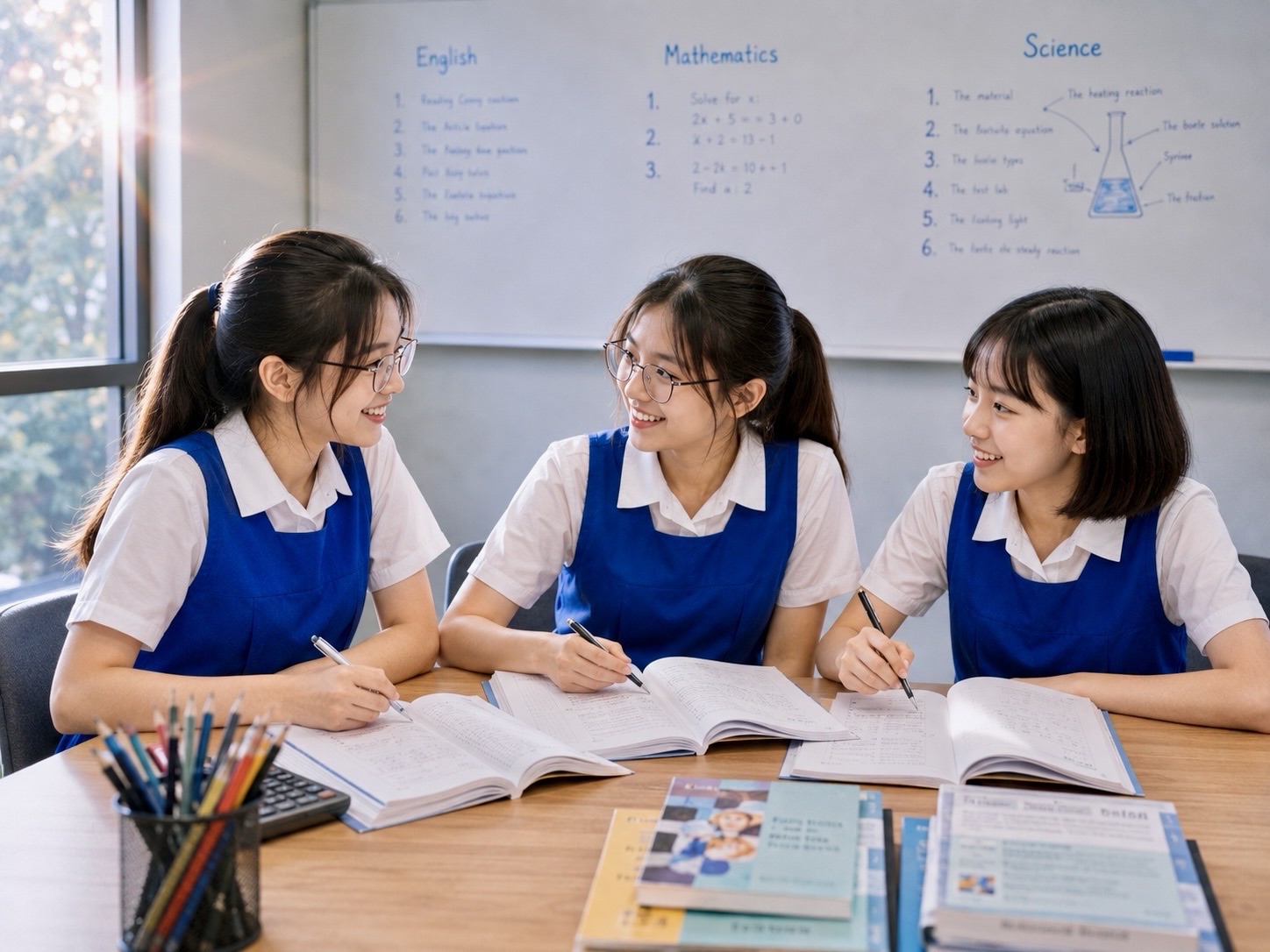
Bukit Timah Tutor · Secondary 3–4 Mathematics Sign Up
Sign up for Secondary 3–4 Additional Mathematics or SEC G3, G2 and G1 Mathematics.
Upper Secondary Mathematics is not one single route. A student may be taking G3 or G2 Additional Mathematics, or Mathematics at G3, G2 or G1. The subject, level, present chapter, earlier algebraic dependencies, school sequence and examination year all affect what should be taught first. Bukit Timah Tutor keeps classes to a maximum of three students, so sign-up begins with a consultation before placement.
01 / Start
Which Mathematics route applies?
Identify the subject, level and examination year first.
02 / G3 A-Math
I need G3 Additional Mathematics tuition.
Repair dependencies and build connected execution.
03 / G2 A-Math
I need G2 Additional Mathematics tuition.
Build stable algebra, method and progression.
04 / G3 Math
I need SEC G3 Mathematics tuition.
Strengthen connection, method choice and exam control.
05 / G2 Math
I need SEC G2 Mathematics tuition.
Stabilise concepts, procedures and application.
06 / G1 Math
I need SEC G1 Mathematics tuition.
Build essential numeracy and reliable working.
07 / Programme
How do placement, lessons and fees work?
Review the three-student teaching structure.
08 / Begin
I am ready to sign up.
Open the prepared upper-secondary consultation.
Secondary 3–4 · Additional Mathematics · SEC G3, G2 and G1 Mathematics. Read the route guide or begin the consultation when the exact subject and main concern are already known.
Read the Full Sign-Up Guide WhatsApp Bukit Timah TutorBukit Timah Tutor · Upper Secondary Mathematics Sign-Up Guide
Secondary 3–4 Additional Mathematics and SEC G3, G2 and G1 Mathematics.
Secondary 3 is where the upper-secondary route becomes concrete. Students begin a more specialised subject combination, encounter denser algebraic dependencies and face chapters that assume earlier skills are already available. Secondary 4 compresses the task: repair, consolidation, revision, examination technique and time management must now happen within a shorter runway.
The exact subject matters. Additional Mathematics is not simply “more Mathematics.” It is a separate elective subject with its own dependency chain. Under the 2027 SEC syllabuses, Additional Mathematics is offered at G3 and G2. Mathematics itself is offered at G3, G2 and G1. This page therefore presents five distinct sign-up routes rather than mixing every student into one Secondary Mathematics category.
Bukit Timah Tutor keeps each class to a maximum of three students. Sign-up is therefore a consultation-led placement process: identify the route, locate the earliest useful weak link, check whether the available class can support a coherent teaching direction, then confirm the programme where a suitable place exists.
01 / Start With Route Accuracy
Secondary 3–4 sign-up begins with the exact subject, level and examination year.
The Singapore-Cambridge Secondary Education Certificate begins in 2027. Under SEC, students sit subjects at G1, G2 or G3 and receive one certificate that reflects the subjects and levels taken. This means a 2027 candidate’s route should be described precisely—for example, G3 Additional Mathematics or G2 Mathematics—not only “upper-secondary Maths.”
There is also a transition to recognise. Secondary 4 students sitting national examinations in 2026 remain under the existing GCE N(T), N(A) and O-Level structure. Students sitting from 2027 move into SEC. The Mathematics itself remains teachable across the transition, but the consultation should record which examination structure and syllabus the student is actually following.
Route accuracy prevents three common errors: teaching the wrong level of demand, confusing Mathematics with Additional Mathematics, and building an examination plan around the wrong assessment year.
02 / G3 Additional Mathematics
G3 Additional Mathematics depends on algebra that remains available under pressure.
Additional Mathematics is cumulative. A student may recognise the chapter title yet struggle because factorisation, indices, surds, equations, symbolic manipulation or graph sense is not sufficiently automatic. Later work becomes expensive when every line consumes attention that should have been available for reasoning.
Tuition should first locate the earliest dependency that is failing. The repair may sit several chapters before the visible mistake. Once that foundation is stable, the student can connect functions, equations, coordinate relationships, trigonometric reasoning, logarithmic and exponential forms, and calculus with less fragmentation.
For stronger students, the route changes from repair to stretch. They need unfamiliar applications, cleaner solution architecture, more efficient method comparison, precise presentation and dependable timed execution.
Foundation Repair
Restore algebraic control before adding chapter difficulty.
Rebuild signs, expressions, equations, identities, graph reading and symbolic discipline from first principles.
Topic Connection
Make the dependency chain visible.
Show how earlier algebra supports later functions, trigonometry, coordinate methods and calculus rather than teaching every chapter as an island.
Greater Stretch
Train unfamiliar applications without losing precision.
Compare routes, manage constraints, justify steps and recover when the standard pattern is hidden.
Examination Control
Convert understanding into reliable marks.
Improve pacing, complete working, prioritisation, checking and error review under timed conditions.
03 / G2 Additional Mathematics
G2 Additional Mathematics needs its own coherent teaching route.
G2 Additional Mathematics is not ordinary Mathematics with extra worksheets, and it should not be treated as a vaguely simplified G3 class. It has an official syllabus route and should be taught according to its intended concepts, pace and assessment demand.
The student may understand a demonstration yet lose the process when notation changes or several algebraic steps are required. The goal is to build a stable sequence: interpret the expression, identify the governing relationship, choose a valid method, maintain accurate working and check the result.
Progress should remain ambitious but controlled. The student needs enough variation to recognise structure, enough repetition to stabilise method and enough explanation to avoid reducing every topic to memorised surface patterns.
04 / SEC G3 Mathematics
G3 Mathematics requires connected method choice and dependable examination execution.
Upper-secondary G3 Mathematics brings several systems together: algebra, graphs, geometry, trigonometry, measurement, statistics, probability and contextual problem-solving. The student must know more than isolated procedures. They must recognise which structure is present and decide what to do first.
A recurring error may originate in interpretation, algebra, diagram reading, formula selection, incomplete working, calculation or checking. Calling every error “careless” hides the mechanism and prevents targeted repair.
Secondary 4 preparation then adds an execution layer: pacing, mark allocation, question triage, visible working, calculator discipline, checking and the ability to recover after a difficult item without losing the rest of the paper.
05 / SEC G2 Mathematics
G2 Mathematics should turn partial recognition into independent performance.
A G2 student may follow a familiar model but become uncertain when the wording changes, the diagram is rotated or the question combines two ideas. This is not always a lack of effort. It may mean the student recognises the surface form without owning the decision process.
Tuition should slow the mechanism down: What is being asked? What information matters? Which representation makes the relationship clearer? What is the first valid step? How can the answer be checked? These questions turn a remembered example into a transferable method.
The long-term aim is not to keep the student dependent on hints. It is to create a dependable working routine that survives new numbers, new wording and examination pressure.
Interpret
Translate the wording, diagram or context into a clear mathematical task.
Represent
Use an equation, table, graph, diagram or organised working format.
Execute
Carry out a stable sequence of steps with accurate notation and calculation.
Check
Test the answer against units, scale, context and mathematical reasonableness.
06 / SEC G1 Mathematics
G1 Mathematics should become clear, usable and increasingly independent.
G1 Mathematics is a Mathematics route. It is not a G1 Additional Mathematics route. Support should concentrate on essential numeracy, interpretation, practical relationships, routine methods, clear working and confidence that grows from successful use.
Some students need earlier foundations revisited before upper-secondary work can hold. The tutor may return to number sense, operations, fractions, percentages, ratio, measurement or simple algebra, then reconnect those foundations to the current school task.
The teaching should remain respectful and purposeful. Clear representations, guided steps, frequent checks for understanding and gradually reduced prompting help the student carry more of the process independently.
07 / Placement, Lessons and Fees
A three-student class must support one coherent upper-secondary route.
The same school year does not guarantee class compatibility. Two Secondary 3 students may be taking different subjects, different levels or different school sequences. Two G3 Additional Mathematics students may also have very different dependency gaps and pace requirements.
Placement therefore considers the exact route, current syllabus region, foundational position, pace, next assessment, examination runway, timetable and the instructional direction of the existing class. The maximum of three students protects observation and correction, but the group must still be teachable as a coherent unit.
The opening four-lesson block is not merely attendance. It should establish the visible difficulty, locate the earliest useful dependency, begin targeted teaching and set the next instructional direction.
- Teach from first principles. Do not assume a formula or technique is understood merely because the student has seen it.
- Observe the actual failure point. Distinguish interpretation, algebra, notation, method choice, calculation, pace and checking.
- Connect the chapter to its dependencies. Repair the earliest weak link that is still affecting present work.
- Train independent method choice. Reduce prompting as the student becomes able to identify and execute the route alone.
- Prepare for the correct examination structure. Record whether the student is under the 2026 GCE route or the SEC route from 2027.
Confirm the route
Secondary 3 or 4; Additional Mathematics or Mathematics; G3, G2 or G1; and the examination year.
Observe the mechanism
See how the student interprets, selects, works, checks and responds to correction.
Begin the repair
Teach the earliest useful dependency and connect it to the present school demand.
Set the direction
Decide what needs consolidation, what can advance and what requires examination training.
Is Additional Mathematics available at G1?
No G1 Additional Mathematics route is presented because the 2027 SEC school-candidate syllabuses list Additional Mathematics at G3 and G2. G1 is available for Mathematics.
Can G3 and G2 Additional Mathematics students share one class?
Not automatically. The syllabus demand, current topics, pace and instructional direction must be sufficiently aligned for coherent teaching.
Can Additional Mathematics and Mathematics students share one class?
These are different subjects. Placement is considered only when the actual work and lesson direction can be managed without weakening either student’s route.
Can a Secondary 4 student join close to the examination?
This depends on the time remaining, present foundation, target, class fit and whether a useful prioritised route can still be built. A short runway may require targeted consolidation rather than complete rebuilding.
Are trial lessons available?
Trial availability is limited because every class is capped at three students and its teaching route must remain coherent. The consultation is the main suitability check. Any trial arrangement remains subject to class availability.
Does sending the WhatsApp message reserve a place?
No. It begins the consultation. A place is confirmed only after route, class fit, timing, programme fee and availability are clarified.
*Fees are indicative, may be adjusted and remain subject to subject, level, programme requirements and class availability. A consultation does not guarantee that an appropriate space is currently available.
08 / Ready to Begin
Send the exact route, current topic and repeated learning concern.
A message that says only “I need Additional Mathematics tuition” does not yet identify whether the route is G3 or G2, whether the student is in Secondary 3 or 4, or whether the immediate need is algebraic repair, present-topic consolidation, examination preparation or greater stretch.
Use the prepared message to send the school year, exact subject route, school, current topics, recent result, recurring difficulty, next assessment, intended outcome and preferred timing. You do not need to diagnose the student in advance. Describe what you are observing; the consultation helps translate it into a possible teaching route.
Begin the Secondary 3–4 Mathematics sign-up consultation.
Choose G3 Additional Mathematics, G2 Additional Mathematics, G3 Mathematics, G2 Mathematics or G1 Mathematics in the prepared WhatsApp message.
Final Upper Secondary Review
Choose the next useful action.
Return to the selector, review the exact subject route, check placement and fees, or begin the Secondary 3–4 consultation.
Secondary 3/4 Additional Mathematics Sign Up at Bukit Timah Tutor
Secondary 3 and Secondary 4 Additional Mathematics can become difficult very quickly.
The problem is not always the chapter currently being taught. A student may appear to struggle with logarithms, trigonometry, coordinate geometry, differentiation or integration, but the actual weakness may have started earlier—with algebraic manipulation, indices, equations, functions, graphs or the ability to recognise which method a question requires.
This is why signing up for Additional Mathematics tuition should not begin with the nearest available class.
It should begin by understanding the student’s position.
At Bukit Timah Tutor, the Secondary 3/4 Additional Mathematics sign-up process begins with a consultation. Parents share the student’s school level, curriculum, latest result, current topics, repeated difficulties and next important assessment. We then consider whether the student needs foundation repair, consolidation, stronger topic connections, greater stretch or examination preparation.
The purpose is not simply to add another lesson to the student’s timetable.
The purpose is to identify what Mathematics needs to become stronger next.
Who Is This Additional Mathematics Programme For?
This programme is intended for students studying Secondary 3 or Secondary 4 Additional Mathematics, including students in suitable school, G3, G2, IP, IGCSE or international Mathematics pathways.
It may be suitable for a student who:
- has recently started Additional Mathematics and finds the transition unexpectedly difficult;
- understands lessons in class but cannot complete unfamiliar questions independently;
- repeatedly loses marks through weak algebraic manipulation;
- memorises formulas without understanding when to use them;
- performs well during untimed practice but struggles during tests;
- has gaps from earlier Mathematics topics that now affect several chapters;
- needs to move from a pass or moderate grade towards stronger examination performance;
- is preparing for a major school examination or national examination;
- needs more advanced questions and distinction-level stretch;
- has become anxious, discouraged or overly dependent on worked solutions.
Secondary 3 students often need help building the structure of the subject correctly.
Secondary 4 students usually need stronger consolidation, examination control and the ability to connect topics under time pressure.
The tuition route should therefore depend on the student’s actual stage—not only the label “Secondary 3” or “Secondary 4”.
Additional Mathematics Is a Dependency Subject
Additional Mathematics is not a collection of unrelated chapters.
It is a dependency system.
Later topics depend on earlier ones. When one important skill is unstable, several later chapters become harder at the same time.
For example:
[
\text{Algebraic control}
\rightarrow
\text{equations}
\rightarrow
\text{functions}
\rightarrow
\text{graphs}
\rightarrow
\text{calculus}
]
A student who cannot manipulate expressions confidently may struggle with logarithms, trigonometric identities, differentiation and integration even when the individual formulas have been memorised.
Similarly:
[
\text{coordinate geometry}
\rightarrow
\text{gradient}
\rightarrow
\text{equations of lines}
\rightarrow
\text{curves}
\rightarrow
\text{tangents and normals}
]
The visible mistake may occur in the final step, but the repair may need to happen much earlier.
This is why Additional Mathematics tuition should not only reteach the chapter where marks were lost.
It should locate the earliest weak dependency beneath the chapter.
Secondary 3 Additional Mathematics Sign Up
Secondary 3 is usually the point where students first experience the full change in Mathematics demand.
The subject becomes more abstract. Questions require longer chains of reasoning. Algebra is no longer one isolated topic; it becomes the language used across the entire subject.
A Secondary 3 student may initially believe that every chapter requires a new formula. In reality, many questions require the same deeper abilities:
- rearranging expressions accurately;
- recognising mathematical structure;
- translating words into equations;
- choosing an appropriate method;
- connecting a new question to an earlier concept;
- maintaining accuracy across several working steps;
- checking whether an answer is mathematically reasonable.
Starting tuition during Secondary 3 can help prevent small gaps from becoming system-wide weaknesses.
The early goal is not only to improve the next test result. It is to establish the working habits and topic connections the student will need throughout Secondary 4.
A Secondary 3 consultation should therefore clarify:
- how recently the student began Additional Mathematics;
- which chapters have already been taught;
- whether the school is moving quickly or deeply;
- whether the student’s Elementary or general Mathematics foundation is stable;
- which mistakes repeat across different topics;
- whether the student can explain a method independently;
- whether the problem is understanding, practice, speed or confidence.
The earlier these distinctions are made, the easier it is to choose the correct repair route.
Secondary 4 Additional Mathematics Sign Up
Secondary 4 Additional Mathematics has a different pressure profile.
By this stage, students may understand individual chapters but struggle to retrieve methods quickly, combine concepts or perform consistently under examination conditions.
The issue may no longer be basic exposure.
It may be execution.
A Secondary 4 student may need help with:
- completing the syllabus;
- repairing weak chapters before revision becomes too compressed;
- connecting algebra, functions, trigonometry, geometry and calculus;
- recognising question families;
- selecting methods without waiting for hints;
- reducing avoidable algebraic errors;
- improving working presentation;
- completing papers within the available time;
- learning how marks are distributed across multi-step questions;
- developing a reliable checking routine;
- preparing for preliminaries, school examinations or national examinations.
At this stage, simply doing more papers may not solve the problem.
Past-year papers reveal weaknesses, but they do not automatically repair them.
A student who repeatedly makes the same mistake needs targeted reconstruction before returning to full-paper practice.
The Secondary 4 sign-up consultation therefore considers both content mastery and examination readiness.
The Four Possible Additional Mathematics Routes
After reviewing the student’s position, the likely tuition route generally falls into one or more of four categories.
1. Foundation Repair
Foundation repair is needed when earlier Mathematics weaknesses are preventing the student from accessing the current chapter.
This may involve:
- algebraic manipulation;
- indices and surds;
- equations and inequalities;
- factorisation;
- functions;
- graph interpretation;
- coordinate geometry;
- trigonometric foundations.
The objective is to repair the dependency beneath the visible difficulty.
2. Consolidation
Consolidation is appropriate when the student broadly understands the subject but remains inconsistent.
The student may need:
- clearer notes and topic organisation;
- more deliberate practice;
- error classification;
- retrieval practice;
- mixed-topic questions;
- stronger working habits;
- repeated independent execution.
The objective is to turn partial understanding into reliable performance.
3. Stretch
Stretch is for students who already perform well but need harder applications and more independent problem-solving.
This route may include:
- non-routine questions;
- deeper method comparison;
- multi-topic problems;
- more demanding algebraic reasoning;
- distinction-level precision;
- faster recognition of elegant methods.
The objective is not unnecessary difficulty. It is to expand the student’s range while preserving accuracy.
4. Examination Preparation
Examination preparation focuses on converting knowledge into marks.
This may include:
- timed topical drills;
- paper planning;
- question selection;
- mark allocation awareness;
- presentation of working;
- checking routines;
- common examination traps;
- full-paper practice;
- post-paper error repair.
The objective is to make the student’s performance more stable under examination conditions.
Why Small-Group Additional Mathematics Tuition?
Bukit Timah Tutor conducts small-group Mathematics lessons with a maximum of three students per class.
Additional Mathematics benefits from a small-group structure because students may be working on the same chapter while making very different mistakes.
One student may not understand the concept.
Another may understand the concept but make algebraic errors.
A third may be accurate but too slow.
These students should not receive exactly the same correction.
A maximum-three-student class gives the tutor more opportunity to:
- inspect individual working;
- identify where a method breaks;
- ask students to explain their reasoning;
- adjust question difficulty;
- compare different methods;
- correct misconceptions before they become habits;
- monitor whether each student can work independently;
- provide peer explanation without allowing students to hide inside a large class.
The class remains social enough for discussion but small enough for individual mathematical attention.
What Happens During the First Four Lessons?
The first four lessons should do more than introduce the student to the tuition class.
They should begin establishing a clearer Mathematics route.
Lesson 1: Establish the Present Position
The tutor observes how the student approaches questions, organises working and responds when unsure.
This helps distinguish between:
- missing knowledge;
- weak recall;
- poor algebraic control;
- incomplete conceptual understanding;
- slow method recognition;
- careless execution;
- examination anxiety.
The student’s working often reveals more than the final answer.
Lesson 2: Locate the Earliest Weak Link
The tutor traces repeated mistakes backwards.
For example, difficulty with differentiation may reveal weakness in indices, functions or algebraic simplification.
Difficulty with trigonometric equations may reveal gaps in identities, graphs or equation solving.
The aim is to identify the earliest repair point that will improve several later topics.
Lesson 3: Teach and Stabilise the Repair Method
The weak mechanism is retaught clearly.
The student then completes guided and increasingly independent questions to ensure the method is understood rather than copied.
Lesson 4: Confirm the Development Route
By the fourth lesson, the tutor should have a clearer view of whether the student mainly needs:
- foundation repair;
- consolidation;
- stretch;
- examination preparation;
- or a combination of these.
The next programme block can then proceed with a clearer purpose.
What Parents Should Send Before Signing Up
A useful consultation begins with clear information.
Parents can send:
- the student’s current level;
- school and curriculum;
- whether the student is in Secondary 3 or Secondary 4;
- current Additional Mathematics topics;
- latest Mathematics or Additional Mathematics result;
- recent test or examination paper, where available;
- repeated mistakes or concerns;
- the next important assessment;
- the outcome the student hopes to achieve;
- preferred lesson timings.
The parent does not need to diagnose the entire problem.
A short description such as “understands during lessons but cannot start questions independently” is already useful.
Other helpful descriptions include:
- “Algebra mistakes appear in almost every chapter.”
- “The student can do topical practice but struggles with mixed papers.”
- “Results fell after logarithms and trigonometry began.”
- “The student is passing but wants to move towards a distinction.”
- “The student is very slow and cannot finish the paper.”
- “The student has lost confidence and avoids difficult questions.”
These patterns help determine the likely starting route.
Secondary 3/4 Additional Mathematics Lesson Structure
The usual programme block consists of:
- four 1.5-hour lessons;
- a maximum of three students per class;
- lessons matched as closely as possible by subject, level and learning need;
- teaching, guided practice, correction and independent execution;
- indicative programme fees from $420 onwards.
Fees and placement remain subject to the student’s level, programme, class suitability and current availability.
A consultation does not automatically guarantee that an appropriate class space is available.
This is important because a very small class should not be filled solely because a seat is empty. The subject route, pace and student profile must also be reasonably suitable.
Should a Student Wait Until Results Fall Further?
Usually, no.
Additional Mathematics gaps tend to compound because later chapters reuse earlier skills.
A student who is already showing repeated difficulty may benefit from intervention before:
- confidence falls further;
- several chapters become connected to the same weakness;
- school revision begins;
- examination practice becomes urgent;
- the student starts memorising without understanding;
- avoidance becomes a fixed habit.
This does not mean every temporary difficulty requires tuition.
Some students need time, school consultation and more disciplined practice.
However, when the same weakness appears repeatedly across topics, waiting may allow the dependency gap to become more expensive to repair.
Is Additional Mathematics Tuition Only for Weak Students?
No.
Students seek Additional Mathematics tuition for different reasons.
Some need to rebuild foundations.
Some need to keep pace with a demanding school sequence.
Some understand the content but need stronger examination execution.
Some are already performing well and want deeper questions, more efficient methods and distinction-level consistency.
The correct question is not:
Is the student weak enough for tuition?
The better question is:
What mathematical development does the student need next?
Is a Trial Lesson Available?
Trial lessons may be limited because classes are capped at three students.
A trial student changes the working balance of a very small class and may not experience the programme accurately without prior placement information.
The preferred starting point is therefore a consultation.
Where a suitable trial arrangement is available, it remains subject to class fit, topic alignment and space.
Sign Up Through a Mathematics Consultation
Signing up should begin with the student—not merely the programme name.
Send Bukit Timah Tutor the student’s:
- Secondary 3 or Secondary 4 level;
- school and curriculum;
- current Additional Mathematics chapters;
- latest result;
- main concern;
- next assessment;
- intended goal;
- preferred lesson timing.
We will consider whether the likely route is foundation repair, consolidation, stretch or examination preparation, and whether an appropriate small-group class is available.
WhatsApp Consultation Message
Hi Bukit Timah Tutor, I would like to request a Secondary 3/4 Additional Mathematics consultation.
Student’s level:
School and curriculum:
Current Additional Mathematics topics:
Recent result:
Main concern or repeated weak link:
Next important assessment:
Goal we hope to achieve:
Preferred lesson timing:
I would like help deciding whether the student needs foundation repair, consolidation, greater stretch or examination preparation.
WhatsApp Bukit Timah Tutor at +65 8823 1234.
Begin With a Clearer Mathematical Direction
Secondary 3 and Secondary 4 Additional Mathematics should not feel like an endless sequence of unrelated formulas.
When the subject is taught properly, its structure becomes visible.
Algebra supports functions. Functions support graphs. Graphs support calculus. Trigonometry connects equations, identities and geometry. Earlier skills continue to travel through later chapters.
The student’s difficulty can therefore be investigated.
The weak link can be located.
The method can be taught.
The repair can be practised.
The student can become more independent.
That is the purpose of the Secondary 3/4 Additional Mathematics sign-up process at Bukit Timah Tutor.
Not simply to enrol the student in more Mathematics.
To begin with a clearer reason for what should be strengthened next.