
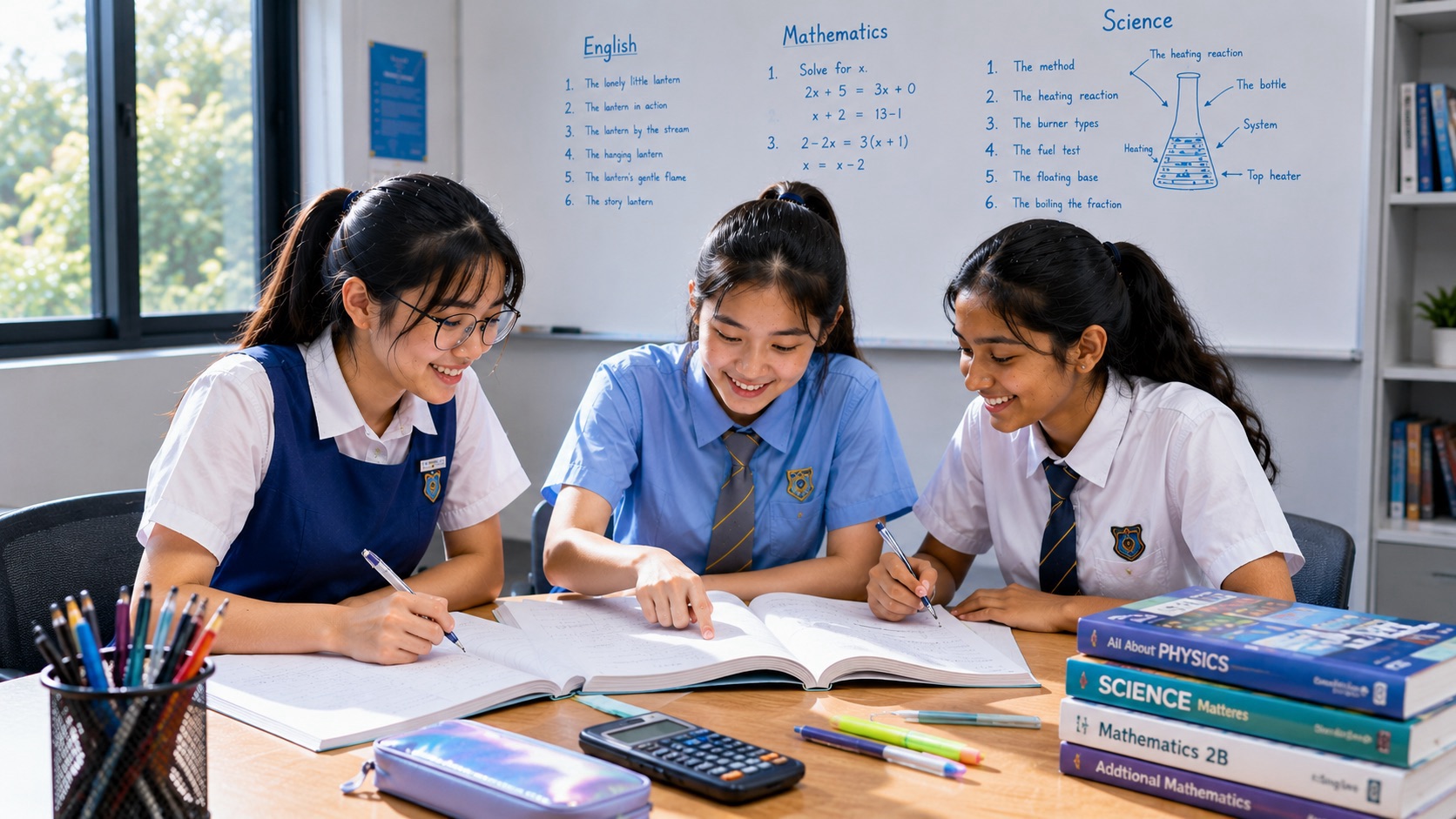
Secondary 3 Additional Mathematics is where school mathematics stops behaving like a collection of chapters and starts behaving like a connected symbolic system.
The student is asked to hold more information at once, move between representations, preserve equivalence while transforming expressions, recognise structures before choosing methods, and continue reasoning after the first obvious step has disappeared. Algebra is no longer just one topic. It becomes infrastructure. Graphs are no longer only drawings. They become models of relationships. Trigonometry becomes a language of periodic structure. Calculus introduces a new way of talking about change.
That is why Secondary 3 Additional Mathematics can feel like a sudden jump even to students who were previously strong in Mathematics. The difficulty is not simply that there is “more content”. The deeper change is that the subject expects a different kind of mathematical control.
Under Singapore’s Full Subject-Based Banding and the Singapore-Cambridge Secondary Education Certificate framework from 2027, the route also needs to be described accurately. Additional Mathematics is offered at G2 and G3, not at G1. For the 2027 SEC, SEAB lists G2 Additional Mathematics as K232 and G3 Additional Mathematics as K341. There is no G1 Additional Mathematics syllabus in the 2027 SEC school-candidate subject list.
So when people say “Secondary 3 Additional Mathematics under G1, G2 and G3”, the precise reading is this: Secondary 3 students live inside a secondary system containing G1, G2 and G3 subject levels, but the Additional Mathematics branch itself begins at G2 and continues at G3. G1 remains important as part of the wider Mathematics and SEC architecture, but it is not a separate Additional Mathematics examination route.
The Short Answer
Secondary 3 Additional Mathematics works by teaching students to recognise, transform and connect mathematical structures under increasing symbolic load.
At G2, the subject is designed as a bridge towards G3 Additional Mathematics. At G3, it is designed as a foundation for more advanced mathematical study, including A-Level H2 Mathematics. Both routes organise content around three large strands: Algebra, Geometry and Trigonometry, and Calculus. Both also assess more than routine technique. Students are expected to solve problems, reason, communicate and apply mathematics.
The central Secondary 3 job is therefore not to rush through a list of topics. It is to build the operating system that will make Secondary 4 possible.
Start With the New SEC Map
Three labels are often mixed together when parents discuss upper-secondary mathematics.
- Secondary 3 is the student’s school stage.
- G1, G2 and G3 are subject levels under Full Subject-Based Banding.
- SEC is the common Singapore-Cambridge Secondary Education Certificate framework beginning for graduating cohorts from 2027.
For Additional Mathematics, the 2027 examination map is straightforward: G2 Additional Mathematics is K232 and G3 Additional Mathematics is K341. SEAB’s G2 syllabus states that the course is intended to prepare students adequately for G3 Additional Mathematics. SEAB’s G3 syllabus states that it prepares students adequately for A-Level H2 Mathematics and assumes knowledge of G3 Mathematics.
This immediately tells us something important about the architecture. Additional Mathematics is not an isolated subject floating beside ordinary Mathematics. It is a dependency route. G2 A-Math depends on G2 Mathematics. G3 A-Math depends on G3 Mathematics. G2 A-Math points forward to G3 A-Math. G3 A-Math points forward towards mathematically demanding post-secondary study.
That dependency structure is the key to understanding why some students struggle even when they can follow classroom examples. The problem may be sitting underneath the visible chapter.
Why There Is No G1 Additional Mathematics Route
This is not a judgement about the worth or potential of a student. It is a statement about how the national subject architecture is currently organised. The SEC subject lists include Mathematics at G1, G2 and G3, while Additional Mathematics appears at G2 and G3.
The practical consequence is that parents should avoid treating “G1, G2 and G3 A-Math” as three parallel versions of the same subject. They are not. The accurate question is:
Is the student on the G2 Additional Mathematics route or the G3 Additional Mathematics route, and what Mathematics foundation is supporting that route?
That question leads to better planning because it identifies the actual syllabus, the correct prerequisites and the correct forward pathway.
Secondary 3 Is a Stage, Not a Separate National A-Math Syllabus
Another distinction matters. The official G2 and G3 Additional Mathematics syllabuses specify the full course content and examination demands, but they do not create one national list called “the Secondary 3 half” and another called “the Secondary 4 half” that every school must teach in exactly the same order.
Schools can sequence parts of the course differently. One school may place a topic earlier, another later. A student may have encountered differentiation while another Secondary 3 student is still consolidating polynomials or trigonometric functions. This is why a good Secondary 3 A-Math programme must know the student’s school sequence without becoming trapped by it.
We therefore use “Secondary 3 Additional Mathematics” to describe the build year: the first sustained year in which the student must learn how this more abstract mathematical system operates. The exact order of chapters may vary, but the underlying capabilities that need to be built are remarkably consistent.
The Real Transition: From Mathematics to Additional Mathematics
Students sometimes expect Additional Mathematics to be ordinary Mathematics with more difficult questions. That description is too weak. A-Math changes the density and dependency of the work.
In ordinary Mathematics, a student may often survive a weak patch in one topic because another topic uses different tools. In Additional Mathematics, algebra is threaded through almost everything. A weakness in signs, fractions, factorisation, rearrangement or substitution can reappear inside quadratic functions, trigonometry, coordinate geometry, differentiation and integration.
This creates a subject with long error chains. A small algebraic weakness can create a large examination problem because later chapters repeatedly call the same foundation.
That is why the move into Secondary 3 A-Math is best understood as a transition from chapter-level competence to system-level competence.
The A-Math Engine: Read → Represent → Transform → Connect → Verify
A useful way to understand the subject is as a five-stage engine.
1. Read
Identify what is given, what is required, what is constrained and what mathematical objects are present. Is the problem about a function, an equation, a tangent, a rate, an area, a periodic relationship, a polynomial or a model?
2. Represent
Turn the information into a useful mathematical form. This may mean an equation, a graph, a factorised expression, a trigonometric identity, a coordinate relation, a derivative or an integral.
3. Transform
Carry out legal mathematical changes while preserving the meaning that must remain invariant. Expand, factorise, rearrange, differentiate, integrate, substitute, complete the square, rationalise or simplify—but always with control of what the transformation does.
4. Connect
Recognise when one chapter calls another. A quadratic may become a condition for tangency. A coordinate problem may call algebra. A trigonometric equation may require identity manipulation before it can be solved. A calculus problem may depend on function behaviour and algebraic simplification before differentiation even begins.
5. Verify
Check whether the answer satisfies the original conditions. Substitute into the original equation. Inspect the domain or interval. Test the sign. Compare with a graph. Check whether a maximum is really a maximum. Confirm units, accuracy and reasonableness where relevant.
Students who only learn the middle stage—transformation—often appear capable in topical homework and then collapse on unfamiliar questions. The full engine is what creates independence.
Algebra Is the Operating Language
Both G2 and G3 Additional Mathematics place algebra at the centre of the subject. This is not accidental. Algebra is how relationships are compressed into manipulable form.
A student who sees algebra only as “moving terms” has not yet reached the level A-Math needs. Strong algebra means understanding equivalence, structure and constraints. It means seeing why completing the square reveals a maximum or minimum, why the discriminant controls the number of real roots, why factorisation changes what can be inferred about a polynomial, and why a transformed expression can expose information that was hidden before.
The official syllabuses include core structures such as quadratic functions, equations and inequalities, surds, polynomials and partial fractions. The G3 route extends the algebra strand further with binomial expansions and exponential and logarithmic functions.
For Secondary 3, the teaching priority should not be “finish algebra quickly so we can get to the interesting chapters”. Algebra is the infrastructure that will decide whether the later chapters work.
Quadratics: The First Major Structure Test
Quadratic functions are a good example of how A-Math changes the student’s relationship with familiar mathematics. A quadratic is not just something to solve. It is simultaneously an equation, a graph, a model and a geometric object with a turning point.
Completing the square is therefore not merely an alternative technique. It changes what is visible. The same expression can reveal roots in one form, factors in another and a maximum or minimum in another. A student who understands these representations begins to see why mathematical form matters.
The discriminant extends this further. It allows a student to reason about the existence and nature of solutions without explicitly solving every equation. The condition for a line to intersect, touch or miss a curve becomes a statement about the number of real roots in the resulting equation.
This is a major Additional Mathematics habit: use structure to know something before doing all the arithmetic.
Surds: Exactness Without Decimals
Surds force students to confront a distinction that becomes increasingly important in higher mathematics: an answer can be exact without being a terminating decimal.
The point is not only to rationalise denominators or simplify expressions. Surds train the student to preserve exact structure rather than converting everything prematurely into calculator approximations. That habit matters later in trigonometry, coordinate work and calculus.
A student who reaches for a decimal too early often loses visibility. A student who can hold an exact symbolic form keeps more information alive.
Polynomials and Partial Fractions: Structure Inside Structure
Polynomials teach students that an expression can carry hidden divisibility and root information. The remainder and factor theorems turn substitution into a structural test. A single value can reveal whether a factor exists. A cubic can be reduced once one factor is located.
Partial fractions reverse the direction. Instead of combining simpler fractions into one expression, the student decomposes a more complicated rational expression into simpler components. The deeper lesson is that mathematical difficulty often depends on representation. A hard-looking object can become manageable when rewritten in a form that exposes its internal parts.
This is one of the most useful habits A-Math can teach: when the current form is difficult, change the form before changing the problem.
What G3 Adds to the Algebra World
The G3 syllabus extends the algebra strand beyond the G2 core. It includes binomial expansions and exponential and logarithmic functions.
Binomial expansion introduces a powerful pattern engine. Instead of multiplying repeated factors line by line, students learn a general structure that predicts coefficients and terms. The mathematics becomes more compressed: a whole expansion is governed by a rule.
Exponential and logarithmic functions then bring in a different family of growth relationships. Logarithms make sense only when the student understands that they invert exponentiation. The question “what is the logarithm?” becomes much easier when translated into “what power produces this number?”
These topics matter because they prepare students to reason about growth, decay, scale and inverse relationships—ideas that later appear across science, finance, statistics and advanced mathematics.
Geometry and Trigonometry: Relationships That Repeat
Trigonometry in Additional Mathematics is not simply SOH-CAH-TOA with harder numbers. The student moves into functions, identities, equations, periodicity, exact values and radians. Sine, cosine and tangent become functions with repeating behaviour rather than only ratios inside one triangle.
This changes the central question. Instead of asking only “what is this side?”, the student begins asking “how does this relationship behave as the angle changes?”
Identities add another form of structural reasoning. The goal is not to substitute values but to show that two expressions represent the same relationship. This is why identity proofs are so revealing. They test whether the student can transform one side while preserving truth until the hidden equivalence becomes visible.
Trigonometric equations then combine identity control with solution control. The student must respect intervals, periodicity and multiple valid angles. One correct value may not be the complete answer.
Coordinate Geometry: When Algebra Becomes Shape
Coordinate geometry is one of the clearest places where algebra and geometry merge. A line can be described by an equation. Parallelism and perpendicularity can be read through gradients. A circle becomes an algebraic object. A geometric condition can be tested symbolically.
For students, this is an important transition because it shows that different branches of mathematics are not separate compartments. Geometry can be translated into algebra, solved there and translated back.
The G3 route also includes transforming certain relationships to linear form so unknown constants can be determined from a straight-line graph. Again, the deeper mechanism is representation: a nonlinear-looking relationship can sometimes be re-expressed so that familiar linear tools become available.
Plane Geometry Proofs in G3
Proof is one of the places where a student’s mathematical maturity becomes visible. A diagram may suggest something, but proof requires the student to show why the conclusion must follow from established facts.
The G3 syllabus includes proof in plane geometry using familiar properties such as parallel lines, triangles, quadrilaterals, circles, similarity, congruence, the midpoint theorem and the tangent-chord theorem.
The important habit is not memorising a chain of reasons. It is learning to distinguish what is given, what is known, what is inferred and what still needs to be proved. That is disciplined mathematical argument.
Calculus: The Subject Learns to Talk About Change
Calculus is often treated as the dramatic moment in Additional Mathematics, but its arrival makes sense when the earlier system is stable.
Differentiation asks a new question: how fast is something changing at a particular point? Geometrically, the derivative is linked to the gradient of a tangent. In applications, it becomes a rate of change. In function analysis, it tells us where a function is increasing, decreasing or stationary.
Integration reverses the direction. If differentiation takes a function to its rate of change, integration can reconstruct a family of functions from that rate. Definite integration also connects to accumulated quantity and area.
The G2 syllabus includes differentiation and integration of algebraic functions within its specified scope, along with applications such as gradients, tangents, normals, rates of change, maxima and minima, definite integrals and area under curves. The G3 syllabus expands the function families involved and adds applications including straight-line motion through displacement, velocity and acceleration.
For Secondary 3 learners, the biggest conceptual breakthrough is often this: a function does not only have values; it has behaviour. Calculus gives a language for that behaviour.
How G2 Additional Mathematics Works
G2 Additional Mathematics should not be described as “easy G3”. It has its own syllabus, assessment and forward purpose. The official 2027 syllabus explicitly states that it is intended to prepare students adequately for G3 Additional Mathematics.
This gives G2 A-Math a clear educational role: it builds a serious Additional Mathematics foundation while creating a bridge into the more demanding G3 route where appropriate.
Knowledge of G2 Mathematics is assumed. In other words, the student cannot treat G2 A-Math as a replacement for ordinary Mathematics. The two subjects have a dependency relationship. Weaknesses in the underlying Mathematics course can reappear inside Additional Mathematics and should be repaired at source.
For 2027, the G2 Additional Mathematics examination consists of two papers, each 1 hour 45 minutes and each worth 70 marks, with equal 50% weighting. The assessment objectives give approximately 50% to standard techniques, 40% to problem solving in varied contexts and 10% to mathematical reasoning and communication.
That balance is instructive. Technique matters, but technique alone cannot carry the subject.
How G3 Additional Mathematics Works
G3 Additional Mathematics is the more advanced SEC A-Math route. Its official syllabus states that it prepares students for A-Level H2 Mathematics, where strong algebraic manipulation and mathematical reasoning are required.
Knowledge of G3 Mathematics is assumed. This is one reason the subject can feel unforgiving when core mathematics is unstable. The A-Math paper may not be directly testing a lower-level skill, but the student may still need that skill to reach the tested concept.
For 2027, G3 Additional Mathematics also uses two equally weighted papers. Each is 2 hours 15 minutes and worth 90 marks. The subject includes the common A-Math core and extends it with additional algebraic, graphical, geometric and calculus content.
The result is a denser system with longer dependency chains. Students need more than memory. They need fluency, structure recognition and the ability to keep working when a question combines ideas.
The Assessment Objectives Tell Us How to Teach
The official assessment objectives are a useful antidote to shallow tuition design.
Students are expected to use standard techniques, solve problems in a variety of contexts, and reason and communicate mathematically. The problem-solving objective includes interpreting information, translating between forms, connecting topics, formulating mathematics from situations, selecting relevant information and interpreting results.
This means a tuition programme built only around repetitive worked examples is incomplete. Students must eventually practise the harder act of recognising which mathematics is needed when the question does not announce the chapter.
Reasoning and communication also mean that working is not cosmetic. Essential working matters. A correct final answer without a valid mathematical route can lose marks. More importantly, poor working makes the student’s own error impossible to audit.
Why Students Who Were Good at Mathematics Can Suddenly Struggle
This pattern is common enough to deserve a precise explanation.
A student may have succeeded earlier through quick pattern matching, good memory and enough fluency to reproduce familiar procedures. Additional Mathematics raises the requirement for structural understanding. The question changes form. Two chapters meet. An algebraic manipulation must be invented rather than copied. A familiar rule appears inside an unfamiliar representation.
The old strategy stops scaling.
This does not mean the student has “lost ability”. It means the subject is now demanding a capability that may not yet have been built: transfer, selection, symbolic control or multi-step endurance.
The Hidden Prerequisites
Before blaming the current A-Math chapter, check the earlier dependencies.
- Can the student manipulate fractions without sign drift?
- Can the student expand and factorise reliably?
- Can the student rearrange formulas while preserving equivalence?
- Can the student solve linear and quadratic equations cleanly?
- Can the student read graphs as relationships rather than pictures?
- Can the student distinguish exact and approximate values?
- Can the student work with negative numbers automatically?
- Can the student substitute without losing brackets?
- Can the student recognise when an answer violates a domain, interval or geometric condition?
- Can the student explain why a transformation is legal?
If these foundations are unstable, the correct intervention may sit below the current chapter. Repairing the earliest broken dependency is often faster than endlessly drilling the latest symptom.
The Secondary 2 to Secondary 3 Symbolic Shock
One of the biggest changes from lower-secondary Mathematics into A-Math is the density of symbols per line. A student may understand every individual symbol yet still lose the overall relationship because working memory is overloaded.
The answer is not simply “do more questions”. Students need cleaner notation, better line-by-line discipline and more automatic foundational algebra so fewer cognitive resources are spent on routine manipulation.
This is why neat working can improve performance. Externalising the reasoning reduces the amount the student has to hold mentally. A well-spaced solution is not an aesthetic luxury. It is cognitive infrastructure.
The First Wrong Line
When a Secondary 3 student gets a long A-Math question wrong, the final answer is often the least useful place to start.
Find the first wrong line.
That line tells us where the mechanism failed. Was the problem misread? Was the wrong representation chosen? Did a sign change illegally? Was a factor lost? Did the student select the wrong identity? Was the derivative correct but the stationary-point interpretation wrong? Did the calculator switch between degree and radian mode?
Everything after the first wrong line may simply be consequence. Repair the first failure, not the final wreckage.
Common Failure Pattern: “I Understand When the Teacher Does It”
Following a worked solution is not the same as owning a method.
There are several stages of learning:
- Recognition: the student understands when the method is shown.
- Reproduction: the student can repeat it on a similar question.
- Selection: the student can choose it without being told.
- Transfer: the student can use the underlying structure when the surface changes.
- Integration: the student can combine it with another chapter under examination conditions.
Secondary 3 should move students progressively towards the later stages. Otherwise apparent classroom success will not survive a mixed paper.
Why Mixed Questions Matter
Topical practice is useful while a method is being acquired. It reduces uncertainty and lets the student focus on the new structure. But if practice remains topical forever, the chapter heading becomes a hidden hint.
Real assessment requires selection. The student must identify what to use.
A good progression therefore moves from worked example to guided practice, independent topical practice, variation, mixed-topic retrieval, unfamiliar application, timed work and delayed retesting.
This sequence converts a method from something recently seen into something independently available.
Calculator State Is Part of the Mathematics
Approved calculators may be used in both papers for both G2 and G3 Additional Mathematics, but the calculator does not remove the need for mathematical control.
A calculator has a state. Degree mode and radian mode are not interchangeable. Stored values can contaminate later work. Premature rounding can distort a final result. A graph or numerical output can look plausible even when the entered expression does not match the intended mathematics.
Strong students therefore treat the calculator as an instrument that must be configured, checked and audited—not as an oracle.
Accuracy and Exactness
The SEC syllabuses specify conventions for numerical accuracy. Non-exact answers are generally given to 3 significant figures, and angles in degrees to 1 decimal place, unless the question specifies otherwise.
Students should not treat this as a last-minute formatting rule. Accuracy discipline starts earlier. Keep sufficient precision through intermediate steps. Preserve exact forms when appropriate. Round at the correct stage. Distinguish an exact symbolic result from a decimal approximation.
A-Math is full of situations where the method is correct but the final numerical handling can still cost marks.
What a Good Secondary 3 A-Math Diagnostic Should Ask
A useful diagnostic is not simply a percentage score. It is a map of the system.
- Which route is the student taking: G2 K232 or G3 K341?
- What has the school already taught and what is coming next?
- Which Mathematics level underpins the A-Math route?
- Where does the first wrong line usually appear?
- Are errors conceptual, algebraic, graphical, trigonometric, calculus-based or examination-based?
- Can the student choose methods without chapter labels?
- Can the student complete standard procedures fluently?
- Can the student explain why a method works?
- Can the student check the result independently?
- Does performance collapse under mixed questions, unfamiliar wording or time pressure?
Once these questions are answered, the intervention becomes much more precise.
How a Strong Secondary 3 A-Math Lesson Works
A productive lesson should do more than present methods. It should progressively remove the teacher.
- Locate the dependency. Identify the concept and the prerequisite beneath it.
- Explain the structure. Show what the mathematics is preserving and why the method exists.
- Model cleanly. Demonstrate a solution that another person can audit.
- Guide deliberately. Give support only where the student’s current system still needs it.
- Release. Remove prompts and require independent selection.
- Vary. Change coefficients, representations, contexts and question forms.
- Mix. Place the idea beside other chapters.
- Verify. Require an independent check.
- Record the error pattern. Track what failed and what repaired it.
- Retest later. Confirm that the learning survives delay.
The end goal is not a lesson that looked smooth. The end goal is a student who can run the mathematics alone.
Secondary 3 Is the Build Year
Secondary 4 has a different job. It must consolidate the syllabus, integrate topics, build examination endurance and convert understanding into reliable marks. If Secondary 3 does not build the underlying system, Secondary 4 becomes an emergency repair year.
A strong Secondary 3 exit should therefore include:
- stable algebraic manipulation;
- confidence moving between equations and graphs;
- control of the trigonometric language taught so far;
- a coherent beginning in calculus where the school sequence has reached it;
- clean mathematical writing;
- method selection without chapter prompts;
- mixed-topic retrieval;
- an independent checking routine;
- a known list of remaining weak dependencies;
- clear understanding of the student’s G2 or G3 SEC route.
That is a far better measure of readiness than simply counting completed worksheets.
How Secondary 3 Prepares for Secondary 4
The transition to Secondary 4 should be a shift from construction to synthesis.
In Secondary 3, the student learns the machine. In Secondary 4, the student must run the machine under denser, more mixed and more time-sensitive conditions.
The strongest preparation is therefore not early exposure to every possible examination trick. It is building a reliable core that can absorb later difficulty. Fluency before speed. Structure before shortcuts. Verification before confidence.
What Parents Should Watch Instead of Marks Alone
Marks matter, but they are a lagging indicator. A parent can often see the trajectory earlier by watching how the student works.
- Does the student start questions without waiting for a hint?
- Can the student explain the first step?
- Is the algebra becoming cleaner?
- Can the student identify the first wrong line after feedback?
- Does the student check answers without being told?
- Can the student return to a topic after two weeks and still solve it?
- Can the student handle a mixed worksheet without chapter labels?
- Does the student know whether the course is G2 or G3 and what that route means?
These behaviours reveal whether mathematical ownership is growing.
A Parent’s Five-Minute A-Math Check
- Are you taking G2 or G3 Additional Mathematics?
- What chapter is school teaching now?
- Show me one question you got wrong recently.
- Where was the first wrong line?
- What check could have caught that mistake?
Those questions reveal more about the learning system than “Did you finish your homework?”
What Additional Mathematics Builds Beyond the Examination
Additional Mathematics is useful even for students who will not become mathematicians. It trains habits that recur in engineering, computing, economics, physics, chemistry, finance, data analysis and other technical fields.
- Represent a difficult situation in a workable form.
- Preserve constraints while transforming a system.
- Recognise hidden structure.
- Use abstraction to compress repeated relationships.
- Reason about change.
- Distinguish exact structure from approximation.
- Check a result by an independent route.
- Communicate a chain of reasoning so another person can audit it.
These are general capabilities. The examination is one environment in which they are trained and measured.
How Bukit Timah Tutor Uses This Architecture
At Bukit Timah Tutor, Secondary 3 Additional Mathematics is treated as a build-year system rather than a worksheet race.
We separate the student’s syllabus route, school sequence, conceptual understanding, algebraic execution, method selection, mixed-topic transfer and examination control. The class format is intentionally small because A-Math errors often live inside the working, not in the final answer.
The central teaching question is always the same: what must become independently reliable before the tutor is removed?
That is the standard that turns help into capability.
The Secondary 3 Additional Mathematics Route
- Singapore Mathematics Hub
- Singapore Mathematics Curriculum Overview
- How Secondary 3 Mathematics Works | SEC G1, G2 & G3
- How Additional Mathematics Works | Complete A-Math Learning System
- What Is G3 and G2 Additional Mathematics? Differences and Pathways
- Should I Take Additional Mathematics? G2 or G3 A-Math
- Secondary 3 Additional Mathematics Topics Explained
- How Strong Must Algebra Be Before Secondary 3 Additional Mathematics?
- How Secondary 3 Additional Mathematics Prepares Students for Secondary 4
- Mathematics Examination Craft
The Existing Secondary 3 Topic Library
The Bukit Timah Tutor estate already contains topic-level Secondary 3 Additional Mathematics explainers. Use them as deeper rooms off this control page:
- Quadratic Functions | Completing the Square
- Surds | Why an Irrational Number Can Still Be Exact
- Polynomials | Factor and Remainder Theorem
- Partial Fractions
- Binomial Expansion
- Exponential & Logarithmic Functions
- Trigonometric Functions
- Trigonometric Identities & Equations
- Coordinate Geometry
- Plane Geometry Proofs
- Differentiation
- Integration
- Definite Integrals & Area
- Kinematics
These pages should be read as topic explainers, not as a claim that every Singapore school teaches every listed topic in Secondary 3. School sequencing varies; the national syllabus governs the course.
Official Singapore References
- Singapore Examinations and Assessment Board — Secondary Education Certificate
- SEAB — 2027 SEC G2 Syllabuses for School Candidates
- SEAB — 2027 SEC G3 Syllabuses for School Candidates
- SEAB — K232 G2 Additional Mathematics Syllabus 2027
- SEAB — K341 G3 Additional Mathematics Syllabus 2027
The Series Ahead
This page is the control spine for a deeper “How Secondary 3 Additional Mathematics Works” series. The next articles can separate the major mechanisms so each has room to breathe without cannibalising the control page.
- How Secondary 3 G2 Additional Mathematics Works
- How Secondary 3 G3 Additional Mathematics Works
- How the G2 → G3 Additional Mathematics Bridge Works
- How Algebra Works in Secondary 3 Additional Mathematics
- How Trigonometry Works in Secondary 3 Additional Mathematics
- How Calculus Works in Secondary 3 Additional Mathematics
- How Mixed-Topic Questions Work in Secondary 3 Additional Mathematics
- How A-Math Error Diagnosis Works
- How A-Math Retrieval and Revision Work
- How Secondary 3 Additional Mathematics Builds the Secondary 4 Runway
Final Principle
Secondary 3 Additional Mathematics works when the student stops treating mathematics as a shelf of methods and starts seeing a connected system of structures, representations, transformations, constraints and checks.
G2 K232 builds a rigorous Additional Mathematics foundation and a bridge towards G3. G3 K341 extends that system and prepares students for more advanced mathematical study. G1 remains part of the wider SEC mathematics architecture, but there is no G1 Additional Mathematics route in the 2027 school-candidate syllabus list.
The labels matter because they tell us which route the student is on. But the deeper work is the same.
Read the structure. Choose the representation. Transform legally. Connect the chapters. Verify the result.
That is how Secondary 3 Additional Mathematics becomes something the student can actually operate.
Secondary 3 A-Math learning and progression
Use the learner’s current subject level to select a route, then connect topic understanding to independent work.
Trigonometry in Secondary 3 A-Math · Algebra in Secondary 3 A-Math · G2-to-G3 A-Math bridge · G3 A-Math · G2 A-Math · Secondary 4 Additional Mathematics.
Further Secondary 3 A-Math reading
From topics to performance: Calculus, Mixed-Topic Questions, Error Diagnosis and Lasting Repair.
Continue: Additional Mathematics Directory.
Recovery handoff: keep specialist Additional Mathematics learning here on BTT. If repeated algebraic, trigonometric or representation failures point to an older dependency, or confidence/examination performance has collapsed, use eduKateYishun Student Diagnostics and Academic Recovery. Return to this BTT route after the prerequisite has been repaired and retested.
Secondary 3 A-Math routes: Additional Mathematics Directory · A-Math Route Selector · Secondary Mathematics Learning Hub · complete directory.