
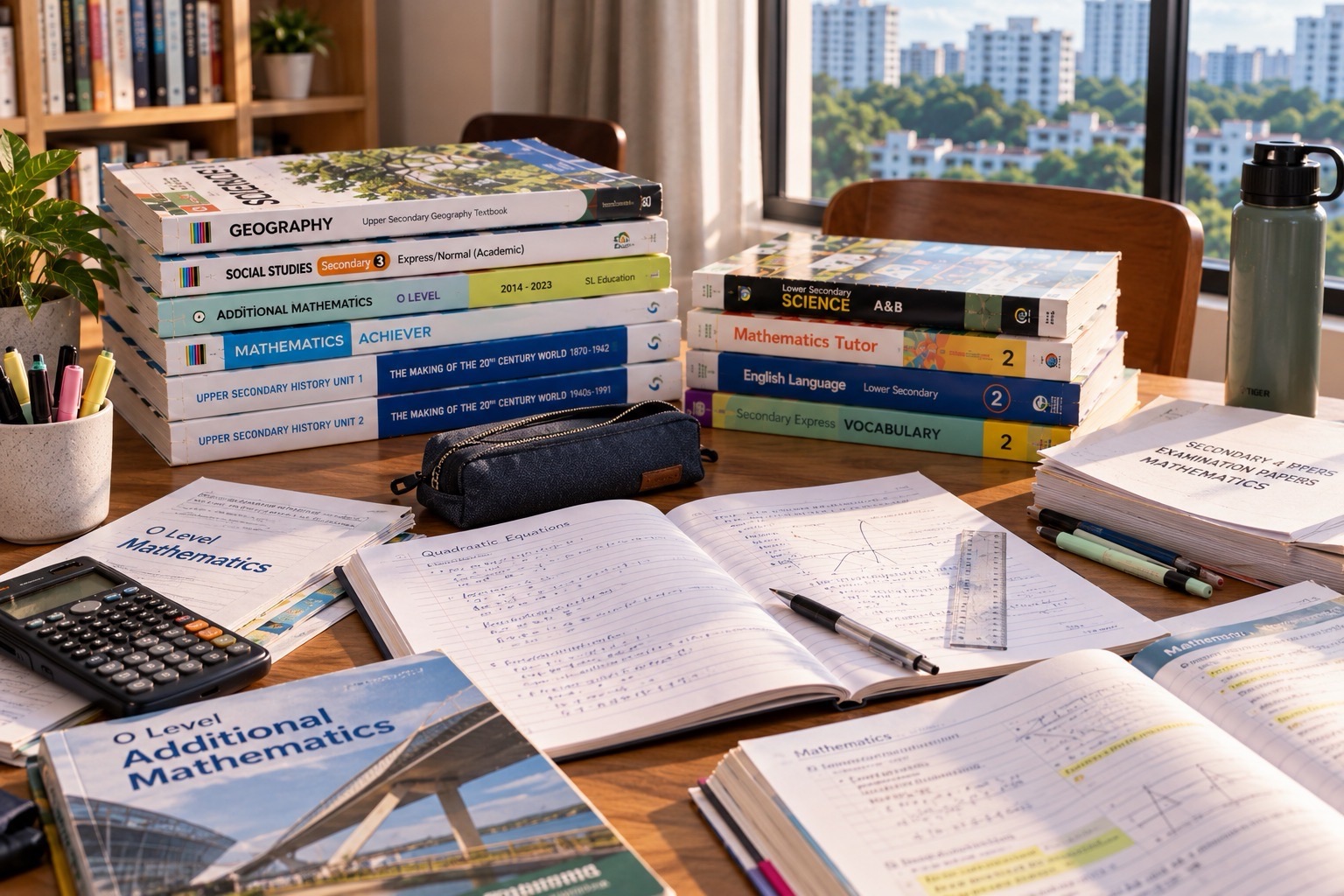
Singapore Math order of operations guide for families and teachers outside Singapore. What Primary 5 students learn about brackets and the four operations, how Singapore teaches the rules, and how to practise them at home.
6 + 4 × 2 has one correct answer.
It is 14, not 20, and the reason is an agreement that every mathematician follows.
In Singapore Mathematics, order of operations and brackets are Primary 5 topics in the current primary syllabus. The syllabus marks them “without calculator”, so students learn to work through mixed calculations by hand.
The same rules carry into Secondary 1, where students work with negative numbers, algebraic expressions and brackets in algebra.
This guide is useful for families and teachers who want to:
- understand what Singapore expects at Primary 5;
- teach the rules so they make sense, not as a chant;
- prepare a child who is moving into a Singapore school; or
- support a student whose materials use a different name, such as BODMAS or PEMDAS.
Quick facts
Level: Primary 5 (Standard and Foundation Mathematics)
Strand: Number and Algebra
Official source: MOE Primary Mathematics Syllabus, the 2021 syllabus first examined at PSLE in 2026
Comes after: Multiplication and Division and Rounding and Estimation
Leads to: Algebra in Primary 6 and Algebraic Expressions
What Order of Operations Means in Singapore Mathematics
When a calculation mixes operations, the order of operations says which part to do first.
At primary level the rules are:
- Work out anything in brackets first.
- Then multiply and divide, working from left to right.
- Then add and subtract, working from left to right.
Multiplication and division have equal priority. So do addition and subtraction. Within each pair, the one that comes first, reading left to right, is done first.
Brackets let the writer change the order on purpose. 6 + 4 × 2 = 14, but (6 + 4) × 2 = 20.
The point is communication. A written expression should mean the same thing to everyone who reads it.
Where Order of Operations Sits in the Singapore Syllabus
In the current primary syllabus, order of operations sits in the Primary 5 “four operations” content.
At Primary 5, students learn:
- multiplying and dividing by 10, 100, 1000 and their multiples;
- the order of operations; and
- the use of brackets.
All three items are marked “without calculator”.
The same items appear in Primary 5 Foundation Mathematics.
Primary order-of-operations work uses the four operations and brackets. Powers and indices come later, in secondary school.
| Level | What students do |
|---|---|
| Primary 1 to 4 | Build the four operations and written methods with whole numbers |
| Primary 5 | Order of operations and brackets, without calculator |
| Primary 6 | Simplify and evaluate simple algebraic expressions, excluding brackets |
| Secondary 1 | Four operations with negative numbers and rational numbers; simplifying algebraic expressions, including brackets |
How Singapore Teaches Order of Operations
1. Start with a story
“Mrs Tan buys 4 pens at $3 each and 2 files at $5 each.” Children work out each cost, then add. They have already done multiplication before addition without a rule.
2. Write the story as one expression
4 × 3 + 2 × 5 = 12 + 10 = 22. The written order now matches the order of the thinking.
3. Introduce brackets as a signal
“She pays with $50. How much change?” The total must be found first, so it goes in brackets: 50 − (4 × 3 + 2 × 5).
4. Practise left to right within a level
24 ÷ 4 × 2 is 6 × 2 = 12. Children learn that division does not wait for multiplication.
5. Show one step per line
Each line rewrites the whole expression with one part worked out. This makes errors easy to find.
Children who learn only a mnemonic often apply it too literally. The story and the line-by-line layout keep the meaning in view.
Worked Examples
Mixed operations without brackets
Question: Find the value of 36 − 12 ÷ 4 × 3 + 5.
Step 1. There are no brackets. Do division and multiplication from left to right: 12 ÷ 4 = 3.
Step 2. Then 3 × 3 = 9. The expression is now 36 − 9 + 5.
Step 3. Do subtraction and addition from left to right: 36 − 9 = 27.
Step 4. 27 + 5 = 32.
Check: Working strictly left to right gives 36 − 12 = 24, then 24 ÷ 4 = 6, 6 × 3 = 18 and 18 + 5 = 23. That different answer is wrong, and it shows why the agreed order matters.
A word problem with brackets
Question: Mrs Tan buys 4 pens at $3 each and 2 files at $5 each. She pays with a $50 note. How much change does she receive?
Step 1. Write one expression: 50 − (4 × 3 + 2 × 5).
Step 2. Inside the brackets, multiply first: 4 × 3 = 12 and 2 × 5 = 10.
Step 3. Still inside the brackets: 12 + 10 = 22.
Step 4. 50 − 22 = 28. She receives $28 change.
Check: $22 spent plus $28 change makes $50.
Common Mistakes
- Working strictly left to right. 6 + 4 × 2 is worked as 10 × 2 = 20. Fix: scan for brackets, then multiplication and division, before doing anything else.
- Always multiplying before dividing. 24 ÷ 4 × 2 is worked as 24 ÷ 8 = 3. Fix: multiplication and division share a level, so work from left to right: 6 × 2 = 12.
- Always adding before subtracting. 20 − 5 + 3 is worked as 20 − 8 = 12. Fix: work from left to right: 15 + 3 = 18.
- Running equals signs together. A child writes 6 + 4 = 10 × 2 = 20. The first “equals” is not true for the whole line. Fix: rewrite the full expression on each new line.
- Dropping brackets halfway. The brackets disappear before their contents are finished. Fix: keep the brackets until only one number is left inside.
Teaching Order of Operations Outside Singapore
The rules are the same everywhere. The names and notation can differ.
- Names. BODMAS, BIDMAS and PEMDAS are names used elsewhere for the order of operations. Each letter order can mislead if read literally, because multiplication and division share a level, as do addition and subtraction.
- Brackets. Singapore and the UK say “brackets”. US materials say “parentheses”.
- Symbols. Singapore primary work uses × and ÷. A child who has only seen * or / on a computer may need a short bridge.
- Calculators. The syllabus marks this topic “without calculator”, and PSLE Paper 1 does not allow calculators, so children need to work these by hand.
- Timing. In Singapore’s current syllabus this is a Primary 5 topic. The Singapore Math Grade Levels guide explains why grade conversions are unreliable.
How to Practise Order of Operations at Home
A few well-chosen expressions each day are enough.
- Turn a shopping story into one expression and work it out.
- Work three expressions without brackets, one step per line.
- Take one expression and add brackets in two different places. Compare the answers.
- Ask the child to explain which step comes first and why.
- Give one “spot the error” question with a worked solution that has a mistake.
- Once a week, mix in a word problem where the child must decide whether brackets are needed.
Ten minutes is enough when each line is written in full.
Try These
- Find the value of 18 + 6 × 3.
- Find the value of 40 ÷ 5 × 2.
- Find the value of 50 − (12 + 8) ÷ 4.
- Insert one pair of brackets so that 3 + 5 × 4 − 2 = 30.
Answers
- 36. Multiply first: 6 × 3 = 18, then 18 + 18 = 36.
- 16. Work from left to right: 40 ÷ 5 = 8, then 8 × 2 = 16.
- 45. Brackets first: 20. Then 20 ÷ 4 = 5. Then 50 − 5 = 45.
- (3 + 5) × 4 − 2. This gives 8 × 4 − 2 = 32 − 2 = 30.
What Comes Next
The order of operations is the grammar of algebra.
- In Algebra in Primary 6, students evaluate expressions such as 3a + 5 by substitution.
- In Secondary 1, Algebraic Expressions adds brackets in algebra and extracting common factors.
- In Integers and Real Numbers, the same rules apply to negative numbers.
A student who writes one clear step per line carries that habit into every later topic.
Frequently Asked Questions
When do Singapore students learn the order of operations?
In the current primary syllabus, order of operations and brackets are taught in Primary 5. The rules are then used throughout secondary Mathematics.
Is BODMAS taught in Singapore?
The syllabus says “order of operations” and “brackets”. It does not name a mnemonic. Whatever name a child has learned, the rules matter more than the letters.
Does multiplication always come before division?
No. They share a level. Work whichever comes first from left to right.
Are calculators allowed for this topic?
The syllabus marks it “without calculator”, and PSLE Paper 1 does not allow calculators. Students should be fluent by hand.
Do Primary 5 questions include powers?
Primary order-of-operations work uses the four operations and brackets. Powers and indices belong to secondary Mathematics.
Why does my child get the right numbers but the wrong answer?
Usually one step was done out of order. Writing the whole expression again on each line makes the slip visible.
Helpful Reading
- Singapore Mathematics | International Edition: Multiplication and Division
- Singapore Mathematics | International Edition: Algebra in Primary 6
- Singapore Mathematics | International Edition: Calculators
- Arithmetic and Operations | Mathematics Knowledge Object
- Arithmetic to Algebra | Mathematics Dependency Corridor
- Why Does Mathematics Accuracy Fall on Longer Multi-Step Questions?
- MOE Primary Mathematics Syllabus
- SEAB PSLE Formats Examined in 2026
Order of Operations in Singapore Mathematics
Brackets first.
Then multiply and divide, left to right.
Then add and subtract, left to right.
One step per line.
Taught this way, the rules are not a trick to memorise.
They are an agreement that lets everyone read an expression the same way.
That agreement is what makes algebra possible.
Ask Bukit Timah Tutor
Bukit Timah Tutor teaches Mathematics in small groups of three students in Singapore.
If your child is learning Singapore Mathematics at home, in an international school or in a Singapore school, and you are unsure where to begin with this topic, send us a short message with the student’s level and one example of the work.
Bukit Timah Tutor
8 Fourth Avenue, Singapore 268674
Near Sixth Avenue MRT
Three-student Mathematics tutorials
By appointment
Properly taught kids shine a bright light into the future.
Singapore Mathematics | International Edition is a Bukit Timah Tutor guide series for families and teachers outside Singapore. It is not a textbook and is not affiliated with MOE, SEAB or any publisher. Syllabus details were checked against MOE and SEAB documents in October 2026. Always confirm current requirements with your school.
← Previous: Singapore Mathematics | International Edition: Rounding and Estimation
Next: Singapore Mathematics | International Edition: Number Patterns and Sequences →
All 100 topics in the International Edition