
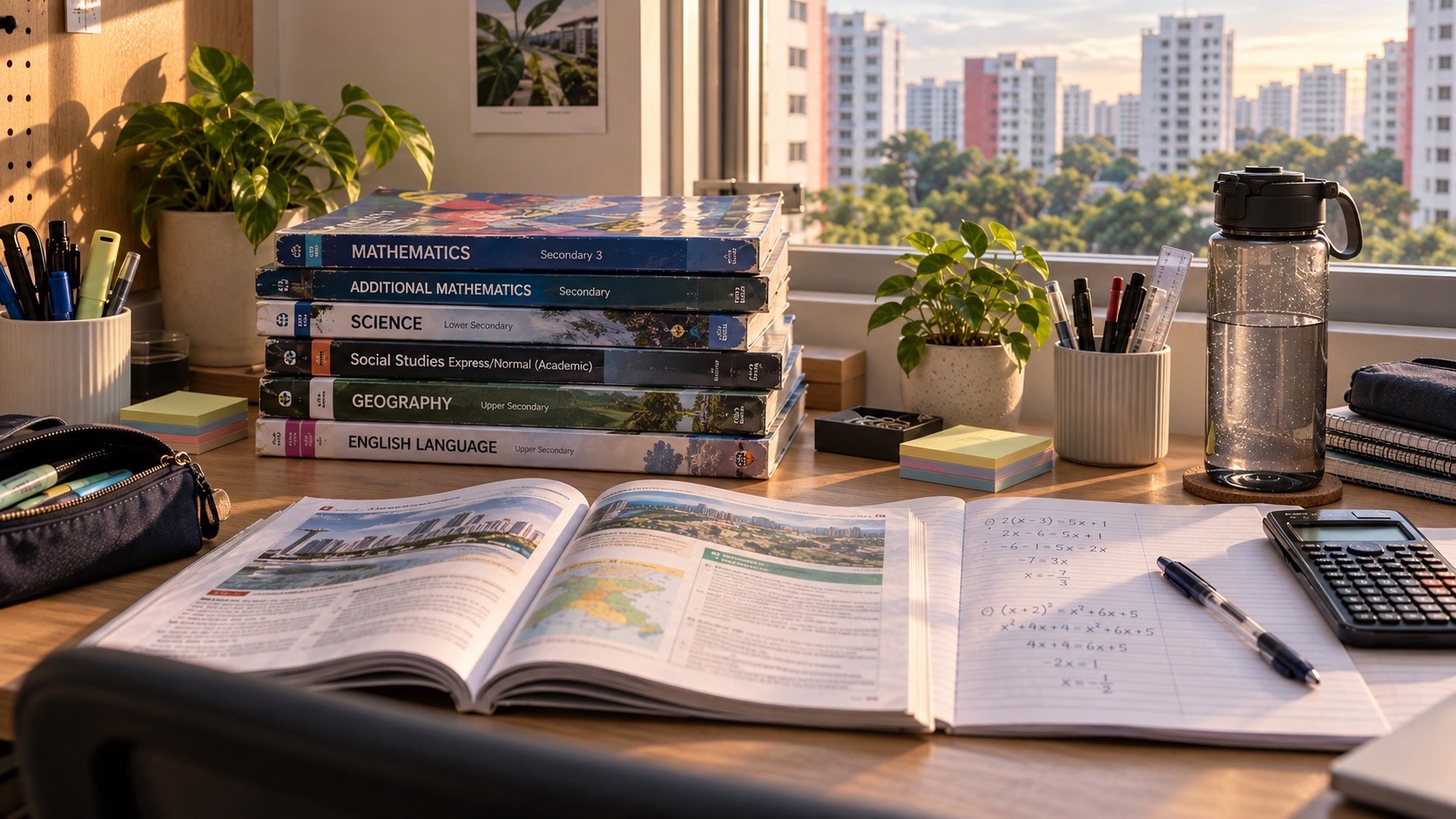
Singapore Math rounding and estimation guide for families and teachers outside Singapore. What Primary 4 students learn about rounding whole numbers and decimals, how Singapore teaches it, and how to practise it at home.
Rounding replaces an exact number with a nearby, simpler one.
Estimation uses those simpler numbers to judge whether an answer makes sense.
In Singapore Mathematics, rounding is a Primary 4 topic in the current primary syllabus. Students round whole numbers to the nearest 10, 100 or 1000, meet the ≈ sign, and round decimals to the nearest whole number, 1 decimal place or 2 decimal places.
Rounding returns in Secondary 1, where students work with decimal places, significant figures and estimating results.
This guide is useful for families and teachers who want to:
- understand what Singapore expects at Primary 4;
- teach rounding with a clear method rather than a rhyme;
- prepare a child who is moving into a Singapore school; or
- help a student use estimation to check calculator answers.
Quick facts
Level: Primary 4 (whole numbers and decimals), revisited in Secondary 1
Strand: Number and Algebra
Official source: MOE Primary Mathematics Syllabus, the 2021 syllabus first examined at PSLE in 2026
Comes after: Whole Numbers and Place Value and Factors and Multiples
Leads to: Decimals and Approximation and Significant Figures
What Rounding and Estimation Mean in Singapore Mathematics
To round a number, a student finds the two “round” numbers it lies between and decides which one it is closer to.
46 372 lies between 46 370 and 46 380. It is closer to 46 370, so 46 372 rounded to the nearest 10 is 46 370.
The rule that follows from this is simple. Look at the digit just to the right of the place you are rounding to. If it is 5 or more, round up. If it is 4 or less, round down.
Estimation puts rounding to work. Before or after a calculation, the student rounds the numbers, works out a rough answer and compares.
The ≈ sign means “is approximately equal to”. Singapore students write 46 372 ≈ 46 370, not 46 372 = 46 370.
The Mathematics framework in the syllabus names estimation as one of the skills taught explicitly, alongside numerical calculation and measurement.
Where Rounding and Estimation Sit in the Singapore Syllabus
In the current primary syllabus, rounding first appears in the Primary 4 content lists.
At Primary 4, students learn:
- rounding numbers to the nearest 10, 100 or 1000, within numbers up to 100 000;
- using the ≈ sign;
- rounding decimals to the nearest whole number, 1 decimal place or 2 decimal places; and
- rounding answers to a specified degree of accuracy, for example after dividing a whole number by a whole number to get a decimal quotient.
Significant figures are not part of the primary syllabus. They come in Secondary 1.
| Level | What students do with rounding and estimation |
|---|---|
| Primary 4 | Round whole numbers to the nearest 10, 100 or 1000; use ≈; round decimals to a whole number, 1 or 2 decimal places; round answers |
| Primary 5 and 6 Foundation | Revisit rounding to the nearest 10, 100 or 1000 (P5) and rounding answers (P6) |
| Secondary 1 | Approximation and estimation with decimal places, significant figures and estimated results |
How Singapore Teaches Rounding and Estimation
1. Start on a number line
Mark 46 300 and 46 400 on a line, then place 46 372 between them. The child can see which end is closer before any rule is mentioned.
2. Name the place
Ask “nearest 10, 100 or 1000?” and underline that digit. The digit to its right is the one that decides.
3. Apply the 5-or-more rule
Once the picture makes sense, the rule becomes a shortcut. Every digit to the right of the rounding place becomes zero.
4. Extend to decimals
The same thinking works for tenths and hundredths. 3.476 lies between 3.4 and 3.5, and it is closer to 3.5.
5. Estimate, then calculate
Students round the numbers in a sum, find a rough answer, then do the exact calculation and compare.
6. Round only at the end
When a question asks for an answer to 2 decimal places, students calculate first and round the final answer once.
The number line matters. A child who only knows “5 or more, round up” often cannot tell you why, and that gap shows up later with decimals.
Worked Examples
Rounding a whole number three ways
Question: Round 46 372 to the nearest 10, the nearest 100 and the nearest 1000.
Step 1. Nearest 10: the ones digit is 2, which is less than 5. Round down: 46 372 ≈ 46 370.
Step 2. Nearest 100: the tens digit is 7, which is 5 or more. Round up: 46 372 ≈ 46 400.
Step 3. Nearest 1000: the hundreds digit is 3, which is less than 5. Round down: 46 372 ≈ 46 000.
Check: 46 372 is 72 away from 46 300 and 28 away from 46 400, so 46 400 is the nearer hundred.
Using estimation to check an answer
Question: A child works out 598 × 7 and gets 3 486. Use estimation to check.
Step 1. Round 598 to the nearest 100: 598 ≈ 600.
Step 2. Estimate: 600 × 7 = 4 200.
Step 3. 3 486 is far from 4 200, so the answer is probably wrong.
Step 4. Recalculate: 598 × 7 = 4 186.
Check: 4 186 is close to the estimate of 4 200, so it is reasonable.
A third example uses decimals. 3.476 rounded to the nearest whole number is 3, to 1 decimal place is 3.5, and to 2 decimal places is 3.48.
Common Mistakes
- Looking at the wrong digit. To round to the nearest 100, some children look at the hundreds digit itself. Fix: underline the rounding place, then circle the digit to its right.
- Rounding in a chain. 4 449 is rounded to 4 450, then to 4 500. The correct answer to the nearest 100 is 4 400. Fix: always round from the original number in one step.
- Dropping the place value. 46 372 to the nearest 100 is written as 464. Fix: replace the digits on the right with zeros so the number keeps its size.
- Losing the required decimal place. 3.96 to 1 decimal place is written as 4. Fix: write 4.0, because the question asks for one decimal place.
- Using = instead of ≈. Writing 598 = 600 is not true. Fix: use ≈ whenever a value has been rounded.
- Rounding too early. Rounding the numbers before an exact calculation gives an inexact answer. Fix: round only the final answer unless the question asks for an estimate.
Teaching Rounding and Estimation Outside Singapore
The ideas are the same in most English-language curricula. A few details are worth knowing.
- Number format. The Singapore syllabus writes large numbers with a space, as in 10 000 and 100 000. Some materials elsewhere use a comma.
- Vocabulary. Singapore says “nearest 10”, “1 decimal place” and “a specified degree of accuracy”. Use the same words so a child recognises them in Singapore books.
- Timing. In Singapore’s current syllabus, rounding is a Primary 4 topic. Your local curriculum may place it differently, so decide by readiness. The Singapore Math Grade Levels guide explains why direct conversions are unreliable.
- Prerequisites. Rounding depends on place value. If a child cannot say what the 7 in 46 372 is worth, revise place value first.
- Calculators. PSLE Paper 2 allows calculators, so estimation is a practical way to catch a mistyped number.
How to Practise Rounding and Estimation at Home
Short, regular practice is more useful than a long session.
- Draw a number line with two round numbers at the ends. Ask the child to place a number and say which end is closer.
- Round one number three ways: nearest 10, 100 and 1000.
- Round two decimals to 1 and 2 decimal places.
- Before any calculation, ask for a quick estimate and write it with ≈.
- Compare the exact answer with the estimate and talk about whether it is reasonable.
- Use real prices, distances and populations from a newspaper or map.
Ten minutes is enough when the child explains each step aloud.
Try These
- Round 58 649 to the nearest 1000.
- Round 7.049 to 2 decimal places. Then round 7.049 to 1 decimal place.
- Estimate 4 912 − 1 987 by rounding each number to the nearest 1000.
- A whole number rounded to the nearest 10 is 350. What are the smallest and largest numbers it could be?
Answers
- 59 000. The hundreds digit is 6, so round up.
- 7.05 to 2 decimal places, because the thousandths digit is 9. To 1 decimal place it is 7.0, because the hundredths digit is 4.
- About 3 000, since 5 000 − 2 000 = 3 000. The exact answer is 2 925, which is close.
- Smallest 345, largest 354. Numbers from 345 to 354 all round to 350.
What Comes Next
Rounding supports a great deal of later work.
- In Decimals, students round quotients and measurements to a given number of decimal places.
- In Order of Operations, estimation helps students spot an answer that is far too large or small.
- In Secondary 1, Approximation and Significant Figures extends rounding to significant figures.
A child who estimates by habit makes fewer careless errors at every level.
Frequently Asked Questions
When do Singapore students learn rounding?
In the current primary syllabus, rounding whole numbers and decimals is taught in Primary 4. Approximation with significant figures comes in Secondary 1.
Do Primary 4 students round to the nearest 10 000?
The Primary 4 content lists rounding to the nearest 10, 100 or 1000. Those are the places to practise.
What does the ≈ sign mean?
It means “is approximately equal to”. Singapore students use it whenever a number has been rounded.
Is estimation the same as guessing?
No. An estimate is calculated from rounded numbers, so it can be explained and checked. A guess cannot.
Should my child round before or after calculating?
After, when an exact answer is needed. Round before calculating only when the question asks for an estimate.
Why does 3.96 become 4.0 and not 4?
Both have the same value, but 4.0 shows that the answer is given to 1 decimal place, as the question asked.
Helpful Reading
- Singapore Mathematics | International Edition: Whole Numbers and Place Value
- Singapore Mathematics | International Edition: Decimals
- Singapore Mathematics | International Edition: Approximation and Significant Figures
- Primary Mathematics: Estimation, Reasoning and Checking
- Primary Mathematics: Decimals, Rounding and Four Operations
- How to Tell Whether a Mathematics Answer Is Reasonable
- MOE Primary Mathematics Syllabus
Rounding in Singapore Mathematics
Find the two round numbers.
Decide which is closer.
Use ≈ when a value is not exact.
Round once, at the end.
Estimate before you trust an answer.
Taught this way, rounding is not a rule to memorise.
It is a habit of asking whether a number makes sense.
Ask Bukit Timah Tutor
Bukit Timah Tutor teaches Mathematics in small groups of three students in Singapore.
If your child is learning Singapore Mathematics at home, in an international school or in a Singapore school, and you are unsure where to begin with this topic, send us a short message with the student’s level and one example of the work.
Bukit Timah Tutor
8 Fourth Avenue, Singapore 268674
Near Sixth Avenue MRT
Three-student Mathematics tutorials
By appointment
Properly taught kids shine a bright light into the future.
Singapore Mathematics | International Edition is a Bukit Timah Tutor guide series for families and teachers outside Singapore. It is not a textbook and is not affiliated with MOE, SEAB or any publisher. Syllabus details were checked against MOE and SEAB documents in October 2026. Always confirm current requirements with your school.
← Previous: Singapore Mathematics | International Edition: Factors and Multiples
Next: Singapore Mathematics | International Edition: Order of Operations →
All 100 topics in the International Edition