
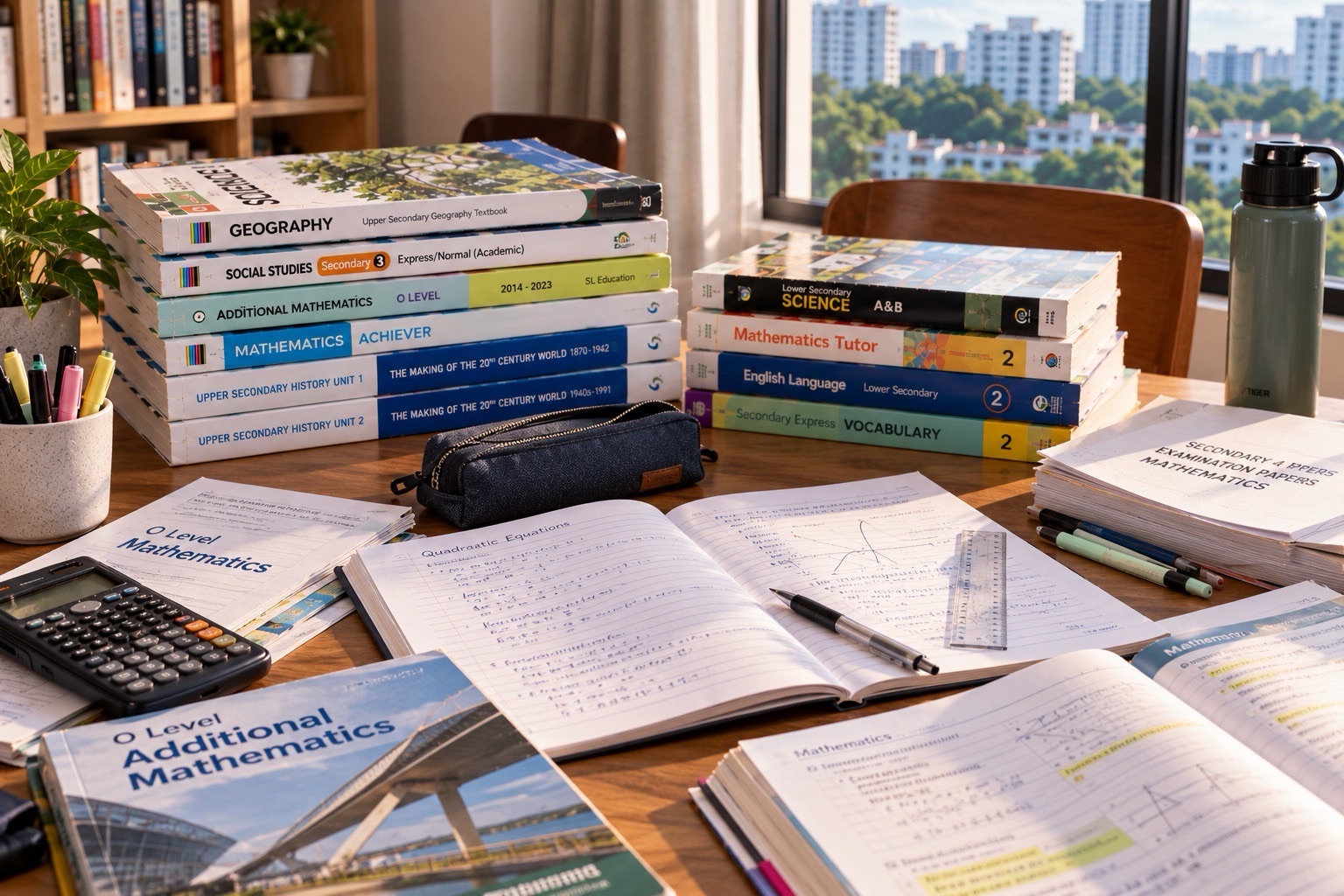
Singapore Math place value guide for families and teachers outside Singapore: what Primary 1 to Primary 5 students learn about whole numbers and place value, and how to practise it at home.
Every digit in a number has a job.
Its job depends on where it sits.
In Singapore Mathematics, the number range grows level by level: numbers up to 100 in Primary 1, 1000 in Primary 2, 10 000 in Primary 3, 100 000 in Primary 4 and 10 million in Primary 5.
From Primary 1 to Primary 4, students count, read and write numbers, use place value, and compare and order them. Rounding and the ≈ sign arrive in Primary 4.
In Secondary 1, the number system widens to negative numbers, integers and real numbers.
This guide is useful for families and teachers who want to:
- know the exact number range at each primary level;
- teach place value in a clear sequence;
- prepare a child who is moving into a Singapore school; or
- support a student using Singapore Math materials in another country.
Quick facts
Level: Primary 1 to Primary 5 (Standard Mathematics; Primary 1 to 4 is common to all students)
Strand: Number and Algebra
Official source: MOE Primary Mathematics Syllabus, the 2021 syllabus first examined at PSLE in 2026
Comes after: Early counting; see Singapore Math for Kindergarten and Early Years
Leads to: Addition and Subtraction and Rounding and Estimation
What Place Value Means in Singapore Mathematics
Place value means that a digit’s value depends on its position.
In 47 382, the 4 stands for 4 ten thousands, the 7 for 7 thousands, the 3 for 3 hundreds, the 8 for 8 tens and the 2 for 2 ones.
Each place is worth ten times the place to its right. Ten ones make one ten, ten tens make one hundred, and so on.
Zero matters too. In 3005, the zeros show that there are no hundreds and no tens. Without them, the number would be 35.
Singapore students learn to say these values aloud: “7 thousands”, not just “7”. That habit makes later work on addition, subtraction and decimals much easier.
Where Whole Numbers and Place Value Sit in the Singapore Syllabus
The range of numbers grows at every level from Primary 1 to Primary 5.
| Level | Numbers up to | What students learn |
|---|---|---|
| Primary 1 | 100 | Counting; place value (tens, ones); numerals and words; comparing and ordering; patterns in number sequences; ordinal numbers from first to tenth |
| Primary 2 | 1000 | Counting in tens and hundreds; place value (hundreds, tens, ones); comparing and ordering; number patterns; odd and even numbers |
| Primary 3 | 10 000 | Counting in hundreds and thousands; place value up to thousands; comparing and ordering; patterns |
| Primary 4 | 100 000 | Place value up to ten thousands; comparing and ordering; patterns; rounding to the nearest 10, 100 or 1000; the ≈ sign |
| Primary 5 | 10 million | Reading and writing numbers in numerals and words |
The Primary 1 to 4 content is common to all students.
At Primary 5, Standard Mathematics also includes multiplying and dividing by 10, 100, 1000 and their multiples, “without calculator”. This is place value in action: the digits move to higher or lower places.
Primary 5 Foundation Mathematics covers reading and writing numbers up to 10 million, comparing and ordering numbers up to 100 000, rounding to the nearest 10, 100 or 1000, and patterns.
Negative numbers, integers and real numbers are Secondary 1 content.
How Singapore Teaches Place Value
1. Count and group real objects
Children count objects, then bundle them in tens. Ten loose straws become one bundle of ten.
2. Show numbers with place-value materials
Many Singapore Math materials use place-value charts and number discs. 243 is shown as 2 hundreds, 4 tens and 3 ones.
3. Read and write in numerals and words
Students move between 243 and “two hundred and forty-three” in both directions.
4. Compare from the greatest place
To compare two numbers with the same number of digits, look at the greatest place first. Move right only when those digits are equal.
5. Find patterns
Counting on or back in tens, hundreds or thousands shows how the digits change. 3480, 3490, 3500 crosses a hundred.
6. Extend the range each year
The same ideas return with larger numbers until, at Primary 5, students read and write numbers up to 10 million.
Worked Examples
The value of a digit
Question: In 47 382, what is the value of the digit 7?
Step 1. Write the number in a place-value chart: 4 ten thousands, 7 thousands, 3 hundreds, 8 tens, 2 ones.
Step 2. The 7 is in the thousands place.
Step 3. Its value is 7 thousands, which is 7000.
Check: 40 000 + 7000 + 300 + 80 + 2 = 47 382.
This is Primary 4 work: place value up to ten thousands.
Comparing and ordering
Question: Arrange 3089, 3908 and 3890 from the smallest to the greatest.
Step 1. All three numbers have 4 digits and 3 thousands, so compare the hundreds.
Step 2. The hundreds digits are 0, 9 and 8.
Step 3. So 3089 is the smallest, then 3890, then 3908.
Check: 3089 < 3890 < 3908.
This is Primary 3 work: numbers up to 10 000.
Common Mistakes
- Treating zero as nothing. “Three thousand and five” is written as 305 or 30005. Fix: use a place-value chart and fill every place, so 3 thousands, 0 hundreds, 0 tens and 5 ones gives 3005.
- Confusing a digit with its value. The child says the 7 in 47 382 is “worth 7”. Fix: always say the place: “7 thousands”.
- Comparing the first digit only. The child thinks 989 is greater than 1200 because 9 is greater than 1. Fix: compare the number of digits first, then the greatest place.
- Losing track in large numbers. 2 040 500 is read wrongly because the digits are not grouped. Fix: group the digits in threes from the right before reading.
- Breaking the pattern at a boundary. Counting on in tens goes 380, 390, 3100. Fix: show that 10 tens make 1 hundred, so 390 is followed by 400.
- Mixing ordinal and counting numbers. “Fifth” and “five” are used as if they meant the same. Fix: line up objects and ask both “How many?” and “Which position?”
Teaching Place Value Outside Singapore
Place value works the same way everywhere, but a few conventions differ.
- Writing large numbers. This guide writes large numbers with a space, as in 47 382. Many materials use a comma instead, as in 47,382. The value is the same.
- Number words. British and Singapore English usually say “two hundred and forty-three”. American English often leaves out the “and”. Both are correct.
- Timing. Singapore reaches 10 million by Primary 5. Primary 1 is the first year of primary school, and most children start it in the year they turn 7. Your local curriculum may move at a different pace, so use the Singapore Math Grade Levels guide rather than converting ages.
- Prerequisites. Before addition and subtraction with renaming, a child needs to know that 10 ones make 1 ten. Check this first.
- Placement. For a child joining partway through, the Singapore Math Placement guide helps you find the right starting level.
How to Practise Place Value at Home
Short, frequent practice works best.
- Build a number with coins, straws or blocks, then write it.
- Read one large number aloud each day from a sign, a price or a page number.
- Ask “What is the value of this digit?” for one digit in that number.
- Play “greater or smaller” with two numbers and ask why.
- Count on or back in tens, hundreds or thousands across a boundary.
- Once a week, write a number in words and in numerals.
Five to ten minutes a day is enough when it is regular.
Try These
- What is the value of the digit 6 in 56 214?
- Arrange from the greatest to the smallest: 7450, 7504, 7045.
- Write two million, forty thousand and five hundred in numerals.
- Round 46 738 to the nearest hundred.
Answers
- 6000. The 6 is in the thousands place.
- 7504, 7450, 7045. All have 7 thousands, so compare the hundreds: 5, 4 and 0.
- 2 040 500. There are 2 millions, 0 hundred thousands, 4 ten thousands, 0 thousands, 5 hundreds, 0 tens and 0 ones.
- 46 700. The tens digit is 3, which is less than 5, so 46 738 ≈ 46 700.
What Comes Next
- Addition and Subtraction uses place value to add and subtract with renaming.
- Rounding and Estimation builds on the Primary 4 rounding work.
- Number Patterns and Sequences extends counting patterns towards later algebra.
- Integers and Real Numbers widens the number system in Secondary 1.
A child who knows what every digit is worth has the base for all of these.
Frequently Asked Questions
When do Singapore students learn place value?
From Primary 1, with tens and ones. The places grow each year until Primary 4 reaches ten thousands. At Primary 5, students read and write numbers up to 10 million.
How large are the numbers at each level?
Up to 100 in Primary 1, 1000 in Primary 2, 10 000 in Primary 3, 100 000 in Primary 4 and 10 million in Primary 5.
When are odd and even numbers taught?
In Primary 2, alongside numbers up to 1000.
When does rounding start?
In Primary 4. Students round to the nearest 10, 100 or 1000 and use the ≈ sign.
Are negative numbers taught in primary school?
Negative numbers and integers are Secondary 1 content in the Singapore syllabus.
My child joins a Singapore school in Primary 3. What should they know?
The Primary 2 content: numbers up to 1000, place value in hundreds, tens and ones, counting in tens and hundreds, and odd and even numbers.
Helpful Reading
- Singapore Mathematics | International Edition: Addition and Subtraction
- Singapore Mathematics | International Edition: Rounding and Estimation
- Singapore Mathematics | International Edition: Number Patterns and Sequences
- Primary Mathematics: Place Value and Regrouping | Worked Learning Guide
- Number and Place Value | Mathematics Knowledge Object
- Singapore Math Number Bonds | Part–Whole Thinking and Mental Mathematics
- MOE Primary Mathematics Syllabus
Place Value in Singapore Mathematics
Every digit has a place.
Every place is worth ten of the one to its right.
Zero holds a place open.
Compare from the left.
Say the value, not just the digit.
Taught this way, place value is not one topic but the floor that later topics stand on.
It grows from 100 in Primary 1 to 10 million in Primary 5, one place at a time.
Ask Bukit Timah Tutor
Bukit Timah Tutor teaches Mathematics in small groups of three students in Singapore.
If your child is learning Singapore Mathematics at home, in an international school or in a Singapore school, and you are unsure where to begin with this topic, send us a short message with the student’s level and one example of the work.
Bukit Timah Tutor
8 Fourth Avenue, Singapore 268674
Near Sixth Avenue MRT
Three-student Mathematics tutorials
By appointment
Properly taught kids shine a bright light into the future.
Singapore Mathematics | International Edition is a Bukit Timah Tutor guide series for families and teachers outside Singapore. It is not a textbook and is not affiliated with MOE, SEAB or any publisher. Syllabus details were checked against MOE and SEAB documents in October 2026. Always confirm current requirements with your school.
← Previous: Singapore Mathematics | International Edition: Calculators
Next: Singapore Mathematics | International Edition: Addition and Subtraction →
All 100 topics in the International Edition