
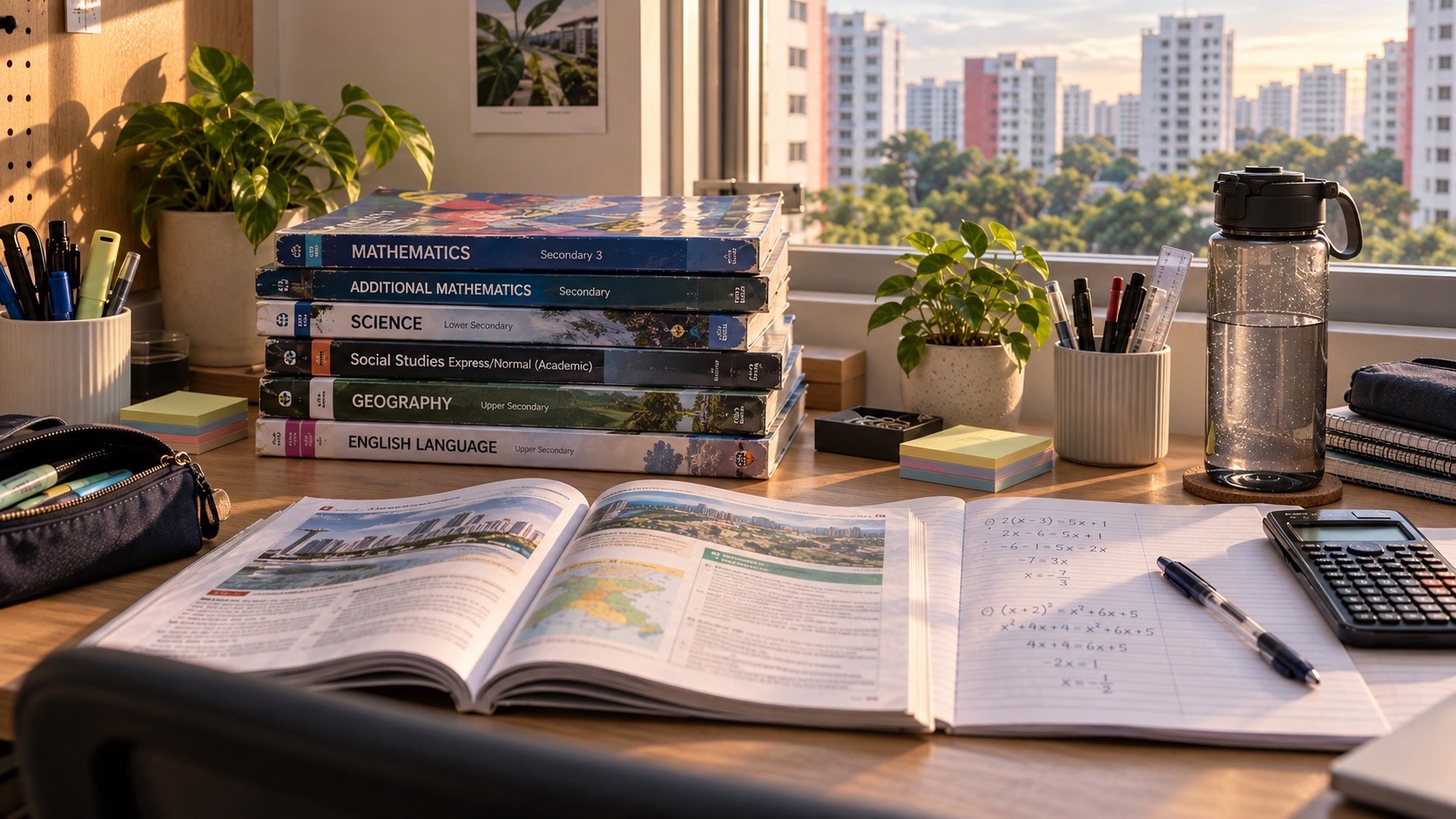
Singapore Math calculator guide for families and teachers outside Singapore: when Singapore students use calculators, from the “without calculator” work of Primary 5 to the graphing calculator at A-Level.
Singapore students learn to calculate without a calculator first.
Then they learn when a calculator helps and when it hides mistakes.
The current primary syllabus has no sentence that introduces calculators. Instead, some Primary 5 and Primary 6 content is marked “without calculator”. At the PSLE, Paper 1 does not allow calculators and Paper 2 does.
In secondary school, an approved calculator is allowed in both papers of G3 Mathematics and Additional Mathematics. At A-Level, H2 Mathematics expects a graphing calculator.
This guide is useful for families and teachers who want to:
- know exactly what the Singapore rules say;
- balance calculator and non-calculator practice;
- prepare a child who is moving into a Singapore school; or
- plan ahead for secondary and A-Level Mathematics.
Quick facts
Level: Primary 5 to A-Level
Strand: All strands. The calculator is a tool, not a topic.
Official source: MOE Primary Mathematics Syllabus (2021); SEAB syllabuses for PSLE Mathematics 0008, G3 Mathematics K310, G3 Additional Mathematics K341 and H2 Mathematics 9758
Comes after: Mathematical Modelling
Leads to: Order of Operations and Approximation and Significant Figures
What Calculators Mean in Singapore Mathematics
In Singapore Mathematics, the calculator is a tool added on top of mental and written methods, not a replacement for them.
Students are expected to estimate, calculate by hand and judge whether an answer is reasonable. Where the rules allow, the calculator then takes over the heavy arithmetic.
The 2021 primary syllabus does not say when calculators begin. Its teaching section mentions ICT for “visualisations, simulations and representations”, but not calculators.
What the syllabus does contain is the phrase “without calculator”. It appears only in Primary 5 and Primary 6 content.
Many people read this as a sign that calculators come into use from Primary 5. That is a reasonable inference, but the syllabus does not state it.
Some older guides say calculators begin at Primary 5. MOE’s earlier 2013 syllabus did include a Primary 5 activity with a calculator. The current syllabus has no such sentence.
Where Calculators Sit in the Singapore Syllabus
| Stage | What the official documents say |
|---|---|
| Primary 1 to 4 | No mention of calculators in the content |
| Primary 5 and 6 | Some content is marked “without calculator”, in both Standard and Foundation Mathematics |
| PSLE (Standard and Foundation) | Paper 1: “The use of calculators is not allowed.” Paper 2: “The use of calculators is allowed.” |
| Secondary 1 | “calculations with calculator” is listed in the G3 Mathematics content |
| G3 Mathematics exams | “An approved calculator may be used in both Paper 1 and Paper 2.” |
| G2 Mathematics exams | Calculators are allowed in both papers |
| G3 Additional Mathematics exams | “An approved calculator may be used in both Paper 1 and Paper 2.” |
| H2 Mathematics | “The use of an approved GC without computer algebra system will be expected.” |
Examples of “without calculator” content include:
- Primary 5: multiplying and dividing by 10, 100, 1000 and their multiples; order of operations and brackets.
- Primary 5: multiplying a proper or improper fraction by a whole number, and a proper fraction by a proper or improper fraction.
- Primary 5: multiplying and dividing decimals by 10, 100, 1000 and their multiples.
- Primary 6: dividing a proper fraction by a whole number, and a whole number or proper fraction by a proper fraction.
At the PSLE, Paper 1 has two booklets and lasts 1 hour 10 minutes. Paper 2 has one booklet and lasts 1 hour 20 minutes. Each paper carries 50 of the 100 marks, and “Both papers will be scheduled on the same day with a break between the two papers.”
The secondary rules come from SEAB’s G3 Mathematics syllabus K310 and G3 Additional Mathematics syllabus K341, first examined in 2027. The 2026 O-Level papers, 4052 and 4049, follow the same rule.
Both syllabuses ask for non-exact answers “correct to 3 significant figures, or 1 decimal place in the case of angles in degrees”, unless the question says otherwise. They also say to use the calculator value of π, or 3.142, unless the answer is wanted in terms of π.
For H2 Mathematics, “unsupported answers obtained from GC are allowed unless the question states otherwise”. Where graphs are used to find a solution, candidates “should sketch these graphs as part of their answers”. H1 and H3 Mathematics also expect an approved graphing calculator without a computer algebra system.
How Singapore Teaches Calculator Use
1. Secure mental and written methods first
Tables, place value and written methods are built from Primary 1 to Primary 4, where the syllabus does not mention calculators.
2. Keep “without calculator” skills alive
At Primary 5 and 6, key skills such as the order of operations and fraction calculations are marked “without calculator”. They are practised by hand even after calculators appear.
3. Estimate before pressing keys
A quick estimate shows whether the display is believable. A keying slip that makes an answer ten times too big is then easy to spot.
4. Let the calculator do arithmetic, not thinking
Students still choose the method, write the working and interpret the answer. The calculator only handles the long calculation.
5. Round as the paper asks
In secondary exams, non-exact answers go to 3 significant figures, or 1 decimal place for angles in degrees, unless the question says otherwise.
6. Use the graphing calculator as part of the working
At A-Level, the graphing calculator is expected. Students still sketch the graphs they use and show their working.
Worked Examples
One idea, two PSLE papers
Paper 1 style (no calculator): Work out 3/4 × 8/9.
Step 1. Multiply the numerators and the denominators: (3 × 8)/(4 × 9) = 24/36.
Step 2. Simplify by dividing both by 12: 24/36 = 2/3.
Check: 3/4 of 8/9 must be less than 8/9, and 2/3 = 6/9 is less than 8/9.
Paper 2 style (calculator allowed): A box holds 17 bottles. How many boxes are needed for 1836 bottles?
Step 1. Estimate. 1800 ÷ 18 = 100, so the answer should be about 100.
Step 2. Calculate. 1836 ÷ 17 = 108.
Check: 17 × 108 = 1836, and 108 is close to the estimate.
Multiplying a proper fraction by a proper fraction is Primary 5 content marked “without calculator”.
Rounding a calculator answer (secondary)
Question: A circle has radius 7.3 cm. Find its area, correct to 3 significant figures.
Step 1. Estimate. π is a little more than 3, and 7.3² is a little more than 50, so the area is a little more than 150 cm².
Step 2. Calculate. Area = π × 7.3² = π × 53.29 = 167.415… cm², using the calculator value of π.
Step 3. Round. 167.415… cm² ≈ 167 cm², correct to 3 significant figures.
Check: With π = 3.142, the area is 53.29 × 3.142 = 167.437… cm², which also rounds to 167 cm².
Common Mistakes
- Using a calculator for all practice. The child struggles in Paper 1, which carries half the PSLE marks. Fix: keep regular non-calculator practice right up to the exam.
- Trusting the display. A keying slip gives a confident wrong answer. Fix: estimate first, then compare.
- Rounding too early. Rounding in the middle of a calculation changes the final answer. Fix: keep the full value on the calculator and round only at the end.
- Using a rough value of π. In secondary exams, using 3 or 3.14 can change the third significant figure. Fix: use the calculator value of π or 3.142, unless the answer is wanted in terms of π.
- Writing only the final answer. In G3 Mathematics, “Omission of essential working will result in loss of marks”, and in H2, “Incorrect answers without working will receive no marks.” Fix: write the method, then the calculator result.
- Bringing an unapproved calculator. Only approved models may be used in national exams. Fix: check the current approved list with the school well before the exam.
Teaching Calculator Use Outside Singapore
- Approved models. SEAB links to an approved calculator list. This guide does not name models; ask the school which ones are accepted.
- Timing. Calculator rules are tied to Singapore levels. Use the Singapore Math Grade Levels guide rather than matching by age.
- Non-calculator fluency. Half of the PSLE marks come from Paper 1, so mental and written methods stay essential through Primary 6.
- Graphing calculators. “GC” means graphing calculator. H2 Mathematics expects one “without computer algebra system”, so a calculator with a computer algebra system (CAS) is not the expected kind.
- Exam habits. Singapore secondary papers ask for 3 significant figures unless told otherwise. Practise this rounding rule early.
How to Practise Calculator Use at Home
- Keep most Primary 1 to Primary 4 practice calculator-free.
- From Primary 5, split practice into “no calculator” and “calculator allowed” sets, as the PSLE does.
- Before every calculator answer, write a one-line estimate.
- After the calculation, compare the answer with the estimate.
- In secondary practice, round final answers to 3 significant figures unless told otherwise.
- Once a week, redo one calculator question by hand to keep the written method alive.
The aim is a student who can work with or without the calculator and knows the difference.
Try These
- Work out 2/3 × 9/10 without a calculator. Give the answer in its simplest form.
- Which PSLE paper allows a calculator?
- A calculator shows 45.678912 for a length in centimetres. Write it correct to 3 significant figures.
- Estimate 412 × 19 before using a calculator. Then find the exact answer.
Answers
- 3/5. (2 × 9)/(3 × 10) = 18/30, and dividing both by 6 gives 3/5.
- Paper 2. Calculators are not allowed in Paper 1.
- 45.7 cm. The fourth significant figure is 7, so the third rounds up from 6 to 7.
- Estimate: 400 × 20 = 8000. Exact: 412 × 19 = 7828, which is close to the estimate.
What Comes Next
- Order of Operations is a Primary 5 topic that the syllabus marks “without calculator”.
- Dividing Fractions is Primary 6 work, also “without calculator”.
- Approximation and Significant Figures explains the rounding used with calculator answers in secondary school.
A calculator is most useful to a student who would notice when it is wrong.
Frequently Asked Questions
When do Singapore students start using calculators?
The syllabus does not say directly. “Without calculator” appears only in Primary 5 and 6 content, and PSLE Paper 2 allows a calculator.
Can calculators be used in the PSLE?
In Paper 2 only. Paper 1 does not allow calculators. The rule is the same for Standard and Foundation Mathematics.
Which calculator should my child buy?
One from SEAB’s approved list. Models are not named here, so check with the school.
Are calculators allowed in secondary Mathematics exams?
Yes. Calculators are allowed in both papers of G3 Mathematics, G2 Mathematics and G3 Additional Mathematics. The G3 syllabuses specify an approved calculator.
What calculator is needed for H2 Mathematics?
An approved graphing calculator without a computer algebra system is expected. H1 and H3 Mathematics expect the same.
Is it harmful to use a calculator early?
Several Primary 5 and 6 skills must still be done “without calculator”, so a child who relies on one early has more to catch up. Use it as a checking tool, not a crutch.
Helpful Reading
- Singapore Mathematics | International Edition: Order of Operations
- Singapore Mathematics | International Edition: Dividing Fractions
- Singapore Mathematics | International Edition: Approximation and Significant Figures
- How Calculator Use Works in PSLE Mathematics | Revised 2026 Paper 2
- How No-Calculator Reasoning Works in PSLE Mathematics | Revised 2026 Paper 1
- Mathematics Calculator Rules 2026–2027 | SAT, ACT, AP, Cambridge and Singapore
- When a Child Relies on a Calculator for Simple Mathematics
- SEAB PSLE Formats Examined in 2026
- SEAB H2 Mathematics Syllabus 9758 (2027)
Calculators in Singapore Mathematics
Mental and written methods first.
Estimate before pressing keys.
No calculator in PSLE Paper 1.
An approved calculator in secondary exams.
A graphing calculator at A-Level.
At every stage, the working still matters.
The calculator does the arithmetic. The student still does the Mathematics.
Ask Bukit Timah Tutor
Bukit Timah Tutor teaches Mathematics in small groups of three students in Singapore.
If your child is learning Singapore Mathematics at home, in an international school or in a Singapore school, and you are unsure where to begin with this topic, send us a short message with the student’s level and one example of the work.
Bukit Timah Tutor
8 Fourth Avenue, Singapore 268674
Near Sixth Avenue MRT
Three-student Mathematics tutorials
By appointment
Properly taught kids shine a bright light into the future.
Singapore Mathematics | International Edition is a Bukit Timah Tutor guide series for families and teachers outside Singapore. It is not a textbook and is not affiliated with MOE, SEAB or any publisher. Syllabus details were checked against MOE and SEAB documents in October 2026. Always confirm current requirements with your school.
← Previous: Singapore Mathematics | International Edition: Mathematical Modelling
Next: Singapore Mathematics | International Edition: Whole Numbers and Place Value →
All 100 topics in the International Edition