
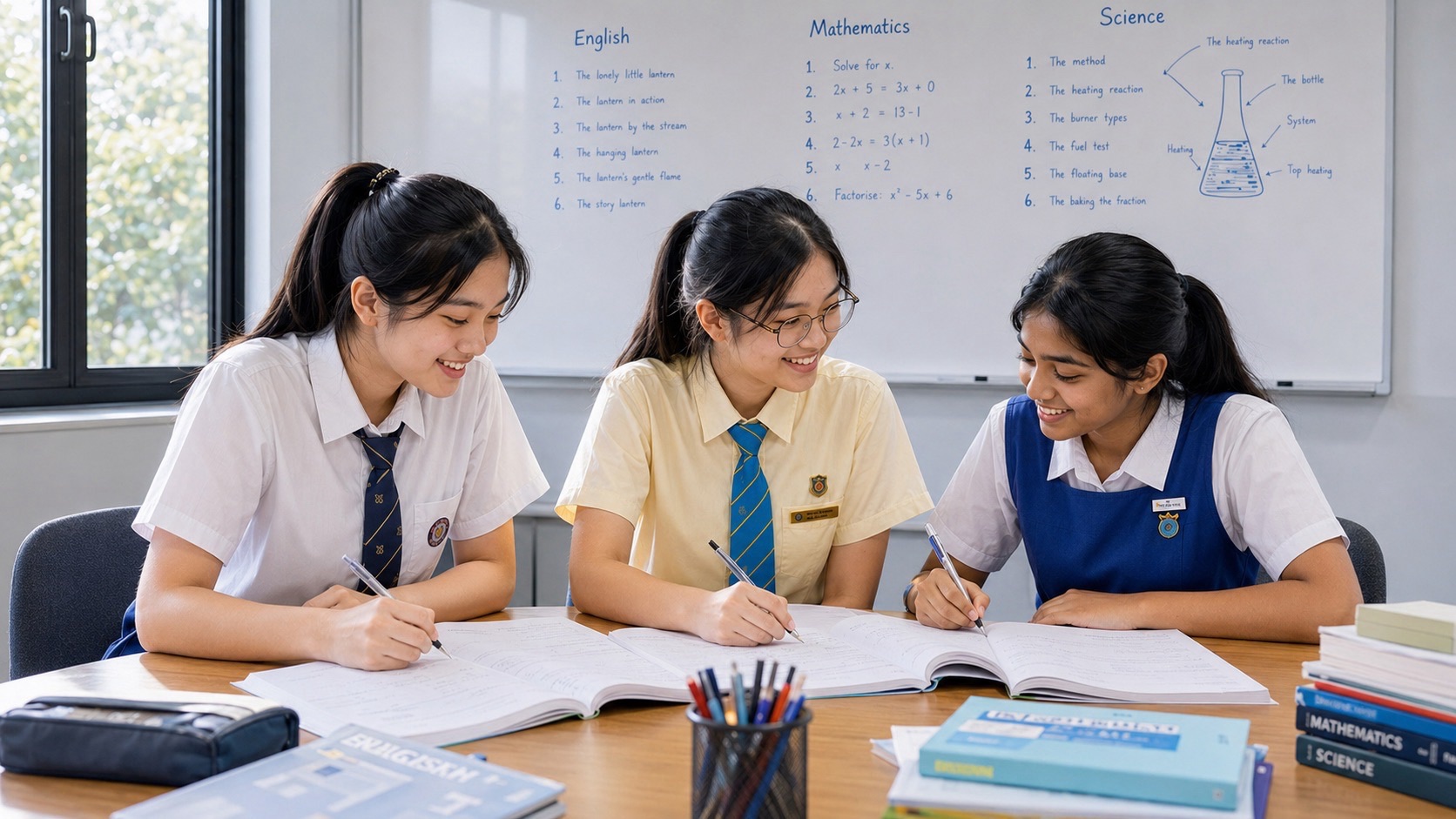
Singapore Math modelling guide for families and teachers outside Singapore: what mathematical modelling means in the Singapore syllabus, mainly at secondary level, and how to practise it at home.
Real problems do not arrive as neat sums.
Someone has to decide what matters, what to ignore and what the answer means.
In Singapore Mathematics, that work is called mathematical modelling. “Applying and modelling” is one of the processes from Primary 1, and the secondary syllabus sets out a full modelling process: formulating, solving, interpreting and reflecting.
In secondary examinations, real-world questions are built into the papers. Modelling then continues into Additional Mathematics and A-Level.
This guide is useful for families and teachers who want to:
- understand how modelling differs from model drawing;
- see where real-world problems appear in Singapore’s secondary exams;
- prepare a student who is moving into a Singapore secondary school; or
- give a student practice with open, realistic problems.
Quick facts
Level: Mainly Secondary 1 to Secondary 4, with roots in primary school
Strand: All strands. Modelling is a process, not a content topic.
Official source: MOE Mathematics Syllabuses, Secondary One to Four (2020), and SEAB G3 Mathematics syllabus K310
Comes after: Metacognition and Mathematical Processes
Leads to: Personal and Household Finance and Distance-Time and Speed-Time Graphs
What Mathematical Modelling Means in Singapore Mathematics
The 2020 secondary syllabus gives the core idea in one sentence: “Applying mathematics to real-world problems often involves modelling, where reasonable assumptions and simplifications are made.”
A model is a simplified mathematical version of a real situation. It might be an equation, a graph, a table or a formula.
The key words are “assumptions” and “simplifications”. A model leaves things out on purpose so that the mathematics can be done. Good modelling says what was left out.
This is different from “model drawing” in primary Singapore Math, where a bar model is a diagram of a word problem. A bar model can be part of a mathematical model, but modelling is the whole cycle from the real problem to a checked real answer.
Where Mathematical Modelling Sits in the Singapore Syllabus
The 2020 secondary syllabus sets out the modelling process in four stages.
| Stage | What the syllabus lists |
|---|---|
| Formulating | “Understand the problem”; “Make assumptions to simplify the problem”; “Represent the problem mathematically” |
| Solving | “Select and use appropriate mathematical methods and tools (including ICT)” |
| Interpreting | “Interpret the mathematical solution in the context of the real-world problem” |
| Reflecting | “Reflect on the real-world solution”; “Improve the model” |
Modelling also appears at other stages of Singapore Mathematics.
| Stage | Where modelling appears |
|---|---|
| Primary (2021 syllabus) | “Applying and modelling” is one of the processes. Problem contexts are meant to “raise students’ awareness of local and global issues around them”. |
| G3 Mathematics (K310) | Paper 2: “The last question in this paper will focus specifically on applying mathematics to a real-world scenario.” |
| G2 Mathematics (K210) | The last question of Paper 2 Section A is also a real-world scenario |
| Additional Mathematics | “Using quadratic functions as models”; “Using exponential and logarithmic functions as models”; “Using trigonometric functions as models” |
| H2 Mathematics | Each paper includes a real-world application question worth at least 12 marks |
The G3 and G2 syllabuses list the kinds of real-world context that questions may use:
- everyday life, “including travel/excursion plans, transport schedules, sports and games, recipes, floor plans, navigation etc.”;
- personal and household finance, “including simple and compound interest, taxation, instalments, utilities bills, money exchange, etc.”;
- “Interpreting and analysing data from tables and graphs, including distance-time and speed-time graphs”; and
- “Interpreting the solution in the context of the problem.”
MOE describes this list as “by no means exhaustive or exclusive”, and states that “Solving problems in real-world contexts should be part of the learning experiences of every student”.
Models is also one of the eight big ideas named in the 2020 secondary syllabus.
How Singapore Teaches Mathematical Modelling
1. Start with a real situation
A trip, a bill, a recipe or a timetable. The question is often open: which option is better, how many are needed, when should we leave?
2. Make the assumptions explicit
Students write down what they will ignore or hold fixed: “Assume every seat is used.” “Assume the price stays the same.”
3. Represent the problem mathematically
Choose the variables, then write an equation, draw a graph or build a table.
4. Solve with suitable tools
Use arithmetic, algebra or ICT, including a calculator. The syllabus names ICT among the tools.
5. Interpret the answer in context
Turn the number back into a real decision. “4 remainder 4” buses means 5 buses.
6. Reflect and improve
Ask whether the assumptions were reasonable, and change the model if they were not.
Worked Examples
Interpreting a division answer
Question: 155 students and 9 teachers go on a trip. Each bus carries 40 passengers. How many buses are needed?
Step 1. Formulate. Total passengers = 155 + 9 = 164. Assume everyone travels by bus and every seat can be used.
Step 2. Solve. 164 ÷ 40 = 4 remainder 4.
Step 3. Interpret. 4 buses carry 160 people, which leaves 4 without a seat. So 5 buses are needed.
Step 4. Reflect. If some students travel separately, the answer could change. The assumption should be stated with the answer.
Check: 5 × 40 = 200 seats, which is enough for 164. 4 × 40 = 160 seats is not enough.
The arithmetic here is primary-level. The modelling happens in steps 1, 3 and 4.
Comparing two plans
Question: Plan A costs $20 a month plus $0.10 per minute of calls. Plan B costs $35 a month with unlimited calls. When is Plan B cheaper?
Step 1. Formulate. Let m be the number of call minutes in a month. Assume the prices do not change and nothing else is charged.
Step 2. Represent. Monthly cost of Plan A = 20 + 0.1m dollars. Monthly cost of Plan B = 35 dollars.
Step 3. Solve. The plans cost the same when 20 + 0.1m = 35. So 0.1m = 15 and m = 150.
Step 4. Interpret. Below 150 minutes a month, Plan A is cheaper. Above 150 minutes, Plan B is cheaper.
Step 5. Reflect. Real use changes from month to month. An improved model might use the average of the last six months.
Check: At 150 minutes, Plan A costs 20 + 0.10 × 150 = 20 + 15 = $35, the same as Plan B.
This uses a linear equation in one variable, which is Secondary 1 content.
Common Mistakes
- Confusing modelling with model drawing. A bar model is a diagram; modelling is the full cycle. Fix: ask “What did we assume, and what does the answer mean?” as well as “What did we draw?”
- Hidden assumptions. Two students get different answers and neither can say why. Fix: write the assumptions down before solving.
- Leaving the raw number. “4 remainder 4 buses” is not a decision. Fix: finish with a sentence that answers the real question.
- Skipping reflection. A model that ignores something important gives a confident wrong answer. Fix: ask “What did we leave out that might matter?”
- Building a model that is too complicated. Too many variables stop progress. Fix: start simple, then add one detail at a time.
- Ignoring units. Mixing minutes with hours, or cents with dollars, breaks the model. Fix: write the unit next to every quantity.
Teaching Mathematical Modelling Outside Singapore
- Spelling. Singapore writes “modelling”; American materials usually write “modeling”. The meaning is the same.
- Two meanings of “model”. In primary Singapore Math materials, “model” usually means the bar model. In the secondary syllabus, modelling means the four-stage process. Make the difference clear to students.
- Timing. Full modelling is mainly secondary work in Singapore. Younger students can still practise interpreting answers in context. Use the Singapore Math Grade Levels guide to judge readiness.
- Tools. The Solving stage includes ICT. In G3 Mathematics exams, an approved calculator may be used in both papers.
- Contexts. Singapore questions use local contexts such as Singapore dollars and transport schedules. Local contexts from your own country work just as well for practice.
How to Practise Mathematical Modelling at Home
Real life supplies the problems.
- Once a week, pick a real decision: a trip, a shopping list, a phone plan or a recipe for more people.
- Ask your child to state the question in one sentence.
- List two or three assumptions together.
- Let your child choose the mathematics: a table, an equation or a graph.
- Ask for the answer as a sentence that makes the decision.
- Change one assumption and see whether the decision changes.
One good problem a week, discussed properly, is enough.
Try These
- A school needs 27 tables. Tables are sold in packs of 4. How many packs must it buy?
- Write two assumptions for this question: “How long will it take to walk to school?”
- Using Plan A and Plan B above, which plan is cheaper for 120 minutes of calls in a month?
- Name the four stages of the modelling process in MOE’s secondary syllabus.
Answers
- 7 packs. 27 ÷ 4 = 6 remainder 3, and 6 packs give only 24 tables, so a seventh pack is needed.
- For example: the walking pace stays steady; there are no long waits at crossings. Any two clearly stated, reasonable assumptions are fine.
- Plan A. It costs 20 + 0.10 × 120 = $32, which is less than $35.
- Formulating, solving, interpreting and reflecting.
What Comes Next
- Personal and Household Finance applies modelling to interest, bills and instalments.
- Distance-Time and Speed-Time Graphs covers one of the real-world contexts named in the secondary syllabus.
- Calculators explains when calculators may be used in Singapore exams.
Modelling is where the earlier pages in this section meet: processes, metacognition and real problems in one task.
Frequently Asked Questions
When do Singapore students learn mathematical modelling?
“Applying and modelling” is a process from Primary 1. The four-stage modelling process is set out in the secondary syllabus, and real-world questions appear in secondary exam papers.
Is mathematical modelling the same as the bar model?
No. The bar model is a diagram used mainly in primary school. Mathematical modelling is the full cycle from a real problem to a checked real-world answer.
Is modelling examined?
Yes. The last question of G3 Mathematics Paper 2 focuses on a real-world scenario, Additional Mathematics uses functions “as models”, and H2 Mathematics has real-world questions worth at least 12 marks.
Does modelling need a calculator or computer?
Not always. The syllabus lists “tools (including ICT)” in the Solving stage, and an approved calculator is allowed in both G3 Mathematics papers.
What kinds of real-world contexts are used?
The secondary syllabus names everyday life, personal and household finance, data in tables and graphs, and interpreting solutions in context.
Is there only one right answer?
Not always. Different reasonable assumptions can lead to different answers. What matters is that the assumptions are stated and the answer is interpreted sensibly.
Helpful Reading
- Singapore Mathematics | International Edition: Mathematical Processes
- Singapore Mathematics | International Edition: Personal and Household Finance
- Singapore Mathematics | International Edition: Distance-Time and Speed-Time Graphs
- How Mathematical Modelling Works | From World to Model and Back Again
- How Secondary 1 Problem Solving and Mathematical Modelling Works
- Singapore Math Bar Model | A Guide to Model Drawing
- How to Make Sense of the SEC G3 Mathematics Syllabus
- MOE Mathematics Syllabuses, Secondary One to Four (2020)
- SEAB G3 Mathematics Syllabus K310
Modelling in Singapore Mathematics
Start with a real question.
Say what you assume.
Turn it into mathematics.
Solve it with the right tools.
Bring the answer back to the real world.
Then ask whether the model was good enough.
That cycle is how Mathematics leaves the textbook and becomes useful.
Ask Bukit Timah Tutor
Bukit Timah Tutor teaches Mathematics in small groups of three students in Singapore.
If your child is learning Singapore Mathematics at home, in an international school or in a Singapore school, and you are unsure where to begin with this topic, send us a short message with the student’s level and one example of the work.
Bukit Timah Tutor
8 Fourth Avenue, Singapore 268674
Near Sixth Avenue MRT
Three-student Mathematics tutorials
By appointment
Properly taught kids shine a bright light into the future.
Singapore Mathematics | International Edition is a Bukit Timah Tutor guide series for families and teachers outside Singapore. It is not a textbook and is not affiliated with MOE, SEAB or any publisher. Syllabus details were checked against MOE and SEAB documents in October 2026. Always confirm current requirements with your school.
← Previous: Singapore Mathematics | International Edition: Metacognition
Next: Singapore Mathematics | International Edition: Calculators →
All 100 topics in the International Edition