
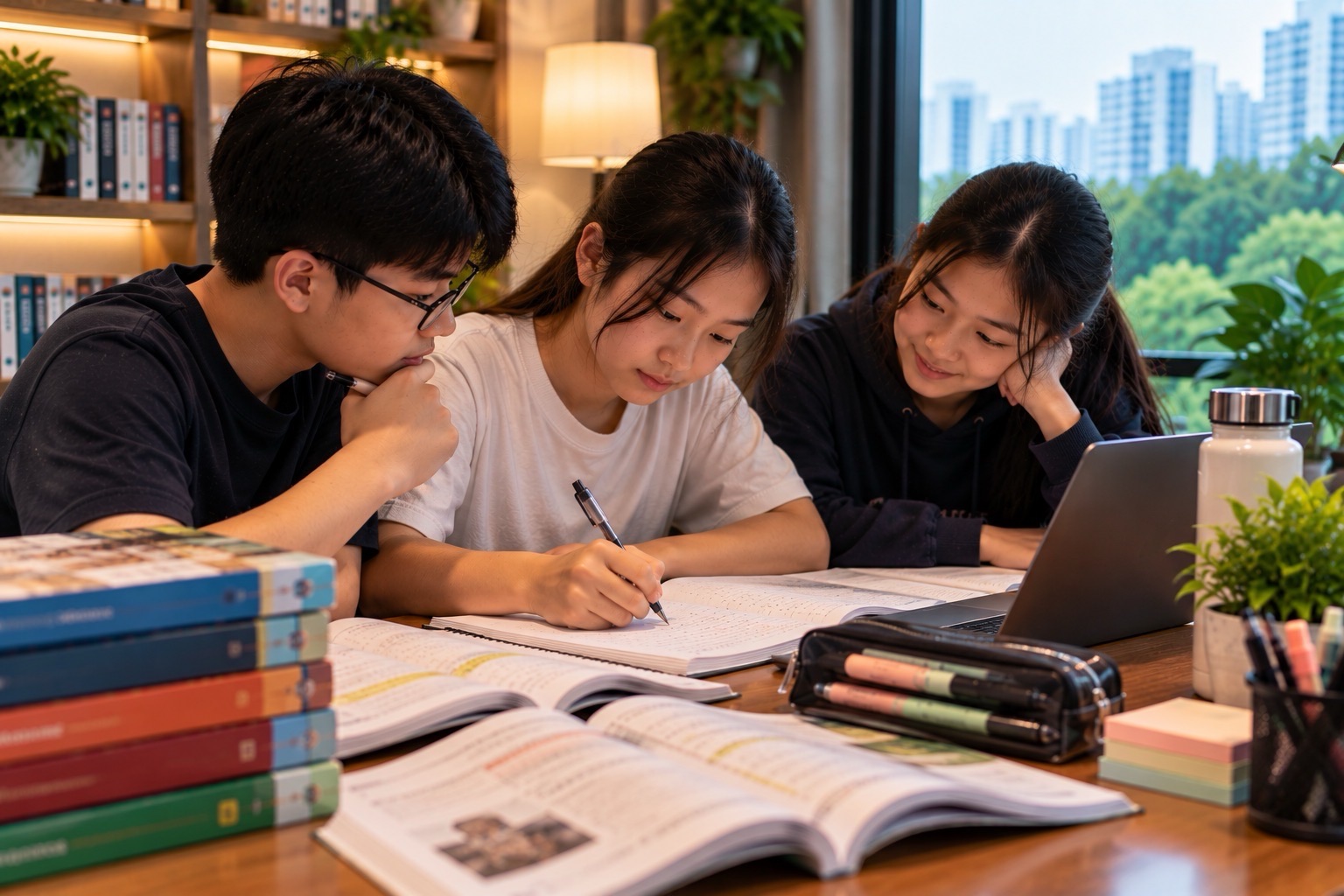
Singapore Math metacognition guide for families and teachers outside Singapore: what MOE means by “thinking about thinking”, where it appears from Primary 1 to Secondary 4, and how to build it at home.
Many wrong answers are not caused by missing knowledge.
They happen because a child did not notice that something had gone wrong.
In Singapore Mathematics, metacognition is one of the five components of the curriculum framework. Students learn to plan, monitor and check their own thinking, and to notice how they feel about a problem.
The 2021 primary syllabus gives it “greater emphasis”, and the 2020 secondary syllabus keeps the same focus on self-directed learning and reflection.
This guide is useful for families and teachers who want to:
- understand what Singapore means by metacognition;
- help a child catch their own mistakes;
- prepare a child who is moving into a Singapore school; or
- build reflection into Singapore Math lessons at home.
Quick facts
Level: Primary 1 to Secondary 4
Strand: All strands. Metacognition is a framework component, not a content topic.
Official source: MOE Primary Mathematics Syllabus (2021) and MOE Mathematics Syllabuses, Secondary One to Four (2020)
Comes after: Mathematical Processes
Leads to: Mathematical Modelling and Calculators
What Metacognition Means in Singapore Mathematics
The 2021 primary syllabus describes it as “Metacognition, or thinking about thinking”.
On the framework diagram, its label is “Awareness, monitoring and regulation of thought processes”.
The 2020 secondary syllabus puts it this way: “Metacognition, or thinking about thinking, refers to the awareness of, and the ability to control one’s thinking processes.”
In practice, that gives three parts:
- Awareness. Knowing what you know, what the question asks, and which strategy you are using.
- Monitoring. Watching the work as it happens: is this still making sense?
- Regulation. Changing course when it is not: checking, going back or trying another strategy.
The primary syllabus adds one more element: awareness of one’s own feelings about a problem. A child who notices “I am starting to panic” can slow down. A child who does not notice may simply guess.
Where Metacognition Sits in the Singapore Syllabus
Metacognition has no content list. It appears in the framework, the aims and the teaching guidance.
| Where | Primary (2021) | Secondary (2020) |
|---|---|---|
| Framework | One of the five components | One of the five components |
| Key focus | “Give greater emphasis to the development of metacognition to promote self-directed learning and reflection.” | “Give attention to developing students’ metacognition by promoting self-directed learning and reflection.” |
| Aims | “develop thinking, reasoning, communication, application and metacognitive skills through a mathematical approach to problem solving” | The SEC G3 Mathematics aims use the same phrase |
The phrase “greater emphasis” marks a change. It is the third of the three key focus areas of the 2021 primary syllabus.
The primary syllabus also describes Phases of Learning. The Mastery phase includes motivated practice, reflective review and extended learning. Reflective review is metacognition built into the lesson cycle.
Metacognition has no separate section in the PSLE or the G3 Mathematics papers. It shows in the results: planned working, sensible estimates and errors caught before the end.
How Singapore Teaches Metacognition
1. Think aloud
The teacher solves a problem aloud, doubts included: “I am not sure this is right. Let me check.” Students hear what monitoring sounds like.
2. Plan before solving
Students say what they know, what they need and which strategy they will try. Both syllabuses name Pólya’s 4 steps, which end with looking back at the solution.
3. Estimate first
A quick estimate gives a target. If the answer lands far from it, something has gone wrong.
4. Check with a different method
Redoing the same steps repeats the same error. Checking subtraction with addition, or division with multiplication, catches it.
5. Name the feeling
Students learn to notice “I am stuck” or “I am rushing” and to respond: reread, draw, or move on and come back.
6. Reflect after practice
After marking, students explain each error in one sentence. Over time, they see their own patterns.
A Worked Example
Catching an error with an estimate
Question: Work out 2436 ÷ 4.
Step 1. Plan. This is a 4-digit number divided by a 1-digit number, a Primary 4 skill. Estimate first.
Step 2. Estimate. 2400 ÷ 4 = 600, so the answer should be close to 600.
Step 3. Solve. The child’s first answer is 69.
Step 4. Monitor. 69 is nowhere near 600. Something has gone wrong.
Step 5. Regulate. Redo it by place value. 24 hundreds ÷ 4 = 6 hundreds. 3 tens ÷ 4 = 0 tens, with 3 tens left over. 36 ones ÷ 4 = 9 ones. The answer is 609.
Check: 4 × 609 = 2436.
The child knew how to divide. The error was a missing zero in the tens place, and only the estimate exposed it.
Four questions for any problem
Before: What do I know, and what do I need to find?
During: Is this still making sense?
After: Does my answer fit my estimate and the question?
Next time: What would I do differently?
These four questions are simple enough for Primary 1 and still useful in Secondary 4.
Common Mistakes
- Checking by repeating the same steps. The same error appears twice and looks confirmed. Fix: check with a different method, such as an inverse operation or an estimate.
- Reflection that says only “be careful”. It names no cause, so nothing changes. Fix: write what exactly went wrong, such as “I forgot to rename a ten.”
- The adult does the monitoring. “That’s wrong” teaches the child to wait for someone else to notice. Fix: ask “Does that fit your estimate?” and let the child find the error.
- Ignoring feelings. Panic leads to guessing. Fix: agree a set response in advance, such as reread the question and draw something.
- Saving metacognition for hard problems. Under pressure, new habits fail. Fix: practise planning and checking on easy problems first.
Teaching Metacognition Outside Singapore
The idea is widely shared, but Singapore states it in the syllabus and builds it into lessons.
- Terminology. Some schools use words such as self-regulation, reflection or self-monitoring for similar ideas. Singapore’s syllabus uses “metacognition” and “thinking about thinking”.
- Timing. Singapore starts at Primary 1 with simple questions and builds from there. Use the Singapore Math Grade Levels guide to judge readiness rather than converting ages.
- Non-calculator work. PSLE Paper 1 does not allow calculators, so estimating and checking by hand are essential.
- Written working. The G3 Mathematics syllabus warns that “Omission of essential working will result in loss of marks.” Clear working also makes self-checking possible.
- Review. Regular review of past errors is part of the Singapore Math review and mastery approach.
How to Practise Metacognition at Home
Build the habit with small, repeated questions.
- Before your child starts, ask for an estimate.
- Halfway through, ask: “Is this still making sense?”
- At the end, ask for a check by a different method.
- When an answer is wrong, ask your child to find the first wrong line.
- Keep a short error log: the question, the mistake in one sentence, and the fix.
- Once a week, read the log together and look for a pattern.
Five minutes of reflection after practice often teaches more than ten more questions.
Try These
These are short practical tasks with model answers.
- Estimate 3980 ÷ 5 before calculating. Then calculate and compare.
- A child writes 52 − 27 = 35. Write one checking question that would catch the error.
- Turn “I was careless” into a useful reflection for the error in question 2.
- Write the three key words in the metacognition label on the 2021 framework diagram.
Answers
- Estimate: 4000 ÷ 5 = 800. Exact answer: 796. The two are close, so the answer is reasonable.
- “Does 35 + 27 = 52?” It gives 62, so 35 is wrong. The correct answer is 25.
- For example: “In the ones, I did 7 − 2 instead of renaming a ten to make 12 − 7.” That names the exact cause.
- Awareness, monitoring and regulation. The full label is “Awareness, monitoring and regulation of thought processes”.
What Comes Next
- Mathematical Modelling asks students to reflect on and improve a model, which is metacognition applied to real problems.
- Calculators explains when calculators are allowed, and why estimation still matters.
- Addition and Subtraction is a good place to practise checking with inverse operations.
A child who checks their own thinking needs less checking from adults.
Frequently Asked Questions
When do Singapore students learn metacognition?
From Primary 1, as part of everyday lessons. It continues through secondary school.
Is metacognition examined?
Not as a separate section. It shows in accuracy, sensible working and errors caught before the paper is handed in.
What changed in the 2021 primary syllabus?
One of its three key focus areas is to “Give greater emphasis to the development of metacognition to promote self-directed learning and reflection.”
Is metacognition just checking answers?
No. Checking is one part. Planning before starting, monitoring during the work and noticing one’s feelings are the others.
Can young children really do this?
Yes, in simple forms. A Primary 1 child can be asked “Does your answer make sense?” and “How could you check?”
How is metacognition different from attitudes?
Attitudes are about belief, confidence and perseverance. Metacognition is about awareness and control of thinking. The two work together: noticing a feeling is metacognition, and keeping going is perseverance.
Helpful Reading
- Singapore Mathematics | International Edition: The Mathematics Framework
- Singapore Mathematics | International Edition: Mathematical Processes
- Singapore Mathematics | International Edition: Mathematical Modelling
- Primary Mathematics: Reflection, Self-Monitoring and Metacognitive Checking | Worked Learning Guide
- How SEC Mathematics Metacognition Works
- How to Check Whether a Mathematics Answer Is Reasonable
- MOE Primary Mathematics Syllabus
- MOE Mathematics Syllabuses, Secondary One to Four (2020)
Metacognition in Singapore Mathematics
Know what you are doing.
Notice when it stops making sense.
Change course when it does.
Check with a different method.
Name the mistake, not the mood.
A child who learns this habit carries it into every topic.
It is the quiet part of the framework, and often the part that decides the result.
Ask Bukit Timah Tutor
Bukit Timah Tutor teaches Mathematics in small groups of three students in Singapore.
If your child is learning Singapore Mathematics at home, in an international school or in a Singapore school, and you are unsure where to begin with this topic, send us a short message with the student’s level and one example of the work.
Bukit Timah Tutor
8 Fourth Avenue, Singapore 268674
Near Sixth Avenue MRT
Three-student Mathematics tutorials
By appointment
Properly taught kids shine a bright light into the future.
Singapore Mathematics | International Edition is a Bukit Timah Tutor guide series for families and teachers outside Singapore. It is not a textbook and is not affiliated with MOE, SEAB or any publisher. Syllabus details were checked against MOE and SEAB documents in October 2026. Always confirm current requirements with your school.
← Previous: Singapore Mathematics | International Edition: Mathematical Processes
Next: Singapore Mathematics | International Edition: Mathematical Modelling →
All 100 topics in the International Edition