
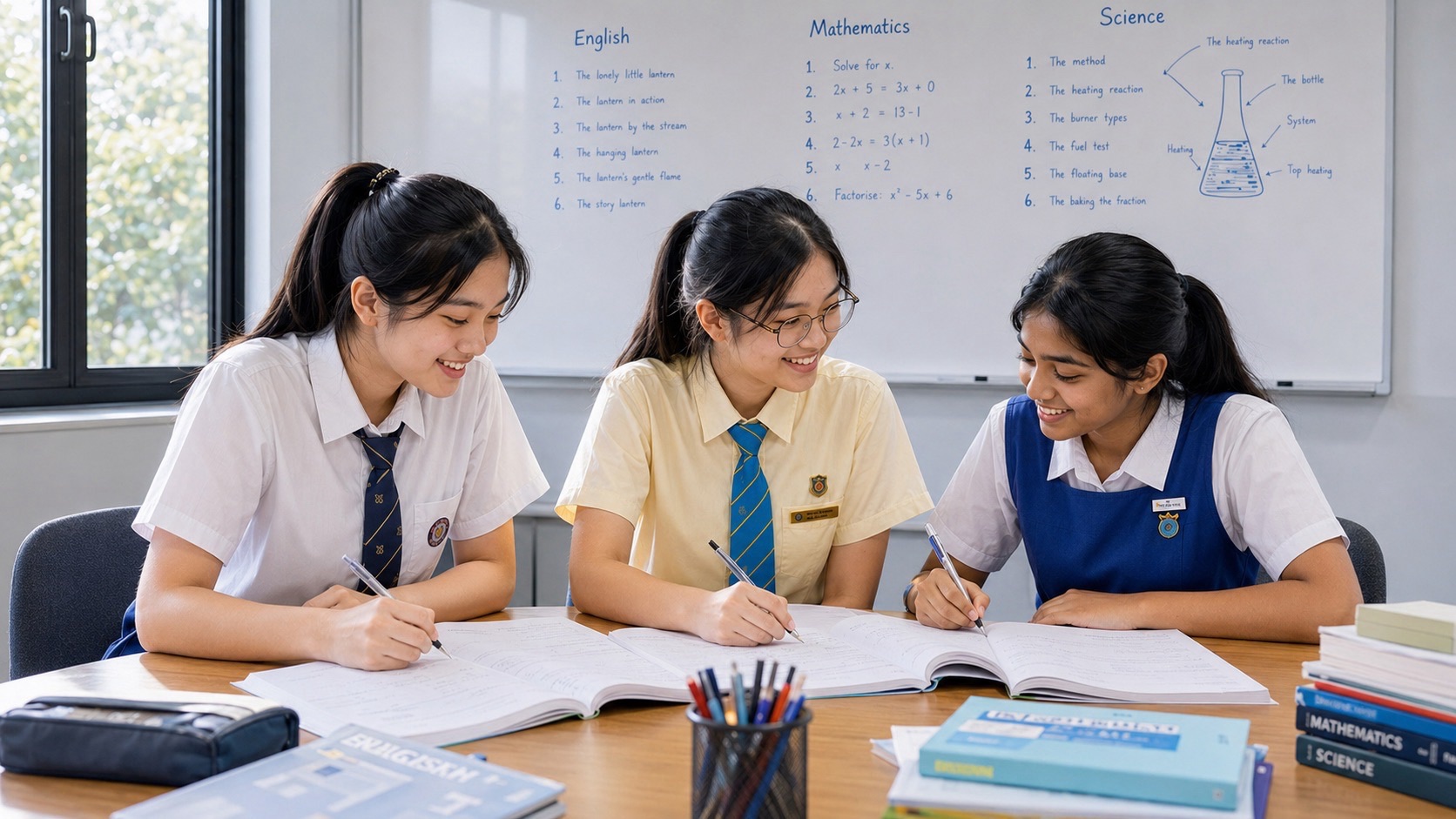
Secondary 1 problem solving works by turning an unfamiliar situation into a mathematical object that can be operated on.
This is the difference between calculation and mathematical problem solving. In calculation, the mathematical structure is usually already visible. In a genuine problem, the student must first decide what the structure is.
Mathematical modelling extends this process into real or realistic situations. The learner identifies quantities, chooses assumptions, builds a mathematical representation, performs the mathematics, interprets the result and checks whether the model is still sensible when returned to the real world.
The difficult part of many Secondary 1 problems is not the calculation. It is deciding what should be calculated.
The Simple Answer
Secondary 1 problem solving and modelling work through a cycle:
- Understand the situation.
- Identify the target, known quantities and constraints.
- Represent the situation mathematically.
- Select a route.
- Execute the mathematics.
- Interpret the result.
- Validate whether it makes sense.
- Revise the model or route if necessary.
Across SEC G1, G2 and G3, this cycle remains recognisable. What changes is the complexity of the representation, the number of steps, the abstraction involved and the amount of scaffolding required.
Why Word Problems Are Not Mainly About Words
A student can read every word correctly and still fail to solve a problem.
The difficulty is often structural. The learner must decide which quantities matter, how they relate and what representation exposes that relationship most clearly.
This is why students who are strong at arithmetic can still struggle with word problems. The arithmetic engine works. The representation engine is unstable.
See Why a Student Can Calculate but Cannot Solve Mathematics Word Problems.
The First Question: What Are We Trying to Find?
Many weak solutions begin before the student has identified the target.
A useful first move is to state the target quantity in plain language. This creates a destination.
Once the destination is clear, the student can ask backward:
- What would I need to know to find this?
- Can that intermediate quantity be found from the information given?
- Which relationship links those quantities?
This is route planning rather than operation guessing.
Known, Unknown and Constraint
Most mathematical problems can be understood as a system containing known quantities, unknown quantities and constraints.
A constraint is a condition that restricts what values or relationships are possible. It may be:
- a total;
- a ratio;
- a fixed perimeter;
- a time limit;
- a geometric property;
- a percentage change;
- a maximum or minimum;
- a statement that two quantities are equal.
Problem solving becomes much easier when students learn to read constraints as mathematical information rather than narrative detail.
Representation Is the Bridge
A problem can often be represented in several ways:
- a bar model;
- a number line;
- a table;
- a ratio;
- an equation;
- a diagram;
- a graph;
- a short verbal relationship.
The best representation is not always the most advanced one. It is the one that exposes the relationship with the least unnecessary complexity.
A student who can choose among representations has a major advantage because a difficult verbal problem may become simple after the correct translation.
Primary Model Drawing Does Not Disappear
Students sometimes assume that entering Secondary 1 means abandoning visual models and replacing everything with algebra.
That is unnecessary. A model drawing remains useful when it clarifies a relationship. Algebra becomes another powerful representation, not a mandatory replacement for every earlier tool.
The stronger learner develops a representation toolbox and chooses according to the problem.
Algebra Makes the Model General
Algebra becomes especially useful when the unknown quantity participates in several relationships or when a problem needs to be generalised.
A verbal condition can become an equation. The equation compresses the relationship. Solving then becomes a controlled transformation of the model.
See How Secondary 1 Algebraic Language Works.
Tables Make Correspondence Visible
When two quantities change together, a table can make correspondence clearer than prose.
This is useful in rate, ratio, percentage, pattern and graph problems. A table can reveal a constant multiplier, repeated change or a missing pair.
The table is not the mathematics itself. It is a viewing instrument for the relationship.
Diagrams Reduce Spatial Complexity
A geometric or measurement problem can become much easier after the diagram is annotated with known values, units, angle relationships and unknowns.
Drawing or redrawing a diagram is therefore not wasted time. It externalises information that would otherwise compete for working memory.
See How Secondary 1 Geometry & Measurement Works.
Graphs Can Be Both Data and Model
A graph may present observed data, or it may represent a mathematical relationship generated by a rule.
In both cases, students need to interpret axes, scale, points and overall shape. A graph can reveal where quantities are equal, how one quantity changes with another or whether a model fits an observed pattern.
See How Secondary 1 Graphs & Coordinates Work.
Route Selection Is a Mathematical Skill
A worksheet organised by chapter often supplies the route invisibly. If the page is titled “Percentage”, the student already knows which family of methods to consider.
Real problems do not provide chapter labels.
Route selection therefore deserves explicit practice. Students should be asked:
- What kind of mathematical object is this?
- What relationship do you see?
- Which representations could work?
- Which route is shortest and safest?
- What alternative route could check the first?
This trains mathematical decision-making rather than recipe recognition.
Forward Working and Backward Planning
Students often work only forward: take a given number, do something to it, then do something else.
Strong problem solvers can also reason backward from the target.
If the final goal is area, what dimensions are needed? If one dimension is unknown, what relationship can find it? If that relationship requires another quantity, can that be calculated from the given information?
Forward and backward reasoning can meet in the middle to create a route.
Multi-Step Problems Are Dependency Chains
A multi-step problem is not difficult merely because it has several calculations. It is difficult because later steps depend on earlier states being correct.
This means students should know which intermediate values are necessary and why. Otherwise they may calculate quantities simply because numbers are available.
See Not Every Number in a Mathematics Question Is Asking to Be Used.
Not Every Given Number Must Be Used
Secondary Mathematics increasingly tests whether students can distinguish relevant from irrelevant information.
The presence of a number does not create an obligation to calculate with it.
This is another reason representation should precede computation. Once the relationship is clear, irrelevant information becomes easier to identify.
Mathematical Modelling: From World to Mathematics and Back Again
A model is a deliberately simplified mathematical representation of a situation.
The modelling cycle can be written as:
World → assumptions → mathematical representation → calculation → mathematical result → interpretation → world check.
The return step is essential. A mathematically correct answer can still be useless if the model ignored an important real-world condition.
Assumptions Are Part of the Model
Real situations contain more detail than most school problems can use. Modelling therefore involves assumptions.
A student might assume:
- speed remains constant;
- prices do not change;
- a shape is perfectly rectangular;
- measurements are accurate enough for the task;
- all items have equal mass;
- the sample is representative of the group being discussed.
At Secondary 1, assumptions can remain simple, but students should begin noticing that models are built rather than discovered fully formed.
Validation: Does the Answer Survive the Return to Reality?
After calculation, the result should be returned to the original context.
Useful checks include:
- Is the sign possible?
- Is the magnitude plausible?
- Are the units correct?
- Does the answer obey the constraints?
- Does rounding change a practical decision?
- Can a fractional answer exist in this context?
- Did the model assume something unrealistic?
A bus problem may produce 3.2 buses mathematically, but the real-world decision may require four buses. Interpretation completes the solution.
Sometimes the Correct Answer Is “Impossible”
Students are often conditioned to believe every question must produce a conventional positive numerical answer.
But mathematical constraints can show that no valid solution exists.
Recognising impossibility is a sign of mathematical maturity because the student is checking the answer against the system rather than forcing a number to appear.
See Sometimes the Correct Mathematics Answer Is: This Cannot Exist.
Common Secondary 1 Problem-Solving Failure Modes
1. Calculate Immediately
The student sees numbers and begins operating before understanding the relationship. Repair by requiring target and representation first.
2. Keyword Hunting
The learner treats words such as “total”, “difference” or “each” as automatic operation commands. Repair by reading the whole relationship instead of isolated vocabulary.
3. The First Method Is Always Used
The student has a favourite representation and forces every problem into it. Repair by comparing two possible representations and discussing which exposes the structure more clearly.
4. The Student Gets Stuck Halfway
The first step is visible but the dependency chain is not. Repair by working backward from the target. See My Child Can Start a Mathematics Question but Gets Stuck Halfway.
5. Every Number Is Used
The learner assumes all numerical information must enter the calculation. Repair by identifying constraints and relevance before computation.
6. No Return to Context
The student obtains a number and stops. Repair by requiring a sentence that interprets the result with units and context.
7. The Model Is Never Questioned
The learner assumes a mathematically valid model must be realistic. Repair by asking what assumptions were made and what would happen if one changed.
How Problem Solving Looks Across G1, G2 and G3
G1: Make the Route Visible, Then Fade the Support
G1 learners benefit from explicit identification of target, known quantities and representations. Scaffolds should gradually fade so the learner begins selecting the route independently.
G2: Compare Routes and Connect Topics
G2 increasingly expects students to choose among ratio, algebra, geometry, tables and graphs, and to solve problems where more than one topic contributes to the final route.
G3: Model, Generalise and Carry More Unknown Structure
G3 learners should increasingly manage unfamiliar surface forms, build algebraic representations, plan multi-step routes and validate results with less prompting.
The problem-solving cycle remains the same. The student carries more of it internally.
A Diagnostic Ladder for Problem Solving
- Comprehension: Can the student explain the situation?
- Target: Can the required quantity be identified?
- Relevance: Can useful and irrelevant information be distinguished?
- Representation: Can the student build a table, model, equation, diagram or graph?
- Route selection: Can a suitable method be chosen?
- Execution: Can the mathematics be carried out accurately?
- Interpretation: Can the result be stated in context?
- Validation: Can the student detect an impossible or implausible result?
- Transfer: Can the same structure be recognised when the story changes?
This ladder helps separate language difficulty, representation difficulty, route difficulty and calculation difficulty.
What Good Problem-Solving Practice Looks Like
- questions without chapter labels;
- problems containing irrelevant information;
- problems with more than one valid route;
- representation-only tasks where calculation is delayed;
- backward-planning exercises;
- error analysis of plausible wrong routes;
- realistic problems requiring interpretation or rounding decisions;
- model critique: what assumption is being made?
- mixed-topic problems;
- retrieval after delays.
Good practice should make the learner decide what mathematics to use.
Why Transfer Is the Real Test
A student who can solve only questions that look like the worked example has learned a surface pattern.
A student who can recognise the same relationship in a new story has learned the mathematical structure.
This is why transfer questions are so valuable. They reveal whether knowledge is attached to the underlying idea or to superficial cues.
SEC G1, G2 and G3 Context
The Singapore-Cambridge Secondary Education Certificate structure offers Mathematics at G1, G2 and G3 subject levels, with 2027 school-candidate codes K110, K210 and K310. Mathematical application, reasoning, communication and problem solving remain central to learning Mathematics across the subject-level system.
Official references: SEC G1 syllabuses, SEC G2 syllabuses, and SEC G3 syllabuses.
Where This Article Sits in the Secondary 1 Mathematics Series
This guide owns the problem-solving-and-modelling mechanism inside How Secondary 1 Mathematics Works | SEC G1, G2 & G3.
- How Secondary 1 Algebraic Language Works
- How Secondary 1 Ratio, Rate & Percentage Works
- How Secondary 1 Geometry & Measurement Works
- How Secondary 1 Graphs & Coordinates Work
- How Secondary 1 Data & Statistics Works
- How Secondary 1 Mathematical Communication, Working & Checking Works
For the broader estate, use the Singapore Mathematics Hub.
Final Answer
Secondary 1 problem solving and mathematical modelling work by converting situations into representations, selecting valid routes, executing the mathematics and then returning the answer to the original context for validation.
The goal is not to make students guess the teacher’s preferred trick.
It is to build a learner who can decide what the mathematics is, use it, and test whether it survived contact with the problem.