
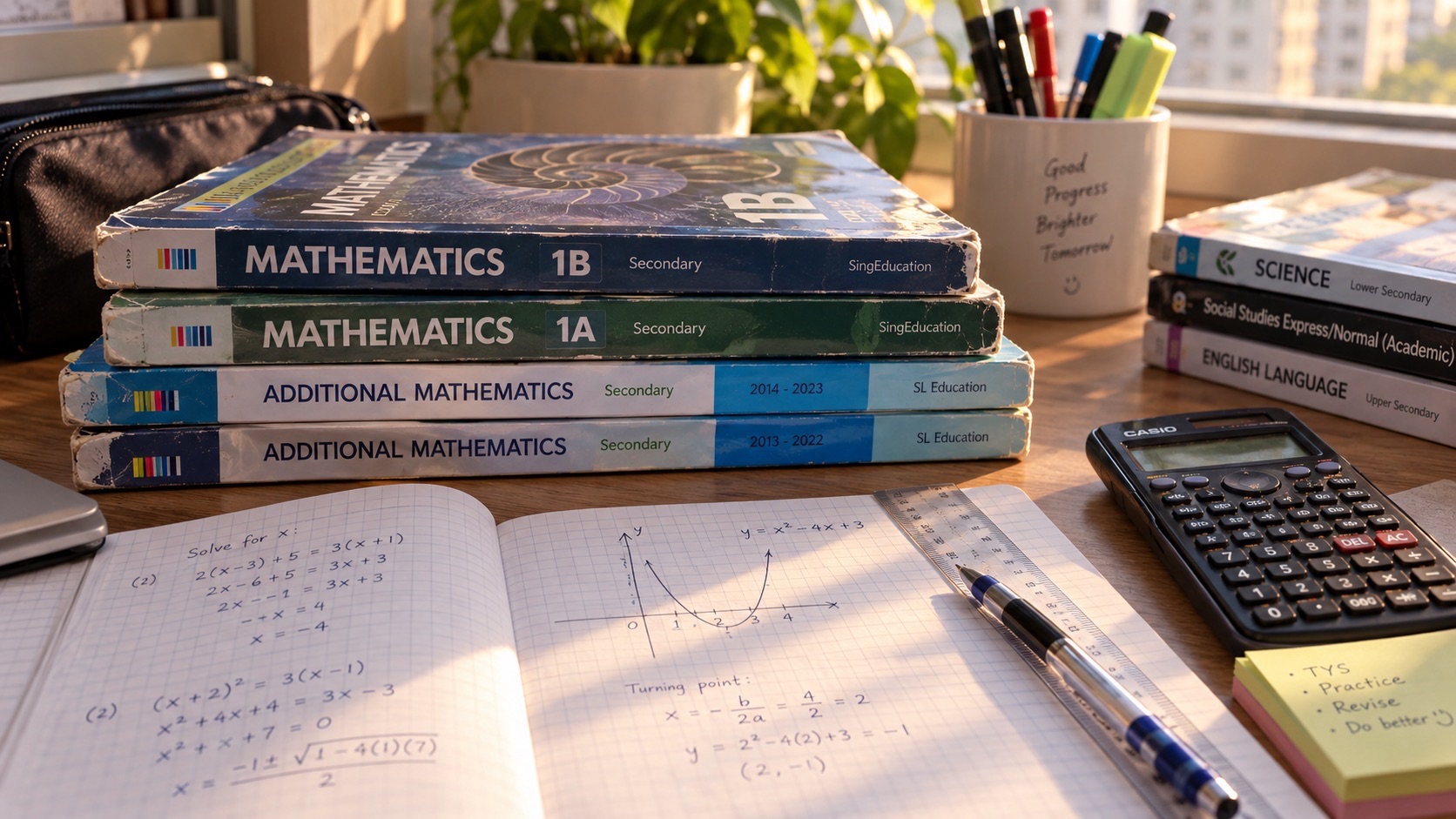
Singapore Math integers and real numbers guide for families and teachers outside Singapore. What Secondary 1 students learn about negative numbers, integers, rational numbers and real numbers, and how to practise them at home.
Secondary 1 opens the number line in both directions.
Almost every later topic in algebra depends on it.
In Singapore Mathematics, primary school works with whole numbers, fractions and decimals. In Secondary 1, G3 Mathematics adds negative numbers, integers, rational numbers and real numbers, and the four operations on them.
Students also place and order numbers on the number line and use the symbols <, >, ≤ and ≥. These ideas lead straight into algebra, equations and inequalities.
This guide is useful for families and teachers who want to:
- understand what Singapore expects at Secondary 1;
- teach negative numbers at home in a clear sequence;
- prepare a child who is moving into a Singapore secondary school; or
- support a student using Singapore Math materials in another country.
Quick facts
Level: Secondary 1 (G3 Mathematics; also in G2)
Strand: Number and Algebra
Official source: MOE Secondary Mathematics Syllabuses (2020) and SEAB G3 Mathematics syllabus K310
Comes after: Whole Numbers and Place Value and Decimals
Leads to: Algebraic Expressions and Linear Inequalities
What Integers and Real Numbers Mean in Singapore Mathematics
Secondary 1 organises numbers into families, each one containing the last.
- Whole numbers: 0, 1, 2, 3 and so on.
- Integers: the whole numbers and their negatives, such as −3, −2, −1, 0, 1, 2 and 3.
- Rational numbers: any number that can be written as a fraction of two integers, such as 3/4, −2/5, 0.6 and −7.
- Real numbers: every point on the number line, including numbers such as √2 and π, which cannot be written as a fraction of two integers.
The syllabus wording is “negative numbers, integers, rational numbers, real numbers, and their four operations”.
A negative number can be pictured as a position to the left of zero, or as a direction: a loss, a fall in temperature, a depth below sea level.
Both pictures help. The number line is the one the syllabus names, and it is the one that makes ordering and operations visible.
Where Integers and Real Numbers Sit in the Singapore Syllabus
In G3 Mathematics, this content belongs to N1 Numbers and their operations, taught in Secondary 1. Students learn:
- negative numbers, integers, rational numbers and real numbers, and their four operations;
- calculations with a calculator;
- representation and ordering of numbers on the number line; and
- use of the symbols <, >, ≤ and ≥.
The same Secondary 1 sub-strand also covers primes, HCF and LCM, and approximation and estimation.
G2 Mathematics includes this content too.
| Level | What students do with numbers |
|---|---|
| Primary 1 to 5 | Whole numbers, up to 10 million by Primary 5 |
| Primary 2 to 6 | Fractions, and from Primary 4, decimals |
| Secondary 1 | Negative numbers, integers, rational and real numbers; four operations; the number line; <, >, ≤, ≥ |
| Secondary 3 or 4 | Standard form, and positive, negative, zero and fractional indices |
How Singapore Teaches Integers and Real Numbers
1. Extend the number line
Draw zero in the middle and mark −1, −2 and −3 to the left of it. Numbers increase from left to right.
2. Compare and order
Further left means smaller. So −5 < −2, even though 5 > 2. Students write comparisons with <, >, ≤ and ≥.
3. Add and subtract by moving
Adding a positive number moves right. Adding a negative number moves left. Subtracting a negative number is the same as adding its opposite, so 4 − (−3) = 4 + 3 = 7.
4. Multiply and divide with sign rules
Two numbers with the same sign give a positive product or quotient. Different signs give a negative one. So (−3) × (−4) = 12 and (−20) ÷ 5 = −4.
5. Place fractions and decimals too
−1/2 sits halfway between −1 and 0. −0.4 is less than −1/3, because it lies further to the left.
6. Use a calculator, but check the sign first
The syllabus includes calculations with a calculator. Students should still predict the sign and rough size of an answer before pressing any keys.
Each step builds on the picture of the number line, so a child can always return to it when a rule feels uncertain.
Worked Examples
Four operations with negative numbers
Question: Evaluate (−3) × 4 − (−10) ÷ 2.
Step 1. Multiply and divide before subtracting. (−3) × 4 = −12.
Step 2. (−10) ÷ 2 = −5.
Step 3. −12 − (−5) = −12 + 5 = −7.
Check: On a number line, start at −12 and move 5 places to the right. You land on −7.
Ordering real numbers
Question: Arrange these numbers in increasing order: 0.5, −2, −1/3, −0.4, √2.
Step 1. Write each as a decimal: 0.5, −2, about −0.333, −0.4 and about 1.414.
Step 2. The negative numbers come first, with the most negative smallest: −2, −0.4, −1/3.
Step 3. Then the positive numbers: 0.5, √2.
Check: −2 < −0.4 < −1/3 < 0.5 < √2. Each number lies to the left of the next one on the number line.
The second example is a common trap. Many students place −1/3 before −0.4 because 0.4 is bigger than 1/3.
Common Mistakes
- Thinking −5 is bigger than −2. The digit 5 looks bigger. Fix: picture the number line, where further left is always smaller.
- Using the multiplication sign rule for addition. −3 − 4 is −7, not 7. Fix: name the operation before choosing a rule.
- Losing the brackets. −3² means −(3²) = −9, but (−3)² = 9. Fix: put brackets around a negative number that is squared or multiplied.
- Ordering negative decimals by their digits. −0.4 is smaller than −0.35. Fix: compare distances from zero first, then remember that the larger distance is the smaller negative number.
- Subtracting a negative wrongly. 6 − (−2) is 8, not 4. Fix: replace “minus a negative” with “plus”.
- Mixing up < and ≤. x ≤ 3 includes 3, but x < 3 does not. Fix: read ≤ aloud as “less than or equal to”.
Teaching Integers and Real Numbers Outside Singapore
The ideas are universal, but the words and habits can differ.
- Other names. Some textbooks say “directed numbers” or “signed numbers” for negative and positive numbers. The ideas are the same.
- Brackets. Writing negative numbers in brackets, as in (−3) × (−4), avoids many sign errors. Brackets are called parentheses in US usage.
- Symbols. The syllabus names <, >, ≤ and ≥ explicitly. Students should read each one aloud correctly and write it by hand.
- Timing. In Singapore’s current syllabus, this is Secondary 1 content. Your local curriculum may introduce negative numbers earlier or later, so decide by readiness. The Singapore Math Grade Levels guide explains why direct conversions are unreliable.
- Calculators. An approved calculator may be used in both G3 Mathematics papers. Mental sign work still matters, because a wrong key press often gives a wrong sign.
How to Practise Integers and Real Numbers at Home
A short daily routine builds confidence quickly.
- Draw a number line from −10 to 10 and place five numbers your child chooses, including a fraction and a decimal.
- Use temperature: start at −3 °C and rise 7 degrees. Where do you finish?
- Work five additions and subtractions with negative numbers, each with a quick number-line sketch.
- Work five multiplications and divisions, saying the sign rule aloud each time.
- Order a mixed set of fractions, decimals and negative numbers from smallest to largest.
- Once a week, check hand-worked answers with a calculator.
Ten focused minutes a day is enough.
Try These
- Evaluate −8 + 5.
- Evaluate (−6) × (−7).
- Evaluate (−24) ÷ 3 − (−2).
- Arrange in increasing order: −1.5, 2/3, −1/4, 0, −2.
Answers
- −3. Start at −8 and move 5 places to the right.
- 42. Two negative numbers multiply to give a positive product.
- −6. (−24) ÷ 3 = −8, and −8 − (−2) = −8 + 2 = −6.
- −2, −1.5, −1/4, 0, 2/3. The most negative number comes first.
What Comes Next
Negative numbers appear in almost every later topic.
- Prime Factorisation, HCF and LCM is part of the same Secondary 1 sub-strand.
- Algebraic Expressions in Secondary 1 often involves substituting negative values.
- Linear Inequalities in Secondary 3 or 4 asks students to show solutions on the number line.
- Indices in Secondary 3 or 4 includes negative indices.
A student who can see the number line clearly usually finds these topics easier.
Frequently Asked Questions
When do Singapore students learn negative numbers?
In the current syllabus, negative numbers, integers, rational numbers and real numbers are Secondary 1 content in G3 Mathematics. G2 Mathematics includes them too.
What is the difference between an integer and a rational number?
An integer is a whole number or its negative. A rational number can be written as a fraction of two integers. Every integer is rational, but 3/4 is rational without being an integer.
Is √2 a real number?
Yes. It sits on the number line at about 1.414. It cannot be written as a fraction of two integers, so it is not a rational number.
Is zero positive or negative?
Neither. Zero is an integer, but it is neither positive nor negative.
Why does a negative times a negative give a positive?
Look at a pattern: 2 × (−3) = −6, 1 × (−3) = −3 and 0 × (−3) = 0. Each answer goes up by 3, so (−1) × (−3) = 3.
Can students use calculators for this topic?
Yes. The Secondary 1 content includes calculations with a calculator, and an approved calculator may be used in both G3 Mathematics papers.
Helpful Reading
- Singapore Mathematics | International Edition: Prime Factorisation, HCF and LCM
- Singapore Mathematics | International Edition: Algebraic Expressions
- Singapore Mathematics | International Edition: Linear Inequalities
- Why Are Negative Numbers So Easy to Get Wrong in Mathematics?
- How the Secondary 1 Number to Algebra Interface Works
- How Secondary 1 Mathematics Works | SEC G1, G2 and G3
- How to Make Sense of the SEC G3 Mathematics Syllabus
- MOE Secondary Mathematics Syllabuses (2020)
- SEAB G3 Mathematics Syllabus K310
Integers and Real Numbers in Singapore Mathematics
Zero in the middle.
Left is smaller.
Signs follow rules, and the rules follow the number line.
Every fraction and decimal has a place, and so do numbers like √2.
Taught this way, negative numbers stop being a trick.
They become the ground on which secondary algebra stands.
Ask Bukit Timah Tutor
Bukit Timah Tutor teaches Mathematics in small groups of three students in Singapore.
If your child is learning Singapore Mathematics at home, in an international school or in a Singapore school, and you are unsure where to begin with this topic, send us a short message with the student’s level and one example of the work.
Bukit Timah Tutor
8 Fourth Avenue, Singapore 268674
Near Sixth Avenue MRT
Three-student Mathematics tutorials
By appointment
Properly taught kids shine a bright light into the future.
Singapore Mathematics | International Edition is a Bukit Timah Tutor guide series for families and teachers outside Singapore. It is not a textbook and is not affiliated with MOE, SEAB or any publisher. Syllabus details were checked against MOE and SEAB documents in October 2026. Always confirm current requirements with your school.
← Previous: Singapore Mathematics | International Edition: Standard and Foundation Mathematics
Next: Singapore Mathematics | International Edition: Prime Factorisation, HCF and LCM →
All 100 topics in the International Edition