
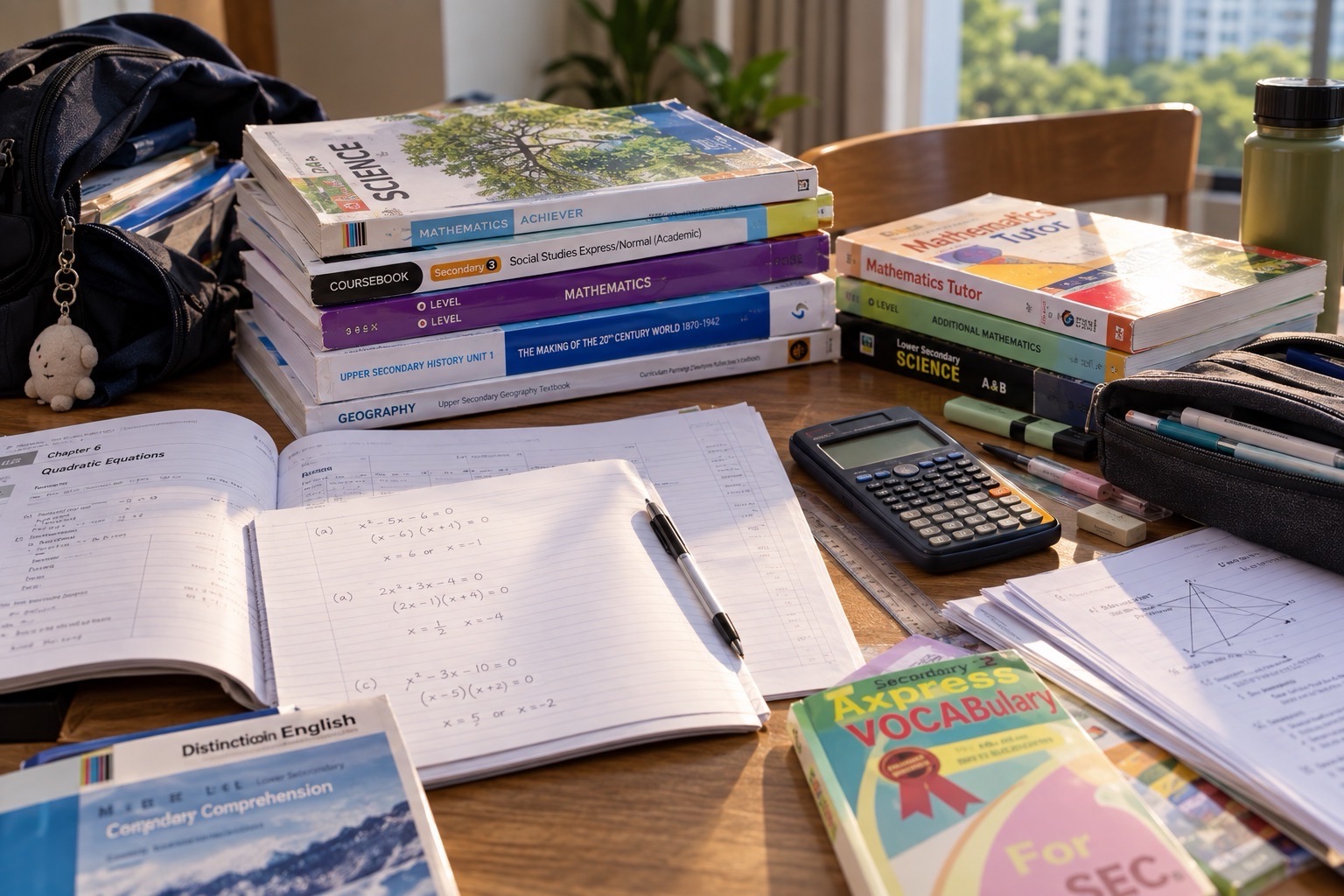
Singapore Math prime factorisation, HCF and LCM guide for families and teachers outside Singapore. What Secondary 1 students learn about primes, highest common factors and lowest common multiples, and how to practise them at home.
Every whole number greater than 1 is either a prime or a product of primes.
Writing it that way makes many problems shorter.
In Singapore Mathematics, factors, multiples, common factors and common multiples are Primary 4 topics. In Secondary 1, G3 Mathematics adds primes and prime factorisation, and uses them to find the HCF and LCM and to work with squares, cubes, square roots and cube roots.
These skills return in ratio, algebraic factorisation and algebraic fractions.
This guide is useful for families and teachers who want to:
- understand what Singapore expects at Secondary 1;
- teach prime factorisation at home in a clear sequence;
- prepare a child who is moving into a Singapore secondary school; or
- support a student using Singapore Math materials in another country.
Quick facts
Level: Secondary 1 (G3 Mathematics; also in G2)
Strand: Number and Algebra
Official source: MOE Secondary Mathematics Syllabuses (2020) and SEAB G3 Mathematics syllabus K310
Comes after: Factors and Multiples and Integers and Real Numbers
Leads to: Factorisation and Algebraic Fractions
What Prime Factorisation Means in Singapore Mathematics
A prime number has exactly two factors: 1 and itself. The first few primes are 2, 3, 5, 7, 11 and 13.
The number 1 is not prime, because it has only one factor.
Prime factorisation writes a number as a product of primes. For example, 360 = 2 × 2 × 2 × 3 × 3 × 5, which is written more briefly as 23 × 32 × 5.
Every whole number greater than 1 has exactly one prime factorisation, apart from the order of the factors.
The HCF (highest common factor) of two numbers is the largest number that divides both exactly. The LCM (lowest common multiple) is the smallest number that is a multiple of both.
Once both numbers are written as products of primes, the HCF and LCM can be read straight off.
Where Prime Factorisation Sits in the Singapore Syllabus
At Primary 4, students learn:
- factors, multiples and how they relate;
- testing whether a 1-digit number is a factor of a number within 100;
- common factors of two numbers;
- testing whether a number is a multiple of a 1-digit number; and
- common multiples of two 1-digit numbers.
In Secondary 1, G3 Mathematics (N1 Numbers and their operations) adds:
- primes and prime factorisation;
- HCF and LCM; and
- squares, cubes, square roots and cube roots by prime factorisation.
G2 Mathematics includes this content too.
| Level | What students do |
|---|---|
| Primary 4 | Factors, multiples, common factors, and common multiples of two 1-digit numbers |
| Primary 5 Foundation | Factors and multiples, as at Primary 4 Standard |
| Secondary 1 | Primes, prime factorisation, HCF and LCM; squares, cubes and roots by prime factorisation |
| Secondary 2 | Factorisation of algebraic expressions; algebraic fractions |
How Singapore Teaches Prime Factorisation, HCF and LCM
1. Recognise primes
Students test small numbers by trying to divide them by 2, 3, 5 and 7. A number with no factors other than 1 and itself is prime.
2. Factorise by repeated division
Divide by the smallest prime that works, then repeat with the result. 360 ÷ 2 = 180, 180 ÷ 2 = 90, 90 ÷ 2 = 45, 45 ÷ 3 = 15, 15 ÷ 3 = 5. A factor tree does the same job.
3. Write the result with powers
Group repeated primes: 360 = 23 × 32 × 5. The laws of indices come later, in Secondary 3 or 4.
4. Find the HCF
Take each prime that appears in both numbers, with the smaller power.
5. Find the LCM
Take every prime that appears in either number, with the larger power.
6. Use prime factors for roots
A perfect square has every prime to an even power, so halving each power gives the square root. For a cube root, divide each power by 3.
The prime factorisation does the hard work once. After that, HCF, LCM and roots are short steps.
Worked Examples
HCF and LCM by prime factorisation
Question: Find the HCF and LCM of 84 and 360.
Step 1. 84 = 22 × 3 × 7.
Step 2. 360 = 23 × 32 × 5.
Step 3. HCF: the common primes are 2 and 3. Take the smaller powers: 22 × 3 = 12.
Step 4. LCM: take every prime with its larger power: 23 × 32 × 5 × 7 = 2520.
Check: HCF × LCM = 12 × 2520 = 30 240, and 84 × 360 = 30 240. For two numbers, these products are always equal.
A square root by prime factorisation
Question: Find √1764 without a calculator.
Step 1. 1764 = 22 × 32 × 72.
Step 2. Every power is even, so 1764 is a perfect square.
Step 3. Halve each power: √1764 = 2 × 3 × 7 = 42.
Check: 42 × 42 = 1764.
Word problems often hide the HCF or LCM. “The largest number of identical bags” usually needs the HCF. “When will they next happen together” usually needs the LCM.
For example, 48 red beads and 60 blue beads are packed into identical bags with none left over. The HCF of 48 and 60 is 12, so the largest number of bags is 12, each holding 4 red and 5 blue beads.
Common Mistakes
- Counting 1 as a prime. The number 1 has only one factor. Fix: a prime has exactly two factors.
- Stopping at a composite factor. 360 = 23 × 45 is not finished. Fix: keep dividing until every factor is prime.
- Swapping the HCF and LCM rules. Fix: the HCF is never larger than the smaller number, and the LCM is never smaller than the larger number.
- Multiplying the numbers to get the LCM. 12 × 18 = 216, but the LCM of 12 and 18 is 36. Fix: use the prime factors and the larger power of each.
- Leaving out a prime. A prime found in only one number belongs in the LCM but not in the HCF. Fix: list every prime before choosing.
- Choosing the wrong tool in a word problem. Fix: ask whether the answer should be smaller or larger than the numbers given. Smaller suggests HCF; larger suggests LCM.
Teaching Prime Factorisation, HCF and LCM Outside Singapore
- HCF and GCF. Singapore says highest common factor (HCF). Other curricula say greatest common factor (GCF) or greatest common divisor (GCD). LCM is used in both, whether it is read as lowest or least common multiple.
- Powers in the answer. Prime factorisations are usually written with powers, as in 23 × 32 × 5. Teach the meaning of a power here, and leave the laws of indices for later.
- Timing. In Singapore’s current syllabus, factors and multiples are Primary 4 content and prime factorisation is Secondary 1 content. Your local curriculum may differ, so decide by readiness. The Singapore Math Grade Levels guide explains why.
- Working and calculators. An approved calculator may be used in both G3 Mathematics papers. The syllabus also notes that “Omission of essential working will result in loss of marks”, so the prime factorisation itself should be shown.
- Prerequisites. Fluent multiplication tables and quick divisibility checks for 2, 3 and 5 make this topic much easier.
How to Practise Prime Factorisation at Home
A few minutes a day keeps the method fresh.
- List the primes up to 50 using a hundred square and crossing out multiples.
- Factorise one number a day, once by repeated division and once with a factor tree.
- Write each answer with powers.
- Find the HCF and LCM of a pair of numbers from their prime factorisations.
- Check with the rule HCF × LCM = the product of the two numbers.
- Once a week, solve one word problem and say why it needs the HCF or the LCM.
Short, accurate practice is better than long lists.
Try These
- Express 252 as a product of its prime factors.
- Find the HCF and LCM of 72 and 120.
- Use prime factorisation to find √576.
- Find the smallest positive integer k such that 252k is a perfect square.
Answers
- 252 = 22 × 32 × 7, because 4 × 9 × 7 = 252.
- HCF = 24 and LCM = 360. 72 = 23 × 32 and 120 = 23 × 3 × 5, so HCF = 23 × 3 and LCM = 23 × 32 × 5.
- 24. 576 = 26 × 32, so √576 = 23 × 3 = 24.
- k = 7. The power of 7 in 252 is odd, and 252 × 7 = 1764 = 42 × 42.
What Comes Next
- Approximation and Significant Figures completes the Secondary 1 work on numbers.
- In Secondary 1 algebra, students extract common factors, which uses the same idea as the HCF. Factorisation in Secondary 2 takes it further.
- Algebraic Fractions in Secondary 2 uses common denominators, which are found like an LCM.
- Indices in Secondary 3 or 4 gives the laws behind the powers.
Prime factors are the building blocks that later algebra keeps returning to.
Frequently Asked Questions
When do Singapore students learn prime factorisation?
In Secondary 1 in G3 Mathematics, and G2 Mathematics includes it too. Factors, multiples, common factors and common multiples come earlier, in Primary 4.
Is 1 a prime number?
No. A prime has exactly two factors, and 1 has only one.
What is the difference between HCF and GCF?
There is no difference in meaning. HCF (highest common factor) is the Singapore term. GCF and GCD are names used elsewhere.
Why use prime factorisation instead of listing factors?
Listing works for small numbers. Prime factorisation is faster for larger numbers, and it also gives squares, cubes and their roots.
Does HCF × LCM always equal the product of the numbers?
For two numbers, yes. For three or more numbers, not in general. For 2, 4 and 8, the HCF is 2 and the LCM is 8, but 2 × 8 = 16 while 2 × 4 × 8 = 64.
Are calculators allowed for this topic?
An approved calculator may be used in both G3 Mathematics papers, but essential working must be shown.
Helpful Reading
- Singapore Mathematics | International Edition: Factors and Multiples
- Singapore Mathematics | International Edition: Integers and Real Numbers
- Singapore Mathematics | International Edition: Factorisation
- Secondary Mathematics: Prime Factors, Divisibility, HCF and LCM
- How Secondary 1 Factors, Multiples and Prime Structure Work
- Arithmetic to Algebra Dependency
- How to Make Sense of the SEC G3 Mathematics Syllabus
- MOE Secondary Mathematics Syllabuses (2020)
- SEAB G3 Mathematics Syllabus K310
Prime Factorisation in Singapore Mathematics
Break the number into primes.
Common primes, smaller powers: the HCF.
Every prime, larger powers: the LCM.
Even powers: a perfect square.
Taught this way, factors and multiples stop being lists to search.
They become a structure a student can see.
That structure carries straight into algebra.
Ask Bukit Timah Tutor
Bukit Timah Tutor teaches Mathematics in small groups of three students in Singapore.
If your child is learning Singapore Mathematics at home, in an international school or in a Singapore school, and you are unsure where to begin with this topic, send us a short message with the student’s level and one example of the work.
Bukit Timah Tutor
8 Fourth Avenue, Singapore 268674
Near Sixth Avenue MRT
Three-student Mathematics tutorials
By appointment
Properly taught kids shine a bright light into the future.
Singapore Mathematics | International Edition is a Bukit Timah Tutor guide series for families and teachers outside Singapore. It is not a textbook and is not affiliated with MOE, SEAB or any publisher. Syllabus details were checked against MOE and SEAB documents in October 2026. Always confirm current requirements with your school.
← Previous: Singapore Mathematics | International Edition: Integers and Real Numbers
Next: Singapore Mathematics | International Edition: Approximation and Significant Figures →
All 100 topics in the International Edition