
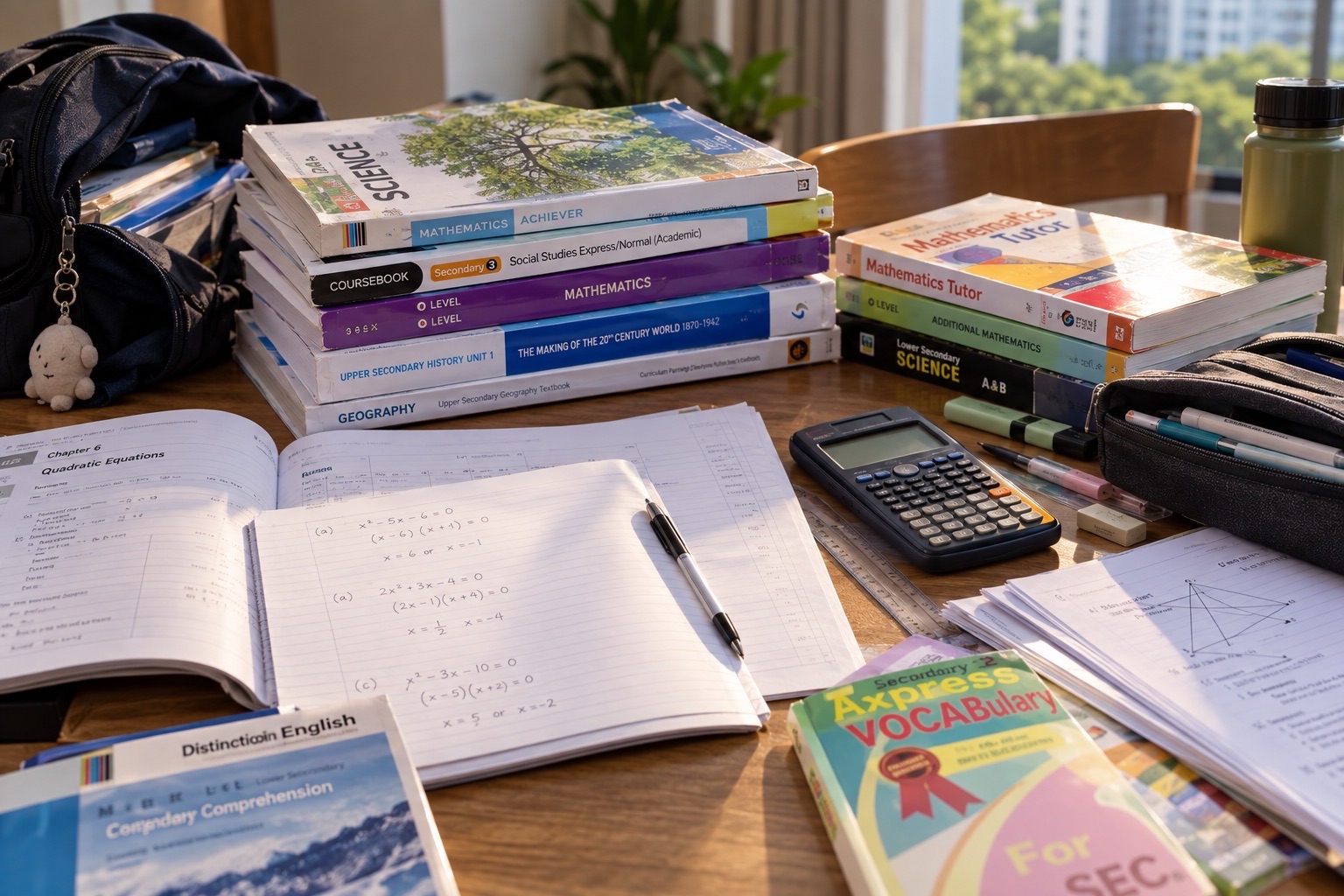
Singapore Math algebraic expressions guide for families and teachers outside Singapore. What Secondary 1 students learn about writing, reading, evaluating and simplifying expressions, and how to practise them at home.
An algebraic expression is a short, exact way to describe a quantity that can change.
Students who read expressions fluently find the rest of secondary algebra much lighter.
In Singapore Mathematics, algebraic expressions are a Secondary 1 topic in G3 Mathematics. Students use letters to represent numbers, interpret notation, evaluate expressions and formulae, and translate simple real-world situations into algebra. They also add, subtract and simplify linear expressions, use brackets and extract common factors.
In Secondary 2, this grows into expansion, factorisation, algebraic fractions and changing the subject of a formula.
This guide is useful for families and teachers who want to:
- understand what Singapore expects in Secondary 1 algebra;
- bridge from Primary 6 algebra to secondary algebra in a clear sequence;
- prepare a student who is moving into a Singapore secondary school; or
- support a student using Singapore Math materials in another country.
Quick facts
Level: Secondary 1 (G3 Mathematics; G2 Mathematics also includes this content)
Strand: Number and Algebra (N5 Algebraic expressions and formulae)
Official source: MOE Secondary Mathematics Syllabuses (2020 Secondary 1 cohort onwards) and SEAB G3 Mathematics syllabus K310 for the SEC from 2027 (O-Level 4052 in 2026)
Comes after: Algebra in Primary 6 and Integers and Real Numbers
Leads to: Expansion and Algebraic Identities and Linear Equations
What Algebraic Expressions Mean in Singapore Mathematics
An algebraic expression combines numbers, letters and operations, such as 3x + 5 or 2(a − b).
It has no equals sign. An expression names a quantity. An equation makes a statement that can be true or false.
The letter stands for a number. If a pen costs x dollars, then 4 pens cost 4x dollars, and 4 pens with a $2 file cost (4x + 2) dollars.
Singapore students meet this idea first in Primary 6, where a letter represents an unknown number. Secondary 1 extends it with negative numbers, brackets and longer expressions.
The Singapore Math to Algebra guide explains the move from bar models to symbols in more detail.
Where Algebraic Expressions Sit in the Singapore Syllabus
In MOE’s teaching syllabus for G3 Mathematics, this content sits in Secondary 1 under “Algebraic expressions and formulae”.
At Secondary 1, students learn:
- using letters to represent numbers;
- interpreting notation such as ab, a/b, a², 3y and 3(x + y);
- evaluating algebraic expressions and formulae;
- translating simple real-world situations into algebraic expressions;
- finding an algebraic expression for the nth term of a number pattern;
- adding and subtracting linear expressions;
- simplifying linear expressions; and
- using brackets and extracting common factors.
G2 Mathematics also includes algebraic expressions and formulae.
| Level | What students do with expressions |
|---|---|
| Primary 6 | A letter for an unknown number; simple expressions; simplifying simple linear expressions without brackets; evaluating by substitution |
| Secondary 1 | Notation, evaluation, real-world translation, the nth term, adding, subtracting and simplifying linear expressions, brackets and common factors |
| Secondary 2 | Expansion, the algebraic identities, factorisation, algebraic fractions and changing the subject of a formula |
How Singapore Teaches Algebraic Expressions
1. Start with a letter as a number
Students describe quantities they can picture: a box holds n pencils, so 3 boxes hold 3n pencils. The letter is a number that has not been fixed yet.
2. Read the notation exactly
3y means 3 × y. ab means a × b. a² means a × a. a/b means a ÷ b. 3(x + y) means 3 times the whole of x + y.
3. Evaluate by substitution
Replace each letter with its value, and put brackets around negative numbers. The rules from Order of Operations matter again here.
4. Collect like terms
Like terms have the same letter part. 5x and −2x are like terms. 5x and 5x² are not.
5. Use brackets and extract common factors
Multiply every term inside a bracket by the number outside. Then reverse the process: 6x + 9 = 3(2x + 3).
6. Translate words into expressions
Students turn short situations into algebra and state what each letter stands for.
Each step uses the one before it. A student who cannot read 3(x + y) correctly will struggle to simplify it.
Worked Examples
Simplifying with brackets
Question: Simplify 3(2x − 5) − 2(x − 4).
Step 1. Expand the first bracket: 3(2x − 5) = 6x − 15.
Step 2. Expand the second bracket, keeping the minus sign: −2(x − 4) = −2x + 8.
Step 3. Collect like terms: 6x − 2x − 15 + 8.
Step 4. Simplify: 4x − 7.
Check: Put x = 1 into both forms. 3(2 − 5) − 2(1 − 4) = −9 + 6 = −3, and 4(1) − 7 = −3.
The check does not prove the two forms are equal for every x, but it catches most slips quickly.
Writing and evaluating an expression
Question: A bicycle hire shop charges a fixed fee of $5 plus $3 for each hour. Write an expression for the charge for h hours, then find the charge for 4 hours.
Step 1. The hourly part for h hours is 3h dollars.
Step 2. The total charge is (3h + 5) dollars.
Step 3. When h = 4, the charge is 3(4) + 5 = 12 + 5 = 17, so the charge is $17.
Check: 4 hours at $3 is $12, and $12 + $5 = $17.
Common Mistakes
- Writing 2x + 3x as 5x². Adding like terms changes the number of x’s, not the power. Fix: say “2 lots of x plus 3 lots of x is 5 lots of x”, so the answer is 5x.
- Multiplying only the first term in a bracket. 4(x + 3) becomes 4x + 3. Fix: draw an arrow from the number outside to every term inside, giving 4x + 12.
- Losing the minus sign before a bracket. −(x − 4) becomes −x − 4. Fix: treat the sign as −1 and multiply every term: −(x − 4) = −x + 4.
- Combining unlike terms. 3x + 4 is written as 7x. Fix: underline like terms in the same colour before collecting. 3x + 4 cannot be simplified.
- Substituting negatives without brackets. With a = −3, a² is written as −9. Fix: always write (−3)² = 9.
- Taking out only part of a common factor. 12x + 18 becomes 2(6x + 9). Fix: use the highest common factor, 6, to get 6(2x + 3).
Teaching Algebraic Expressions Outside Singapore
Singapore Math materials use the same algebraic notation found in most English-language curricula.
A few points are worth knowing.
- Terminology. Singapore says “brackets” where US materials often say “parentheses”, and “extract common factors” or “factorise” where US materials say “factor”.
- Subject levels. G3 is the subject level mapped from the former Express standard. This page describes G3 Mathematics.
- Timing. In Singapore, this content is Secondary 1. Your local curriculum may place it differently, so decide by readiness rather than age. The Singapore Math Grade Levels guide explains why direct conversions are unreliable.
- Prerequisites. Expressions depend on negative numbers, order of operations and factors. If those are weak, repair them first.
- Calculators. In G3 Mathematics, an approved calculator may be used in both papers. Simplifying is still done by hand, and the syllabus notes that “Omission of essential working will result in loss of marks.”
How to Practise Algebraic Expressions at Home
A short, regular routine works better than one long weekend session.
- Say one expression aloud each day in words: “3(x + 2) means three lots of the whole of x + 2”.
- Simplify three expressions with like terms, including one with negative coefficients.
- Expand two brackets, one with a minus sign in front.
- Factorise one expression by taking out the highest common factor.
- Substitute values, including one negative value, into a formula.
- Once a week, write an expression for a real situation, such as the cost of n items with a fixed delivery charge.
Ten to fifteen minutes is enough when the work is focused.
Try These
- Simplify 5a + 3b − 2a + 4b.
- Expand and simplify 4(x + 3) − (x − 5).
- Factorise 12x + 18y.
- Evaluate a² − 3ab when a = −2 and b = 5.
Answers
- 3a + 7b, collecting the a terms and the b terms separately.
- 3x + 17. The expansion is 4x + 12 − x + 5.
- 6(2x + 3y), using the highest common factor 6.
- 34. (−2)² = 4 and −3 × (−2) × 5 = 30, so the value is 4 + 30 = 34.
What Comes Next
Expressions are the raw material of secondary algebra.
- In Secondary 1, they are used to write and solve Linear Equations.
- In Secondary 2, students expand products in Expansion and Algebraic Identities and reverse the process in Factorisation.
- Also in Secondary 2, Changing the Subject of a Formula treats a formula as something to rearrange.
A student who reads expressions accurately usually finds these later topics easier to learn.
Frequently Asked Questions
When do Singapore students learn algebraic expressions?
A letter for an unknown number begins in Primary 6. The fuller content, including negative numbers in expressions, brackets and common factors, is Secondary 1 in G3 Mathematics.
What is the difference between an expression and an equation?
An expression has no equals sign, such as 2x + 3. An equation states that two expressions are equal, such as 2x + 3 = 11, and can be solved.
Is the nth term of a sequence part of this topic?
Yes. MOE lists finding an algebraic expression for the nth term under algebraic expressions in Secondary 1. The Number Patterns and Sequences page covers it.
Does G2 Mathematics include algebraic expressions?
Yes. The G2 Mathematics syllabus also includes algebraic expressions and formulae.
My child did algebra in Primary 6. Why does Secondary 1 feel harder?
Primary 6 algebra simplifies simple expressions without brackets. Secondary 1 adds negative numbers, brackets and longer expressions, so sign errors appear. Short daily practice with a substitution check helps.
Should students check by substituting a number?
Yes. Putting a simple value such as x = 1 into the original and the simplified forms is a quick way to catch errors.
Helpful Reading
- Singapore Mathematics | International Edition: Algebra in Primary 6
- Singapore Mathematics | International Edition: Expansion and Algebraic Identities
- Singapore Mathematics | International Edition: Linear Equations
- Singapore Math to Algebra | Moving from Models and Arithmetic to Symbols
- Why Algebra Becomes the Language of Secondary Mathematics
- Secondary Mathematics: Signed Numbers, Brackets and Algebraic Structure
- How to Make Sense of the SEC G3 Mathematics Syllabus
- MOE Secondary Mathematics Syllabuses (2020)
- SEAB G3 Mathematics Syllabus K310
Algebraic Expressions in Singapore Mathematics
A letter is a number.
Notation is exact.
Like terms collect. Unlike terms stay apart.
Every term in a bracket is multiplied.
Check with a number before moving on.
Taught this way, expressions stop being strings of symbols.
They become a language a student can read, and that fluency carries a student from Secondary 1 into equations, expansion and factorisation.
Ask Bukit Timah Tutor
Bukit Timah Tutor teaches Mathematics in small groups of three students in Singapore.
If your child is learning Singapore Mathematics at home, in an international school or in a Singapore school, and you are unsure where to begin with this topic, send us a short message with the student’s level and one example of the work.
Bukit Timah Tutor
8 Fourth Avenue, Singapore 268674
Near Sixth Avenue MRT
Three-student Mathematics tutorials
By appointment
Properly taught kids shine a bright light into the future.
Singapore Mathematics | International Edition is a Bukit Timah Tutor guide series for families and teachers outside Singapore. It is not a textbook and is not affiliated with MOE, SEAB or any publisher. Syllabus details were checked against MOE and SEAB documents in October 2026. Always confirm current requirements with your school.
← Previous: Singapore Mathematics | International Edition: Rate and Speed
Next: Singapore Mathematics | International Edition: Expansion and Algebraic Identities →
All 100 topics in the International Edition