
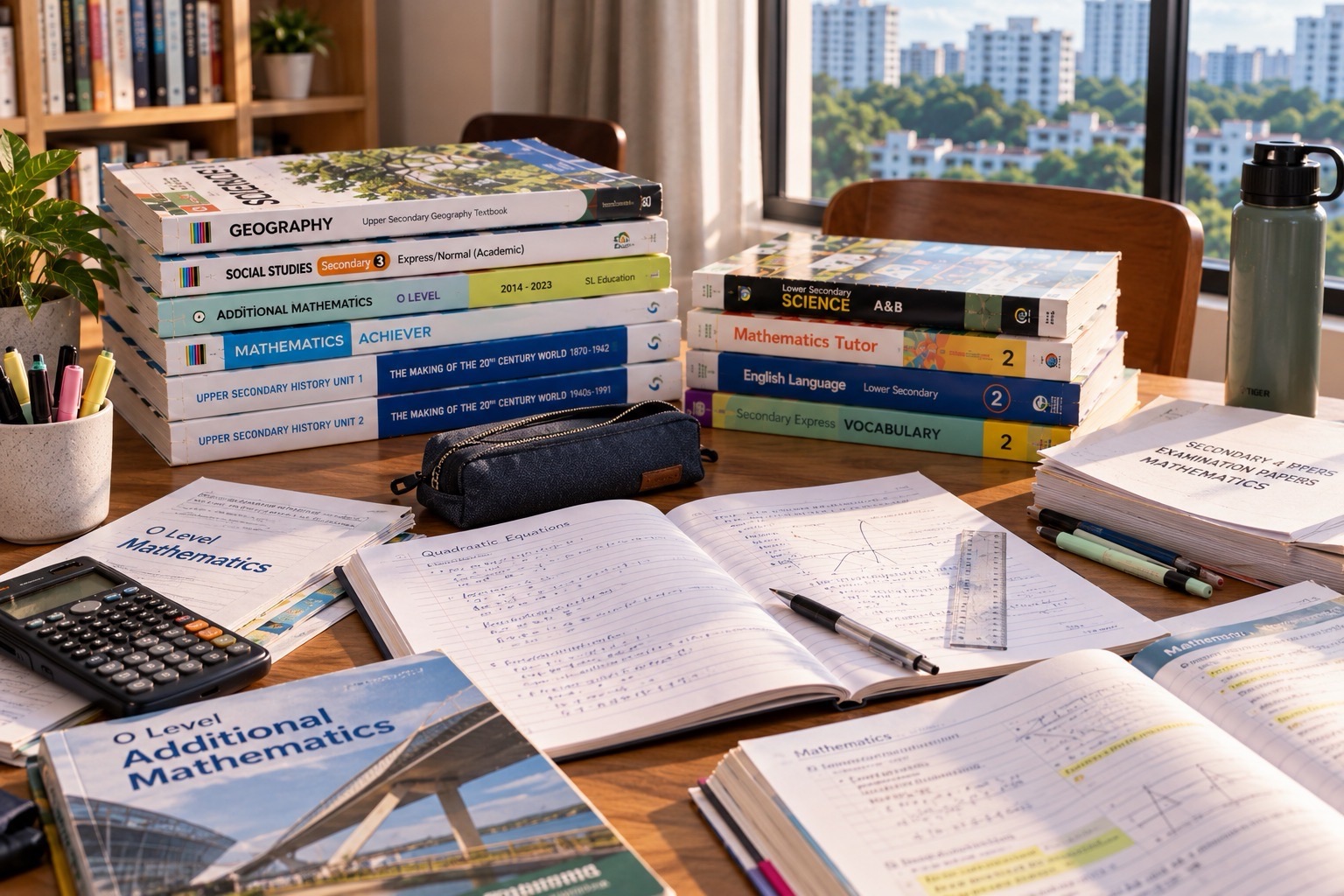
Singapore Math guide to changing the subject of a formula for families and teachers outside Singapore. What Secondary 2 students learn about rearranging formulae, how Singapore teaches it, and how to practise at home.
A formula can be read in more than one direction.
Changing the subject lets a student make any letter the one they want to find.
In Singapore Mathematics, students evaluate formulae from Secondary 1. In Secondary 2, G3 students learn to change the subject of a formula and to find the value of an unknown quantity in a given formula.
The skill is then used across the rest of the course, from mensuration to coordinate geometry, and in science subjects too.
This guide is useful for families and teachers who want to:
- understand what Singapore expects in Secondary 2 algebra;
- teach rearranging formulae as a natural extension of solving equations;
- prepare a student who is moving into a Singapore secondary school; or
- support a student using Singapore Math materials in another country.
Quick facts
Level: Secondary 2 (G3 Mathematics), building on evaluating formulae in Secondary 1
Strand: Number and Algebra (N5 Algebraic expressions and formulae)
Official source: MOE Secondary Mathematics Syllabuses (2020 Secondary 1 cohort onwards) and SEAB G3 Mathematics syllabus K310 for the SEC from 2027 (O-Level 4052 in 2026)
Comes after: Linear Equations and Algebraic Fractions
Leads to: Pyramids, Cones and Spheres and Coordinate Geometry
What Changing the Subject Means in Singapore Mathematics
The subject of a formula is the letter that stands alone on one side. In A = lb, the subject is A.
To change the subject is to rearrange the formula so that a different letter stands alone. From A = lb, making l the subject gives l = A/b.
The steps are the same as solving an equation. Whatever is done to one side is done to the other.
The difference is that the answer is an expression in other letters, not a single number.
Singapore students also meet the related task of finding an unknown in a formula. Given v = u + at with v = 20, u = 5 and t = 3, they find a = 5.
Where Changing the Subject Sits in the Singapore Syllabus
In MOE’s teaching syllabus for G3 Mathematics, the content builds over two years.
| Level | Content |
|---|---|
| Secondary 1 | Evaluation of algebraic expressions and formulae |
| Secondary 1 | Solving linear equations in one variable |
| Secondary 2 | Changing the subject of a formula |
| Secondary 2 | Finding the value of an unknown quantity in a given formula |
The formulae come from across the course, for example the mensuration formulae for prisms, cylinders, pyramids, cones and spheres.
In the G3 Mathematics examination, “Relevant mathematical formulae will be provided for candidates.” The list includes formulae such as the volume of a cone, ⅓πr²h. Students may still need to rearrange a given formula to find a radius or a height.
G2 Mathematics also includes changing the subject of a formula. MOE’s G2 sequence places some algebra items later than G3 does.
How Singapore Teaches Changing the Subject
1. Start from solving equations
Students solve 3x + 5 = 20, then solve 3x + 5 = y for x. The steps match: subtract 5, then divide by 3.
2. Undo operations in reverse order
Think about how the target letter was built up, then undo those steps in the opposite order.
3. Use inverse operations
Subtraction undoes addition, division undoes multiplication, and squaring undoes a square root.
4. Clear fractions early
Multiply both sides by the denominator to remove a fraction before isolating the letter.
5. Collect the target letter when it appears twice
If the new subject appears in two terms, bring those terms to one side and factorise.
6. Check by substituting numbers
Choose values, work out the original formula, then confirm that the rearranged formula gives back the value you started with.
Students who see changing the subject as “solving with letters” usually find it far less mysterious than a list of rules.
Worked Examples
Making r the subject
Question: The volume of a cylinder is V = πr²h. Make r the subject.
Step 1. Divide both sides by πh: r² = V/(πh).
Step 2. Take the square root. Since r is a length, use the positive root: r = √(V/(πh)).
Check: With r = 2 and h = 5, V = π × 4 × 5 = 20π. Then √(20π/(5π)) = √4 = 2.
When the subject appears twice
Question: Make x the subject of y = (x + 3)/(x − 2).
Step 1. Multiply both sides by (x − 2): y(x − 2) = x + 3.
Step 2. Expand: xy − 2y = x + 3.
Step 3. Bring the x terms to one side: xy − x = 2y + 3.
Step 4. Factorise: x(y − 1) = 2y + 3.
Step 5. Divide by (y − 1): x = (2y + 3)/(y − 1).
Check: Put x = 3. Then y = 6/1 = 6, and (2 × 6 + 3)/(6 − 1) = 15/5 = 3.
The second example uses expansion, factorisation and fractions together. That is why changing the subject is easier once those Secondary 2 skills are secure.
Common Mistakes
- Doing different things to each side. Students subtract from one side only. Fix: write the operation beside both sides, for example “−5 on both sides”.
- Undoing in the wrong order. In y = 3x + 5, students divide by 3 first and write x = y/3 − 5. Fix: subtract 5 first, then divide, so x = (y − 5)/3.
- Dividing only one term. From 2x = y + 4, students write x = y/2 + 4. Fix: divide the whole side, giving x = (y + 4)/2.
- Square rooting term by term. From x² = a² + b², students write x = a + b. Fix: x = √(a² + b²). A square root does not split over addition.
- Leaving the subject on both sides. x = (y + x)/3 is not finished. Fix: multiply by 3 and collect the x terms: 3x = y + x, so 2x = y and x = y/2.
- Ignoring the sign of a square root. Fix: for lengths and other positive quantities, state the positive root. Otherwise remember that x² = 9 gives x = 3 or x = −3.
Teaching Changing the Subject Outside Singapore
A few points are worth knowing when you use Singapore materials elsewhere.
- Terminology. Many US materials call this “solving literal equations” or “solving for a variable”. The skill is the same.
- Timing. In Singapore, this is Secondary 2 content in G3 Mathematics. The Singapore Math Grade Levels guide explains why age-based conversions are unreliable, so decide by readiness.
- Prerequisites. Linear equations, expansion, factorisation and algebraic fractions. Changing the subject draws on all of them.
- Formula list. A given formula still has to be rearranged by the student. Practise with the formulae that appear on the list, such as the volume of a cone and the curved surface area of a cone, πrl.
- Calculators. An approved calculator may be used in both G3 Mathematics papers. Rearranging first and substituting at the end keeps the working clear and avoids rounding too early.
How to Practise Changing the Subject at Home
A short, regular routine works better than one long weekend session.
- Solve one equation with numbers, then the same structure with letters, side by side.
- Rearrange two simple formulae, such as P = 2(l + b) for b and A = ½bh for h.
- Rearrange one formula with a square or a square root.
- Rearrange one formula where the new subject appears twice.
- Check each answer by substituting numbers into both forms.
- Once a week, take a formula from another subject, such as science, and make each letter the subject in turn.
Ten to fifteen minutes is enough when the work is focused.
Try These
- Make b the subject of P = 2(l + b).
- Make h the subject of A = ½bh.
- Make x the subject of y = √(x − 3).
- Make t the subject of a(t + 2) = bt.
Answers
- b = P/2 − l, which can also be written b = (P − 2l)/2. Divide both sides by 2, then subtract l.
- h = 2A/b. Multiply both sides by 2, then divide by b.
- x = y² + 3. Square both sides to get y² = x − 3, then add 3.
- t = 2a/(b − a). Expand to at + 2a = bt, then collect the t terms: 2a = bt − at = t(b − a).
What Comes Next
- In Secondary 2, Pyramids, Cones and Spheres uses formulae that students rearrange to find a radius or a height.
- In Secondary 3 or 4, Coordinate Geometry works with the equation of a straight line, y = mx + c, which is often rearranged.
- In Additional Mathematics, Linear Law transforms relationships such as y = axn into linear form.
A student who can rearrange a formula calmly has a tool that appears in almost every later topic.
Frequently Asked Questions
When do Singapore students learn to change the subject of a formula?
In Secondary 2, in G3 Mathematics. Evaluating formulae by substitution comes earlier, in Secondary 1.
Is changing the subject the same as solving an equation?
The steps are the same. The difference is that the answer is an expression in other letters, not a single number.
Should students substitute first or rearrange first?
For a single question with numbers, either works. When the same formula is used several times, rearranging first saves effort and avoids rounding too early.
Are formulae given in the examination?
For G3 Mathematics, “Relevant mathematical formulae will be provided for candidates.” The list includes mensuration formulae such as the volume of a cone. Students still need to rearrange them.
What if the new subject appears twice?
Collect both terms on one side and factorise, as in the second worked example.
Does G2 Mathematics include this?
Yes. G2 Mathematics includes changing the subject of a formula, although MOE’s G2 sequence places some algebra items later than G3 does.
Helpful Reading
- Singapore Mathematics | International Edition: Linear Equations
- Singapore Mathematics | International Edition: Algebraic Fractions
- Singapore Mathematics | International Edition: Pyramids, Cones and Spheres
- Secondary Mathematics: Algebraic Fractions, Formulae and Substitution
- How to Use a Maths Formula Sheet: Recall, Conditions, Substitution and Verification
- Why Does the Equal Sign Become Difficult in Secondary Mathematics?
- MOE Secondary Mathematics Syllabuses (2020)
- SEAB G3 Mathematics Syllabus K310
Changing the Subject in Singapore Mathematics
It is solving, with letters.
Undo in reverse order.
Do the same to both sides.
Collect the subject, then factorise.
Check with numbers.
Taught this way, a formula stops being fixed in one direction.
It becomes something a student can turn around, and that skill carries a student through mensuration, coordinate geometry and beyond.
Ask Bukit Timah Tutor
Bukit Timah Tutor teaches Mathematics in small groups of three students in Singapore.
If your child is learning Singapore Mathematics at home, in an international school or in a Singapore school, and you are unsure where to begin with this topic, send us a short message with the student’s level and one example of the work.
Bukit Timah Tutor
8 Fourth Avenue, Singapore 268674
Near Sixth Avenue MRT
Three-student Mathematics tutorials
By appointment
Properly taught kids shine a bright light into the future.
Singapore Mathematics | International Edition is a Bukit Timah Tutor guide series for families and teachers outside Singapore. It is not a textbook and is not affiliated with MOE, SEAB or any publisher. Syllabus details were checked against MOE and SEAB documents in October 2026. Always confirm current requirements with your school.
← Previous: Singapore Mathematics | International Edition: Algebraic Fractions
Next: Singapore Mathematics | International Edition: Linear Equations →
All 100 topics in the International Edition