
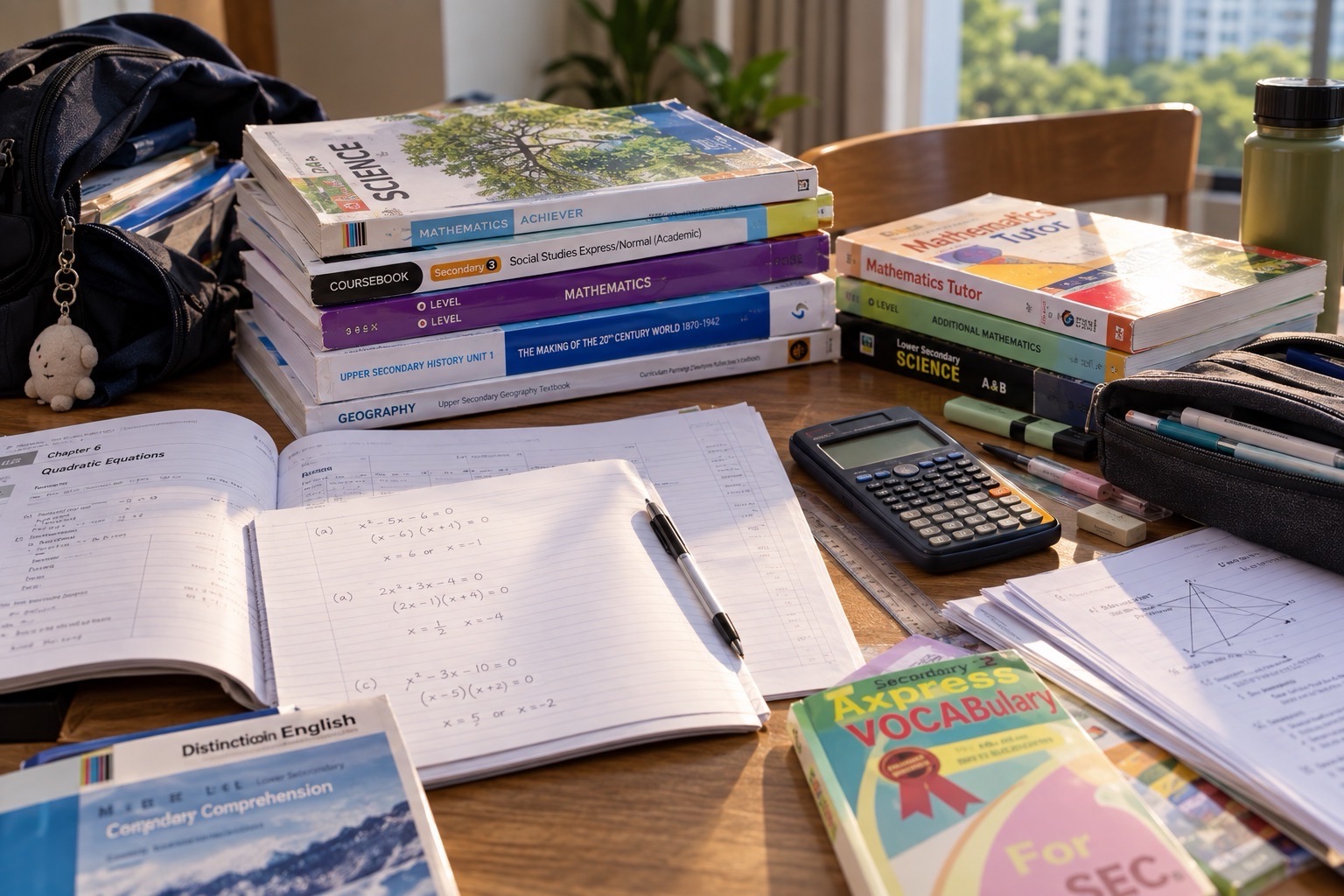
Singapore Math coordinate geometry guide for families and teachers outside Singapore. What Secondary 3 or 4 students learn about gradient, length and straight-line equations, and how to practise at home.
Coordinate geometry turns shapes into numbers.
A line becomes an equation, and a distance becomes a calculation.
In Singapore Mathematics, coordinate geometry is Secondary 3 or 4 content in G3 Mathematics, and it is also in G2 Mathematics. Students find the gradient of a line from two points, the length of a line segment and the equation of a line in the form y = mx + c, then use coordinates to solve geometric problems.
The topic builds on linear graphs from Secondary 1 and 2. It continues in Additional Mathematics with midpoints, perpendicular lines and circles.
This guide is useful for families and teachers who want to:
- understand what Singapore expects in Secondary 3 or 4;
- teach gradient, length and straight-line equations in a clear sequence;
- prepare a student who is moving into a Singapore secondary school; or
- support a student using Singapore Math materials in another country.
Quick facts
Level: Secondary 3 or 4 (G3 Mathematics; also in G2 Mathematics)
Strand: Geometry and Measurement
Official source: SEAB G3 Mathematics syllabus K310 (SEC, from 2027; O-Level 4052 in 2026), with year placement from MOE’s 2020 secondary Mathematics syllabus
Comes after: Linear Graphs and Gradient and Pythagoras’ Theorem
Leads to: Vectors and Coordinate Geometry of Circles
What Coordinate Geometry Means in Singapore Mathematics
Every point on a Cartesian plane has coordinates (x, y). Coordinate geometry uses those numbers to describe lines and shapes.
Three tools do most of the work:
- gradient measures steepness: m = (y2 − y1) ÷ (x2 − x1), the vertical change divided by the horizontal change;
- length of a segment comes from Pythagoras’ theorem: √((x2 − x1)² + (y2 − y1)²); and
- the equation y = mx + c describes a straight line with gradient m that crosses the y-axis at (0, c).
A positive gradient rises from left to right. A negative gradient falls. A horizontal line has gradient 0.
A vertical line, such as x = 3, has no numerical gradient, because the horizontal change is zero.
A point lies on a line exactly when its coordinates satisfy the line’s equation.
Where Coordinate Geometry Sits in the Singapore Syllabus
The SEAB G3 Mathematics syllabus lists “Coordinate geometry” in the Geometry and Measurement strand. MOE’s teaching syllabus places it in Secondary 3 or 4. The same content appears in G2 Mathematics.
The syllabus lists:
- “finding the gradient of a straight line given the coordinates of two points on it”;
- “finding the length of a line segment given the coordinates of its end points”;
- “interpreting and finding the equation of a straight line graph in the form y = mx + c”; and
- “geometric problems involving the use of coordinates”.
| Level | Related content |
|---|---|
| Secondary 1 | Cartesian coordinates; linear functions y = ax + b; gradient as vertical change over horizontal change |
| Secondary 2 | Graphs of linear equations ax + by = c; solving simultaneous equations by the graphical method |
| Secondary 3 or 4 | Gradient from two points; length of a segment; y = mx + c; geometric problems |
| Additional Mathematics | Parallel and perpendicular lines; midpoints; area of rectilinear figures; equations of circles |
Midpoints, the condition for two lines to be parallel or perpendicular, and the area of a rectilinear figure are listed in the Additional Mathematics syllabus, not in the G3 Mathematics list above.
Non-exact answers, such as √80, are given correct to 3 significant figures unless the question says otherwise.
How Singapore Teaches Coordinate Geometry
1. Sketch first
Students sketch the points before calculating. A quick sketch shows whether the gradient should be positive or negative, and roughly how long a segment is.
2. Gradient as rise over run
Counting squares on a grid gives vertical change ÷ horizontal change. The formula is the same count written with coordinates.
3. Length from a right-angled triangle
The horizontal and vertical changes form the two shorter sides of a right-angled triangle. The segment is the hypotenuse.
4. Find the equation
Calculate m, substitute one point into y = mx + c, and solve for c.
5. Read an equation
Rearrange into y = mx + c before reading the gradient and the y-intercept. For 2y = 3x − 8, the gradient is 3/2, not 3.
6. Solve geometric problems
Check whether a point lies on a line, find where a line meets the axes, or find the area of a triangle formed with the axes.
Worked Examples
Gradient, length and equation
Question: A is (−1, 3) and B is (3, 11). Find the gradient of AB, the length of AB and the equation of the line AB.
Step 1. Gradient = (11 − 3) ÷ (3 − (−1)) = 8 ÷ 4 = 2.
Step 2. Length AB = √(4² + 8²) = √80 = 8.944…, which is 8.94 units.
Step 3. The line is y = 2x + c. Substituting A(−1, 3) gives 3 = 2(−1) + c, so c = 5.
Step 4. The equation is y = 2x + 5.
Check: Substitute B(3, 11): 2(3) + 5 = 11, so B lies on the line.
A geometric problem
Question: The line y = −2x + 6 meets the x-axis at P and the y-axis at Q. O is the origin. Find the area of triangle OPQ and the length of PQ.
Step 1. At Q, x = 0, so y = 6. Q is (0, 6).
Step 2. At P, y = 0, so −2x + 6 = 0 and x = 3. P is (3, 0).
Step 3. Triangle OPQ is right-angled at O, so its area = ½ × 3 × 6 = 9 square units.
Step 4. PQ = √(3² + 6²) = √45 = 6.708…, which is 6.71 units.
Check: The gradient of PQ is (6 − 0) ÷ (0 − 3) = −2, which matches the equation.
Common Mistakes
- Subtracting in different orders. Writing (y2 − y1) ÷ (x1 − x2) flips the sign. Fix: take both differences in the same order, starting from the same point.
- Putting x over y. Gradient is vertical change over horizontal change. Fix: say “rise over run” and write the y difference on top.
- Reading m before rearranging. In 2y = 3x − 8, the gradient is not 3. Fix: divide through first to get y = 1.5x − 4.
- Losing negative signs. 3 − (−1) is 4, not 2. Fix: put negative coordinates in brackets when substituting.
- Treating c as the x-intercept. c is where the line crosses the y-axis. Fix: set x = 0 for the y-intercept and y = 0 for the x-intercept.
- Measuring length from a graph. Unequal scales on the axes distort lengths. Fix: calculate the length from the coordinates.
Teaching Coordinate Geometry Outside Singapore
Coordinate geometry is taught widely, but the notation and the grouping of topics vary.
- Notation. y = mx + c is the usual Singapore and UK form. Many US books write y = mx + b. The c and the b are the same y-intercept.
- Timing. In Singapore, this topic is Secondary 3 or 4 content, after linear graphs in Secondary 1 and 2. Your local curriculum may place it at a different stage, so decide by readiness. The Singapore Math Grade Levels guide explains why direct conversions are unreliable.
- What is not here. If your materials teach midpoints and perpendicular gradients with this topic, note that Singapore lists them in Additional Mathematics.
- Prerequisites. Students need negative numbers, Pythagoras’ theorem and confident solving of linear equations.
- Calculators. An approved calculator may be used in both papers of G3 Mathematics. It helps with square roots, but clear working with coordinates still matters.
How to Practise Coordinate Geometry at Home
A short, regular routine works better than one long weekend session.
- Plot two points on squared paper and count the rise and run before using the formula.
- Find the gradients of three lines: one positive, one negative and one horizontal.
- Find the lengths of two segments, one with negative coordinates.
- Find the equation of one line from two points, then check it with the second point.
- Rearrange two equations, such as 3y − 6x = 9, into y = mx + c and read off m and c.
- Once a week, solve one problem that finds where a line meets the axes and the area of the triangle formed.
Sketching first catches most sign errors before they happen.
Try These
- Find the gradient of the line through (2, 3) and (6, 11).
- Find the length of the line segment joining (1, 1) and (7, 9).
- Find the equation of the line with gradient −3 that passes through (2, 4).
- Find the gradient and the y-intercept of the line 2y = 3x − 8.
Answers
- 2, because (11 − 3) ÷ (6 − 2) = 8 ÷ 4 = 2.
- 10 units, because √(6² + 8²) = √100 = 10.
- y = −3x + 10, because 4 = −3(2) + c gives c = 10.
- Gradient 3/2 and y-intercept −4, because the equation rearranges to y = 1.5x − 4.
What Comes Next
Coordinate geometry opens the way to vectors and to the algebra of curves.
- For G3 students, Vectors describe the movement from one point to another, and a vector’s magnitude uses the same √(x² + y²).
- In Additional Mathematics, coordinate geometry continues with parallel and perpendicular lines, midpoints and, in Coordinate Geometry of Circles, the equations of circles.
- Also in Additional Mathematics, Linear Law transforms relationships such as y = axn into straight-line form to find unknown constants.
Each of these depends on reading y = mx + c fluently.
Frequently Asked Questions
When do Singapore students learn coordinate geometry?
Linear graphs and gradient begin in Secondary 1. The coordinate geometry topic, with gradient from two points, lengths and y = mx + c, is Secondary 3 or 4 content in G3 Mathematics, and it is also in G2 Mathematics.
Is the midpoint formula in G3 Mathematics?
The midpoint of a line segment is listed in the Additional Mathematics syllabus, not in the G3 Mathematics coordinate geometry list.
Are perpendicular gradients included?
The condition for two lines to be parallel or perpendicular is listed in Additional Mathematics.
Is the length formula on the formula list?
No. The length of a segment comes from Pythagoras’ theorem, which students are expected to know.
What does “interpreting” y = mx + c mean?
Reading the gradient and the y-intercept from an equation and explaining them. In a real context, for example, c might be a starting value and m a rate of change.
Why does my child keep getting the sign of the gradient wrong?
Usually the coordinates are subtracted in different orders. Sketching the points first shows whether the line rises or falls.
Helpful Reading
- Singapore Mathematics | International Edition: Linear Graphs and Gradient
- Singapore Mathematics | International Edition: Pythagoras’ Theorem
- Singapore Mathematics | International Edition: Vectors
- Why Does Coordinate Geometry Feel Like Algebra and Geometry at the Same Time?
- Secondary Mathematics: Coordinate Geometry, Gradient, Distance and Line Equations
- Vectors and Coordinate Geometry | Mathematics Knowledge Object
- How to Make Sense of the SEC G3 Mathematics Syllabus
- SEAB G3 Mathematics Syllabus K310 (PDF)
- MOE Secondary Mathematics Syllabuses (2020)
Coordinate Geometry in Singapore Mathematics
Sketch the points.
Rise over run, in the same order.
Pythagoras’ theorem for length.
Substitute one point to find c.
Check with the other.
Taught this way, coordinate geometry joins algebra and geometry into one skill.
Every straight line has an equation, and every linear equation draws a straight line.
Ask Bukit Timah Tutor
Bukit Timah Tutor teaches Mathematics in small groups of three students in Singapore.
If your child is learning Singapore Mathematics at home, in an international school or in a Singapore school, and you are unsure where to begin with this topic, send us a short message with the student’s level and one example of the work.
Bukit Timah Tutor
8 Fourth Avenue, Singapore 268674
Near Sixth Avenue MRT
Three-student Mathematics tutorials
By appointment
Properly taught kids shine a bright light into the future.
Singapore Mathematics | International Edition is a Bukit Timah Tutor guide series for families and teachers outside Singapore. It is not a textbook and is not affiliated with MOE, SEAB or any publisher. Syllabus details were checked against MOE and SEAB documents in October 2026. Always confirm current requirements with your school.
← Previous: Singapore Mathematics | International Edition: Circle Properties
Next: Singapore Mathematics | International Edition: Vectors →
All 100 topics in the International Edition