
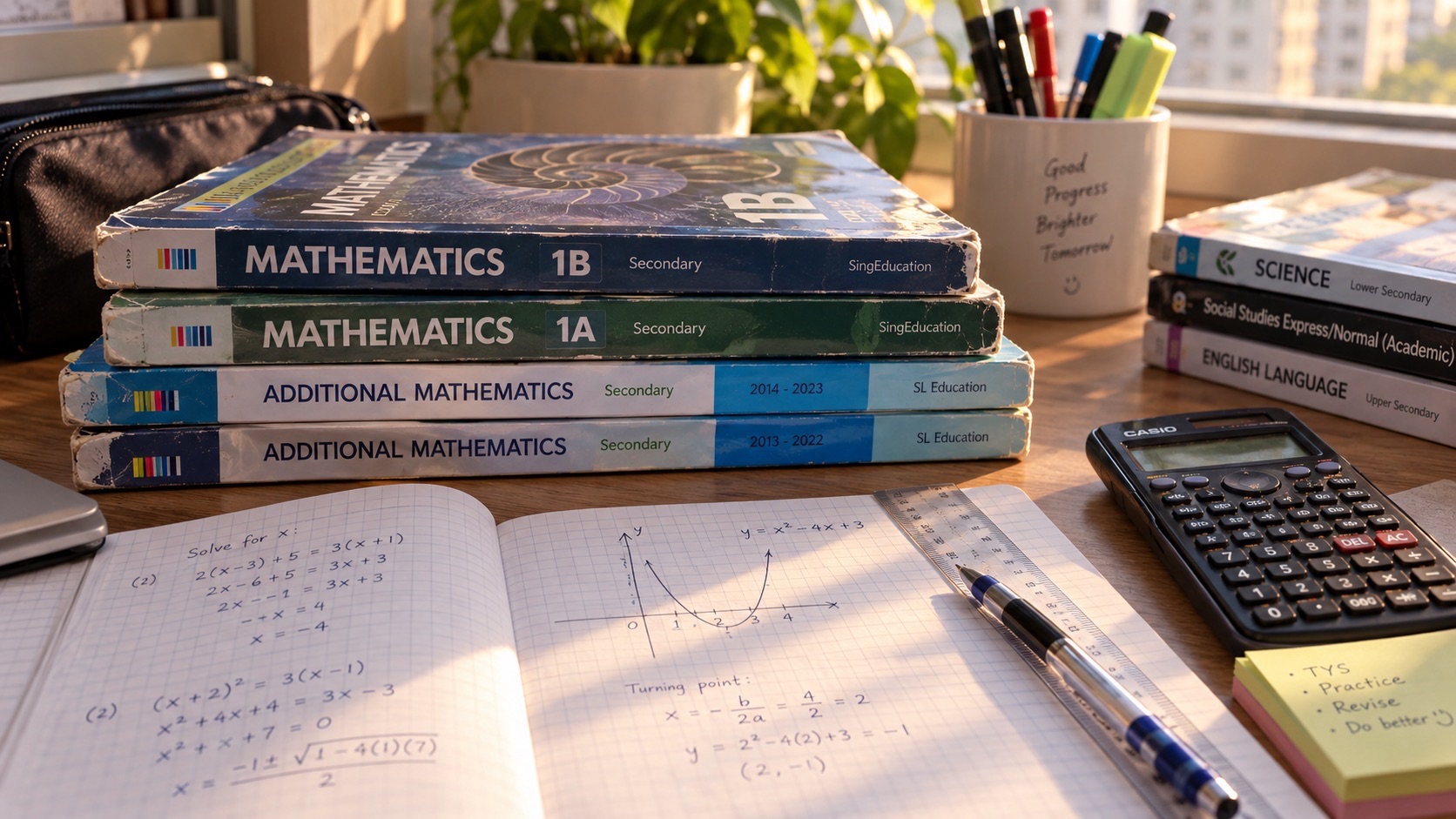
Singapore Math circle properties guide for families and teachers outside Singapore. The symmetry and angle properties Secondary 3 or 4 students learn, how they are taught, and how to practise them at home.
A circle looks simple, but the chords, tangents and angles inside it follow strict rules.
Once students know the rules and the reasons behind them, many geometry questions become a chain of short steps.
In Singapore Mathematics, circle properties are Secondary 3 or 4 content in G3 Mathematics, and they are also in G2 Mathematics. The syllabus lists four symmetry properties and five angle properties.
Students who take Additional Mathematics use these properties again in proofs in plane geometry.
This guide is useful for families and teachers who want to:
- understand exactly which circle properties Singapore lists;
- teach them with reasons, not only rules;
- prepare a student who is moving into a Singapore secondary school; or
- support a student using Singapore Math materials in another country.
Quick facts
Level: Secondary 3 or 4 (G3 Mathematics; also in G2 Mathematics)
Strand: Geometry and Measurement
Official source: SEAB G3 Mathematics syllabus K310 (SEC, from 2027; O-Level 4052 in 2026), with year placement from MOE’s 2020 secondary Mathematics syllabus
Comes after: Polygons and Angle Sums and Congruence and Similarity
Leads to: Proofs in Plane Geometry and Coordinate Geometry of Circles
What Circle Properties Mean in Singapore Mathematics
A few words come first.
- A chord is a straight line joining two points on the circle. A diameter is a chord through the centre.
- A tangent is a straight line that touches the circle at exactly one point.
- A segment is the region between a chord and an arc. The two regions on either side of a chord are opposite segments.
- An angle at the circumference has its vertex on the circle. An angle at the centre has its vertex at the centre.
Circle properties describe what must be true in every circle. They fall into two groups: symmetry properties, about chords, tangents and the centre, and angle properties, about angles formed inside the circle.
Many of them rest on one fact. Every radius has the same length, so a triangle with two radii as sides is isosceles.
Where Circle Properties Sit in the Singapore Syllabus
The SEAB G3 Mathematics syllabus lists “Properties of circles” in the Geometry and Measurement strand. MOE’s teaching syllabus places it in Secondary 3 or 4. The same content appears in G2 Mathematics.
The symmetry properties of circles are:
- “equal chords are equidistant from the centre”;
- “the perpendicular bisector of a chord passes through the centre”;
- “tangents from an external point are equal in length”; and
- “the line joining an external point to the centre of the circle bisects the angle between the tangents”.
The angle properties of circles are:
- “angle in a semicircle is a right angle”;
- “angle between tangent and radius of a circle is a right angle”;
- “angle at the centre is twice the angle at the circumference”;
- “angles in the same segment are equal”; and
- “angles in opposite segments are supplementary”.
The last property is the one often stated as “opposite angles of a cyclic quadrilateral add up to 180°”.
The alternate segment theorem, also called the tangent-chord theorem, is not in this list. It appears in the Additional Mathematics syllabus, under proofs in plane geometry.
| Level | Related content |
|---|---|
| Secondary 1 | Angles on a straight line and at a point; parallel lines; properties of triangles and polygons |
| Secondary 2 | Congruent and similar triangles; Pythagoras’ theorem |
| Secondary 3 or 4 | The symmetry and angle properties of circles |
| Additional Mathematics | Proofs in plane geometry using circle properties, including the tangent-chord theorem |
How Singapore Teaches Circle Properties
1. Draw the radii
Joining the centre to points on the circle reveals isosceles triangles. Many properties follow from them.
2. Discover by measuring
Students draw several angles in a semicircle and measure each one. All are 90°. The property is then explained, not only stated.
3. Link chords to the centre
Folding a paper circle so that the two ends of a chord meet shows that the fold, the perpendicular bisector, passes through the centre.
4. Spot the shape of each property
The angle at the centre property often looks like an arrowhead. Angles in the same segment look like a bow tie. Opposite segments form a cyclic quadrilateral. Seeing the shape helps students choose the property.
5. Write the reason
Each step in a solution names the property used, such as “(angle at centre = 2 × angle at circumference)”. The syllabus notes that omission of essential working results in loss of marks.
6. Combine with earlier geometry
Circle questions usually also need angle sums, isosceles triangles, parallel lines or Pythagoras’ theorem.
Worked Examples
Angle at the centre
Question: A, B and C lie on a circle with centre O, and C is on the major arc AB. Angle ACB = 34°. Find angle AOB and angle OAB.
Step 1. Angles AOB and ACB stand on the same arc AB, so angle AOB = 2 × 34° = 68° (angle at centre = 2 × angle at circumference).
Step 2. OA = OB because both are radii, so triangle AOB is isosceles.
Step 3. Angle OAB = (180° − 68°) ÷ 2 = 56° (base angles of an isosceles triangle).
Check: 68° + 56° + 56° = 180°, so the angles of triangle AOB add up correctly.
Tangents from an external point
Question: TA and TB are tangents from a point T to a circle with centre O. Angle ATB = 50°. Find angle AOB, angle TAB and angle ATO.
Step 1. Angle OAT = angle OBT = 90° (tangent perpendicular to radius).
Step 2. In quadrilateral OATB, angle AOB = 360° − 90° − 90° − 50° = 130° (angle sum of a quadrilateral).
Step 3. TA = TB (tangents from an external point), so triangle TAB is isosceles and angle TAB = (180° − 50°) ÷ 2 = 65°.
Step 4. OT bisects angle ATB (line from external point to centre), so angle ATO = 25°.
Check: In triangle OAT, angle AOT = 180° − 90° − 25° = 65°, which is half of 130°, as the symmetry requires.
Common Mistakes
- Doubling across different arcs. The angle at the centre is twice the angle at the circumference only when both stand on the same arc. Fix: trace the arc each angle stands on before doubling or halving.
- Assuming a chord is a diameter. The angle in a semicircle is 90° only if the chord passes through the centre. Fix: check that the centre lies on the line.
- Treating any quadrilateral as cyclic. Opposite angles add up to 180° only when all four vertices lie on the circle. Fix: check every vertex is on the circumference.
- Missing the tangent and radius right angle. A diagram with a tangent nearly always hides a 90° angle. Fix: draw the radius to the point of contact and mark the right angle.
- Confusing same and opposite segments. Angles in the same segment are equal, but angles in opposite segments add up to 180°. Fix: check whether the two angles are on the same side of the chord.
- Giving answers without reasons. A correct angle with no property named may not earn full marks. Fix: write a short reason in brackets after each step.
Teaching Circle Properties Outside Singapore
The geometry is the same everywhere. The names and the list of what is included can differ.
- Names. Many books call these “circle theorems” and give each one a short name. The Singapore syllabus calls them the symmetry properties and angle properties of circles. Check your materials against the nine listed above.
- The alternate segment theorem. Some curricula teach it alongside the others. In Singapore it appears in Additional Mathematics, not in the G3 Mathematics list.
- Timing. In Singapore this is Secondary 3 or 4 content. Your local curriculum may place it at a different stage, so decide by readiness rather than age. The Singapore Math Grade Levels guide explains why direct conversions are unreliable.
- Prerequisites. Students need angle facts from Secondary 1, isosceles triangle properties and Pythagoras’ theorem for chord and tangent lengths.
- Instruments. Candidates are expected to bring geometrical instruments to both papers. A pair of compasses makes accurate practice diagrams easy.
How to Practise Circle Properties at Home
A short, regular routine works better than one long weekend session.
- Draw a large circle with compasses and mark its centre. Draw one example of each of the nine properties and label it.
- Measure angles in a semicircle and angles in the same segment to see the properties hold.
- Make a one-page sheet with a small sketch and the exact wording of each property.
- Solve two angle questions, writing a reason for every step.
- Solve one chord or tangent length question using Pythagoras’ theorem.
- Once a week, cover the reasons in a finished solution and ask the student to supply them.
Naming the property matters as much as finding the angle.
Try These
- AB is a diameter of a circle and C is a point on the circle. Angle CAB = 28°. Find angle ABC.
- ABCD is a cyclic quadrilateral with angle DAB = 105°. Find angle BCD.
- A chord of length 16 cm lies in a circle of radius 10 cm. Find the distance of the chord from the centre.
- A point T is 13 cm from the centre O of a circle of radius 5 cm. TA is a tangent touching the circle at A. Find TA.
Answers
- 62°. Angle ACB = 90° (angle in a semicircle), so angle ABC = 180° − 90° − 28° = 62°.
- 75°. Angles in opposite segments are supplementary, so angle BCD = 180° − 105° = 75°.
- 6 cm. The perpendicular bisector of the chord passes through the centre, so the shortest distance meets the chord at its midpoint. That gives a right-angled triangle with hypotenuse 10 cm and side 8 cm, and √(10² − 8²) = √36 = 6.
- 12 cm. Angle OAT = 90° (tangent perpendicular to radius), so TA = √(13² − 5²) = √144 = 12.
What Comes Next
Circle properties feed into proof and into the algebra of circles.
- In Additional Mathematics, Proofs in Plane Geometry uses these properties with congruent and similar triangles, the midpoint theorem and the tangent-chord theorem.
- Also in Additional Mathematics, Coordinate Geometry of Circles describes circles with equations such as (x − a)² + (y − b)² = r².
- Arc Length, Sector Area and Radians measures the parts of a circle that these properties describe.
Students who can name a reason for every step are ready for formal proof.
Frequently Asked Questions
When do Singapore students learn circle properties?
In Secondary 3 or 4 in G3 Mathematics. The same properties are also in G2 Mathematics.
How many circle properties are in the syllabus?
Nine: four symmetry properties and five angle properties, listed in full above.
Is the alternate segment theorem included?
Not in the G3 Mathematics list. The tangent-chord theorem, also called the alternate segment theorem, appears in Additional Mathematics under proofs in plane geometry.
Do students have to prove the properties?
Proofs in plane geometry are a named topic in Additional Mathematics. In G3 Mathematics, students mainly use the properties, although the assessment objectives include justifying statements and writing mathematical arguments.
What is a cyclic quadrilateral?
A quadrilateral with all four vertices on a circle. Its opposite angles lie in opposite segments, so they add up to 180°.
Why does my child find circle questions hard?
Usually the difficulty is seeing which property applies in a crowded diagram. Practise spotting the shapes: the arrowhead, the bow tie and the cyclic quadrilateral.
Helpful Reading
- Singapore Mathematics | International Edition: Polygons and Angle Sums
- Singapore Mathematics | International Edition: Proofs in Plane Geometry
- Singapore Mathematics | International Edition: Arc Length, Sector Area and Radians
- Why Do Circle Theorems Feel Like Too Many Unrelated Rules?
- Secondary Mathematics: Circle Symmetry, Equal Chords, Tangent Pairs and Centre Lines
- Why Does My Child Misread Mathematics Diagrams?
- How to Make Sense of the SEC G3 Mathematics Syllabus
- SEAB G3 Mathematics Syllabus K310 (PDF)
- MOE Secondary Mathematics Syllabuses (2020)
Circle Properties in Singapore Mathematics
Draw the radii.
Find the isosceles triangles.
Trace the arc each angle stands on.
Look for the right angles: the semicircle, the tangent and the radius.
Name the property for every step.
Taught this way, nine properties become one connected picture.
A crowded diagram becomes a short chain of reasons.
Ask Bukit Timah Tutor
Bukit Timah Tutor teaches Mathematics in small groups of three students in Singapore.
If your child is learning Singapore Mathematics at home, in an international school or in a Singapore school, and you are unsure where to begin with this topic, send us a short message with the student’s level and one example of the work.
Bukit Timah Tutor
8 Fourth Avenue, Singapore 268674
Near Sixth Avenue MRT
Three-student Mathematics tutorials
By appointment
Properly taught kids shine a bright light into the future.
Singapore Mathematics | International Edition is a Bukit Timah Tutor guide series for families and teachers outside Singapore. It is not a textbook and is not affiliated with MOE, SEAB or any publisher. Syllabus details were checked against MOE and SEAB documents in October 2026. Always confirm current requirements with your school.
← Previous: Singapore Mathematics | International Edition: Arc Length, Sector Area and Radians
Next: Singapore Mathematics | International Edition: Coordinate Geometry →
All 100 topics in the International Edition