
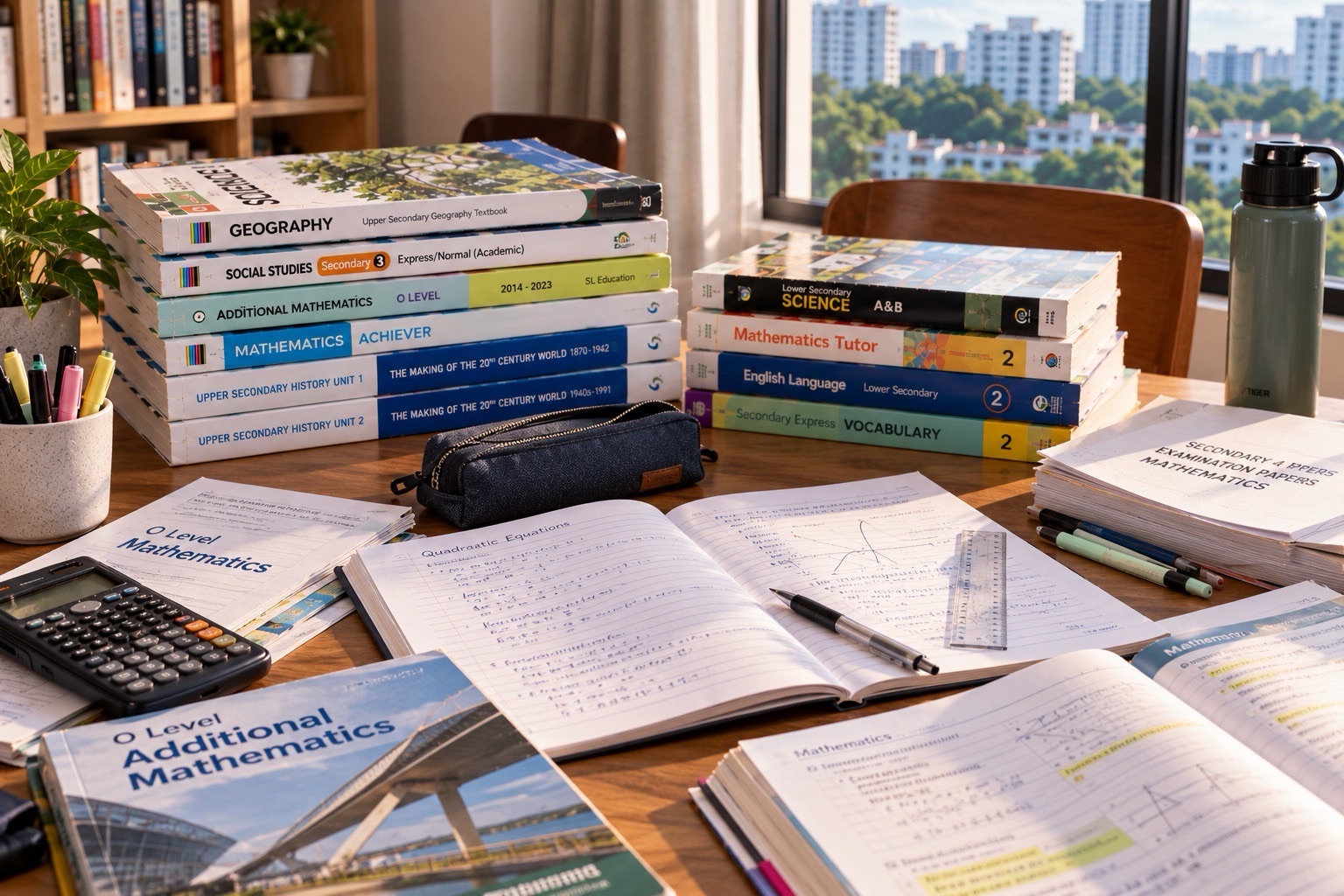
Singapore Math congruence and similarity guide for families and teachers outside Singapore. What Secondary 2 to 4 students learn about congruent and similar figures, how Singapore teaches them, and how to practise them at home.
Two shapes can be exact copies, or one can be a scaled copy of the other.
Telling these cases apart, and using them, is a central skill in secondary geometry.
In Singapore Mathematics, Secondary 2 students learn that similar figures have equal corresponding angles and proportional corresponding sides, and they enlarge and reduce plane figures. In Secondary 3 or 4 they make scale drawings and construct perpendicular bisectors and angle bisectors.
G3 students also decide whether two triangles are congruent or similar, and go on to the areas and volumes of similar figures.
This guide is useful for families and teachers who want to:
- understand what Singapore expects from Secondary 2 to Secondary 4;
- teach congruence and similarity at home in a clear sequence;
- prepare a student who is moving into a Singapore secondary school; or
- support a student using Singapore Math materials in another country.
Quick facts
Level: Secondary 2 (G3 and G2); Secondary 3 or 4 (scale drawings and bisectors in G3 and G2; congruence and similarity tests in G3 only). Years are for G3; G2 timing can differ.
Strand: Geometry and Measurement (G2 Congruence and similarity)
Official source: SEAB G3 Mathematics syllabus K310 (2027 SEC; O-Level 4052 in 2026), with year placement from MOE’s 2020 secondary Mathematics syllabus
Comes after: Ratio and Polygons and Angle Sums
Leads to: Areas and Volumes of Similar Figures and Trigonometric Ratios
What Congruence and Similarity Mean in Singapore Mathematics
Congruent figures have the same shape and the same size. All corresponding sides and all corresponding angles are equal.
Similar figures have the same shape but may differ in size. Corresponding angles are equal and corresponding sides are proportional.
The common ratio of corresponding sides is the scale factor. An enlargement has a scale factor greater than 1. A reduction has a scale factor between 0 and 1.
Congruent figures are similar figures with a scale factor of 1.
The word “corresponding” matters most. Students must match each vertex of one figure with the right vertex of the other before comparing anything.
Where Congruence and Similarity Sit in the Singapore Syllabus
This is sub-strand G2, “Congruence and similarity”. MOE spreads it over two stages. The years below are for G3; G2 timing can differ.
In Secondary 2, for both G3 and G2, students learn:
- “congruent figures and similar figures”;
- for similar triangles and polygons, that “corresponding angles are equal” and “corresponding sides are proportional”;
- “enlargement and reduction of a plane figure”; and
- “solving simple problems involving similarity and congruence”.
In Secondary 3 or 4, for both G3 and G2, students learn:
- “scale drawings”; and
- “properties and construction of perpendicular bisectors of line segments and angle bisectors”.
In Secondary 3 or 4, for G3 only, students learn:
- determining whether two triangles are congruent or similar; and
- the ratio of areas of similar plane figures and the ratio of volumes of similar solids, covered in Areas and Volumes of Similar Figures.
| Level | What students do |
|---|---|
| Secondary 2 | Recognise congruent and similar figures, use equal angles and proportional sides, enlarge and reduce figures, solve simple problems |
| Secondary 3 or 4 | Scale drawings; construct perpendicular bisectors and angle bisectors |
| Secondary 3 or 4, G3 only | Decide whether two triangles are congruent or similar; area and volume ratios |
Transformations such as reflection and rotation are not topics in the current Singapore secondary syllabus. Enlargement appears only as “enlargement and reduction of a plane figure” within this sub-strand.
How Singapore Teaches Congruence and Similarity
1. Compare real shapes
Students lay cut-out shapes on top of each other. Exact fits are congruent. Same shape, different size, is similar.
2. Match corresponding vertices
The order of letters shows the matching. “Triangle ABC is similar to triangle PQR” means A matches P, B matches Q and C matches R.
3. Find the scale factor
Scale factor = a length on the new figure ÷ the matching length on the original. Every length is multiplied by this same number.
4. Enlarge and reduce figures
On squared paper, students draw a figure 2 times larger or half the size, and check that the angles stay the same.
5. Draw to scale and construct bisectors (Secondary 3 or 4)
Scale drawings use a given scale such as 1 : 200. Perpendicular bisectors and angle bisectors are constructed with compasses and a ruler.
6. Test triangles (G3, Secondary 3 or 4)
The standard tests for congruent triangles are SSS, SAS, AAS (or ASA) and RHS. Two triangles are similar if two pairs of angles are equal, if all three pairs of sides are in the same ratio, or if two pairs of sides are in the same ratio with the included angles equal.
Worked Examples
Finding a side in similar triangles
Question: Triangle ABC is similar to triangle PQR. AB = 6 cm, BC = 8 cm and PQ = 9 cm. Find QR.
Step 1. Corresponding sides: AB matches PQ, and BC matches QR.
Step 2. Scale factor from ABC to PQR = PQ ÷ AB = 9 ÷ 6 = 1.5.
Step 3. QR = 1.5 × 8 = 12 cm.
Check: PQ : QR = 9 : 12 = 3 : 4, and AB : BC = 6 : 8 = 3 : 4. The ratios match.
Similar triangles in a real setting
Question: A vertical pole 1.5 m tall casts a shadow 2 m long. At the same time, a vertical tree casts a shadow 12 m long. Find the height of the tree.
Step 1. The sun’s rays make the same angle with the ground for both, and both stand at right angles to the ground, so the two triangles are similar.
Step 2. Scale factor = 12 ÷ 2 = 6.
Step 3. Height of the tree = 6 × 1.5 = 9 m.
Check: Height ÷ shadow is 1.5 ÷ 2 = 0.75 for the pole and 9 ÷ 12 = 0.75 for the tree.
Deciding whether triangles are congruent (G3)
Question: In triangles ABC and DEF, AB = DE = 5 cm, BC = EF = 8 cm and ∠ABC = ∠DEF = 50°. Are the triangles congruent?
Step 1. Two pairs of sides are equal, and so is the angle between them.
Step 2. This is the SAS case (side, angle, side), so triangle ABC is congruent to triangle DEF.
Check: The equal angle must be the included angle. ∠ABC lies between AB and BC, and ∠DEF lies between DE and EF, so the test applies.
Common Mistakes
- Matching vertices by position on the page. Similar triangles are often drawn turned round. Fix: match vertices using the equal angles, then write the triangles’ names in matching order.
- Using SSA as a test. Two sides and an angle that is not between them do not always fix one triangle. Fix: the angle must be the included angle for SAS.
- Assuming that all shapes of one kind are similar. Rectangles measuring 2 cm by 3 cm and 3 cm by 4 cm are not similar. Fix: check that every pair of sides has the same ratio.
- Dividing the wrong way for the scale factor. Fix: scale factor = new length ÷ original length, and check whether the answer should be bigger or smaller.
- Adding instead of multiplying. Enlarging by adding 3 cm to every side does not give a similar figure. Fix: multiply every length by the scale factor.
- Mixing units in scale drawings. Fix: convert the real length into the same unit as the scale before dividing.
Teaching Congruence and Similarity Outside Singapore
Most English-language courses teach similar ideas, but the surrounding topics differ.
- Transformations. Reflection and rotation are not topics in Singapore’s current secondary syllabus. If your course teaches them, treat them as extra. The syllabus gives no further detail about enlargement, so keep the focus on scale factor and proportional sides.
- Names of tests. Some books write ASA where others write AAS, and many American texts call RHS the HL (hypotenuse-leg) test.
- G2 and G3. G2 includes the Secondary 2 work, scale drawings and bisector constructions. Deciding whether triangles are congruent or similar, and area and volume ratios, are G3 only.
- Timing. Decide by readiness rather than age. The Singapore Math Grade Levels guide explains why direct conversions are unreliable.
- Prerequisites. Similarity depends on Ratio and Map Scales. Constructions need compasses and a ruler; candidates bring geometrical instruments for both papers.
How to Practise Congruence and Similarity at Home
- Find similar objects at home, such as photo prints of different sizes, and measure matching sides to find the scale factor.
- Enlarge a simple shape on squared paper by a scale factor of 2, then reduce it by a factor of 1/2.
- Solve one missing-side problem with similar triangles each session, writing the matched vertices first.
- Construct one perpendicular bisector and one angle bisector with compasses.
- Make a scale drawing of a room using a scale such as 1 : 50.
- For G3 students, decide which congruence test applies to three pairs of triangles each week.
Matching vertices correctly is the habit that prevents most errors.
Try These
- Two rectangles are similar. The smaller is 4 cm by 6 cm. The shorter side of the larger is 10 cm. Find its longer side.
- Are triangles with sides 3 cm, 4 cm, 5 cm and 6 cm, 8 cm, 10 cm similar?
- Are triangles with sides 3 cm, 4 cm, 5 cm and 4 cm, 5 cm, 6 cm similar?
- On a scale drawing with scale 1 : 200, a wall is 3.5 cm long. Find its real length in metres.
Answers
- 15 cm. The scale factor is 10 ÷ 4 = 2.5, and 2.5 × 6 = 15.
- Yes. Each side is multiplied by 2, so the sides are in the same ratio.
- No. 4 ÷ 3 is not equal to 5 ÷ 4, so the sides are not in the same ratio.
- 7 m. 3.5 × 200 = 700 cm, which is 7 m.
What Comes Next
Similarity reaches into many later topics.
- Areas and Volumes of Similar Figures extends the scale factor to area and volume, for G3 students in Secondary 3 or 4.
- Trigonometric Ratios rest on the fact that similar right-angled triangles have the same side ratios.
- In Additional Mathematics, Proofs in Plane Geometry uses congruent and similar triangles.
A student who matches vertices carefully usually finds these later topics much clearer.
Frequently Asked Questions
When do Singapore students learn congruence and similarity?
Congruent and similar figures are taught in Secondary 2. Scale drawings and bisector constructions come in Secondary 3 or 4, along with the G3-only triangle tests.
What is the difference between congruent and similar?
Congruent figures have the same shape and size. Similar figures have the same shape, but their sizes may differ by a scale factor.
Do G2 students learn the congruence and similarity tests?
No. Determining whether two triangles are congruent or similar is not in the G2 Mathematics content (K210).
Are reflections and rotations part of this topic?
No. Transformations are not topics in the current Singapore secondary syllabus.
Why is SSA not a congruence test?
With two sides and a non-included angle, two different triangles can sometimes be drawn. The data does not fix a single triangle.
What are perpendicular bisectors and angle bisectors?
They are constructions with compasses and a ruler. A perpendicular bisector cuts a line segment in half at right angles, and an angle bisector splits an angle into two equal parts.
Helpful Reading
- Singapore Mathematics | International Edition: Ratio
- Singapore Mathematics | International Edition: Map Scales
- Singapore Mathematics | International Edition: Areas and Volumes of Similar Figures
- Why Are Similarity and Congruence So Easy to Confuse?
- Secondary Mathematics: Angles, Similarity and Geometric Reasoning
- How to Make Sense of the SEC G3 Mathematics Syllabus
- SEAB G3 Mathematics Syllabus K310
- SEAB G2 Mathematics Syllabus K210
Congruence and Similarity in Singapore Mathematics
Same shape, same size: congruent.
Same shape, any size: similar.
Match the vertices first.
Multiply every length by one scale factor.
Taught this way, similarity stops being a list of rules.
It becomes ratio, seen in shapes.
That idea carries a student into trigonometry, area and volume, and proof.
Ask Bukit Timah Tutor
Bukit Timah Tutor teaches Mathematics in small groups of three students in Singapore.
If your child is learning Singapore Mathematics at home, in an international school or in a Singapore school, and you are unsure where to begin with this topic, send us a short message with the student’s level and one example of the work.
Bukit Timah Tutor
8 Fourth Avenue, Singapore 268674
Near Sixth Avenue MRT
Three-student Mathematics tutorials
By appointment
Properly taught kids shine a bright light into the future.
Singapore Mathematics | International Edition is a Bukit Timah Tutor guide series for families and teachers outside Singapore. It is not a textbook and is not affiliated with MOE, SEAB or any publisher. Syllabus details were checked against MOE and SEAB documents in October 2026. Always confirm current requirements with your school.
← Previous: Singapore Mathematics | International Edition: Polygons and Angle Sums
Next: Singapore Mathematics | International Edition: Areas and Volumes of Similar Figures →
All 100 topics in the International Edition