
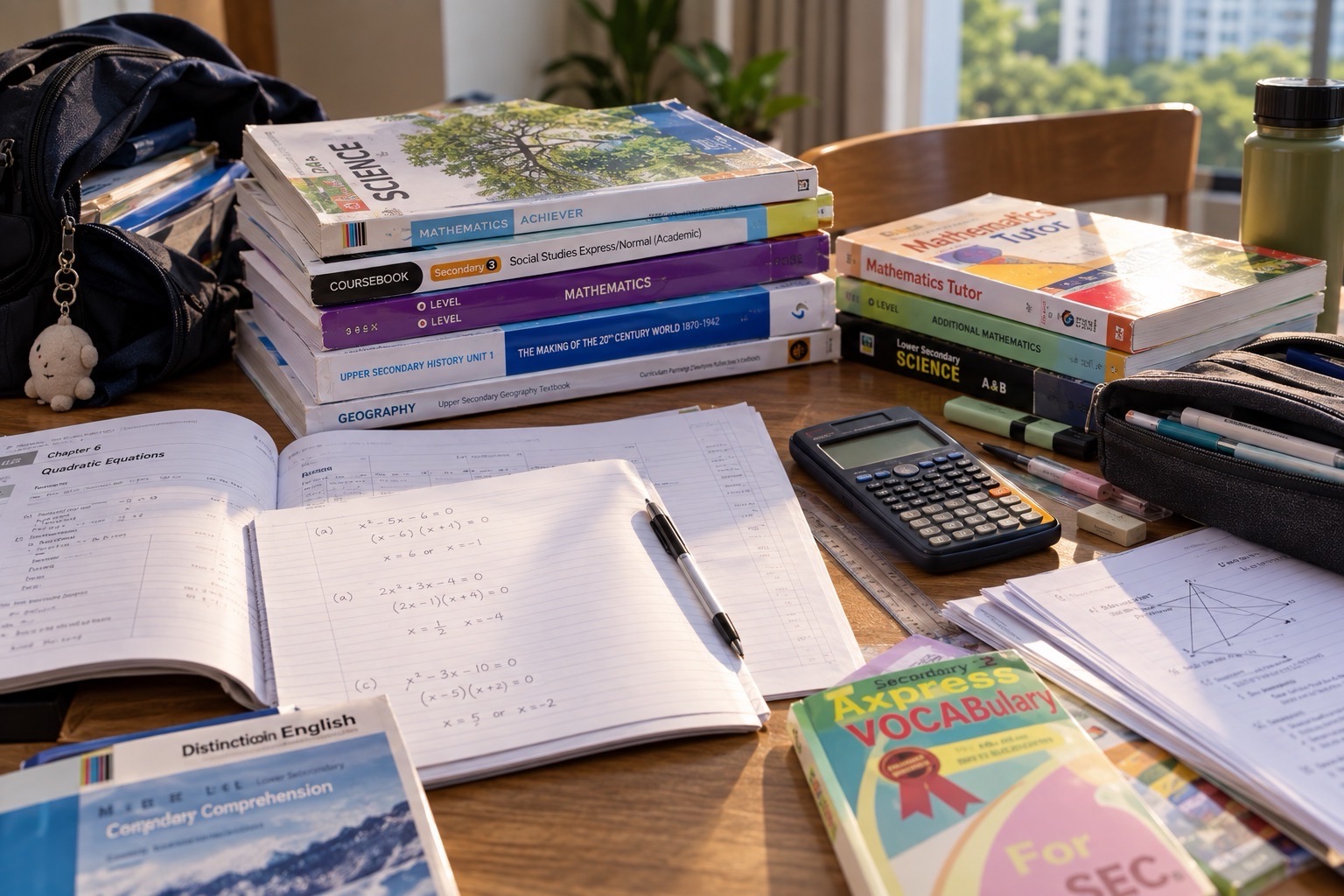
Singapore Math trigonometric ratios guide for families and teachers outside Singapore. What Secondary 2 students learn about sine, cosine and tangent, how the topic is taught, and how to practise it at home.
Trigonometry links the angles of a right-angled triangle to the ratios of its sides.
Once that link is clear, a height that no tape measure can reach can be found from one angle and one length.
In Singapore Mathematics, G3 students meet the sine, cosine and tangent of acute angles in Secondary 2, and the same content is in G2 Mathematics. They use them to find unknown sides and angles in right-angled triangles.
In Secondary 3 or 4, sine and cosine are extended to obtuse angles and used in triangles of any shape.
This guide is useful for families and teachers who want to:
- understand what Singapore expects at Secondary 2;
- teach sine, cosine and tangent in a clear sequence;
- prepare a student who is moving into a Singapore secondary school; or
- support a student using Singapore Math materials in another country.
Quick facts
Level: Secondary 2 (G3 Mathematics; also in G2 Mathematics)
Strand: Geometry and Measurement
Official source: SEAB G3 Mathematics syllabus K310 (SEC, from 2027; O-Level 4052 in 2026), with year placement from MOE’s 2020 secondary Mathematics syllabus
Comes after: Pythagoras’ Theorem and Congruence and Similarity
Leads to: Sine Rule and Cosine Rule and Bearings, Elevation and Depression
What Trigonometric Ratios Mean in Singapore Mathematics
Choose one acute angle, θ, in a right-angled triangle. The sides are then named from that angle:
- the hypotenuse is opposite the right angle;
- the opposite side is across from θ; and
- the adjacent side is next to θ and is not the hypotenuse.
The three ratios are:
- sin θ = opposite ÷ hypotenuse;
- cos θ = adjacent ÷ hypotenuse; and
- tan θ = opposite ÷ adjacent.
Why do these ratios stay fixed? All right-angled triangles with the same angle θ are similar. Their sides are in proportion, so each ratio depends only on θ, not on the size of the triangle.
The idea rests on similar triangles, which Singapore students also study in Secondary 2. The calculator stores the ratio for each angle. The student supplies the correct triangle and the correct ratio.
Where Trigonometric Ratios Sit in the Singapore Syllabus
In the SEAB G3 Mathematics syllabus, trigonometry sits in the Geometry and Measurement strand, under “Pythagoras’ theorem and trigonometry”. MOE’s teaching syllabus places right-angled trigonometry in Secondary 2.
At Secondary 2, the syllabus lists the “use of trigonometric ratios (sine, cosine and tangent) of acute angles to calculate unknown sides and angles in right-angled triangles”.
The same content appears in G2 Mathematics.
| Level | What students do |
|---|---|
| Secondary 2 | Sine, cosine and tangent of acute angles; unknown sides and angles in right-angled triangles |
| Secondary 3 or 4 | Sine and cosine extended to obtuse angles; area of a triangle as ½ab sin C; the sine rule and cosine rule |
| Secondary 3 or 4 | Problems in two and three dimensions, including angles of elevation and depression and bearings |
| Additional Mathematics, Secondary 3 to 4 | Six trigonometric functions for angles of any magnitude, in degrees or radians |
The ratios themselves are not on the formula list provided in the examination. The list gives the sine rule and cosine rule, which come later.
Angles in degrees are given correct to 1 decimal place, and other non-exact answers correct to 3 significant figures, unless a question says otherwise.
How Singapore Teaches Trigonometric Ratios
1. Name the sides from the angle
Students mark the angle being used, then label the hypotenuse, opposite and adjacent sides. The labels change when the angle changes.
2. Measure before calculating
Two triangles drawn with the same 30° angle but different sizes both give opposite ÷ hypotenuse = 0.5. The ratio belongs to the angle.
3. Choose the ratio
List the two sides involved: the one you know and the one you want. That pair decides the ratio. Opposite and hypotenuse means sine.
4. Find a side
Write the equation, then rearrange. If the unknown is on top of the fraction, multiply. If it is underneath, divide.
5. Find an angle
Calculate the ratio, then use the inverse function on the calculator, such as tan⁻¹.
6. Apply it in context
Ramps, ladders and the heights of buildings give the triangles a purpose. Named angles of elevation and depression belong to Secondary 3 or 4 in the syllabus.
Many students remember the ratios with the mnemonic SOH CAH TOA. It helps, but only after the sides are labelled correctly.
Worked Examples
Finding a side
Question: In triangle ABC, angle B = 90°, angle A = 35° and AC = 12 cm. Find BC.
Step 1. From angle A, AC is the hypotenuse and BC is the opposite side.
Step 2. Opposite and hypotenuse give sine: sin 35° = BC/12.
Step 3. BC = 12 sin 35° = 6.882…
Step 4. BC = 6.88 cm, correct to 3 significant figures.
Check: BC is shorter than the hypotenuse, and sin 35° is a little over 0.5, so BC should be a little over 6 cm. It is.
Finding an angle
Question: A straight ramp rises 5 m over a horizontal distance of 8 m. Find the angle the ramp makes with the ground.
Step 1. From the angle at the ground, the 5 m rise is opposite and the 8 m distance is adjacent.
Step 2. Opposite and adjacent give tangent: tan θ = 5/8 = 0.625.
Step 3. θ = tan⁻¹ 0.625 = 32.005…°
Step 4. θ = 32.0°, correct to 1 decimal place.
Check: tan 32.0° = 0.6249, which is very close to 0.625.
When the unknown side is underneath, divide. If tan 40° = 7/x, then x = 7 ÷ tan 40° = 8.34 cm. A student who multiplies gets 5.87 cm, which is wrong.
Common Mistakes
- Calculator in the wrong mode. sin 30 shows −0.988 instead of 0.5. Fix: check the calculator is in degree mode before every session. Radians come later, in Secondary 3 or 4.
- Labelling from the wrong angle. The opposite side for one acute angle is the adjacent side for the other. Fix: mark the angle being used before labelling anything.
- Multiplying when the unknown is underneath. For tan 40° = 7/x, writing x = 7 tan 40° gives 5.87 instead of 8.34. Fix: rearrange one step at a time, then substitute the answer back to check.
- Reading sin⁻¹ as 1 ÷ sin. The inverse function finds an angle from a ratio. Fix: read sin⁻¹ 0.5 as “the angle whose sine is 0.5”.
- Rounding the ratio too early. Using tan θ = 0.63 instead of 0.625 gives 32.2° instead of 32.0°. Fix: keep full values in the calculator until the last step.
- Using the ratios without a right angle. SOH CAH TOA needs a right-angled triangle. Fix: for other triangles, use the sine rule or cosine rule, which come in Secondary 3 or 4.
Teaching Trigonometric Ratios Outside Singapore
Right-angled trigonometry is widely taught. Most differences are in notation, timing and exam conventions.
- Notation. Singapore materials write sin⁻¹, cos⁻¹ and tan⁻¹ for the inverse functions. Some books write arcsin, arccos and arctan. They mean the same thing.
- Timing. In Singapore, right-angled trigonometry is a Secondary 2 topic. Your local curriculum may place it at a different stage, so decide by readiness rather than age. The Singapore Math Placement guide explains how to judge where a student should start.
- Prerequisites. Students need Pythagoras’ theorem, similar triangles and confident rearranging of simple equations.
- Calculators. An approved calculator may be used in both papers of G3 Mathematics. The calculator gives the values; the student still has to choose the ratio.
- Accuracy. Angles in degrees are given to 1 decimal place and other non-exact answers to 3 significant figures, unless the question states otherwise.
How to Practise Trigonometric Ratios at Home
A short, regular routine works better than one long weekend session.
- Draw a right-angled triangle, mark one acute angle and label the three sides. Then switch to the other acute angle and relabel.
- Write sin, cos and tan for both angles as fractions of side names.
- Measure a real triangle, such as a book propped against a box, and compare a measured ratio with the calculator value.
- Solve one side question with the unknown on top and one with the unknown underneath.
- Solve one angle question using an inverse function.
- Once a week, mix in Pythagoras’ theorem questions so the student must decide which tool fits.
Ten to fifteen minutes is enough when the work is focused.
Try These
- In a right-angled triangle, the hypotenuse is 10 cm and one angle is 30°. Find the side opposite the 30° angle.
- The side adjacent to a 50° angle in a right-angled triangle is 9 cm. Find the opposite side, correct to 3 significant figures.
- In a right-angled triangle, the side opposite angle θ is 4 cm and the hypotenuse is 9 cm. Find θ, correct to 1 decimal place.
- The hypotenuse of a right-angled triangle is 15 cm and one angle is 25°. Find the side adjacent to the 25° angle, correct to 3 significant figures.
Answers
- 5 cm, because 10 sin 30° = 10 × 0.5 = 5.
- 10.7 cm, because tan 50° = opposite/9, so the opposite side is 9 tan 50° = 10.725…
- 26.4°, because sin θ = 4/9, so θ = sin⁻¹(4/9) = 26.38…°
- 13.6 cm, because cos 25° = adjacent/15, so the adjacent side is 15 cos 25° = 13.594…
What Comes Next
Right-angled trigonometry is the base for the rest of the trigonometry strand.
- In Secondary 3 or 4, Sine Rule and Cosine Rule extend sine and cosine to obtuse angles and to triangles without a right angle.
- Bearings, Elevation and Depression apply the ratios to heights, distances and directions in two and three dimensions.
- In Additional Mathematics, Trigonometric Functions and Graphs extend the functions to angles of any size, in degrees or radians.
Each step relies on the same first skill: naming the sides from the angle.
Frequently Asked Questions
When do Singapore students learn trigonometric ratios?
In Secondary 2, for acute angles in right-angled triangles. Sine and cosine are extended to obtuse angles in Secondary 3 or 4.
Is trigonometry in G2 Mathematics?
Yes. Right-angled trigonometry is in both G2 and G3 Mathematics, and so are later items such as the sine rule and cosine rule.
Are the ratios given on the formula list?
No. The formula list gives the sine rule and cosine rule, but sin, cos and tan as ratios of sides are expected to be known.
Do students learn exact values such as sin 30° = 1/2?
The Additional Mathematics syllabus lists exact values for 30°, 45° and 60°. In G3 Mathematics, non-exact answers are given to 3 significant figures, or 1 decimal place for angles, unless a question says otherwise.
What does SOH CAH TOA mean?
It is a memory aid: Sine = Opposite/Hypotenuse, Cosine = Adjacent/Hypotenuse, Tangent = Opposite/Adjacent. It is not official syllabus wording.
Why does my child use the right method but get the wrong number?
The usual causes are a calculator in radian mode, or a ratio rounded before the last step. Check both first.
Helpful Reading
- Singapore Mathematics | International Edition: Pythagoras’ Theorem
- Singapore Mathematics | International Edition: Sine Rule and Cosine Rule
- Singapore Mathematics | International Edition: Congruence and Similarity
- Why Does Trigonometry Feel Like Choosing Between Too Many Formulas?
- Secondary Mathematics: Trigonometry, Pythagoras, Bearings and Elevation
- Trigonometry | Mathematics Knowledge Object
- How to Make Sense of the SEC G3 Mathematics Syllabus
- SEAB G3 Mathematics Syllabus K310 (PDF)
- MOE Secondary Mathematics Syllabuses (2020)
Trigonometric Ratios in Singapore Mathematics
Mark the angle.
Name the sides from it.
Let the pair of sides choose the ratio.
Multiply or divide, then check.
Taught this way, trigonometry is not a pile of formulas.
It is one idea: similar triangles keep their ratios.
That idea carries a student from Secondary 2 into the sine rule, bearings and beyond.
Ask Bukit Timah Tutor
Bukit Timah Tutor teaches Mathematics in small groups of three students in Singapore.
If your child is learning Singapore Mathematics at home, in an international school or in a Singapore school, and you are unsure where to begin with this topic, send us a short message with the student’s level and one example of the work.
Bukit Timah Tutor
8 Fourth Avenue, Singapore 268674
Near Sixth Avenue MRT
Three-student Mathematics tutorials
By appointment
Properly taught kids shine a bright light into the future.
Singapore Mathematics | International Edition is a Bukit Timah Tutor guide series for families and teachers outside Singapore. It is not a textbook and is not affiliated with MOE, SEAB or any publisher. Syllabus details were checked against MOE and SEAB documents in October 2026. Always confirm current requirements with your school.
← Previous: Singapore Mathematics | International Edition: Pythagoras’ Theorem
Next: Singapore Mathematics | International Edition: Sine Rule and Cosine Rule →
All 100 topics in the International Edition