
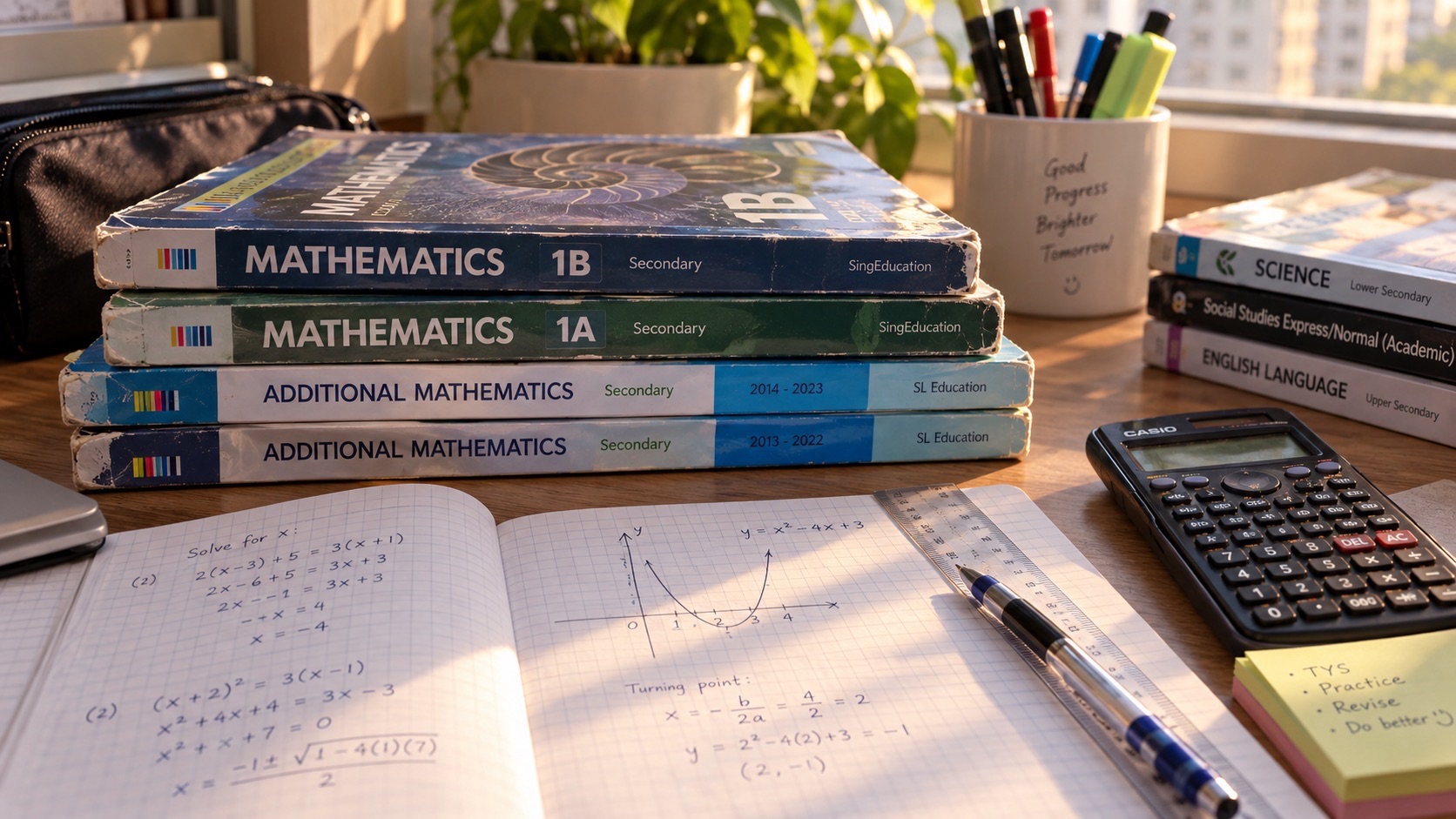
Singapore Math guide to trigonometric functions and graphs, an upper secondary Additional Mathematics topic, for families and teachers outside Singapore.
In lower secondary, sine, cosine and tangent belong to right-angled triangles.
In Additional Mathematics, they become functions that repeat forever.
In Singapore Mathematics, students in G3 Additional Mathematics (Secondary 3 to 4) extend the six trigonometric functions to angles of any size, in degrees or radians. They learn exact values, principal values, and how amplitude and period shape the graphs.
This work leads straight into identities, equations and trigonometric calculus.
This guide is useful for families and teachers who want to:
- understand what the Additional Mathematics syllabus expects;
- teach the graphs from a few key features rather than by plotting tables;
- prepare a student who is moving into a Singapore secondary school; or
- support a student using Singapore Math materials in another country.
Quick facts
Level: Secondary 3 to 4 (G3 Additional Mathematics, an elective)
Strand: Geometry and Trigonometry
Official source: SEAB G3 Additional Mathematics, Syllabus K341 (SEC, from 2027). The 2026 O-Level Additional Mathematics syllabus 4049 has the same content.
Comes after: Trigonometric Ratios and Arc Length, Sector Area and Radians
Leads to: Trigonometric Identities and Equations and Differentiation
What Trigonometric Functions Mean in Singapore Mathematics
A trigonometric function takes an angle and returns a number.
For acute angles, that number is a side ratio in a right-angled triangle. For larger or negative angles, students use a point moving round a circle centred at the origin. The angle is measured anticlockwise from the positive x-axis.
The sign of each function then depends on the quadrant. The size depends only on the basic angle, the acute angle made with the x-axis.
Because the point returns to the same place every 360°, or 2π radians, the functions repeat. That is why their graphs are waves.
The three reciprocal functions complete the set of six: cosec x = 1/sin x, sec x = 1/cos x and cot x = 1/tan x.
Where Trigonometric Functions Sit in the Singapore Syllabus
Trigonometry builds across three stages. G3 Mathematics introduces trigonometric ratios of acute angles in Secondary 2 and extends sine and cosine to obtuse angles in Secondary 3 or 4.
In G3 Additional Mathematics, the syllabus lists:
- six trigonometric functions for angles of any magnitude, in degrees or radians;
- principal values of sin⁻¹ x, cos⁻¹ x and tan⁻¹ x;
- exact values for the special angles 30°, 45° and 60°, or π/6, π/4 and π/3;
- amplitude, periodicity and symmetries related to the sine and cosine functions;
- graphs of y = a sin (bx) + c, y = a sin (x/b) + c, y = a cos (bx) + c, y = a cos (x/b) + c and y = a tan (bx), where a is real, b is a positive integer and c is an integer; and
- using trigonometric functions as models.
| Course | What students do |
|---|---|
| G3 Mathematics, Sec 2 | Sine, cosine and tangent of acute angles in right-angled triangles |
| G3 Mathematics, Sec 3 or 4 | Sine and cosine of obtuse angles; radian measure |
| G3 Additional Mathematics, Sec 3 to 4 | Six functions for any angle; exact and principal values; graphs, amplitude and period; models |
The same strand then continues with identities and equations, covered on the next page in this series.
How Singapore Teaches Trigonometric Functions
1. Revisit the ratios
Students recall sine, cosine and tangent in right-angled triangles and the exact values from the 30°-60°-90° and 45°-45°-90° triangles.
2. Extend to any angle with quadrants
They place angles on coordinate axes, find the basic angle and decide the sign from the quadrant. All four quadrants are covered, and negative angles are measured clockwise.
3. Read the graphs from key features
For y = a sin (bx) + c, the amplitude is |a|, the period is 360°/b and the graph is centred on the line y = c. Students sketch from these features rather than plotting long tables.
4. Treat tangent separately
y = tan x has no amplitude. It has period 180° and vertical asymptotes at 90°, 270° and so on.
5. Introduce principal values
A calculator gives one angle for sin⁻¹, cos⁻¹ or tan⁻¹: the principal value. Students learn the ranges: −90° to 90° for sin⁻¹ and tan⁻¹, and 0° to 180° for cos⁻¹.
6. Use the graphs as models
Tides, daylight hours and rotating wheels give contexts where amplitude, period and midline have a physical meaning.
Worked Examples
Sketching a transformed sine graph
Question: Sketch y = 3 sin 2x + 1 for 0° ≤ x ≤ 360°, and state its maximum and minimum values.
Step 1. Amplitude = 3. The graph is centred on the line y = 1.
Step 2. Period = 360° ÷ 2 = 180°, so two full waves fit into 0° to 360°.
Step 3. Maximum value = 1 + 3 = 4, at x = 45° and x = 225°.
Step 4. Minimum value = 1 − 3 = −2, at x = 135° and x = 315°.
Step 5. The graph crosses its centre line y = 1 at x = 0°, 90°, 180°, 270° and 360°.
Check: At x = 45°, y = 3 sin 90° + 1 = 3 + 1 = 4.
An exact value for a larger angle
Question: Find the exact values of cos 210° and sec 210°.
Step 1. 210° is in the third quadrant. Its basic angle is 210° − 180° = 30°.
Step 2. Cosine is negative in the third quadrant, so cos 210° = −cos 30° = −√3/2.
Step 3. sec 210° = 1/cos 210° = −2/√3 = −2√3/3.
Check: A calculator gives cos 210° = −0.866…, which matches −√3/2.
Common Mistakes
- Getting the period backwards. The period of sin 2x is 180°, not 720°. Fix: divide 360° by b.
- Giving a negative amplitude. For y = −2 cos x the amplitude is 2. The negative sign reflects the graph in its centre line. Fix: amplitude is |a|.
- Treating c as a stretch. In y = a sin (bx) + c, the value c moves the graph up or down. Fix: the maximum is c + |a| and the minimum is c − |a|.
- Using the wrong calculator mode. sin 2 in degrees and sin 2 in radians are very different numbers. Fix: check the mode before every question.
- Taking the principal value as the only answer. sin⁻¹ 0.5 = 30°, but 150° also has sine 0.5. Fix: use the graph or the quadrants to find every angle in the interval.
- Drawing a wave for tangent. tan x is not bounded. Fix: mark the asymptotes before sketching.
Teaching Trigonometric Functions Outside Singapore
- Accuracy rules. In the SEAB papers, non-exact answers are given to 3 significant figures, or to 1 decimal place for angles in degrees, unless the question says otherwise.
- Radians are expected. The syllabus works in degrees or radians, and calculus results later depend on radians.
- Timing. This topic sits in the upper secondary elective. Your local course may place it differently, so decide by readiness. The Singapore Math Grade Levels guide explains why direct conversions are unreliable.
- Prerequisites. Students need trigonometric ratios, radians and surds before starting.
- Calculators. An approved calculator may be used in both Additional Mathematics papers, but exact values for 30°, 45° and 60° are still expected without one.
How to Practise Trigonometric Functions at Home
- Draw the 30°-60°-90° and 45°-45°-90° triangles from memory and read off the exact values.
- Choose three angles between 90° and 360°. Find each basic angle and the sign of sin, cos and tan.
- Sketch y = sin x and y = cos x for 0° to 360° on one set of axes.
- Change one feature at a time: y = 2 sin x, then y = sin 2x, then y = sin x + 1.
- State amplitude, period, maximum and minimum for two given equations before sketching them.
- Once a week, describe one real repeating situation as a sine or cosine model.
Short, frequent sketches build more understanding than long tables of values.
Try These
- State the amplitude and period of y = 4 cos 3x − 1.
- Find the exact value of sin 135°.
- Find the principal value of cos⁻¹ (−1/2).
- Find the maximum and minimum values of y = 2 − 5 sin x.
Answers
- Amplitude 4, period 120°, because 360° ÷ 3 = 120°.
- √2/2. The basic angle is 45° and sine is positive in the second quadrant.
- 120°. The principal value of cos⁻¹ lies between 0° and 180°, and cos 120° = −1/2.
- Maximum 7, minimum −3. Here |a| = 5 and c = 2, so the values are 2 + 5 and 2 − 5.
What Comes Next
Trigonometric functions are the base for the rest of the trigonometry in Additional Mathematics.
- Trigonometric Identities and Equations uses these graphs to find every solution in an interval.
- Differentiation includes the derivatives of sin x, cos x and tan x.
- Integration includes sin (ax + b), cos (ax + b) and sec² x.
A student who can sketch a graph from its features finds these later topics far more manageable.
Frequently Asked Questions
When do Singapore students learn trigonometric functions and graphs?
In G3 Additional Mathematics, the upper secondary elective taken in Secondary 3 to 4. It builds on trigonometric ratios from Secondary 2 and obtuse angles from Secondary 3 or 4.
Are cosec, sec and cot included?
Yes. The syllabus lists six trigonometric functions for angles of any magnitude.
Which graph forms are in the syllabus?
Sine and cosine graphs of the forms a sin (bx) + c, a sin (x/b) + c, a cos (bx) + c and a cos (x/b) + c, plus y = a tan (bx). Here a is real, b is a positive integer and c is an integer.
Which exact values must be known?
The values for 30°, 45° and 60°, or π/6, π/4 and π/3, together with their use in all four quadrants.
What is a principal value?
It is the single angle a calculator returns for sin⁻¹, cos⁻¹ or tan⁻¹. Other solutions come from symmetry.
Is this the same as G2 Additional Mathematics?
This page describes G3 Additional Mathematics. G2 also includes trigonometric functions, so check the G2 syllabus for its exact list.
Helpful Reading
- Singapore Mathematics | International Edition: Trigonometric Ratios
- Singapore Mathematics | International Edition: Arc Length, Sector Area and Radians
- Singapore Mathematics | International Edition: Trigonometric Identities and Equations
- Why Does Trigonometry Feel Like Choosing Between Too Many Formulas?
- Secondary 3 Additional Mathematics | Trigonometric Functions
- Additional Mathematics Synthesis Guide 32: Transformed Trigonometric Graphs
- How to Make Sense of the SEC G3 Additional Mathematics Syllabus
- SEAB G3 Additional Mathematics Syllabus K341
Trigonometric Functions in Singapore Mathematics
Basic angle first.
Then the quadrant and the sign.
Amplitude, period, centre line.
Sketch from features, not tables.
Every principal value has partners.
Taught this way, trigonometry stops being a list of triangle rules.
It becomes the mathematics of anything that repeats.
Ask Bukit Timah Tutor
Bukit Timah Tutor teaches Mathematics in small groups of three students in Singapore.
If your child is learning Singapore Mathematics at home, in an international school or in a Singapore school, and you are unsure where to begin with this topic, send us a short message with the student’s level and one example of the work.
Bukit Timah Tutor
8 Fourth Avenue, Singapore 268674
Near Sixth Avenue MRT
Three-student Mathematics tutorials
By appointment
Properly taught kids shine a bright light into the future.
Singapore Mathematics | International Edition is a Bukit Timah Tutor guide series for families and teachers outside Singapore. It is not a textbook and is not affiliated with MOE, SEAB or any publisher. Syllabus details were checked against MOE and SEAB documents in October 2026. Always confirm current requirements with your school.
← Previous: Singapore Mathematics | International Edition: Exponential and Logarithmic Functions
Next: Singapore Mathematics | International Edition: Trigonometric Identities and Equations →
All 100 topics in the International Edition