
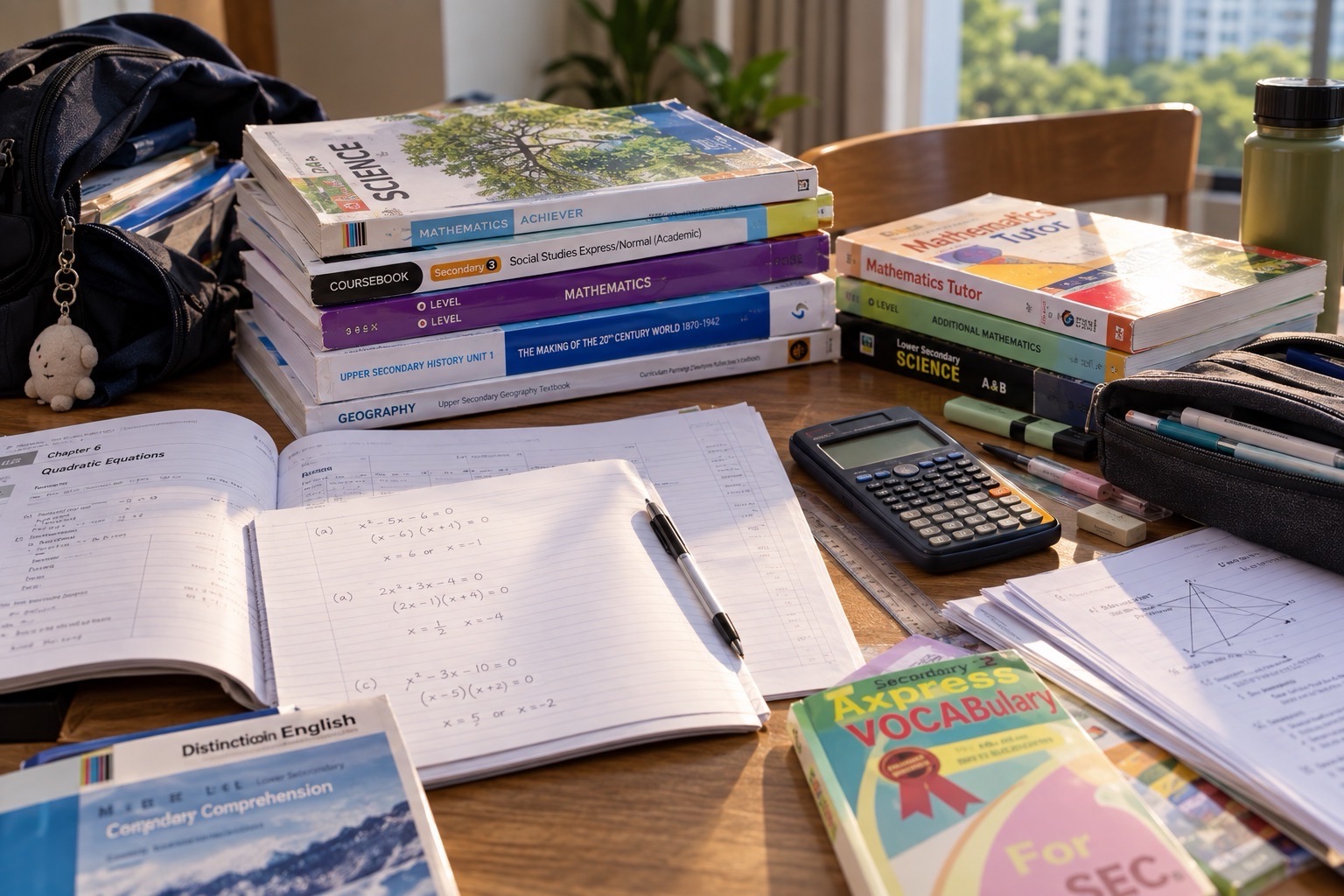
Singapore Math guide to trigonometric identities and equations, an upper secondary Additional Mathematics topic, for families and teachers outside Singapore.
An identity is true for every angle. An equation is true only for some.
Most of the skill in this topic lies in knowing which one you are holding.
In Singapore Mathematics, students in G3 Additional Mathematics (Secondary 3 to 4) use the Pythagorean identities, the sum and difference formulae, the double-angle formulae and the R-formula. They prove simple identities and solve equations in a given interval.
These skills are then used in trigonometric calculus and in modelling problems.
This guide is useful for families and teachers who want to:
- understand what the Additional Mathematics syllabus includes and excludes;
- teach proofs and equations as two different tasks;
- prepare a student who is moving into a Singapore secondary school; or
- support a student using Singapore Math materials in another country.
Quick facts
Level: Secondary 3 to 4 (G3 Additional Mathematics, an elective)
Strand: Geometry and Trigonometry
Official source: SEAB G3 Additional Mathematics, Syllabus K341 (SEC, from 2027). The 2026 O-Level Additional Mathematics syllabus 4049 has the same content.
Comes after: Trigonometric Functions and Graphs and Sine Rule and Cosine Rule
Leads to: Differentiation and Integration
What Trigonometric Identities and Equations Mean in Singapore Mathematics
An identity such as sin²A + cos²A = 1 holds for every value of A. Students use identities to rewrite expressions and to prove that two expressions are equal.
An equation such as 2 sin x = 1 holds only for particular angles. Students find those angles inside a stated interval.
The two tasks often meet. To solve a harder equation, a student uses an identity to change it into a form that can be factorised or solved directly.
The R-formula is a special identity. It rewrites a cos θ + b sin θ as a single sine or cosine, which turns a two-term expression into a single wave.
Where Trigonometric Identities and Equations Sit in the Singapore Syllabus
This content sits in the Geometry and Trigonometry strand of G3 Additional Mathematics, with the trigonometric functions.
Students use:
- tan A = sin A/cos A and cot A = cos A/sin A;
- sin²A + cos²A = 1, sec²A = 1 + tan²A and cosec²A = 1 + cot²A;
- the sum and difference formulae for sin (A ± B), cos (A ± B) and tan (A ± B);
- the double-angle formulae for sin 2A, cos 2A and tan 2A; and
- the R-formula: a cos θ + b sin θ written as R cos (θ ± α) or R sin (θ ± α).
They also simplify trigonometric expressions, prove simple identities, use trigonometric functions as models, and solve simple trigonometric equations in a given interval. The general solution is excluded.
| On the formula list | Not on the formula list |
|---|---|
| Pythagorean identities | The R-formula |
| sin (A ± B), cos (A ± B), tan (A ± B) | Exact values for special angles |
| sin 2A, cos 2A in three forms, tan 2A | Principal value ranges |
| Sine rule, cosine rule, area = ½bc sin A | Methods for solving equations |
A formula list is provided in the examination, but students still need to know when each formula helps.
How Singapore Teaches Trigonometric Identities and Equations
1. Solve basic equations from the graph
Students solve sin x = 0.5 for 0° ≤ x ≤ 360° by finding the basic angle, 30°, then using the quadrants or the graph to get 30° and 150°.
2. Adjust the interval for multiple angles
For sin 2x = 0.5 with 0° ≤ x ≤ 360°, the angle 2x runs from 0° to 720°. Students find all values of 2x first, then halve them.
3. Use identities to reach one function
Equations with both sin²x and cos x are rewritten using sin²x = 1 − cos²x, giving a quadratic in cos x.
4. Prove by working on one side
A proof starts from one side and transforms it, step by step, until it matches the other side. Each step uses a known identity.
5. Expand with the addition and double-angle formulae
Students find exact values such as sin 75° = sin (45° + 30°), and they rewrite sin 2x and cos 2x in terms of x.
6. Combine terms with the R-formula
R is found from R² = a² + b², and α from tan α. The result shows the maximum and minimum values at once, which is useful in models.
Worked Examples
An equation with a double angle
Question: Solve 3 sin 2x = 2 cos x for 0° ≤ x ≤ 360°.
Step 1. Use sin 2x = 2 sin x cos x: 6 sin x cos x = 2 cos x.
Step 2. Bring every term to one side and factorise: 2 cos x (3 sin x − 1) = 0.
Step 3. cos x = 0 gives x = 90° or x = 270°.
Step 4. sin x = 1/3 gives a basic angle of 19.47°, so x = 19.5° or x = 160.5°.
Step 5. The solutions are x = 19.5°, 90°, 160.5° and 270°.
Check: At x = 19.47°, 3 sin 38.94° is about 1.886 and 2 cos 19.47° is about 1.886.
Dividing both sides by cos x at Step 1 would lose x = 90° and x = 270°. Factorising keeps every solution.
Using the R-formula
Question: Express 3 sin θ + 4 cos θ in the form R sin (θ + α), where R > 0 and 0° < α < 90°. Hence solve 3 sin θ + 4 cos θ = 2 for 0° ≤ θ ≤ 360°.
Step 1. R = √(3² + 4²) = 5, and tan α = 4/3, so α = 53.13°.
Step 2. So 3 sin θ + 4 cos θ = 5 sin (θ + 53.13°).
Step 3. Solve 5 sin (θ + 53.13°) = 2, so sin (θ + 53.13°) = 0.4.
Step 4. θ + 53.13° lies between 53.13° and 413.13°. The basic angle is 23.58°, so θ + 53.13° = 156.42° or 383.58°.
Step 5. θ = 103.3° or θ = 330.4°, correct to 1 decimal place.
Check: At θ = 103.3°, 3 sin 103.3° + 4 cos 103.3° is about 2.92 − 0.92 = 2.00.
Common Mistakes
- Dividing by a trigonometric function. Cancelling cos x loses the solutions where cos x = 0. Fix: bring all terms to one side and factorise.
- Forgetting to widen the interval. For an equation in 2x, the angle 2x covers twice the range. Fix: write the new interval before solving.
- Treating sin 2x as 2 sin x. These are not equal. Fix: use sin 2x = 2 sin x cos x.
- Working on both sides of a proof. Changing both sides at once, as if solving an equation, does not prove an identity. Fix: start from one side and finish at the other.
- Expecting the R-formula on the formula list. It is not there. Fix: learn how to find R and α from the expansion of R sin (θ + α).
- Rounding α too early. Using 53° instead of 53.13° shifts every answer. Fix: keep the full value until the final step.
Teaching Trigonometric Identities and Equations Outside Singapore
- Names. The sum and difference formulae are also called compound-angle or addition formulae. The R-formula is sometimes called the harmonic form or auxiliary angle method.
- Interval answers only. The syllabus excludes the general solution. Students give every answer inside the stated interval, in degrees or radians as asked.
- Timing. This topic sits in the upper secondary elective. Your local course may place it differently. The Singapore Math Placement guide can help you decide where to begin.
- Prerequisites. Students need exact values, quadrant signs, factorising and solving quadratic equations.
- Calculators. An approved calculator may be used in both papers. Proofs and exact-value questions still require full working.
How to Practise Trigonometric Identities and Equations at Home
- Write the three Pythagorean identities from memory, then check them against the formula list.
- Solve two basic equations, such as tan x = −1, across 0° to 360° using a sketch.
- Solve one equation in 2x, writing the widened interval first.
- Prove one identity, starting from the more complicated side.
- Write one expression in R-formula form and state its maximum and minimum values.
- Once a week, check one solution set by substituting each answer back into the equation.
Fifteen to twenty minutes of focused work is enough for one session.
Try These
- Solve tan x = −1 for 0° ≤ x ≤ 360°.
- Prove that (1 − cos 2A)/sin 2A = tan A.
- Find the exact value of sin 75°.
- Solve 2 sin²x = sin x for 0° ≤ x ≤ 360°.
Answers
- x = 135° or 315°. The basic angle is 45°, and tangent is negative in the second and fourth quadrants.
- Using cos 2A = 1 − 2 sin²A and sin 2A = 2 sin A cos A, the left side becomes 2 sin²A/(2 sin A cos A) = sin A/cos A = tan A.
- (√6 + √2)/4, because sin 75° = sin 45° cos 30° + cos 45° sin 30° = √6/4 + √2/4.
- x = 0°, 30°, 150°, 180° or 360°. Factorise to sin x (2 sin x − 1) = 0, so sin x = 0 or sin x = 1/2.
What Comes Next
These identities are used throughout the calculus that follows.
- Differentiation uses the derivatives of sin x, cos x and tan x, often after an identity has simplified the expression.
- Integration includes sin (ax + b), cos (ax + b) and sec²x.
- Proofs in Plane Geometry uses the same habit of step-by-step reasoning.
A student who can prove one side equals the other usually writes clearer solutions everywhere.
Frequently Asked Questions
When do Singapore students learn trigonometric identities and equations?
In G3 Additional Mathematics, the upper secondary elective taken in Secondary 3 to 4, after the trigonometric functions and their graphs.
Is the R-formula in the syllabus?
Yes. Expressing a cos θ + b sin θ as R cos (θ ± α) or R sin (θ ± α) is listed. It is not on the formula list.
Are double-angle formulae included?
Yes. The formulae for sin 2A, cos 2A and tan 2A are included and appear on the formula list.
Do students need the general solution?
No. The syllabus excludes the general solution. Equations are solved in a given interval.
What makes a proof “simple”?
The syllabus says “simple trigonometric identities” without defining the word. Prepare for proofs that use the listed identities in a few clear steps.
Why does my child lose solutions?
Usually by dividing by sin x or cos x, or by not widening the interval for 2x. Both habits can be repaired with steady practice.
Helpful Reading
- Singapore Mathematics | International Edition: Trigonometric Functions and Graphs
- Singapore Mathematics | International Edition: Sine Rule and Cosine Rule
- Singapore Mathematics | International Edition: Differentiation
- Secondary 3 Additional Mathematics | Trigonometric Identities and Equations
- Additional Mathematics Synthesis Guide 34: Trigonometric Identity Engineering
- Why Does Trigonometry Feel Like Choosing Between Too Many Formulas?
- How to Make Sense of the SEC G3 Additional Mathematics Syllabus
- SEAB G3 Additional Mathematics Syllabus K341
Identities and Equations in Singapore Mathematics
An identity is always true.
An equation is true sometimes.
Factorise, never cancel.
Widen the interval first.
Prove from one side.
Taught this way, the formula list stops looking like a wall of symbols.
It becomes a set of tools a student knows how to choose.
Ask Bukit Timah Tutor
Bukit Timah Tutor teaches Mathematics in small groups of three students in Singapore.
If your child is learning Singapore Mathematics at home, in an international school or in a Singapore school, and you are unsure where to begin with this topic, send us a short message with the student’s level and one example of the work.
Bukit Timah Tutor
8 Fourth Avenue, Singapore 268674
Near Sixth Avenue MRT
Three-student Mathematics tutorials
By appointment
Properly taught kids shine a bright light into the future.
Singapore Mathematics | International Edition is a Bukit Timah Tutor guide series for families and teachers outside Singapore. It is not a textbook and is not affiliated with MOE, SEAB or any publisher. Syllabus details were checked against MOE and SEAB documents in October 2026. Always confirm current requirements with your school.
← Previous: Singapore Mathematics | International Edition: Trigonometric Functions and Graphs
Next: Singapore Mathematics | International Edition: Coordinate Geometry of Circles →
All 100 topics in the International Edition